
Choose a Free Commodities Data API
That Fits Your Build如何选择适合开发的
免费大宗商品数据 API
Compare commodity price APIs by coverage, freshness, history, format, free-tier limits, and usage rights before you integrate.
按覆盖品类、更新频率、历史深度、返回格式、免费额度和使用权,筛选适合应用或智能体的大宗商品行情 API。
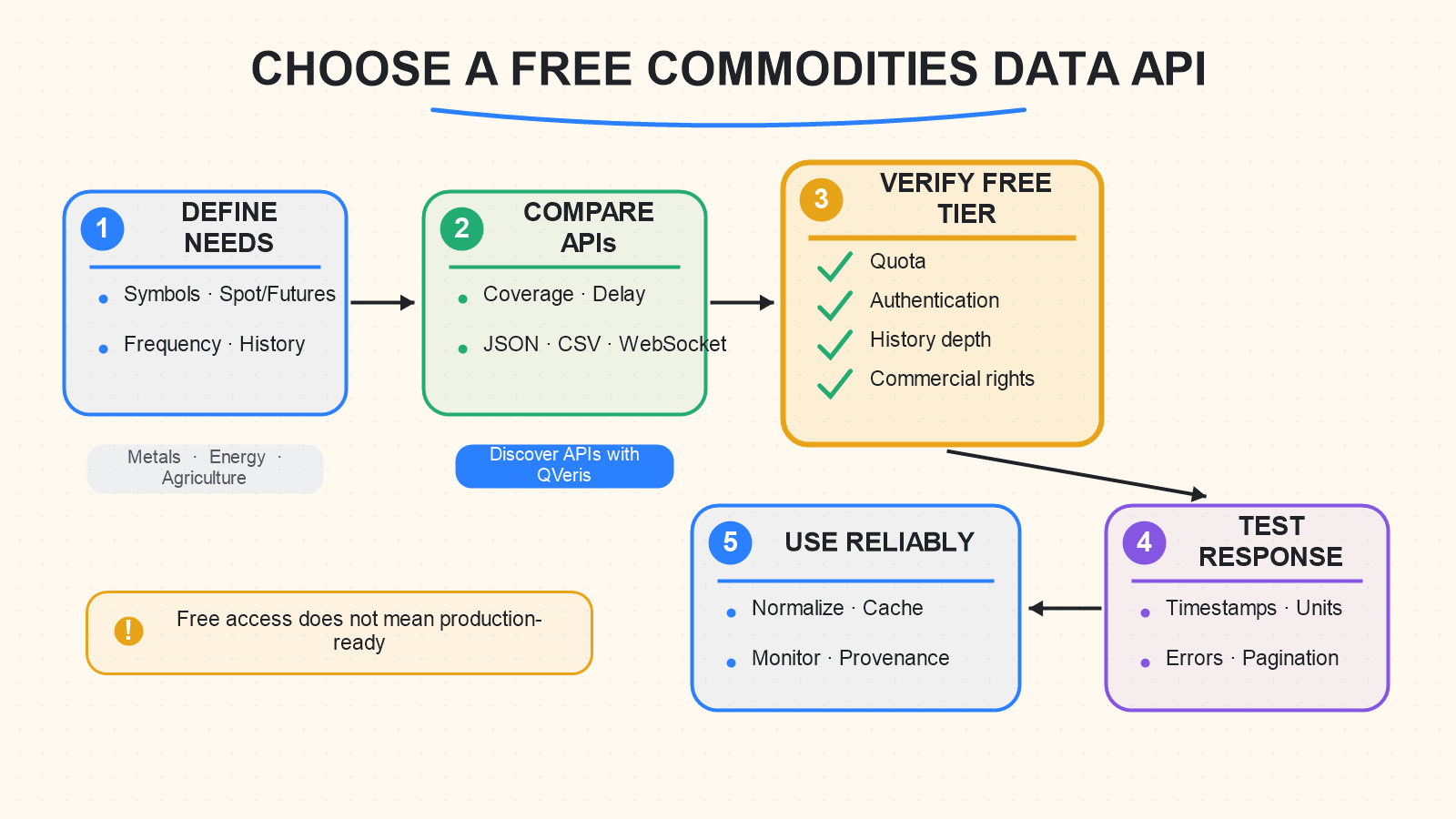
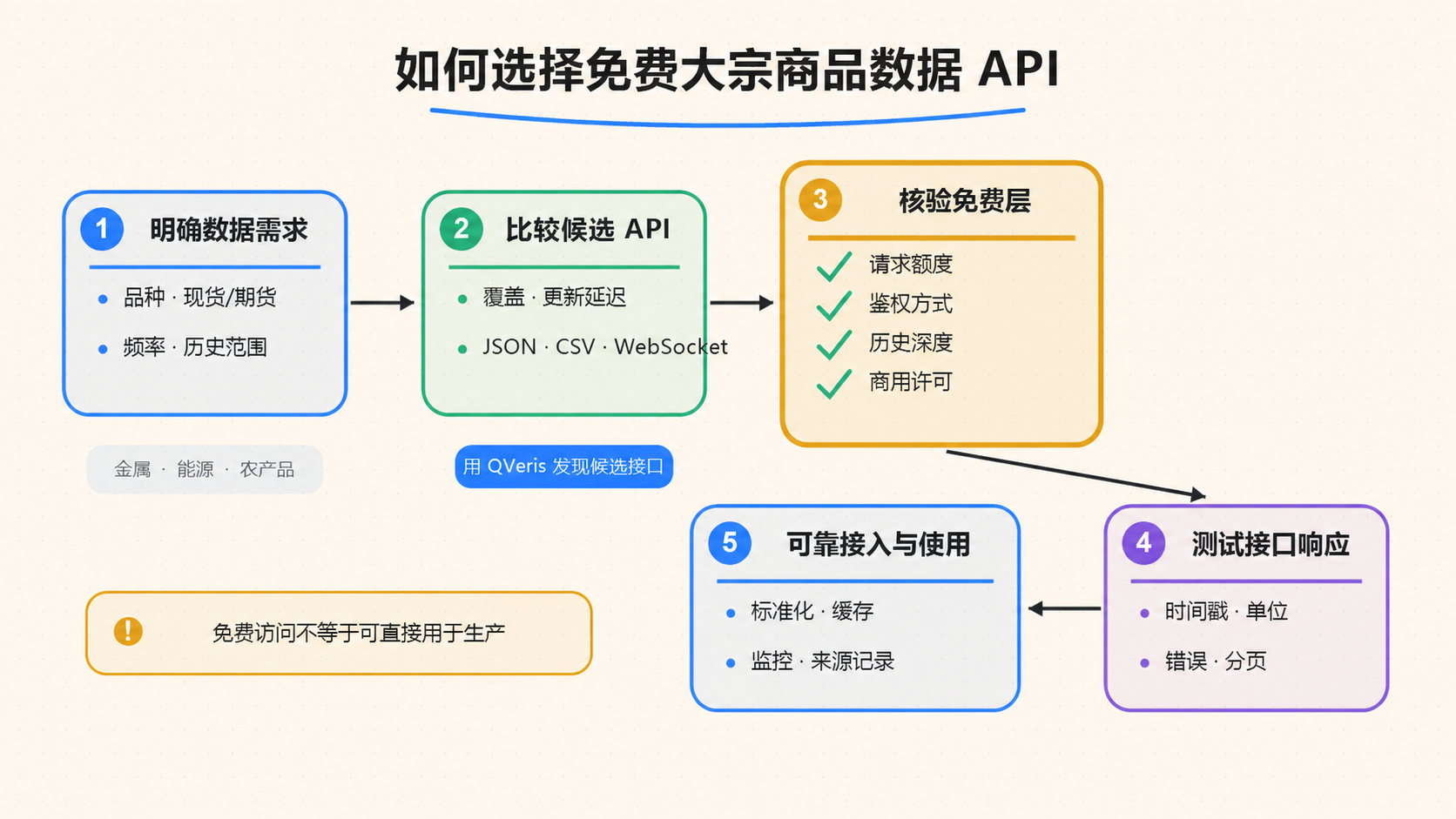
TL;DR快速结论
Find a usable free commodity price API with documented endpoints, clear quotas, and enough data to test a real application.
Spot or futures prices, real-time or delayed updates, historical OHLCV, symbols, units, currencies, and timestamps.
Verify request limits, history windows, attribution, redistribution, commercial-use rules, and card requirements.
Discover and inspect relevant data capabilities before calling the selected provider.
找到文档清楚、免费额度透明,并足以测试真实应用的大宗商品行情 API。
现货或期货、实时或延迟、历史 OHLCV、代码、单位、币种和时间戳。
检查调用量、历史窗口、署名、再分发、商用规则与绑卡要求。
在调用供应商前发现并检查相关数据能力。
Free-tier limits can be multi-dimensional
A plan may allow many requests but restrict symbols, history, endpoints, WebSocket connections, or commercial use. Estimate usage by endpoint and symbol instead of relying on one headline request number.
No authentication does not mean no obligations
Public endpoints may still require attribution, a descriptive User-Agent, fair-use behavior, or compliance with an upstream dataset license. Save the applicable terms with the integration record.
A free prototype still needs an exit plan
Document how to change providers, remap symbols, backfill gaps, and preserve internal identifiers. This prevents a temporary evaluation feed from becoming an undocumented production dependency.
免费限制通常不止一个维度
套餐可能允许较多请求,却限制品种数量、历史范围、特定端点、WebSocket 连接或商用权限。评估时应按端点和品种估算,而不是只看宣传中的总请求数。
无需鉴权不代表没有义务
公共端点仍可能要求署名、声明清晰的 User-Agent、遵守公平使用规则,或继承上游数据集许可。应把适用条款与接口配置一起保存。
免费原型也需要退出方案
提前记录如何更换供应商、重新映射代码、回填缺口并保留内部标识,避免临时评估数据源变成无人说明的生产依赖。
What a free commodities data API should provide免费大宗商品数据 API 应提供哪些数据
A commodities API is only useful when its market definition matches the application. “Gold price” may mean a spot reference, a futures contract, a fixing, or a provider-derived benchmark. Oil can refer to WTI, Brent, Dubai, a front-month contract, or a physical assessment. Record the exact instrument, venue, currency, unit, and timestamp convention before comparing providers.
The same distinction applies to freshness. A dashboard for monthly procurement analysis can work with daily observations, while an alerting workflow may need intraday updates. A free plan that says “live” is not enough evidence: inspect sample timestamps, documented delay, market hours, and the behavior outside active sessions.
大宗商品 API 是否有用,取决于数据定义能否匹配应用。“黄金价格”可能是现货参考价、期货合约、定盘价或供应商计算的基准;原油又可能指 WTI、Brent、Dubai、近月合约或现货评估价。比较服务前,应先记录准确品种、交易场所、币种、单位和时间戳规则。
时效需求也必须具体化。月度采购分析通常可以使用日频数据,而价格提醒可能需要盘中更新。免费套餐只写“实时”并不能证明满足需求,还要检查样例时间戳、文档中的延迟、交易时段,以及休市期间如何返回数据。
A multi-commodity panel adds another layer of risk: series can follow different holiday calendars, close at different local times, quote in incompatible physical units, and publish revisions on different schedules. Align each observation to an explicit business date, retain the native value, and store every currency or unit conversion separately so a cross-market comparison can be reproduced.
当一个页面同时比较多种商品时,还会多出一层风险:不同序列可能采用不同节假日日历、在不同当地时间收盘、使用无法直接比较的物理单位,并按各自节奏修订。应把每条观测对齐到明确的业务日期,保留原始数值,并单独记录币种和单位换算,确保跨市场比较可以复现。
Real-time commodity prices API
Confirm the upstream source, exchange or benchmark, delay, market session, timezone, timestamp, and update cadence for every symbol. Also test whether the last value is marked stale when a market closes or an upstream feed stops.
Historical commodity data API
Check the first available date, daily versus intraday frequency, OHLCV fields, contract-roll methodology, revisions, missing observations, and records returned per request. Free plans often expose less history than the main documentation implies.
Metals, energy, and agriculture coverage
Do not count categories alone. Verify the exact identifiers needed by the product: XAU/USD is not the same instrument as a gold futures contract, and a broad agriculture index cannot replace corn or wheat prices.
Commodity market data API formats
REST and JSON suit application calls, CSV supports research and spreadsheet workflows, and WebSocket fits streaming. A stable schema, explicit units, ISO timestamps, pagination, and structured errors reduce integration risk.
Fundamentals versus market prices
Some providers focus on quotes and OHLCV; others expose inventories, production, crop estimates, positioning, or supply-and-demand balances. These datasets can complement each other but should not be treated as interchangeable.
License and provenance
Keep the provider, upstream source, observation timestamp, retrieval timestamp, units, and permitted uses with downstream records. “Free access” does not automatically allow redistribution, public display, model training, or commercial use.
实时大宗商品行情接口
逐个品种核对上游来源、交易所或基准、延迟、交易时段、时区、时间戳和更新频率;还要测试休市或上游中断后是否标记陈旧数据。
商品期货历史数据 API
检查最早日期、日频或盘中周期、OHLCV 字段、连续合约换月规则、数据修订、缺失值和每次返回条数。免费套餐的历史范围往往比主文档更窄。
金属、能源与农产品覆盖
不能只看类别数量,要核对具体标识符。XAU/USD 与黄金期货不是同一标的,综合农产品指数也不能替代玉米或小麦价格。
行情接口返回格式
REST 与 JSON 适合应用调用,CSV 方便研究和表格流程,WebSocket 适合持续推送。稳定 Schema、明确单位、ISO 时间戳、分页和结构化错误能降低接入风险。
基本面与市场价格
部分服务提供报价和 OHLCV,另一些提供库存、产量、作物预估、持仓或供需平衡。这些数据可以互补,但不能互相替代。
许可与数据来源
为下游记录保留供应商、上游来源、观测时间、抓取时间、单位和允许用途。“免费访问”不等于允许再分发、公开展示、模型训练或商业使用。
Free commodity price API comparison checklist免费商品价格 API 的筛选清单
| Check检查项 | Questions to ask需要确认的问题 | Evidence to collect应收集的证据 | Common failure常见问题 |
|---|---|---|---|
| Instrument coverage标的覆盖 | Are the exact spot references, futures contracts, benchmarks, and fundamentals available?是否提供所需的现货参考价、期货合约、基准和基本面数据? | Symbol catalogue, exchange, contract metadata, sample response.品种目录、交易所、合约元数据和样例响应。 | A category is listed, but the required instrument is absent.有这个类别,却没有实际需要的标的。 |
| Freshness时效 | Is the value real time, delayed, end-of-day, or periodically updated?数据是实时、延迟、日终还是定期更新? | Source timestamp, retrieval timestamp, timezone, update policy.源时间、抓取时间、时区与更新政策。 | A cached last value is presented as live.把缓存的最后价格误当成实时行情。 |
| History历史数据 | How far back does free access go, at which intervals, and with what roll method?免费历史能追溯多久、支持哪些周期、如何处理换月? | Earliest date, interval list, pagination, revision policy.最早日期、周期列表、分页和修订政策。 | Documentation describes paid history, not the free tier.文档展示的是付费历史范围,并非免费套餐。 |
| Limits and reliability限流与可靠性 | What are the per-minute and monthly limits, retries, timeouts, and uptime expectations?分钟和月度额度、重试、超时与可用性预期是什么? | Rate-limit headers, error schema, status page, test logs.限流响应头、错误 Schema、状态页和测试日志。 | A prototype succeeds but production traffic is throttled.原型可用,上线后却被限流。 |
| Rights and cost许可与成本 | Can data be cached, displayed, redistributed, used commercially, or supplied to an AI agent?是否允许缓存、展示、再分发、商用或提供给智能体? | Terms, attribution rules, pricing page, written clarification.服务条款、署名规则、价格页和书面确认。 | “Free” is assumed to mean unrestricted use.误以为“免费”代表用途不受限制。 |
How to integrate a free commodities data API如何接入免费大宗商品行情 API
Treat the free tier as an evaluation environment, not automatic production approval. Build a small acceptance test that checks both the happy path and failure behavior, then store the findings next to the provider configuration.
应把免费套餐视为评估环境,而不是自动获得生产使用资格。先建立一个小型验收测试,同时覆盖正常响应和失败行为,再把测试结果与供应商配置一起保存。
1. Write a data contract
List exact symbols, exchanges, units, quote currencies, intervals, acceptable delay, required fields, and maximum missing-data tolerance. Define whether the application expects spot, futures, continuous contracts, or fundamentals.
2. Test the commodity API JSON response
Validate HTTP status codes, authentication, nulls, timestamps, timezone, units, pagination, rate-limit headers, and structured errors. Repeat the test during an active session and after the market closes.
3. Normalize without erasing meaning
Map provider fields into an internal schema, but retain the original symbol, source, contract month, unit, and timestamps. Do not combine spot, futures, and index values under one generic price field without metadata.
4. Cache and monitor responsibly
Cache only when the license permits it. Monitor data age, missing symbols, unit changes, schema changes, remaining quota, response latency, and repeated upstream errors.
5. Separate prototypes from production
Before launch, recheck monthly volume, burst limits, commercial rights, redistribution, attribution, support, uptime expectations, and the cost of moving beyond the free tier.
1. 编写数据契约
列出准确品种、交易所、单位、报价币种、周期、可接受延迟、必需字段和最大缺失容忍度,并明确应用需要现货、期货、连续合约还是基本面。
2. 验证 API JSON 响应
检查 HTTP 状态码、鉴权、空值、时间戳、时区、单位、分页、限流响应头和结构化错误;在交易时段与休市后分别重复测试。
3. 标准化但不抹掉含义
把供应商字段映射到内部 Schema,同时保留原始代码、来源、合约月份、单位和时间戳。没有元数据时,不应把现货、期货和指数都塞进一个通用价格字段。
4. 负责任地缓存与监控
只在许可允许时缓存,并监控数据年龄、缺失品种、单位或 Schema 变化、剩余额度、响应延迟和连续上游错误。
5. 区分原型与生产
上线前重新核对月度用量、突发限流、商用与再分发权、署名、支持、可用性预期,以及超出免费额度后的成本。
Minimal response check: require a stable symbol, numeric value, explicit unit and currency, source timestamp, retrieval timestamp, and source identifier. Reject or quarantine a record when its timestamp is missing, the unit changes unexpectedly, or the observation is older than the application’s freshness threshold.
最小响应检查:至少要求稳定的品种代码、数值、明确单位与币种、源时间、抓取时间和来源标识。如果缺少时间戳、单位意外变化,或数据年龄超过应用的时效阈值,应拒绝或隔离该记录。
Where commodities data APIs are useful大宗商品数据 API 适合哪些场景
The right provider depends on the decision the data supports. A research notebook, procurement dashboard, alerting service, and AI agent may all request the same commodity name while needing different instruments, freshness, history, and usage rights.
供应商选择取决于数据支持什么决策。研究笔记、采购看板、价格提醒和智能体可能都查询同一种商品,但对标的定义、时效、历史深度与使用权的要求并不相同。
Market and macro research
Combine historical prices with inventories, production, positioning, or crop estimates. Prioritize stable identifiers, revision notes, long history, downloadable formats, and reproducible timestamps over millisecond delivery.
Procurement and cost dashboards
Track relevant benchmarks in the correct currency and unit, then preserve the conversion method. Daily or weekly observations may be sufficient, but licensing for internal display and stored history still matters.
Price alerts and monitoring
Define the maximum acceptable data age and how alerts behave during market closures. Use source timestamps, stale-data flags, deduplication, and retry controls so an old value does not trigger a false alert.
AI agents and automated analysis
Expose structured inputs, units, source metadata, and bounded date ranges. Require the agent to distinguish observed data from calculations and avoid treating one provider’s output as investment advice.
市场与宏观研究
把历史价格与库存、产量、持仓或作物预估结合。相比毫秒级传输,更应重视稳定代码、修订说明、长期历史、可下载格式和可复现时间戳。
采购与成本看板
使用正确币种和单位追踪相关基准,并保留换算方法。日频或周频通常已经足够,但内部展示与保存历史的许可仍需核对。
价格提醒与监控
定义最大可接受数据年龄以及休市期间的提醒行为。通过源时间戳、陈旧标记、去重和重试控制,避免旧价格触发错误提醒。
智能体与自动分析
向 Agent 提供结构化参数、单位、来源元数据和受限日期范围,并要求其区分观测数据与计算结果,不能把供应商输出直接当作投资建议。
Use QVeris to discover commodities data capabilities用 QVeris 发现大宗商品数据能力
QVeris is a capability discovery and routing layer, not the underlying commodity exchange or data publisher. Open the QVeris provider details to inspect a capability’s inputs and outputs, and identify what must still be verified directly in the provider’s documentation and terms.
QVeris 是能力发现与路由层,不是底层交易所或行情发布方。可以通过 QVeris 服务商详情发现相关服务、检查能力的输入输出,并识别仍需在供应商文档和条款中直接核验的项目。
- Search by capability—commodity prices, energy data, metals, agriculture, or historical series—rather than assuming one provider covers every instrument.
- Inspect required parameters and response schemas before exposing a capability to an agent or automated workflow.
- Keep freshness, licensing, attribution, production eligibility, and financial suitability as explicit human-reviewed checks.
- Use observable calls and retained provenance so downstream users can distinguish provider output from application transformations.
- 按商品价格、能源数据、金属、农产品或历史序列等能力搜索,不假设单一供应商覆盖所有标的。
- 把能力交给 Agent 或自动化流程前,先检查必需参数和响应 Schema。
- 把时效、许可、署名、生产资格和金融场景适用性保留为明确的人工审核项。
- 保留可观测调用与数据来源,让下游用户能区分供应商原始输出和应用转换结果。
FAQ
Is there a free API for commodity prices?
Yes. Current results include public no-auth endpoints and account-based free tiers. They differ in quotas, symbols, history, update cadence, attribution, and commercial rights, so “free” must be evaluated against the intended use.
Can I get real-time commodity prices via API?
Some APIs provide real-time or frequently updated values, while others are delayed or end-of-day. Confirm the upstream source, market hours, timezone, source timestamp, delay, and whether that access is actually included in the free plan.
Which commodities can an API cover?
Common groups include precious and industrial metals, energy, grains, soft commodities, and livestock. Verify exact instruments because spot references, futures contracts, physical assessments, fundamentals, and commodity indexes represent different data.
Does a free commodity API include historical data?
Often, but the free tier may restrict the start date, interval, symbols, contract history, or records per request. Also check whether continuous futures are adjusted and how contract rolls are handled.
Can free commodity data be used commercially?
Not automatically. Review display, caching, attribution, redistribution, derived-data, model-training, and production-use clauses. Ask the provider when the terms do not clearly cover the planned workflow.
What should I monitor after integration?
Track response status, latency, quota, data age, missing symbols, unit and schema changes, duplicate observations, and gaps between the source timestamp and retrieval time.
哪里可以获取免费的商品期货数据 API?
可从政府开放数据、交易数据服务商的免费套餐、公共接口或工具发现平台寻找。选择时要逐项核对合约覆盖、周期、历史深度、额度、换月规则和许可。
大宗商品实时行情 API 真的是实时吗?
不一定。有些是逐笔或分钟级数据,有些存在延迟,也可能只返回日终价格。应以数据源、交易时段、时区、源时间戳和文档中的延迟说明为准。
免费行情接口可以商用吗?
不能默认可以。需要检查公开展示、缓存、署名、再分发、衍生数据、模型训练和生产使用条款;计划用途不明确时,应向供应商确认。
如何用 Python 获取大宗商品历史数据?
通过 HTTP 客户端调用历史端点,传入品种、周期和日期范围,解析 JSON 或 CSV,并处理鉴权、分页、限流、空值、时区和重试。
现货、期货和商品指数能混用吗?
不能直接混用。它们的标的、价格形成方式、单位、到期机制和用途不同。标准化时必须保留 instrument type、来源和合约信息。
接入后需要监控哪些指标?
持续监控响应状态、延迟、剩余额度、数据年龄、缺失品种、单位与 Schema 变化、重复记录,以及源时间与抓取时间之间的差距。