
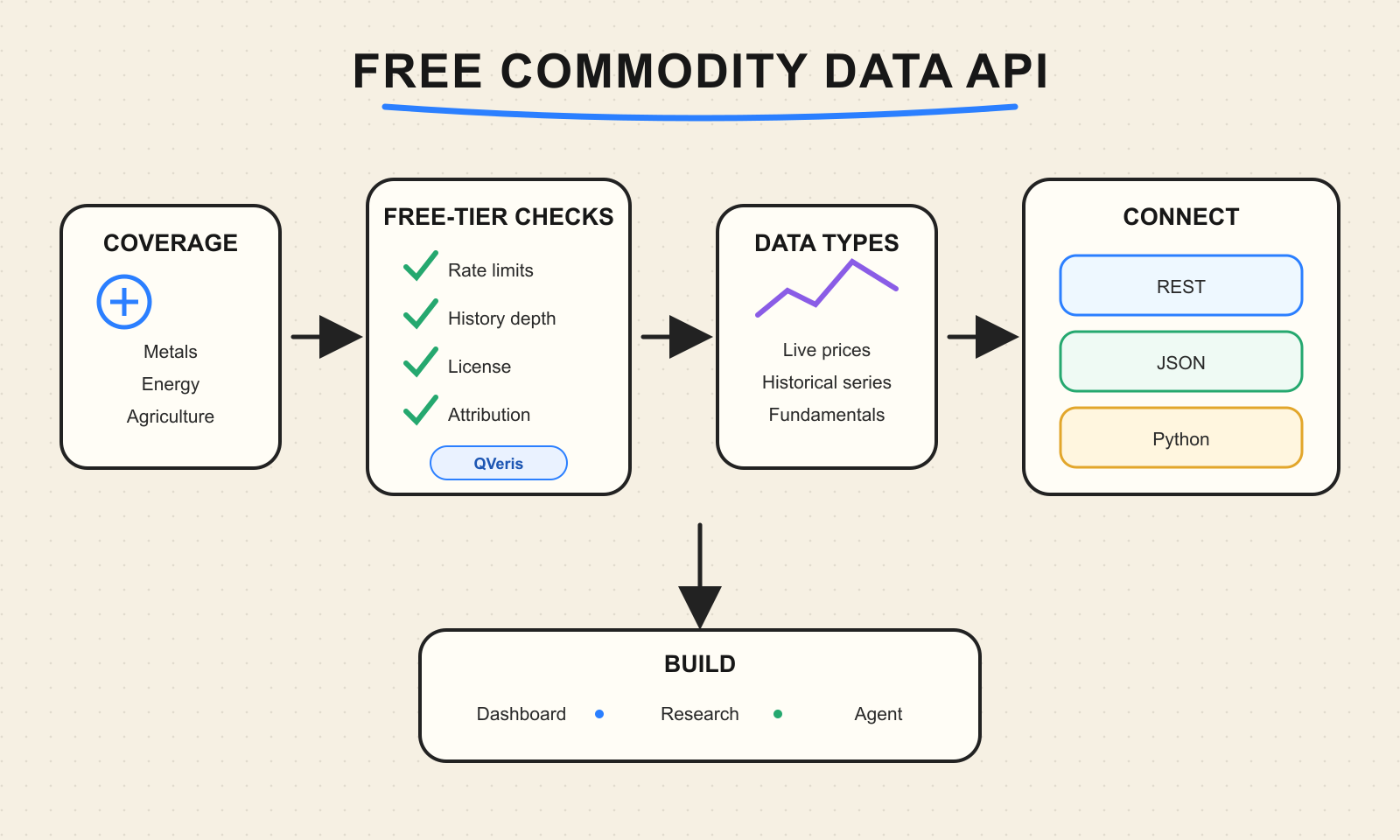
Free commodity data API: what you can actually get免费大宗商品数据 API:实际能获取什么
A “free” API may mean a permanent low-volume tier, a trial, delayed quotes, daily observations, or an open public dataset. Choose by the job you need to complete, not by the word free.
“免费”可能指长期低配额、限时试用、延迟行情、每日观测值或开放数据集。应按实际任务选择,不能只看“免费”标签。
- For a dashboard, confirm price symbols, update cadence, currency, unit, and timestamp.
- For research, confirm whether the API includes inventories, production, positioning, crop balances, revisions, and historical depth.
- For production, confirm authentication, rate limits, commercial use, attribution, and redistribution terms.
- 行情看板要核对价格代码、更新频率、币种、计量单位和时间戳。
- 研究场景要确认是否包含库存、产量、持仓、作物平衡表、修订和历史深度。
- 生产接入还要核对鉴权、请求限额、商业使用、署名与再分发条款。
What should a commodity data API cover?大宗商品数据 API 应覆盖哪些数据?
Real-time commodity prices
Gold, silver, copper, WTI, Brent, and natural gas may be spot benchmarks, futures, or assessed prices. Record exactly what each endpoint represents.
Historical commodity data
For charts and backtests, verify dates, frequency, OHLCV fields, adjustments, continuous-contract rules, revisions, and missing observations.
Commodity fundamentals
Inventory, production, refinery, crop, supply-demand, and CFTC positioning series answer different questions from a price feed and often update weekly or monthly.
实时大宗商品价格
黄金、白银、铜、WTI、布伦特与天然气可能对应现货基准、期货或评估价,必须记录接口所代表的准确口径。
历史大宗商品数据
用于图表或回测时,要核对日期、频率、OHLCV 字段、调整、连续合约规则、修订与缺失值。
大宗商品基本面
库存、产量、炼厂、作物、供需平衡与 CFTC 持仓解决的问题不同于价格流,通常按周或按月更新。
The hardest errors are semantic rather than technical. A spot assessment, front-month futures close, cash-settled benchmark, and vendor-built continuous contract may all be labeled “oil price,” yet they have different roll behavior, trading calendars, and licensing. Store contract month, venue, settlement type, unit, currency, and series-construction method as first-class fields.
最难发现的问题往往不是接口报错,而是数据含义被混用。现货评估价、近月期货收盘价、现金结算基准和供应商拼接的连续合约,都可能被笼统称为“油价”,但它们的换月方式、交易日历和许可并不相同。应把合约月份、交易场所、结算类型、单位、币种和序列构造方法作为正式字段保存。
Continuous-contract example: suppose the expiring crude-oil contract closes at $78 and the next contract closes at $80 on the vendor's roll date. A raw switch from one contract to the other creates an apparent ($80 ÷ $78) - 1 = 2.56% daily gain even if neither contract actually moved by that amount. A difference-adjusted series may add $2 to all pre-roll observations, while a ratio-adjusted series may multiply them by 80 ÷ 78; the two methods preserve different properties and change historical price levels differently. Store both contract closes, the roll trigger, selected contract before and after the roll, adjustment factor, and an unadjusted series. Otherwise a chart or backtest can mistake a stitching decision for market performance.
连续合约示例:假设供应商换月当日,临近到期的原油合约收于 78 美元,下一月份合约收于 80 美元。如果直接从前一个合约切换到后一个合约,连续序列会显示 (80 ÷ 78) - 1 = 2.56% 的单日上涨,即使两个可交易合约本身都没有出现这笔涨幅。价差调整可能把换月前全部价格加上 2 美元,比例调整则可能把它们乘以 80 ÷ 78;两种方法保留的统计性质不同,对历史价格水平的改写也不同。数据中应同时保存两个合约的收盘价、换月触发条件、换月前后选中的合约、调整因子和未调整序列,否则图表或回测很容易把拼接规则误判成市场收益。
Where free commodity data comes from免费大宗商品数据通常来自哪里
A free endpoint is not a single kind of product. It may expose a government statistical release, an exchange-derived market feed, a vendor-normalized dataset, or a short evaluation tier. The source determines what “latest,” “historical,” and “free” actually mean.
免费接口并不是一种统一产品。它可能提供政府统计发布、交易所衍生行情、供应商标准化数据,或仅供评估的短期免费层。数据来源决定了“最新”“历史”和“免费”的真实含义。
Public statistical APIs
Agencies such as the U.S. EIA publish energy prices, production, inventories, imports, exports, and storage series. These datasets are valuable for research, but publication cadence is usually daily, weekly, or monthly rather than streaming.
Market-data free tiers
Commercial APIs may expose selected spot or futures symbols with delayed updates, shallow history, or a capped request allowance. Confirm whether the free tier is permanent, a trial, or restricted to non-commercial evaluation.
Aggregated economic datasets
Repositories such as FRED make many commodity series easier to query and compare. Always preserve the original series ID, source agency, frequency, unit, seasonal-adjustment flag, and revision behavior.
公共统计 API
美国 EIA 等机构发布能源价格、产量、库存、进出口和储存数据。这类数据适合研究,但更新通常按日、周或月进行,并非流式实时行情。
市场数据免费层
商业 API 可能开放少量现货或期货代码,同时限制更新时效、历史深度或请求次数。需要确认它是长期免费、限时试用,还是仅限非商业评估。
聚合经济数据库
FRED 等数据库便于查询和比较商品序列,但仍应保存原始序列 ID、来源机构、频率、单位、季调标记和修订机制。
How to compare free commodity data APIs如何比较免费大宗商品数据 API
| Check核验项 | Ask要问的问题 | Why it matters为什么重要 |
|---|---|---|
| Price type价格类型 | Spot, futures, settlement, index, or assessed price?现货、期货、结算价、指数还是评估价? | Similar labels can represent different markets.相似名称可能代表不同市场。 |
| Freshness时效 | Real-time, delayed, end-of-day, or periodically updated?实时、延迟、日终还是定期更新? | “Latest” does not prove real-time delivery.“最新”不等于实时。 |
| History历史 | Start date, frequency, revisions, and continuous series?起始日期、频率、修订和连续序列如何? | Backtests need reproducible observations.回测需要可复现数据。 |
| Units单位 | USD per barrel, ounce, tonne, bushel, or index points?美元/桶、盎司、吨、蒲式耳还是指数点? | Wrong unit conversions silently corrupt results.错误换算会悄悄污染结果。 |
| Free tier免费额度 | Requests, symbols, retention, trial expiry, and attribution?请求数、品种数、保存期、试用到期和署名? | Free access may not support production.免费访问未必适合生产。 |
Choose the API by use case, not by claim按使用场景选择 API,而不是只看宣传标签
No free commodity API is best for every workload. A dashboard, research notebook, procurement model, backtest, and production agent each need a different balance of freshness, history, reliability, and licensing.
不存在适合所有任务的免费大宗商品 API。数据看板、研究笔记、采购模型、回测和生产智能体,对时效、历史、稳定性与授权的权衡各不相同。
| Use case使用场景 | Minimum data requirements最低数据要求 | Main risk to test重点测试风险 |
|---|---|---|
| Prototype dashboard原型看板 | Latest value, timestamp, unit, stable symbol, modest quota最新值、时间戳、单位、稳定代码和基础配额 | A “latest” endpoint may be delayed or update only when the source publishes.“最新”端点可能延迟,或只在上游发布时更新。 |
| Research and analysis研究分析 | Long history, documented frequency, revisions, downloadable batches较长历史、明确频率、修订说明和批量下载 | Revised observations can make a result impossible to reproduce.数据修订可能导致分析结果无法复现。 |
| Backtesting策略回测 | Point-in-time data, OHLCV definitions, contract rolls, missing-value rules时点数据、OHLCV 定义、换月规则和缺失值规则 | Continuous futures or revised fundamentals can introduce look-ahead bias.连续期货或修订后的基本面可能引入前视偏差。 |
| Production agent生产智能体 | Schema stability, error contracts, monitoring, commercial rights, fallbackSchema 稳定性、错误约定、监控、商业权限和回退方案 | A free tier can change, expire, throttle, or forbid customer-facing display.免费层可能变更、到期、限流或禁止面向客户展示。 |
Decision rule: reject an API if you cannot identify the source, timestamp, unit, update policy, quota, and permitted use. A successful HTTP response is not proof that the data is fit for your application.
决策规则:如果无法确认来源、时间戳、单位、更新政策、配额和允许用途,就不应接入。HTTP 请求成功并不能证明数据适合你的应用。
How to fetch commodity data in Python如何用 Python 获取大宗商品数据
The exact URL and field names vary by provider, so treat the following as an integration pattern rather than a live endpoint. It demonstrates the checks that should surround any commodity data API request.
不同供应商的 URL 和字段名不同,下面展示的是通用接入模式,而不是可直接调用的真实端点。重点是说明每次大宗商品数据请求周围应具备的校验。
1. Define the commodity and price meaning
Write down the commodity, benchmark or contract, venue, currency, unit, timezone, and required frequency before selecting an endpoint.
2. Test one free JSON request
Start with the provider’s official documentation. Keep the API key outside source code, set a timeout, and capture quota and freshness metadata.
3. Normalize price, unit, and timestamp
Store the raw symbol and source. Convert units explicitly, reject missing timestamps, flag stale values, and preserve revision dates for historical observations.
4. Add rate-limit-safe retries
Use bounded exponential backoff for transient errors, respect 429 responses, cache slow-changing series, and avoid spending a small free quota on unnecessary polling.
5. Validate expiry and roll behavior
For futures, request dates around expiry and compare the named contract with the continuous series. Record the roll trigger, back-adjustment method, and whether volume moves before the vendor rolls.
6. Reconcile against an authoritative release
Check a sample observation against the exchange, benchmark administrator, or public agency. A successful HTTP response does not prove that the unit, contract, or release vintage is correct.
1. 明确商品与价格口径
选择接口前,写清商品、基准或合约、交易场所、币种、单位、时区和所需频率。
2. 测试一次免费 JSON 请求
从供应商官方文档开始,把 API 密钥放在源码之外,设置超时,并记录配额和数据时效元数据。
3. 统一价格、单位和时间戳
保留原始代码和来源,显式换算单位,拒绝缺失时间戳,标记过期值,并为历史观测保存修订日期。
4. 在限流范围内安全重试
对临时错误使用有上限的指数退避,遵守 429,缓存低频序列,避免把有限免费额度浪费在无意义轮询上。
5. 验证到期与换月规则
期货数据应覆盖临近到期的日期,并对照指定月份合约与连续合约。记录换月触发条件、回溯调整方式,以及成交量转移和供应商换月是否同步。
6. 与权威发布值核对
抽取样本观测,与交易所、基准管理机构或公共部门发布值对照。HTTP 请求成功并不代表单位、合约或数据版本一定正确。
| Response field响应字段 | Validation校验方式 | Store with the value应与数值一起保存 |
|---|---|---|
symbol | Match an allowlist; do not infer a benchmark from a display name.与允许列表匹配,不要根据展示名称猜测基准。 | Provider symbol and internal normalized ID供应商代码和内部标准化 ID |
value | Require a numeric value and define how nulls are handled.必须为数值,并定义空值处理方式。 | Raw value, normalized value, and conversion formula原始值、标准值和换算公式 |
timestamp | Parse timezone explicitly and compare age with the expected cadence.显式解析时区,并按预期频率检查数据年龄。 | Observation time, retrieval time, and timezone观测时间、获取时间和时区 |
unit | Reject unknown units; distinguish USD from US cents and tonnes from short tons.拒绝未知单位,区分美元与美分、公吨与短吨。 | Currency, physical unit, quote convention币种、物理单位和报价惯例 |
source | Require a documented origin and series definition.必须能找到明确来源和序列定义。 | Source, endpoint, series ID, and license version来源、端点、序列 ID 和授权版本 |
Move from a free API test to production safely如何把免费 API 测试安全推进到生产环境
Cache by publication cadence
Do not poll a weekly inventory series every minute. Cache according to the documented release schedule, preserve the upstream timestamp, and invalidate only when new data should exist.
Separate transport from data quality
Monitor HTTP failures, latency, and rate limits separately from stale timestamps, null values, unit changes, large jumps, and source revisions.
Plan an explicit fallback
Decide whether to serve the last known value, show “data unavailable,” switch sources, or stop an automated action. Never silently substitute a different benchmark.
按发布频率缓存
不要每分钟轮询按周发布的库存序列。应根据官方发布时间缓存,保留上游时间戳,并只在预计出现新数据时失效。
区分传输与数据质量
HTTP 失败、延迟和限流应与过期时间戳、空值、单位变化、异常跳变和来源修订分别监控。
设计明确回退策略
提前决定是提供最后已知值、显示“数据不可用”、切换来源,还是停止自动操作;不要静默替换为另一种基准。
- Record quota headers and alert before the monthly limit is exhausted.
- Pin expected response fields with contract tests and review provider changelogs.
- Keep API keys server-side, rotate credentials, and avoid exposing them in browser JavaScript.
- Recheck licensing before public display, redistribution, model training, or customer-facing use.
- 记录配额响应头,并在月度额度耗尽前告警。
- 用契约测试固定预期响应字段,并持续查看供应商变更日志。
- 把 API 密钥保留在服务端,定期轮换,不要暴露在浏览器 JavaScript 中。
- 在公开展示、再分发、模型训练或客户使用前重新核对授权。
Use QVeris to find commodity data API capabilities用 QVeris 发现大宗商品数据 API 能力
QVeris helps developers and agents discover callable data capabilities and inspect inputs before integration. It does not make licensed exchange data free or guarantee that a provider is suitable for trading.
QVeris 帮助开发者和智能体发现可调用的数据能力,并在接入前检查输入要求。它不会把受许可约束的交易所数据变成免费,也不保证某个来源适合交易。
- Open the QVeris provider details for commodity and financial-data capabilities.
- Inspect symbols, parameters, authentication, output schema, units, and timestamps before an agent calls a provider.
- Keep licensing, accuracy, latency, and suitability checks in your approval process.
- 使用 QVeris 服务商详情搜索大宗商品与金融数据能力。
- 在智能体调用前检查品种代码、参数、鉴权、输出 Schema、单位和时间戳。
- 把授权、准确性、延迟和适用性检查保留在审批流程中。
1. Discover the capability
Search by the task—latest commodity value, historical series, inventory, production, or positioning—rather than assuming one provider exposes every dataset.
2. Inspect the callable contract
Review required inputs, authentication, symbol conventions, response schema, and error behavior before allowing an agent to call the tool.
3. Add approval boundaries
Require human approval or policy checks when data may trigger trading, purchasing, pricing, or customer-visible output.
1. 按任务发现能力
根据最新商品值、历史序列、库存、产量或持仓等任务搜索,不要假设一个供应商覆盖全部数据。
2. 检查可调用契约
在允许智能体调用前,检查必填输入、鉴权、代码规则、响应 Schema 和错误行为。
3. 设置审批边界
当数据可能触发交易、采购、定价或面向客户的输出时,应加入人工审批或策略检查。
FAQ
Is there a free commodity data API?
Yes. Public datasets, permanent free tiers, delayed feeds, and trials exist, but their coverage and usage rights differ.
Which commodities does a free API cover?
Common groups include metals, energy, and agriculture; some APIs also expose inventories, production, crop balances, or trader positioning.
Can I get historical commodity prices by API?
Many APIs return JSON or CSV history, but depth, frequency, revisions, continuous-series construction, and free limits vary.
How do I fetch commodity data in Python?
Use a documented REST endpoint with a timeout, keep keys outside source code, validate timestamps and units, and handle 429 responses.
Does a free commodity API require a credit card?
Some do not, while others only offer a time-limited trial. Confirm signup terms and what happens when the trial ends.
What are free-tier rate limits?
Limits may apply by minute, day, month, symbol, record count, or history depth. Check current provider documentation before integrating.
Is a continuous futures price the same as a tradable contract?
No. It is usually a research series constructed by rolling between expiries. The roll schedule and adjustment method can change returns and may not represent an executable price.
Why do commodity prices differ between APIs?
The feeds may reference different venues, contract months, assessment windows, units, currencies, settlement types, delays, or continuous-series methodology.
有免费的大宗商品数据 API 吗?
有。公开数据集、长期免费套餐、延迟数据和试用服务都可获取,但覆盖范围与使用权各不相同。
免费 API 覆盖哪些大宗商品?
常见品类包括金属、能源和农产品;部分接口还提供库存、产量、作物平衡或交易者持仓。
免费接口是否提供历史数据?
许多接口返回 JSON 或 CSV 历史数据,但深度、频率、修订、连续序列和免费限制不同。
如何用 Python 获取大宗商品价格?
调用官方 REST 端点并设置超时,将密钥放在源码之外,校验时间戳和单位,并处理 429 响应。
免费接口需要信用卡吗?
部分服务不需要,另一些只是限时试用;注册前应核对条款和试用结束后的处理方式。
免费大宗商品 API 有哪些调用限制?
限制可能按分钟、日、月、品种、记录数或历史深度计算,接入前应查看当前官方文档。
连续期货价格等于可交易合约价格吗?
不等于。连续合约通常是为研究构造的序列,会在不同到期月份之间换月。换月日程和调整方法都会影响收益,而且该价格未必可以实际成交。
为什么不同 API 的商品价格不一致?
它们可能对应不同交易场所、合约月份、评估窗口、单位、币种、结算类型、延迟程度或连续序列算法。