
Choose a Free Company Financial Data API
You Can Trust如何选择值得信赖的
免费公司财务数据 API
Evaluate statements, reporting periods, provenance, normalization, quotas, and licensing before company fundamentals become a product dependency.
从财务报表、报告期、数据来源、标准化、请求额度和使用许可等方面评估,
再决定是否将公司基本面数据作为产品所依赖的数据源。
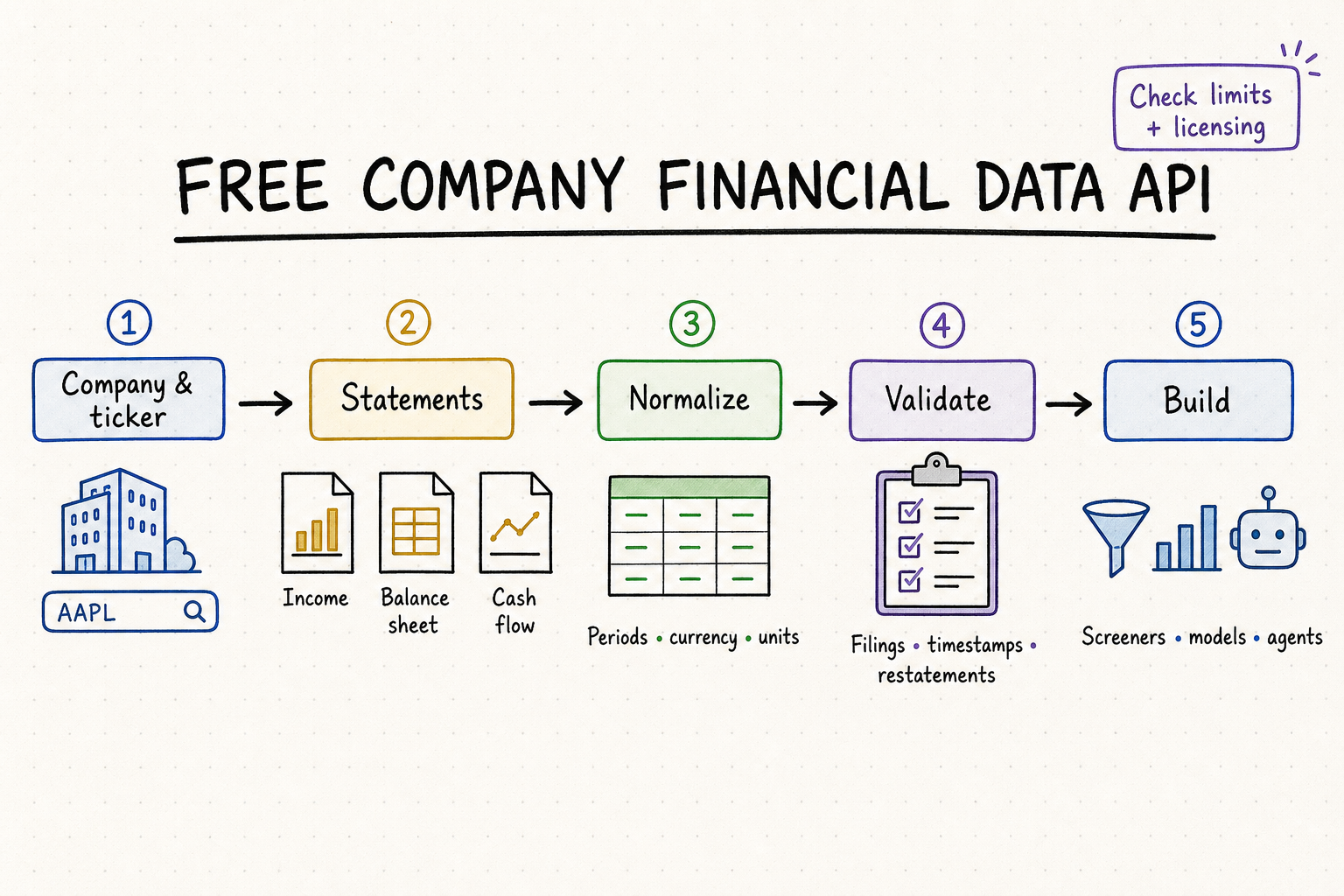
Free company financial data API: the short answer免费公司财务数据 API:先看结论
A company financial data API should let an application reconstruct one issuer's financial story from period to period: what the company reported, when it reported it, what later changed, and how each value connects to the source filing. This is different from building a broad factor dataset. The priority here is a complete, traceable company timeline that supports profiles, research pages, credit reviews, and earnings briefs without mixing fiscal periods or corporate entities.
公司财务数据 API 应帮助应用还原一家发行人连续的财务轨迹:企业在每个报告期披露了什么、何时披露、后来哪些数值发生过修订,以及每项数据如何追溯到原始文件。这与构建覆盖大量公司的因子数据集不同,本页更关注单家公司时间线的完整性和可追溯性,使公司资料页、研究报告、信用审查和财报简报不会混用财务报告期或公司主体。
Expect limits on company coverage, fiscal history, bulk downloads, request volume, normalized fields, or commercial use.
Income, balance sheet, and cash-flow values are meaningful only with periods, currency, units, and filing provenance.
Check accession numbers, timestamps, restatements, missing facts, and fiscal calendars with representative companies.
Connect statements, earnings events, amendments, capital changes, and fiscal-calendar changes in effective-date order.
免费服务通常会限制公司覆盖范围、财务历史跨度、批量下载、请求量、标准化字段或商业用途。
利润表、资产负债表和现金流量表中的数值,只有结合报告期、币种、单位和申报文件来源才有明确含义。
选取有代表性的公司,检查申报文件编号、申报时间、重述记录、缺失数据项和财年安排。
按照实际生效顺序关联财务报表、业绩事件、修订文件、资本变动和财年调整,避免把不同版本混为一谈。
What should a company financial data API cover?公司财务数据 API 应覆盖哪些内容?
Company financial data includes identity records, standardized statements, segment disclosures, capital structure, earnings events, selected ratios, and links to regulatory filings. Define the jurisdictions, issuer types, reporting frequency, and fiscal history your company view needs before comparing providers. A useful response should connect these records through stable company IDs and effective dates rather than return unrelated endpoint snapshots.
公司财务数据通常包括主体标识、标准化财务报表、分部披露、资本结构、业绩事件、部分衍生比率以及监管申报文件链接。比较供应商前,应先明确公司视图需要覆盖的司法辖区、发行人类型、财务报告频率和历史范围。可靠的响应应通过稳定的公司 ID 与生效日期把这些记录串联起来,而不是只返回彼此割裂的接口快照。
Confirm the legal issuer, parent and subsidiary relationships, share classes, primary listing, domicile, reporting currency, accounting standard, and consolidated scope. Acquisitions and reorganizations can change which operations belong in a company's historical comparison.
Verify annual and quarterly income, balance-sheet, and cash-flow coverage. Each fact needs a fiscal period, instant or duration type, currency, unit, consolidation scope, source filing, and an indication of whether it is reported or standardized.
Company-level totals can hide the source of change. For deeper profiles, inspect revenue and profit by business segment or geography, customer concentration where disclosed, headcount, production, subscribers, or other issuer-specific operating metrics.
Track basic and diluted shares, debt, cash, preferred securities, minority interest, dividends, repurchases, splits, and issuance. Per-share trends are unreliable when the share-count basis and corporate-action adjustments are unclear.
Check filing dates, acceptance timestamps, accession numbers, earnings release dates, amendments, restatements, and links to source documents. Preserve both the originally reported record and later corrections so the company timeline remains explainable.
确认法律意义上的发行人、母子公司关系、不同股权类别、主要上市地、注册地、记账本位币、会计准则和合并报表范围。企业并购或重组后,历史比较中所包含的业务边界可能随之变化。
核对年度和季度利润表、资产负债表与现金流量表。每项数据都应包含财务报告期、时点型或期间型标记、币种、单位、合并范围、来源文件,并说明它是企业原始披露值还是供应商标准化值。
公司合计数往往无法解释变化来自哪里。对于较深入的公司资料,应检查按业务分部或地区拆分的收入与利润、企业披露的客户集中度,以及员工数、产量、订阅用户等行业特有经营指标。
持续记录基本股数与稀释后股数、债务、现金、优先证券、少数股东权益、股息、回购、拆股和新股发行。如果股本口径及公司行动调整方式不清楚,每股指标的长期趋势就不可靠。
检查文件提交日期、监管系统接收时间、申报编号、业绩发布日期、修订与重述记录,并保留原始文件链接。首次披露与后续更正应分别保存,才能解释公司财务时间线为何发生变化。
Fiscal periods, TTM, and restatements need explicit rules财务报告期、TTM 与重述必须有明确规则
A financial fact is not just a metric and number. It also has an issuer, accounting concept, start or instant date, end date, fiscal year, fiscal period, currency, unit, consolidation scope, filing, and availability time. Two records labeled “revenue” can be incomparable when one is a single quarter and the other is year to date, or when one represents a continuing operation and the other includes a discontinued business.
一项财务数据不能只保存“指标名称与数值”。它还应包含发行人、会计概念、期初或时点日期、期末日期、财年、财务期间、币种、单位、合并范围、来源文件和可得时间。即使两条记录都叫“营业收入”,只要一条是单季度、另一条是年初至今累计,或一条仅含持续经营、另一条包含终止经营,就不能直接比较。
Worked example: derive quarters without adding YTD values twice实例:从累计值还原单季,避免重复相加
Assume a company reports Q1 revenue of 100, six-month YTD revenue of 230, nine-month YTD revenue of 360, and full-year revenue of 500. The standalone quarters are Q1 = 100, Q2 = 230 − 100 = 130, Q3 = 360 − 230 = 130, and Q4 = 500 − 360 = 140. Adding 100 + 230 + 360 + 500 would double-count the same periods and produce 1,190—an impossible annual total.
假设某公司披露第一季度收入 100、上半年累计收入 230、前三季度累计收入 360、全年收入 500。对应单季数据应为:Q1 = 100,Q2 = 230 − 100 = 130,Q3 = 360 − 230 = 130,Q4 = 500 − 360 = 140。若直接把 100、230、360 和 500 相加,会重复计算相同期间,得到不可能的全年收入 1,190。
At the next Q1, suppose the new standalone quarter is 110. Trailing-twelve-month revenue can be updated as 500 − 100 + 110 = 510, provided the prior full year and both Q1 values share currency, consolidation scope, and accounting basis. Do not label a provider field TTM until its component periods, adjustment rules, and availability times can be reproduced.
到了下一财年第一季度,假设新单季收入为 110,则滚动十二个月收入可以按 500 − 100 + 110 = 510 更新,但前提是上一全年和两个 Q1 的币种、合并范围与会计口径一致。在无法复现组成期间、调整规则和可得时间前,不应把供应商字段直接标记为 TTM。
Current view and point-in-time view should preserve different versions当前视图与历史时点视图应保留不同版本
Suppose annual revenue of 500 was filed on February 15 and later restated to 490 on May 1. A current company profile can show 490 with a restatement note and links to both filings. A backtest with a March 1 cutoff must still retrieve 500 because the correction was not yet public. Store filing acceptance time, period, accession, version lineage, and superseded state instead of overwriting the original row.
假设公司在 2 月 15 日申报全年收入 500,随后在 5 月 1 日重述为 490。当前公司资料页可以展示 490,同时标注重述并链接新旧文件;但截止时间为 3 月 1 日的历史回测必须读取 500,因为当时更正尚未公开。数据库应保存监管系统接收时间、报告期、申报编号、版本关系和被替代状态,而不是直接覆盖原记录。
Company type changes the statement model公司类型会改变报表模型
Revenue, cost of sales, inventory, deferred revenue, R&D, capital expenditure, and operating segments often drive the model.
Interest income and expense, deposits, loans, credit-loss allowance, capital ratios, and net interest margin need bank-specific concepts.
Premiums, claims, reserves, investment income, combined ratio, and statutory context cannot be forced into a generic industrial template.
Funds from operations, property metrics, partnership structures, or sector-specific non-GAAP measures require definitions and reconciliations.
收入、销售成本、存货、递延收入、研发支出、资本开支和经营分部通常是核心模型。
利息收入与支出、存款、贷款、信用损失准备、资本充足率和净息差需要银行专属概念。
保费、赔付、准备金、投资收益、综合成本率和法定口径不能强行套入普通工业企业模板。
运营资金、物业指标、合伙结构或行业特有非 GAAP 指标都需要定义与勾稽。
Choose the source layer by task根据任务选择数据来源层
| Source layer来源层 | Strength优势 | Application responsibility应用方责任 |
|---|---|---|
| SEC filings and CompanyfactsSEC 申报与 Companyfacts | Primary US filing evidence, structured facts, accessions, periods, units, and source traceability.美国公司一手申报证据、结构化数据项、申报编号、期间、单位与来源追溯。 | Resolve concepts, duplicates, dimensions, amended filings, company identity, and filing-time availability.处理会计概念、重复项、维度、修订文件、公司身份与申报可得时间。 |
| Normalized financial-data provider标准化财务数据供应商 | Consistent metrics, cross-company access, simpler JSON, ratios, and easier multi-market integration.提供一致指标、跨公司查询、简化 JSON、财务比率与更方便的多市场接入。 | Audit mappings, preserve reported values and source links, verify free limits, and test sector-specific coverage.审计字段映射,保留原始披露值与来源链接,核对免费限制,并测试行业专属覆盖。 |
| Issuer investor-relations material公司投资者关系资料 | Earnings releases, presentations, guidance, operating KPIs, and non-GAAP reconciliations.业绩公告、演示材料、业绩指引、经营 KPI 与非 GAAP 勾稽。 | Separate management presentation from filed statements and record publication time and document version.区分管理层展示与监管报表,并保存发布时间和文档版本。 |
The criteria that make company financials dependable判断公司财务数据是否可靠的关键标准
| Criterion评估维度 | What to verify核验要点 | Common free-tier trade-off免费套餐的常见取舍 | Test测试方法 |
|---|---|---|---|
| Coverage覆盖范围 | Companies, jurisdictions, statements, fields, and history.公司覆盖、司法辖区、财务报表、数据字段和历史数据跨度。 | Large-cap issuers or short history only.仅覆盖大市值发行人,或仅提供较短的历史数据。 | Query representative, foreign, and delisted issuers.分别查询有代表性的发行人、境外发行人和已退市发行人。 |
| Company model公司模型 | Stable issuer ID, listings, subsidiaries, reporting currency, and consolidated scope.稳定的发行人 ID、上市关系、子公司、记账本位币与合并范围。 | One ticker treated as the company.直接把一个股票代码等同于整家公司。 | Follow an issuer through a reorganization or listing change.选择经历过重组或上市关系变化的发行人,核对前后主体映射。 |
| Provenance数据来源 | Filing IDs, dates, periods, units, and revisions.申报文件编号、日期、报告期、单位和修订记录。 | Normalized values without source links.只提供标准化数值,不提供原始来源链接。 | Trace sampled facts to the original filing.抽样核对若干数据项,并逐项追溯至原始申报文件。 |
| Continuity时间连续性 | Fiscal-year changes, amendments, restatements, acquisitions, and discontinued operations.财年变更、修订、重述、并购与终止经营。 | Latest values overwrite prior company history.最新数值直接覆盖此前的公司历史。 | Rebuild a five-year company timeline and explain every break.重建五年公司时间线,并解释每一个不连续点。 |
| Segments分部数据 | Business and geographic dimensions, segment changes, eliminations, and reconciliation.业务与地区维度、分部变更、抵销项和与公司合计数的勾稽。 | Only consolidated totals.仅提供公司合并层面的合计数。 | Reconcile segment revenue to the consolidated total.将分部收入与公司合并收入进行勾稽核对。 |
| Limits请求限额 | Per-minute, daily, concurrent, and endpoint quotas.每分钟和每日请求限额、并发请求数上限及各接口配额。 | Low burst capacity or hard daily caps.突发请求容量较低,或设有严格的每日上限。 | Exercise 429 responses and retry headers.主动触发 429 响应,并检查重试相关响应头。 |
| Rights数据使用权 | Commercial use, storage, attribution, and redistribution.商业使用、数据存储、署名义务和再分发权限。 | Personal or non-commercial use only.仅限个人或非商业用途。 | Read both API terms and upstream data rights.同时查阅 API 服务条款与上游数据许可。 |
A safer integration pattern for company financials更稳妥地接入公司财务数据
Use a stable issuer identifier and verify the requested listing, share class, jurisdiction, and reporting entity. Do not infer company identity from a bare ticker when the result will be shown to users.
Store the source field, filing ID, period, currency, unit, consolidation scope, and retrieval time with each normalized metric for later audits. Retain the original response rather than keeping only transformed columns.
Separate fiscal years, quarters, year-to-date durations, trailing periods, and instant facts. Compare only when currency, units, scope, and periods agree; calendar-quarter labels alone are not enough for off-calendar issuers.
Merge filings, earnings releases, amendments, restatements, dividends, splits, issuance, and fiscal-calendar changes using both event time and data-availability time. This keeps a profile current without erasing its history.
Check statement equations, cash-flow roll-forwards, segment-to-company totals, and share-count changes. Record whether a missing value is not disclosed, not applicable, delayed, mapping-related, or caused by a provider error.
使用稳定的发行人标识,并核对所请求的上市地、股权类别、司法辖区和财务报告主体。结果将面向用户展示时,不能根据一个不带交易所信息的股票代码猜测公司身份。
保存每个标准化指标时,同时保留原始字段、申报文件编号、报告期、币种、计量单位、合并范围和数据获取时间,便于后续审计。除转换后的字段外,还应保留原始响应。
分别处理财年、季度、年初至今期间、滚动期和时点型数据。只有币种、单位、合并范围与报告期一致的数据才可直接比较;对于财年并非自然年的公司,单看自然季度标签并不够。
利用事件发生时间和数据可得时间,将监管文件、业绩公告、修订、财报重述、股息、拆股、证券发行和财年变更合并为一条连续时间线。这样既能保持公司资料最新,也不会抹去历史版本。
检查财务报表恒等关系、现金流衔接、分部数据与公司合计数,以及股本变动。对于缺失值,应区分企业未披露、不适用、数据尚未更新、字段映射失败和供应商错误。
Use QVeris to discover company data capabilities使用 QVeris 发现公司财务数据能力
Provider lists go stale and every API describes itself differently. QVeris helps developers and agents discover, inspect, and call relevant company-data capabilities while keeping inputs and constraints visible. It can simplify capability routing when a workflow needs profiles, statements, filing facts, or corporate events from different tools. The application still owns company identity resolution, period normalization, source retention, and the final explanation shown to the reader.
服务商名录容易过时,而且各 API 对自身能力的描述方式也不尽相同。QVeris 帮助开发者和智能体发现、核验并调用相关公司数据能力,同时保留对输入参数和限制条件的了解。当一个工作流需要从不同工具获取公司概况、财务报表、申报文件数据项或公司事件时,它可以简化能力路由。应用方仍需负责公司主体映射、报告期标准化、来源留存,以及最终向读者作出的解释。
- Search by the capability you need—statements, ratios, company profiles, filing data points, or historical fundamentals—not only by vendor name.
- Inspect inputs, outputs, authentication, and constraints before wiring a capability into an automated workflow.
- Keep provider adapters and provenance in your application even when discovery and calling are streamlined.
- 按所需能力搜索,例如财务报表、财务比率、公司概况、申报文件数据项或历史基本面数据,而不只按服务商名称搜索。
- 接入自动化工作流前,先检查输入、输出、鉴权方式和限制条件。
- 即使能力发现和调用流程已经简化,也应在应用中保留服务商适配模块和数据来源信息。
FAQ常见问题
Yes. Free sources can expose statements and filings, but company coverage, fiscal history, normalization, quotas, and commercial rights vary.
Test revenue, net income, assets, liabilities, cash flow, fiscal periods, currencies, units, filing IDs, and restatements.
Company financial data usually serves a traceable profile or timeline for one issuer. A fundamental dataset additionally emphasizes cross-company standardization, historical universe membership, and point-in-time panels for screening or backtesting.
Yes. Reported values preserve what the issuer disclosed; standardized values make common comparisons easier. Keeping both lets analysts audit mappings and handle company-specific disclosures.
Store the original filing and each amendment as separate versions with availability timestamps. The current view may show the latest version, but historical research should retrieve the version known at that time.
Not for every product, but they materially improve company research when growth, margins, or risk differ across businesses or regions. Segment totals should reconcile to consolidated disclosures.
有。免费数据源可以提供财务报表和监管申报文件,但公司覆盖范围、财务历史跨度、标准化程度、请求配额和商业使用权限各不相同。
应优先核验营业收入、净利润、资产、负债、现金流、财务报告期、币种、单位、申报文件编号和重述记录等字段。
公司财务数据通常用于建立单一发行人可追溯的资料页或财务时间线;基本面数据集还强调跨公司标准化、历史股票池和历史时点面板,以支持选股与回测。
建议同时保存。原始值保留企业实际披露内容,标准化数值便于常规比较;两者并存,分析人员才能核验字段映射,并妥善处理公司特有科目。
首次申报和每次修订都应作为独立版本保存,并记录数据可得时间。当前公司视图可以展示最新版本,但历史研究必须读取当时已经公开的版本。
并非所有产品都需要,但当不同业务或地区的增长、利润率和风险差异明显时,分部数据会显著提高研究质量。各分部合计数应能与公司合并披露完成勾稽。