
Free Company Peer Data API
for Comparable Company Analysis用于可比公司分析的
免费公司同业数据 API
Build defensible peer groups with consistent identifiers, periods, currencies, financial metrics, and documented selection rules.
通过一致的公司标识、财务期间、币种、指标口径和明确的筛选规则,构建可解释、可复核的同业公司组。
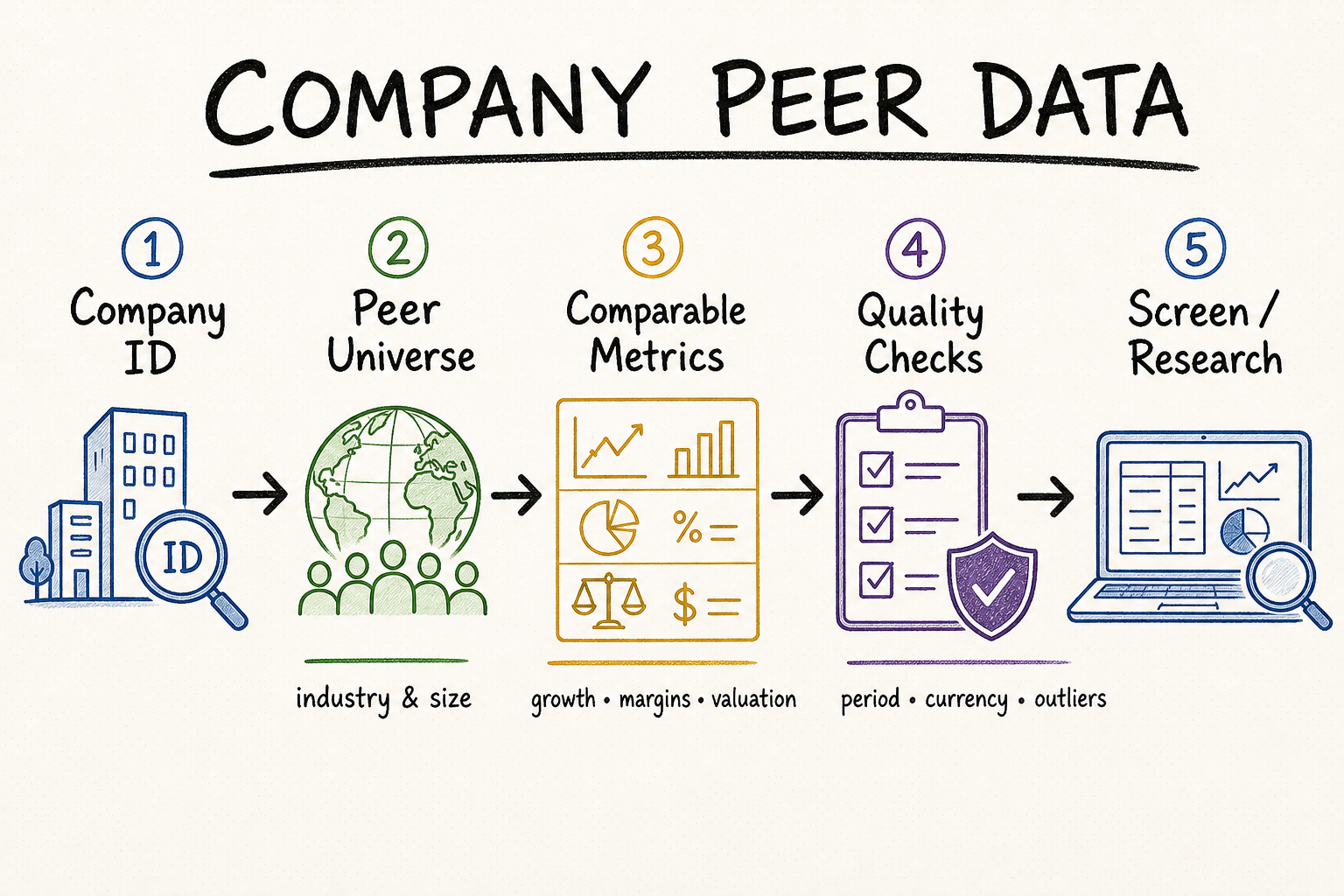
What a company peer data API should do公司同业数据 API 应具备哪些能力
A useful response identifies why each company belongs: industry, business model, geography, revenue scale, market value, growth, or another declared rule.
Metrics should share fiscal definitions or expose period dates clearly. Mixing annual, trailing, and quarterly values can create false rankings.
Keep currency, units, statement basis, timestamps, provider, and company identifiers so every comparison can be reproduced.
有效的 API 响应应说明每家公司为何被纳入同业组,例如基于行业、商业模式、所在地区、营收规模、市值、增长率或其他明确说明的筛选规则。
各项指标应采用一致的财务期间定义,或明确给出各指标对应期间的起止日期。将年度、滚动十二个月(TTM)和季度数据混合排名,会得出失真的结果。
应保留币种、单位、财务报表编制口径、数据时间戳、数据提供方及公司标识,使每次比较都能复现。
A good peer API should return candidates, not an unexplained verdict. The application needs enough evidence to include or exclude each company for a specific use case: valuation, operating benchmarking, credit analysis, or market positioning. A software issuer may share an industry code with hardware, consulting, or marketplace businesses but differ materially in revenue model and margin structure. Treat the provider’s list as a documented starting universe, then apply a reproducible selection policy.
优质的同业 API 应返回候选公司和判断依据,而不是给出无法解释的最终答案。应用需要掌握足够证据,才能针对估值、经营对标、信用分析或市场定位等具体用途决定纳入或排除哪些公司。某家软件企业可能与硬件、咨询或平台型企业共用同一行业代码,但收入模式和利润结构截然不同。因此,服务商返回的名单更适合作为有依据的初始样本,后续仍应执行可复现的筛选规则。
Fields that make peer data usable让同业数据真正可用的字段
A peer API may return a ready-made list, similarity scores, or attributes for building a peer set. Request permanent company and listing IDs, name, industry code, country, reporting currency, fiscal year end, and active status. Symbols alone are fragile: they change, collide across exchanges, and may identify a security rather than the company.
Common metrics include revenue, growth, margins, EBITDA, debt, market value, and valuation multiples. Require period end, units, currency method, and whether each value is reported, normalized, or estimated.
同业数据 API 可能直接返回现成的同业名单、相似度评分,也可能返回用于自行构建同业组的属性。应获取长期稳定的公司标识和证券标识,以及名称、行业代码、国家、报告币种、财年截止日和上市状态。股票代码可能发生变更,也可能在不同交易所重复,而且它标识的可能是某只证券而非公司,因此不能仅凭股票代码识别公司。
常用指标包括营收、增长率、利润率、EBITDA、债务、市值和估值倍数。响应应注明报告期截止日、单位和币种换算方法,并说明每项数值是已披露值、标准化结果还是估算值。
Keep a permanent company ID separate from listing, share-class, ADR, and ticker IDs. Record the primary listing, active dates, parent or subsidiary relationship, and whether market value represents one security or the consolidated company.
Return the taxonomy and version, business description or segment exposure, geography, scale bands, similarity features, score, rank, filters, and exclusion reason. This makes a peer set explainable rather than provider-dependent.
Attach period start and end, fiscal year, annual or interim form, trailing-window definition, accounting basis, restatement status, currency, unit, and source date to every metric used in ranking.
For P/E, EV/EBITDA, price-to-sales, or free-cash-flow yield, retain numerator and denominator as well as the multiple. Specify market-value time, net-debt policy, diluted share basis, treatment of negative denominators, and foreign-exchange time.
Save an as-of time, methodology version, contributor source, and membership effective dates. Historical analysis should use the peers and information available then, not a present-day list retroactively applied to the past.
永久公司 ID 应与上市地、股份类别、ADR 和股票代码分别保存。还要记录主要上市地、有效日期、母子公司关系,并说明市值代表单只证券还是合并后的公司整体。
返回行业体系及版本、业务描述或分部敞口、地区、规模区间、相似度特征、得分、排名、过滤条件和排除原因,使同业组可以解释,而不是只能依赖服务商结论。
每个用于排序的指标都应附上期间起止日、财年、年度或中期口径、滚动窗口定义、会计准则、重述状态、币种、单位和数据来源日期。
对于市盈率、EV/EBITDA、市销率或自由现金流收益率,既要保留倍数,也要保留分子和分母,并说明市值时点、净债务政策、摊薄股数口径、负分母处理和汇率时间。
保存数据时点、方法版本、来源和成员有效日期。历史分析应使用当时真实可得的同业名单与信息,不能把今天的名单直接套用到过去。
{
  "subject_company_id": "company_1024",
  "peer_company_id": "company_2048",
  "peer_set_as_of": "2026-07-31",
  "methodology_version": "peer-model-3.2",
  "membership": "included",
  "similarity_score": "0.84",
  "features": {
    "business_model": "subscription-software",
    "revenue_scale_band": "500m-1b",
    "primary_region": "north-america"
  },
  "metric_period_end": "2026-06-30",
  "metric_basis": "TTM",
  "reporting_currency": "USD",
  "source_observed_at": "2026-08-01T09:15:00Z"
}
This normalized example separates three clocks: when peer membership was valid, which financial period supports the comparison, and when the source was retrieved. It also keeps the decision and feature evidence together. If the provider returns only a list of tickers, enrich it through an identity and fundamentals layer before calculating medians or multiples. Never infer an exclusion from a missing row; record whether the candidate was screened out, unsupported, inactive, or temporarily unavailable.
这个标准化示例把三个时间维度分开:同业成员关系在哪个时点有效、比较采用哪个财务期间,以及数据在何时被获取;同时把纳入结论与特征证据保存在一起。如果供应商只返回一串股票代码,应先通过公司身份与基本面数据层补全信息,再计算中位数或估值倍数。候选公司没有出现在结果中时,不能直接推断为“已排除”,而应明确它是未通过筛选、暂不支持、已经失效,还是服务暂时无法返回。
Evaluate a free company peer data API如何评估免费公司同业数据 API
| Check检查维度 | What to verify需要核实的内容 | Failure signal异常信号 |
|---|---|---|
| Selection筛选规则 | Taxonomy, filters, ranking, and exclusions行业体系、过滤条件、排序与排除规则 | Opaque or unstable peers同业名单不透明或频繁漂移 |
| Coverage覆盖范围 | Regions, exchanges, private firms, inactive listings地区、交易所、非上市公司与已退市证券 | Biased comparison universe可比公司样本存在偏差 |
| Timing时间一致性 | Period ends, update lag, restatements期末日期、更新延迟与财报重述 | Mixed or stale observations各项数据的期间不一致或数据已过时 |
| Identity身份识别 | Company, listing, share class, ADR, parent, and active dates公司、上市地、股份类别、ADR、母公司和有效日期 | Duplicates or incomparable securities重复公司或不可直接比较的证券被混入样本 |
| Methodology方法说明 | Feature weights, score meaning, taxonomy version, and exclusions特征权重、得分含义、行业体系版本和排除规则 | A peer list that cannot be defended同业名单无法解释或复核 |
| Metric lineage指标来源链 | Numerators, denominators, currency, period, source, and estimate status分子、分母、币种、期间、来源和估算状态 | False ranking from mixed definitions指标定义混用造成虚假排名 |
| Access访问条件 | Quota, pagination, caching, display rights调用额度、分页、缓存与展示授权 | Prototype cannot scale legally原型无法在合规前提下扩展至生产规模 |
Test a bank, new listing, foreign issuer, and multi-class company. Repeat calls to detect peer-list drift. Free access does not automatically permit redistribution, client display, model training, or commercial use.
应选取银行、新上市公司、境外发行人和具有多类股份的公司进行测试,并通过重复调用检查同业名单是否发生漂移。免费访问权限并不等于获准再分发数据、向客户展示、用于模型训练或投入商业用途。
A worked case exposes problems that a field checklist cannot. Assume the subject is a listed cloud billing software company with subscription revenue, mid-market customers, positive gross margin, negative operating margin, and most revenue in North America. An industry-code match can produce many candidates, but the final peer set should reflect the decision being made.
完整案例能够发现字段清单看不到的问题。假设目标公司是一家上市云计费软件企业,以订阅收入为主,客户集中在中型企业,毛利为正但营业利润仍为负,主要收入来自北美。按行业代码可以找到许多候选公司,但最终同业组必须服务于具体决策。
| Candidate profile候选公司特征 | Operating benchmark经营对标 | Valuation peer set估值同业组 | Reason判断依据 |
|---|---|---|---|
| Subscription billing SaaS, similar size规模接近的订阅计费 SaaS | Include纳入 | Include纳入 | Revenue model, customer motion, margin structure, and lifecycle are aligned.收入模式、获客方式、利润结构和发展阶段都较为一致。 |
| Large enterprise SaaS platform大型企业级 SaaS 平台 | Use cautiously谨慎纳入 | Sensitivity only仅用于敏感性分析 | Business model matches, but scale, sales efficiency, liquidity, and profitability can dominate the multiple.商业模式相近,但规模、销售效率、流动性与盈利能力可能显著影响估值倍数。 |
| IT consulting company with the same code行业代码相同的 IT 咨询公司 | Exclude排除 | Exclude排除 | Labor-led project revenue and gross-margin economics are not comparable with subscription software.以人力项目收入为主,毛利结构与订阅软件不可比。 |
| Payments marketplace with recurring fees具有持续收费的支付平台 | Exclude or segment排除或分部处理 | Secondary reference次级参考 | Recurring revenue alone does not resolve take-rate, transaction-volume, credit, and regulatory differences.仅有持续收入并不能消除抽佣率、交易规模、信用风险和监管差异。 |
| Similar SaaS issuer in another region其他地区的相似 SaaS 公司 | Include with region tag标记地区后纳入 | Include after FX and market checks完成汇率与市场校验后纳入 | Operating similarity may be strong, but reporting currency, market regime, accounting basis, and liquidity require normalization.经营特征可能很接近,但报告币种、市场环境、会计准则和流动性仍需统一处理。 |
Start with hard eligibility rules—active listing, required geography, available periods, supported accounting fields, and no duplicate company identity. Rank the surviving candidates using declared features such as business-model match, revenue scale, growth, margin profile, customer exposure, and lifecycle. Hard filters prevent invalid comparisons; the score orders candidates that are already eligible.
A sample model might assign 35% to business-model match, 20% to product or industry exposure, 15% to logarithmic revenue distance, 15% to growth and margin profile, 10% to geography, and 5% to lifecycle. Those weights are not universal. Return every component, missing-value treatment, final score, and methodology version so an analyst can see why one candidate outranked another.
Calculate the median and range, then repeat after removing the largest company, the highest multiple, and each member one at a time. Show the number of valid observations for every metric. If the valuation conclusion changes materially after one exclusion, report a sensitivity range rather than presenting one precise peer median.
先执行硬性准入条件,例如上市状态有效、地区符合要求、财务期间可用、关键会计字段齐全,并排除重复公司身份。随后再按商业模式、营收规模、增长、利润结构、客户类型和发展阶段等明确特征对剩余候选公司排序。硬性条件负责排除无效比较,相似度得分只用于排列已经合格的候选公司。
示例模型可以把 35% 权重分配给商业模式,20% 分配给产品或行业敞口,15% 分配给营收规模的对数距离,15% 分配给增长与利润结构,10% 分配给地区,5% 分配给企业生命周期。这些权重并非通用答案。API 应返回各项分值、缺失值处理、最终得分和方法版本,让分析人员能够看出候选公司排名变化的原因。
先计算中位数和分布区间,再分别剔除规模最大的公司、倍数最高的公司,并逐一执行留一法复算。每项指标都要展示有效样本数。如果剔除一家公司就会明显改变估值结论,应披露敏感性区间,而不是给出看似精确的单一同业中位数。
Build a reliable peer comparison pipeline构建可靠的同业比较流程
- Define the decision first: state whether the peer set supports valuation, operating benchmarks, credit, market positioning, or another decision because each purpose needs different filters.
- Resolve identity first: map user input to permanent company, listing, and security IDs before requesting peers; collapse duplicate share classes only under an explicit rule.
- Store the selection recipe: retain filters, feature values, weights, taxonomy version, similarity score, rank, exclusions, request time, and raw provider response.
- Normalize before ranking: align periods, currencies, units, accounting basis, signs, and null rules; winsorize or impute only under a documented policy.
- Separate discovery from metrics: version peer membership independently from fast-changing market values and slower financial statements so each dataset can refresh safely.
- Review outliers manually: inspect conglomerates, banks, pre-revenue issuers, recent listings, negative denominators, M&A targets, and companies undergoing major business-model changes.
- Monitor drift: alert when coverage falls, peer membership changes unexpectedly, one company dominates the median, fields disappear, or update lag exceeds policy.
- 先明确比较目的:说明同业组用于估值、经营对标、信用分析、市场定位还是其他决策,因为不同目的需要不同筛选条件。
- 先解析公司身份:请求同业名单前,将用户输入映射到永久公司、上市地和证券 ID;只有在规则明确时,才合并同一公司的多类股份。
- 保存筛选逻辑:保留过滤条件、特征值、权重、行业体系版本、相似度得分、排名、排除原因、请求时间和原始响应。
- 先标准化,再排序:统一期间、币种、单位、会计准则、正负号和空值规则;缩尾或插补只能依据书面政策执行。
- 将名单与指标解耦:同业成员应独立建立版本,并与更新较快的市值和更新较慢的财务报表分别刷新。
- 人工复核异常公司:重点检查综合企业、银行、尚未产生收入的公司、新上市公司、分母为负的指标、并购标的和商业模式发生重大变化的企业。
- 监控名单漂移:覆盖下降、成员异常变化、单家公司显著左右中位数、字段消失或更新延迟超标时应触发告警。
Use QVeris to discover peer data capabilities借助 QVeris 查找同业数据服务能力
QVeris helps applications and AI agents discover external data tools, inspect their inputs and outputs, and route a request to an appropriate capability. Use it to shortlist providers and reduce integration guesswork, then keep peer methodology, licensing, and quality controls inside your own workflow.
QVeris 可帮助应用和 AI 智能体发现外部数据工具、核查其输入参数与输出结果,并将请求交给具备相应能力的工具处理。你可以借此筛选候选数据供应商,减少接入时的反复试错,同时继续在自己的工作流中管理同业筛选方法、数据授权和质量控制。
FAQ常见问题
Comparable companies plus the identifiers, metrics, periods, and rules needed to explain the comparison.
Possibly, when coverage, quota, uptime, licensing, and support fit the workload. Add monitoring and a fallback.
No. Business model, geography, size, growth, profitability, and lifecycle can improve comparability.
公司同业数据包括可比公司名单,以及解释比较结果所需的公司标识、指标、财务期间和筛选规则。
有可能。如果覆盖范围、调用额度、服务可用性、数据授权和技术支持都能满足实际业务负载要求,即可考虑用于生产环境,但仍需设置监控并准备备用方案。
不够。还应考虑商业模式、地区、规模、增长水平、盈利能力和企业生命周期阶段,以提高可比性。
There is no universal count. Use enough independent observations for the statistic, but not so many that business-model differences overwhelm comparability. Show the full distribution and sensitivity to exclusions.
Usually not for operating comparisons because they represent one company. For security-level market analysis they may matter. Preserve both IDs and document the consolidation rule.
Do not rank or average them as ordinary positive multiples. Mark the denominator and sign, use an alternative metric where appropriate, and disclose exclusions from summary statistics.
Only when membership, identifiers, taxonomy, financial values, and market values are preserved point in time. Applying today’s surviving peer list to the past creates look-ahead and survivorship bias.
没有适用于所有场景的固定数量。样本要足以支持所用统计方法,但不能大到让商业模式差异淹没可比性;还应展示完整分布和剔除个别公司后的敏感性。
用于经营比较时通常不应重复,因为它们代表同一家公司;用于证券层面的市场分析时则可能需要分别保留。两类 ID 都应保存,并明确合并规则。
不能把它们当作普通正倍数直接排序或求平均。应标明分母及其符号,在适当情况下改用其他指标,并披露汇总统计中排除的公司。
只有在成员关系、公司标识、行业体系、财务数据和市值都按历史时点保存时才可以。把今天仍存续的同业名单直接套用到过去,会产生前视偏差和幸存者偏差。