
Free Crypto Data API
for Developers免费加密货币数据 API
开发者选型指南
Compare free crypto APIs by live prices, historical OHLCV, coverage, quotas, licensing, and integration fit.
按实时价格、历史 OHLCV、覆盖范围、免费额度、授权与接入方式比较加密货币数据接口。
Free crypto data API: the short answer免费加密货币数据 API:快速结论
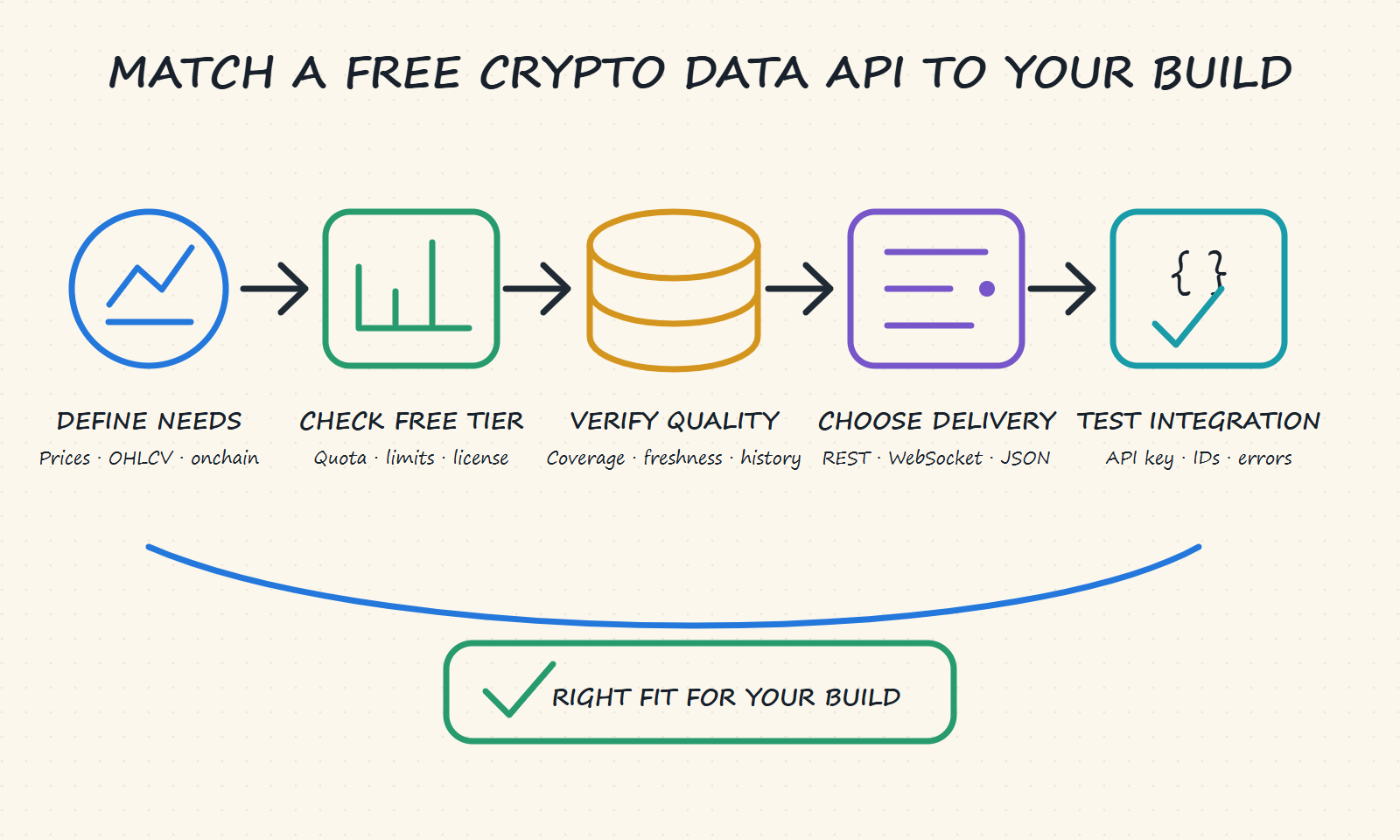
No free provider fits every product. Match the API to portfolio tracking, charts, research, alerts, or agent workflows.
Check current monthly credits, per-minute limits, endpoint access, historical depth, and whether commercial use is permitted.
Compare asset and exchange coverage, timestamps, cache intervals, OHLCV granularity, identifiers, and correction policy.
Add caching, backoff, schema validation, source attribution, monitoring, and a migration path before production.
投资组合、行情图、研究、告警和智能体工作流需要的数据范围不同,没有一个免费接口适合所有产品。
检查当前月度额度、每分钟限流、可用端点、历史深度以及商业使用是否被允许。
比较币种与交易所覆盖、时间戳、缓存间隔、OHLCV 粒度、标识符与修订机制。
上线前加入缓存、退避、Schema 校验、来源归因、监控和可迁移的数据适配层。
How to choose a free cryptocurrency market data API如何选择免费数字货币行情 API
Start with the task, not a provider name. A dashboard may need aggregated spot prices, while backtesting needs stable historical candles and a trading interface may need exchange-level WebSocket data. “Real time” is not a universal specification, so inspect timestamps and documented update behavior.
先定义任务,再看供应商。行情看板通常需要聚合现货价格,回测需要稳定的历史 K 线,交易界面则可能需要交易所级 WebSocket。所谓“实时”不是统一标准,应检查响应时间戳和官方更新说明。
Define live crypto price API requirements
List assets, fiat quote currencies, exchanges, maximum acceptable delay, polling frequency, and whether a consolidated price or venue-specific quote is required.
Define historical crypto data API requirements
Specify OHLCV interval, earliest date, timezone, gaps, inactive assets, delisted markets, and whether trades or order books are required beyond candles.
Separate market data from blockchain data
Prices, volume, market cap, token metadata, onchain transfers, DEX pools, and wallet balances are distinct datasets. Do not assume one free endpoint covers them all.
明确实时加密货币价格接口需求
列出币种、法币计价、交易所、可接受延迟、轮询频率,并确认需要聚合价格还是单一交易场所报价。
明确加密货币历史行情 API 需求
确定 OHLCV 周期、最早日期、时区、缺口处理、下架币种,以及是否需要逐笔成交或订单簿。
区分行情数据与链上数据
价格、成交量、市值、代币元数据、链上转账、DEX 池和钱包余额是不同数据集,不能假设一个免费端点全部覆盖。
Crypto data types a free API may expose免费加密货币 API 可能提供的数据类型
“Crypto data” can refer to several incompatible products. Decide which dataset your application needs before comparing endpoint counts. A provider with broad aggregated coverage may be ideal for a portfolio dashboard but unsuitable for exchange-level order-book analysis.
“加密货币数据”可能指完全不同的数据产品。比较端点数量前,应先确定应用真正需要的数据集。覆盖广泛的聚合接口可能适合投资组合看板,却未必适合交易所级订单簿分析。
Aggregated market data
Current price, market cap, volume, circulating supply, rankings, categories, and token metadata combined from multiple markets.
Exchange market data
Venue-specific tickers, trades, candles, funding rates, open interest, and order books delivered through REST or WebSocket.
Historical OHLCV data
Open, high, low, close, and volume series for charts, indicators, research, and backtesting. Depth and interval availability vary.
Onchain and DEX data
Contract-address metadata, pools, liquidity, swaps, token transfers, wallet balances, and decentralized-market activity.
Reference and discovery data
Stable asset IDs, symbols, networks, contract addresses, exchange lists, categories, descriptions, and project links.
Derived market signals
Dominance, volatility, technical indicators, sentiment, indexes, and risk metrics. Always inspect the calculation methodology.
聚合市场数据
从多个市场汇总当前价格、市值、成交量、流通量、排名、分类和代币元数据。
交易所行情数据
特定交易场所的报价、逐笔成交、K 线、资金费率、持仓量和订单簿,通常通过 REST 或 WebSocket 交付。
历史 OHLCV 数据
用于图表、指标、研究和回测的开高低收与成交量序列;免费层可用深度和周期通常不同。
链上与 DEX 数据
合约地址元数据、流动性池、兑换、代币转账、钱包余额和去中心化市场活动。
参考与发现数据
稳定资产 ID、代码、网络、合约地址、交易所列表、分类、项目说明和官方链接。
衍生市场信号
市场占比、波动率、技术指标、情绪、指数和风险指标;使用前必须检查计算方法。
Worked example: normalize quote currencies before aggregation实算示例:跨市场聚合前先统一计价币
Suppose Venue A reports BTC/USD at 60,000 bid / 60,020 ask, while Venue B reports BTC/USDT at 60,040 bid / 60,060 ask. Their raw midpoints are 60,010 USD and 60,050 USDT, but they are not yet comparable. If the contemporaneous USDT/USD conversion is 0.9980, Venue B normalizes to 60,050 × 0.9980 = 59,929.90 USD. With verified USD-equivalent volume weights of 70% and 30%, an illustrative composite is 60,010×0.70 + 59,929.90×0.30 = 59,985.97 USD. Preserve both venue prices, the stablecoin conversion source and time, weights, exclusions, and calculation method; the composite is a reference value, not an executable quote.
假设交易场所 A 的 BTC/USD 报价为买价 60,000、卖价 60,020,交易场所 B 的 BTC/USDT 报价为买价 60,040、卖价 60,060。两者原始中间价分别为 60,010 USD 和 60,050 USDT,此时还不能直接比较。若同一时点的 USDT/USD 换算价为 0.9980,那么 B 的美元标准化价格为 60,050 × 0.9980 = 59,929.90 USD。再按经核验的美元等值成交量赋予 70% 和 30% 权重,示例聚合价为 60,010×0.70 + 59,929.90×0.30 = 59,985.97 USD。结果应保留两地原始价格、稳定币换算来源与时间、权重、排除项和计算方法;该聚合值是参考价格,不是可直接成交的报价。
| Price field价格字段 | What it represents代表含义 | Appropriate use适合用途 |
|---|---|---|
| Venue bid / ask交易场所买卖价 | Current displayed liquidity on one market.单一市场当前展示的买卖流动性。 | Execution-aware applications, with depth and latency checks.考虑执行的应用,但仍需检查深度与延迟。 |
| Last trade最新成交价 | Most recent matched trade, which may be stale or unusually small.最近一笔撮合成交,可能陈旧或成交量异常小。 | Trade history and charts when timestamp and size are retained.保留时间和成交量后的成交历史与图表。 |
| Aggregated spot聚合现货价 | A provider-defined composite across selected markets.供应商按既定方法汇总多个市场的参考值。 | Portfolio display, discovery, research, and valuation reference.资产组合展示、发现、研究与估值参考。 |
| Index / mark price指数价 / 标记价 | A derivatives reference or risk-control price, not necessarily a spot trade.衍生品参考或风控价格,并不一定对应现货成交。 | Funding, margin, liquidation, and derivatives analytics under the venue's rules.按交易场所规则计算资金费、保证金、强平与衍生品分析。 |
Identity, supply, and volume need their own controls. Store network, contract address, provider asset ID, symbol, name, and token decimals; symbols alone collide across chains and can change after migrations or forks. Calculate market cap only from a price and circulating-supply snapshot with compatible timestamps and definitions. For volume, document whether mirrored pairs, derivatives, internal transfers, wash trading, and the same trade reported by both venue and aggregator are excluded, or totals may be counted twice.
资产身份、供应量和成交量需要分别控制。应保存网络、合约地址、供应商资产 ID、代码、名称和代币精度;仅凭代码无法区分跨链同名资产,迁移或分叉后代码也可能变化。市值只能由时间和定义相互匹配的价格与流通供应量快照计算。成交量还要说明是否排除镜像交易对、衍生品、内部转账、刷量,以及交易所和聚合商重复上报的同一笔成交,否则总量可能被重复计算。
Which crypto API provider type fits your project?哪类加密货币 API 供应商适合你的项目?
Use provider names as starting points, not automatic recommendations. Confirm every endpoint, quota, license, and update interval in current official documentation because free plans change.
供应商名称只能作为候选起点,不能直接视为推荐。免费套餐会变化,应在当前官方文档中逐项确认端点、额度、授权和更新间隔。
| Project need项目需求 | Provider type to evaluate可评估的供应商类型 | Examples to inspect可检查的示例 | Key validation关键验证项 |
|---|---|---|---|
| Portfolio or price dashboard投资组合或价格看板 | Aggregated market-data API聚合行情 API | CoinGecko, CoinMarketCap, CoinLore | Bulk quotes, stable IDs, fiat conversion, cache interval.批量报价、稳定 ID、法币换算、缓存间隔。 |
| Single-exchange chart单一交易所行情图 | Exchange public market-data API交易所公共行情 API | Coinbase, Kraken, OKX | Market symbols, candle limits, maintenance and regional availability.市场代码、K 线限制、维护状态和地区可用性。 |
| Low-latency streaming低延迟流式行情 | WebSocket exchange or specialist feed交易所 WebSocket 或专业数据源 | Exchange feeds, CoinAPI | Sequence numbers, reconnects, snapshots, message limits.序列号、重连、快照、消息限制。 |
| DEX and token discoveryDEX 与代币发现 | Onchain or DEX-indexed API链上或 DEX 索引 API | GeckoTerminal, DexScreener, DIA | Contract-address identity, chain coverage, liquidity and pool methodology.合约地址身份、链覆盖、流动性和池数据方法。 |
| Backtesting历史回测 | Historical market-data vendor or exchange archive历史行情供应商或交易所归档 | Provider OHLCV endpoints, exchange archives | Survivorship bias, delistings, gaps, revisions, timezone and granularity.幸存者偏差、下架、缺口、修订、时区和粒度。 |
Important: aggregated price APIs are generally appropriate for display, discovery, and research. They should not be treated as executable quotes unless the provider explicitly documents that use and the application independently validates latency, source, and licensing.
重要说明:聚合价格 API 通常适合展示、发现和研究。除非供应商明确说明适用,并且应用独立验证延迟、来源与授权,否则不应把它当作可执行交易报价。
Free crypto API comparison checklist免费加密货币 API 对比清单
| Criterion维度 | Verify核验内容 | Why it matters重要性 | Common trap常见误区 |
|---|---|---|---|
| Coverage覆盖 | Coins, tokens, contracts, CEX, DEX, fiat pairs.币种、合约、CEX、DEX、法币交易对。 | Determines whether identifiers and markets match the product.决定标识符和市场是否匹配产品。 | A large asset count can include illiquid or duplicate listings.币种数量大不等于数据可用。 |
| Freshness时效 | Source timestamp, cache interval, REST or WebSocket.源时间戳、缓存间隔、REST 或 WebSocket。 | “Latest” may still be cached or aggregated.“最新”仍可能经过缓存或聚合。 | Treating free polling as execution-grade streaming.把免费轮询当作交易级流数据。 |
| History历史 | OHLCV granularity, depth, gaps, delisted markets.K 线粒度、深度、缺口、下架市场。 | Backtests need reproducible series.回测需要可复现序列。 | Assuming current-price access includes deep history.误以为实时价格包含完整历史。 |
| Free plan免费层 | Credits, requests per minute, endpoints, attribution, license.额度、限流、端点、署名和授权。 | Defines prototype and production boundaries.决定原型与生产边界。 | Relying on an old comparison after plans change.套餐变化后仍引用旧对比。 |
| Developer fit开发体验 | REST, JSON, API key, SDKs, errors, status page.REST、JSON、API Key、SDK、错误和状态页。 | Reduces integration and operations risk.降低接入和运维风险。 | Hard-coding one provider response schema.把供应商字段写死在业务代码中。 |
How to use a free crypto data API in Python如何用 Python 调用免费加密货币数据 API
1. Test one documented REST endpoint
Use the provider’s official sample, keep the API key in an environment variable, set a timeout, and save a representative JSON response for schema review.
2. Normalize symbols, IDs, prices, and timestamps
Preserve provider IDs and source fields. Convert timestamps explicitly, use decimal-safe handling where required, and record the quote currency and market source.
3. Handle crypto API rate limits and errors
Cache responses, respect 429 and retry guidance, use exponential backoff with jitter, and distinguish authentication, quota, server, and validation failures.
4. Validate before production use
Monitor stale timestamps, missing assets, schema changes, duplicate candles, gaps, and provider status. Re-check licensing and free-plan limits before public display.
1. 测试一个有官方文档的 REST 端点
从官方示例开始,把 API Key 放入环境变量,设置超时,并保存代表性 JSON 响应用于 Schema 检查。
2. 统一代码、标识符、价格和时间戳
保留供应商 ID 与来源字段,显式转换时区,按需要使用安全的小数处理,并记录计价币种和市场来源。
3. 处理加密货币 API 限流与错误
缓存响应,遵守 429 与重试说明,采用带抖动的指数退避,并区分鉴权、配额、服务端和参数错误。
4. 正式使用前验证
监控过期时间戳、缺失币种、Schema 变化、重复 K 线与数据缺口,并在公开展示前重新检查授权和免费额度。
Minimum JSON fields to preserve建议保留的最小 JSON 字段
| Field group字段组 | Recommended values建议值 | Validation rule校验规则 |
|---|---|---|
| Identity身份 | Provider ID, symbol, name, chain, contract address.供应商 ID、代码、名称、链、合约地址。 | Never rely on ticker symbols alone; symbols are not globally unique.不能只依赖 ticker,代码并非全局唯一。 |
| Market市场 | Base, quote, venue, price type, value, volume.基础币、计价币、场所、价格类型、数值、成交量。 | Keep aggregated and venue-specific quotes distinguishable.区分聚合报价和交易所报价。 |
| Time时间 | Source timestamp, received-at time, interval, timezone.源时间戳、接收时间、周期、时区。 | Reject stale data against a use-case-specific threshold.按场景阈值拒绝过期数据。 |
| Provenance来源 | Provider, endpoint, request ID, raw response version.供应商、端点、请求 ID、原始响应版本。 | Retain enough context to reproduce and investigate anomalies.保留足够上下文以复现和调查异常。 |
A resilient integration places a provider adapter between application code and the external API. The adapter maps provider-specific IDs and fields into an internal schema, while caching, retries, quota tracking, and freshness checks remain observable.
稳健的接入方式是在业务代码与外部 API 之间增加供应商适配层,把供应商特有的 ID 和字段映射到内部 Schema,并让缓存、重试、配额追踪和时效检查保持可观测。
Use QVeris to find and inspect crypto data capabilities用 QVeris 发现并检查加密货币数据能力
QVeris helps developers and agents discover callable capabilities and inspect required inputs before integration. It does not make licensed market data free or guarantee that a feed is suitable for trading.
QVeris 帮助开发者和智能体发现可调用能力,并在接入前检查输入要求;它不会把受授权限制的数据变成免费,也不保证某个数据源适合交易。
- Open the QVeris tool details for crypto and market-data capabilities.
- Inspect authentication, symbols, parameters, and output schemas before an agent calls a provider.
- Keep licensing, latency, suitability, and risk checks in your application’s approval process.
- 使用 QVeris 工具详情发现加密货币与行情数据能力。
- 在智能体调用前检查鉴权、代码、参数和输出 Schema。
- 把授权、延迟、适用性和风险核验保留在应用审批流程中。
FAQ
Which free API should I use for cryptocurrency data?
The right fit depends on coverage, freshness, history, quotas, licensing, and delivery method. Compare current official plans against your use case.
Can I get real-time crypto prices from a free API?
Often yes, but update intervals vary. Verify source timestamps, cache behavior, venue coverage, REST polling limits, and whether streaming is included.
Which free crypto API has historical data?
Several providers expose some historical candles, but depth and granularity differ by endpoint and plan. Confirm the exact OHLCV interval and date range.
Do free crypto APIs require an API key?
Some do and some offer keyless evaluation endpoints. Treat keys as secrets and never embed them in public client code.
Can I use a free crypto data API in production?
Only after verifying quotas, reliability, attribution, commercial-use and redistribution terms, monitoring, and a migration plan.
哪个免费加密货币数据 API 最适合开发?
应按币种覆盖、时效、历史深度、免费额度、授权和交付方式匹配具体场景,并以当前官方套餐为准。
免费 API 能获取实时数字货币价格吗?
通常可以,但更新间隔不同。应检查源时间戳、缓存、交易场所覆盖、REST 限流和流式接口权限。
免费加密货币 API 提供历史 K 线吗?
部分供应商提供有限历史行情,但深度与粒度因端点和套餐而异,应确认 OHLCV 周期和日期范围。
免费数字货币 API 需要 API Key 吗?
有的需要,有的提供免 Key 测试端点。密钥应作为机密保存,不能嵌入公开客户端代码。
免费加密货币数据接口能用于生产吗?
应先验证配额、稳定性、署名、商业使用与再分发条款、监控和迁移方案。