
Free Crypto Price API
Data, Limits & Integration免费加密货币价格 API
数据、限额与接入方法
Compare free crypto price API options, test live market data, and choose the right REST or WebSocket path for your application.
比较免费加密货币价格 API 的数据覆盖、限流与鉴权方式,
再用可执行请求验证实时行情是否适合你的应用。
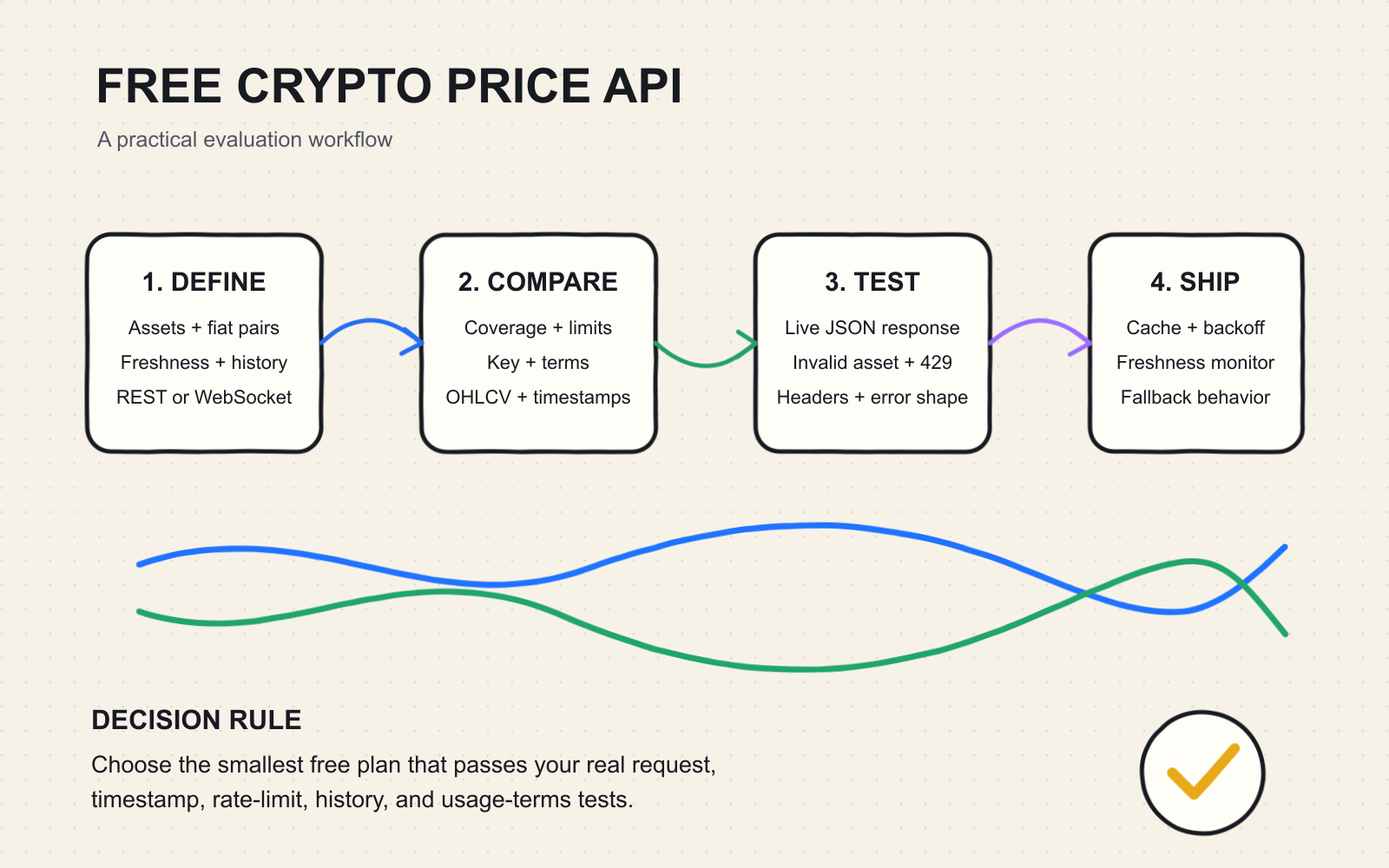
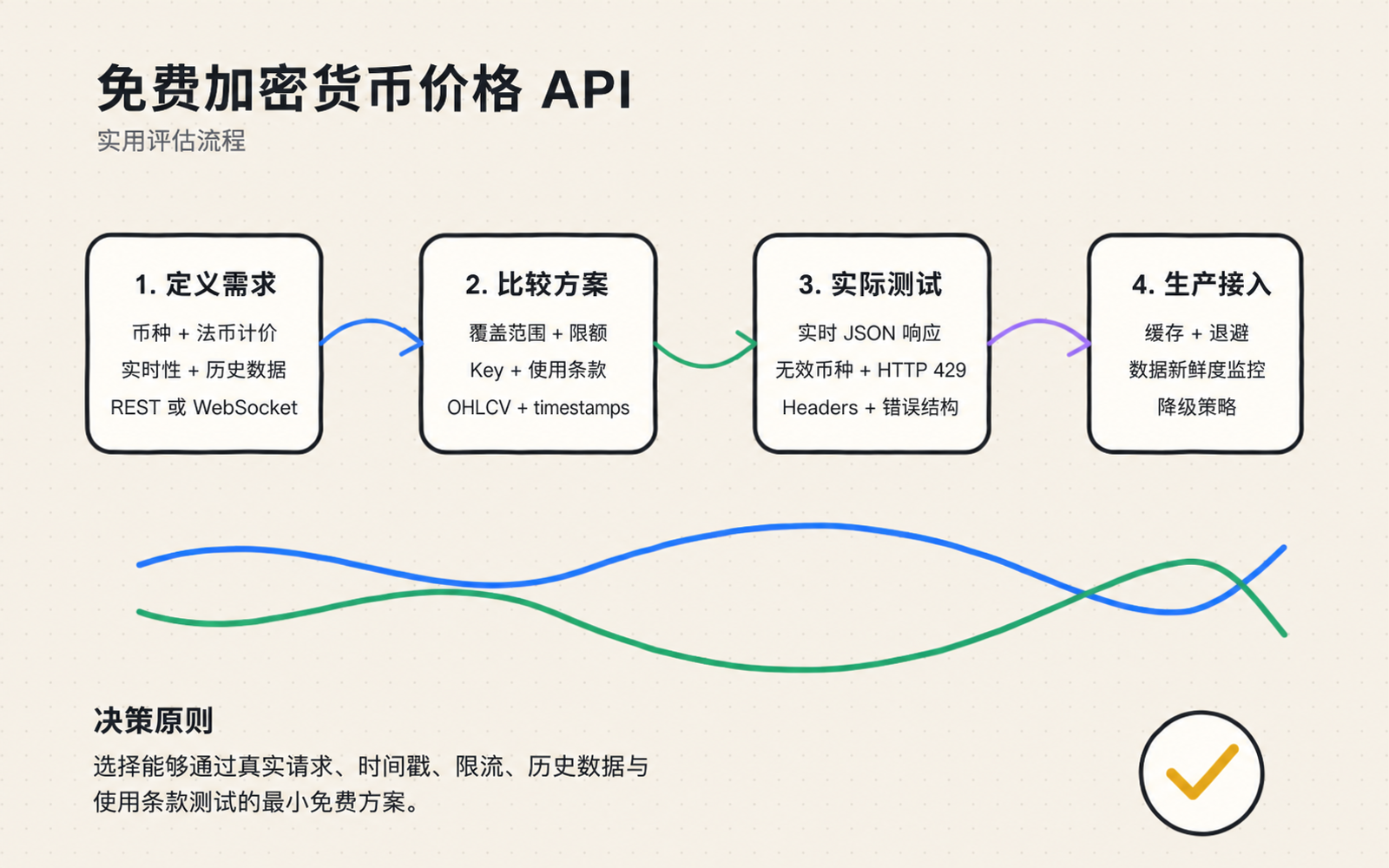
Free crypto price API: what to check first选择免费加密货币价格 API 时先看什么
Confirm the assets, quote currencies, market-cap fields, volume, timestamps, and historical intervals your feature actually needs.
Check requests per minute, monthly credits, attribution, caching rules, and whether commercial use is allowed.
REST suits snapshots and periodic refreshes. WebSocket is better for continuous updates when the free plan includes it.
Run one real request, inspect the timestamp and error shape, then test throttling and an unknown asset.
确认币种、计价货币、市值、成交量、时间戳和历史区间是否覆盖真实功能需求。
检查每分钟请求数、月度额度、署名、缓存规则和商业使用条款。
REST 适合快照和定时刷新;需要持续更新时再确认免费方案是否提供 WebSocket。
运行真实请求,检查时间戳和错误结构,并测试限流与不存在的币种。
Define the crypto market data your app needs先定义应用需要的加密货币行情数据
The phrase “real-time crypto price API” can describe very different products. A portfolio widget may need a cached USD snapshot every minute; an alerting system may need exchange-level timestamps; a backtest needs consistent historical OHLCV rather than only the latest price.
“实时加密货币行情 API”可能对应完全不同的产品需求。资产组合组件也许只需每分钟更新一次美元价格;预警系统要检查交易所级时间戳;回测则需要连续的历史 OHLCV,而不只是最新价格。
Live cryptocurrency price API fields实时加密货币价格接口需要哪些字段
List the symbol or provider ID, quote currency, price, source timestamp, 24-hour change, volume, and market cap. Treat “live” as a claim to verify: compare the response timestamp with the provider's documented update cadence.
列出币种代码或供应商 ID、计价货币、价格、数据源时间戳、24 小时涨跌、成交量和市值。不要只看“实时”标签,应将返回时间戳与官方更新频率对照。
Historical crypto price API depth历史加密货币价格 API 的数据深度
Record the earliest available date, candle interval, timezone, missing-data policy, adjustment rules, and whether OHLCV is included on the free tier. “Historical data available” may still mean a short retention window.
记录最早日期、K 线粒度、时区、缺失值处理、修正规则,以及免费额度是否含 OHLCV。“支持历史数据”不代表免费方案有足够长的回溯区间。
Match the endpoint to the product task根据产品任务选择正确的行情端点
A provider can advertise thousands of assets and still be a poor fit if the endpoint shape does not match your workload. Decide whether the application needs one latest price, a batch market snapshot, exchange-specific trades, candles, or a continuous stream before comparing plans.
供应商即使覆盖数千种资产,如果端点结构不适合你的工作负载,依然不是合适选择。比较方案前,应先明确应用需要单币最新价、批量市场快照、交易所逐笔成交、K 线,还是连续数据流。
| Data task数据任务 | Typical endpoint常见端点 | Important fields关键字段 | Common pitfall常见问题 |
|---|---|---|---|
| Single asset price单币最新价格 | /price/{id} | price, quote, timestamp价格、计价币、时间戳 | Ticker symbols may be ambiguous; many APIs require a provider-specific ID.币种简称可能重复,很多 API 必须使用供应商自己的资产 ID。 |
| Portfolio or dashboard资产组合或仪表盘 | /markets?ids=… | price, change, volume, market cap价格、涨跌、成交量、市值 | Calling once per asset wastes credits when a batch endpoint exists.已有批量端点时逐币调用,会快速消耗免费额度。 |
| Historical chart历史走势图 | /market_chart / /ohlcv | open, high, low, close, volume, interval开高低收、成交量、时间粒度 | Free retention and interval granularity may change with the requested range.免费回溯长度和数据粒度可能随查询区间变化。 |
| Price alert价格提醒 | REST polling or WebSocket tickerREST 轮询或 WebSocket ticker | event time, source, reconnect state事件时间、来源、重连状态 | A fast poll can exceed limits; a stream needs heartbeat and reconnect logic.高频轮询容易超限;数据流则必须处理心跳和断线重连。 |
Asset identity matters: “BTC” is usually clear, but smaller tokens can share symbols or exist on several networks. Store provider ID, symbol, contract address, network, and quote currency together.
资产身份非常关键:“BTC”通常没有歧义,但小型代币可能共享简称或部署在多条链上。应同时保存供应商 ID、symbol、合约地址、network 和计价币。
A field named “price” is not a complete market-data definition名为“price”的字段并不等于完整行情定义
| Price type价格类型 | Meaning含义 | Use and limitation用途与限制 |
|---|---|---|
| Bid / ask买价 / 卖价 | Displayed buying and selling interest on one venue, at a stated depth.单一交易场所在特定深度展示的买卖意愿。 | Closest to execution context, but top-of-book size, latency, fees, and slippage still matter.最接近执行语境,但仍需考虑一档数量、延迟、手续费和滑点。 |
| Last trade最新成交价 | The most recent matched trade on the stated market.指定市场最近一笔已经撮合的成交。 | Useful for trade history; it may be older than the current order book or unusually small.适合成交历史,但可能早于当前订单簿,也可能只代表一笔极小成交。 |
| Aggregated spot聚合现货价 | A provider-defined reference combined from selected spot markets.供应商按照既定方法汇总若干现货市场形成的参考值。 | Good for dashboards and valuation reference; not automatically executable on any venue.适合仪表盘和估值参考,但不一定能在任何单一市场成交。 |
| Index / mark price指数价 / 标记价 | A derivatives benchmark or risk-control value derived under venue rules.按衍生品交易场所规则生成的基准或风控价格。 | Used for funding, margin, and liquidation logic; it is not a spot last trade.用于资金费、保证金和强平逻辑,并不是现货最新成交。 |
Worked quote state: a venue reports 62,000 bid, 62,020 ask, and a last trade of 61,980. The top-of-book midpoint is (62,000 + 62,020) ÷ 2 = 62,010, while the quoted spread is 20. The last trade can be lower simply because it occurred earlier; the midpoint is not itself an executed trade; and neither guarantees the price available for a large order. Return field type, venue, event time, received time, quote currency, size or depth where available, and market status with the number.
报价状态示例:某交易场所返回买价 62,000、卖价 62,020,最新成交价为 61,980。一档中间价为 (62,000 + 62,020) ÷ 2 = 62,010,报价点差为 20。最新成交价较低,可能只是因为它发生得更早;中间价本身并不是一笔真实成交;两者也都不能保证大额订单能够按该价格执行。数值必须同时携带字段类型、交易场所、事件时间、接收时间、计价币、可用时的数量或深度,以及市场状态。
Compare free cryptocurrency API options by constraint按约束比较免费数字货币行情 API
Compare coverage, authentication, rate limits, historical depth, REST endpoints, WebSocket availability, and usable code examples together. Provider limits change, so treat the table as a decision framework and verify current official documentation before shipping.
比较方案时,应同时检查币种覆盖、鉴权方式、限流、历史深度、REST 端点、WebSocket 可用性和能否实际运行的代码示例。供应商额度会变化,因此下表只用于建立选型框架;上线前仍须核对当前官方文档。
| Option方案 | Useful for适合场景 | Verify before use使用前核对 | Access pattern接入方式 |
|---|---|---|---|
| CoinGecko API | Broad price, market, metadata, and historical discovery.价格、市场、元数据与历史数据的综合查询。 | Current demo-plan credits, historical depth, attribution, and commercial terms.当前免费额度、历史深度、署名及商业条款。 | REST; key requirements depend on endpoint and plan.REST;是否需要 Key 取决于端点与方案。 |
| CoinLore | Public market snapshots, coin metadata, exchanges, and OHLCV exploration.公共市场快照、币种元数据、交易所与 OHLCV 探索。 | Fair-use guidance, update cadence, field definitions, and production reliability.合理使用建议、更新频率、字段定义与生产可靠性。 | Public REST endpoints.公共 REST 端点。 |
| Exchange public APIs | Venue-specific tickers, order books, candles, and streaming market data.单一交易所的行情、订单簿、K 线与流式数据。 | Symbol format, regional availability, rate limits, and whether the feed is exchange-only.交易对格式、地区可用性、限流及数据是否只代表单一交易所。 | REST plus WebSocket on many exchanges.许多交易所同时提供 REST 与 WebSocket。 |
| QVeris discovery | Finding and inspecting callable market-data capabilities for agents and applications.为 Agent 与应用发现并检查可调用的市场数据能力。 | The selected provider's own limits, terms, data provenance, and response semantics.所选供应商自身的限额、条款、来源与返回语义。 | Capability search and documented calls.能力搜索与文档化调用。 |
Evaluate crypto price data quality, not just price不要只比较价格,还要评估行情数据质量
Two APIs can return different but individually valid prices because they aggregate different exchanges, weight markets differently, exclude low-liquidity pairs, or update on different schedules. The goal is not to find a magical universal price; it is to choose a documented methodology that fits the product.
两个 API 可能返回不同但各自合理的价格,因为它们聚合的交易所、市场权重、低流动性过滤和更新时间不同。目标不是寻找唯一的“绝对价格”,而是选择方法透明、与产品需求匹配的数据源。
Compare source or event time—not only the time your server received the response.比较数据源时间或事件时间,而不仅是服务器收到响应的时间。
Know whether the value comes from one exchange, a volume-weighted aggregate, or an onchain pool.确认数据来自单一交易所、成交量加权聚合,还是链上流动性池。
Thin markets can distort an aggregate. Check how stale or abnormal pairs are removed.低流动性市场会扭曲聚合价,需要了解异常或过期交易对如何被过滤。
Test newly listed and inactive assets. A missing value should not silently become zero.测试新上线与不活跃资产,缺失值不能在业务中被静默转换成零。
Use decimal-safe parsing for very small token prices and large market-cap values.极小代币价格和大额市值应使用安全的十进制解析,避免浮点误差。
Do not assume a fixed 1.00 value when depeg detection or risk monitoring matters.涉及脱锚检测或风险监控时,不能把稳定币价格固定写成 1.00。
Test a free crypto price API with real requests用真实请求测试免费加密货币价格 API
The examples below demonstrate the validation pattern rather than promising a permanent provider limit. Use the current official documentation to confirm the endpoint, authentication requirement, attribution, and production terms.
下面展示的是验证方法,而不是对供应商额度作永久承诺。实际接入前,应以当前官方文档核对端点、鉴权、署名要求和生产使用条款。
REST snapshot with curl使用 curl 获取 REST 行情快照
Request a small payload first and inspect the HTTP status, content type, timestamp, and unit before reading the price.
先请求小型响应,在读取价格前检查 HTTP 状态、Content-Type、时间戳和计价单位。
curl --fail-with-body \
  "https://api.coinlore.net/api/ticker/?id=90"
JavaScript validation with timeout and field checks用 JavaScript 验证超时与关键字段
Treat the upstream response as untrusted input. Check status, shape, numeric parsing, and freshness before returning data to the UI.
把上游响应视为不可信输入。在数据进入界面前,检查状态码、结构、数值解析和新鲜度。
const response = await fetch(endpoint, {
  signal: AbortSignal.timeout(5000)
});
if (!response.ok) throw new Error(`HTTP ${response.status}`);

const payload = await response.json();
const price = Number(payload[0]?.price_usd);
if (!Number.isFinite(price)) throw new Error("Invalid price");
WebSocket lifecycle checklistWebSocket 生命周期检查清单
For streaming feeds, verify subscribe acknowledgements, sequence or event timestamps, heartbeat behavior, reconnect backoff, resubscription, duplicate messages, and the maximum number of symbols per connection.
使用流式行情时,应验证订阅确认、序列号或事件时间、心跳、重连退避、重新订阅、重复消息,以及单连接允许订阅的最大币种数。
How to integrate a free crypto price API safely如何安全接入免费加密货币价格 API
Test a crypto price API without an API key测试无需 API Key 的加密货币价格接口
Start with a provider's documented public endpoint. Save the raw JSON, HTTP status, response headers, timestamp, and any rate-limit headers. A successful browser response is only the first test; also request an invalid symbol and repeat calls until you understand the failure contract.
从供应商文档中的公共端点开始,保存原始 JSON、HTTP 状态、响应头、时间戳和限流信息。浏览器能返回数据只是第一步,还要请求无效币种并重复调用,理解错误与限流约定。
Build for rate limits, caching, and fallbacks为限流、缓存与降级设计
Cache by asset and quote currency, deduplicate concurrent requests, use exponential backoff for 429 responses, and avoid embedding private keys in client-side code. Define what the UI shows when data is stale or unavailable.
按币种与计价货币缓存,合并并发请求,对 429 使用指数退避,并避免把私密 Key 放进前端代码。还要定义数据过期或不可用时界面如何降级。
Keep API keys and provider logic on the server将 API Key 与供应商逻辑保留在服务端
A backend adapter prevents secret exposure, normalizes provider-specific IDs and fields, enforces a shared cache policy, and gives the frontend one stable response contract. Restrict keys by environment and rotate them when a team member or integration changes.
后端适配层可以避免密钥暴露、统一供应商特有的资产 ID 和字段、执行共享缓存策略,并向前端提供稳定的返回约定。应按环境限制 Key,并在成员或集成发生变化时轮换。
Monitor the upstream contract持续监控上游数据约定
Track latency, HTTP status, freshness lag, schema validation failures, missing assets, cache hit rate, and monthly credit use. Alert separately on provider outage, stale-but-successful responses, and a breaking field change.
监控延迟、HTTP 状态、新鲜度滞后、Schema 验证失败、缺失资产、缓存命中率和月度额度使用。供应商中断、返回成功但数据过期、字段破坏性变更应分别告警。
Minimal validation sequence: read the official endpoint documentation → send one request → verify fields and timestamps → test 4xx/429 behavior → add caching → monitor freshness and error rate.
最小验证顺序:阅读官方端点文档 → 发出一次请求 → 核对字段与时间戳 → 测试 4xx/429 → 添加缓存 → 监控新鲜度与错误率。
Use QVeris to find crypto market data capabilities用 QVeris 查找加密货币行情数据能力
QVeris helps developers and AI agents discover, inspect, and call external capabilities. For this task, it can shorten the path from “I need a crypto price feed” to a documented candidate that can be evaluated against coverage, authentication, limits, and response shape.
QVeris 帮助开发者与 AI Agent 发现、检查和调用外部能力。针对加密行情需求,它可以把“我需要价格数据源”转化为可检查的候选能力,再按覆盖、鉴权、限额和返回结构进行验证。
- Open the QVeris tool details to inspect market-data capabilities rather than hardcoding a provider before requirements are clear.
- Inspect the selected API's parameters and response contract, then validate it directly against official provider documentation.
- Keep provider selection separate from your product logic so a limit or terms change is easier to handle.
- 先用 QVeris tool details 搜索行情能力,不要在需求未明确前写死供应商。
- 检查候选 API 的参数与返回约定,并用供应商官方文档再次验证。
- 将供应商选择与产品逻辑解耦,便于应对限额或条款变化。
Free crypto price API questions免费加密货币价格 API 常见问题
Is there a free crypto price API?
Yes. Several providers offer free plans or public endpoints. Compare coverage, request limits, attribution, historical depth, reliability, and commercial-use terms before choosing one.
Can I get crypto prices without an API key?
Some providers expose keyless endpoints. They are convenient for evaluation, but you still need to review throttling, caching, reliability, and terms before production use.
How do I get real-time crypto prices via API?
Use REST for periodic snapshots or WebSocket for continuous updates. Verify the response timestamp and documented update cadence instead of assuming every “live” feed is tick-level.
Which crypto API is best for historical price data?
Choose by required date range, interval, asset coverage, OHLCV availability, timezone, and free-tier retention. Test the exact historical endpoint with your target assets.
Should I use REST or WebSocket for crypto prices?
Use REST for pages, reports, and refresh intervals measured in seconds or minutes. Use WebSocket when the product needs continuous updates and can correctly handle heartbeat, reconnect, resubscription, and duplicate events.
Can a free crypto API be used in production?
Sometimes, but “free” is not a production guarantee. Confirm commercial-use terms, attribution, uptime expectations, rate limits, support, data licensing, caching rights, and the cost of moving to a paid plan.
有免费的加密货币价格 API 吗?
有。多个供应商提供免费方案或公共端点,但币种覆盖、请求限额、署名、历史深度、可靠性和商业条款不同。
无需 API Key 可以获取加密货币价格吗?
部分供应商提供免 Key 公共接口,适合快速验证;用于生产前仍要核对限流、缓存、可靠性与使用条款。
如何通过 API 获取实时加密货币价格?
定时快照使用 REST,持续更新考虑 WebSocket。必须核对响应时间戳与官方更新频率,不能把所有“实时”都理解为逐笔行情。
哪个 API 更适合历史加密货币价格数据?
根据日期范围、时间粒度、币种覆盖、OHLCV、时区和免费保留期选择,并用目标币种实测具体历史端点。
加密货币价格应该使用 REST 还是 WebSocket?
页面、报表和秒级或分钟级刷新适合 REST;需要连续更新并能正确处理心跳、重连、重新订阅和重复事件时,再使用 WebSocket。
免费加密货币 API 可以用于生产环境吗?
有时可以,但“免费”不等于生产保障。必须核对商业使用、署名、稳定性、限流、支持、数据许可、缓存权利和升级成本。