
Free Cryptocurrency Data API
for Developers免费加密货币数据 API
开发者选型指南
Compare free crypto APIs by live prices, historical OHLCV, coverage, quotas, licensing, and integration fit.
按实时价格、历史 OHLCV、覆盖范围、免费额度、授权与接入方式比较加密货币数据接口。
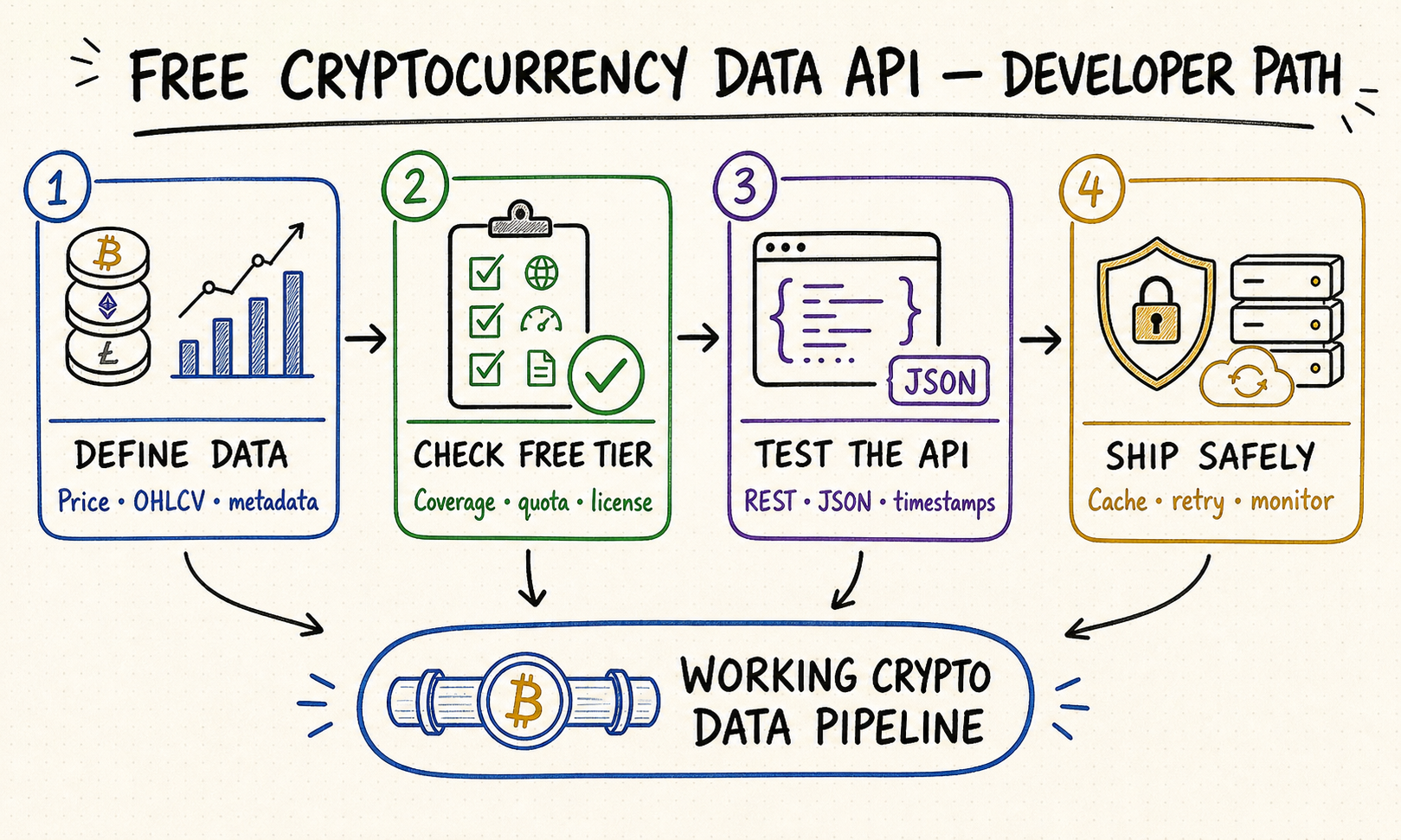
Free cryptocurrency data API: the short answer免费加密货币数据 API:快速结论
Use this page when the product must identify, classify, and describe cryptocurrencies—not when it needs a low-latency order book.
Require provider ID, network, contract address, symbol history, active dates, and migration relationships before joining prices.
Compare names, descriptions, categories, project links, supply fields, market-cap inputs, platform mappings, and status flags.
Keep renamed, migrated, wrapped, deprecated, and delisted assets traceable instead of exposing only today’s survivors.
当产品需要识别、分类和描述加密资产时使用本页;需要低延迟订单簿时应选择行情数据指南。
关联价格前要求供应商 ID、网络、合约地址、代码历史、有效日期和迁移关系。
比较名称、描述、分类、项目链接、供应量、市值输入、平台映射和状态标记。
让更名、迁移、封装、弃用和退市资产仍可追溯,而不是只展示今天仍存续的币种。
How to choose a free cryptocurrency reference-data API如何选择免费加密资产参考数据 API
Start with the catalogue task: asset search, portfolio onboarding, token selector, compliance review, taxonomy, or cross-chain identity. A reference API should answer “what asset is this?” and “how is it related to other representations?” before it answers “what is the latest price?” This page deliberately separates metadata from live trades, order books, and candle delivery.
先确定目录任务:资产搜索、组合录入、代币选择器、合规复核、分类体系或跨链身份。参考数据 API 应先回答“这是什么资产”和“它与其他表示形式有什么关系”,之后才是“最新价格是多少”。本页刻意把元数据与实时成交、订单簿和 K线交付分开。
Resolve assets with durable identifiers
Test provider ID, chain ID, contract address, token decimals, native-versus-token status, symbol aliases, wrapped assets, and migration lineage. Never use a ticker alone as a database key.
Verify taxonomy and descriptive metadata
Inspect categories, tags, project and explorer links, launch dates, status, protocol relationships, sector labels, and localization. Treat provider-written descriptions as editorial data with their own update policy.
Separate reference facts from changing measurements
Identity, contract, and platform mappings change slowly; price, volume, market cap, and supply estimates change continually. Store observation time and methodology for measurements rather than merging them into timeless metadata.
使用持久标识解析资产
测试供应商 ID、链 ID、合约地址、代币精度、原生币或代币状态、代码别名、封装资产和迁移关系。不能只用 ticker 作为数据库主键。
验证分类体系与描述性元数据
检查分类、标签、项目与浏览器链接、上线日期、状态、协议关系、行业标签和本地化。供应商编写的描述属于编辑内容,也应有更新政策。
区分参考事实与动态测量值
身份、合约和平台映射变化较慢,价格、成交量、市值和供应量估算持续变化。动态测量值必须保存观测时间和方法,不能与静态元数据混为一谈。
Turn the product requirement into an API acceptance test把产品需求转成 API 验收测试
| Requirement需求 | Measurable acceptance test可量化验收条件 | Evidence to save应保存的证据 |
|---|---|---|
| Asset coverage资产覆盖 | Every required asset resolves to a stable provider ID and expected network.每个必需资产都能映射到稳定的供应商 ID 和预期网络。 | ID mapping sample and unresolved-asset list.ID 映射样本与未解析资产清单。 |
| Freshness数据时效 | Source timestamp stays within the product’s declared stale-data threshold.源时间戳始终处于产品声明的过期阈值以内。 | Observed source time, fetch time, and cache headers.源时间、抓取时间和缓存响应头。 |
| Quota fit额度适配 | Estimated daily calls, retries, and background jobs remain below the usable allowance.预计日调用、重试和后台任务低于实际可用额度。 | Request budget and current official plan URL.请求预算与当前官方套餐链接。 |
| Failure behavior失败行为 | Timeouts, 429s, invalid symbols, and server errors produce bounded retries and explicit states.超时、429、无效代码和服务端错误会触发有限重试与明确状态。 | Recorded error responses and retry logs.错误响应样本和重试日志。 |
Cryptocurrency reference fields a free API may expose免费加密资产参考 API 可能提供的字段
Reference data turns inconsistent token names and symbols into an asset catalogue that applications can search and join. Evaluate field completeness, identity stability, lifecycle history, provenance, localization, and update cadence—not trading latency. A provider can be excellent for token discovery even if it does not offer executable quotes.
参考数据把不一致的代币名称和代码整理成可搜索、可关联的资产目录。评估重点应是字段完整性、身份稳定性、生命周期历史、来源、本地化和更新频率,而不是交易延迟。即使不提供可成交报价,供应商也可能非常适合代币发现。
Reference-data acceptance test: give the API a symbol collision, a token that migrated contracts, a wrapped representation, a native chain asset, and a deprecated project. A strong response resolves each to a durable identity, exposes relationships, and states which representation is active. A weak response returns five unrelated rows with the same ticker and leaves the client to guess.
参考数据验收测试:向接口提交代码冲突、已迁移合约的代币、封装资产、链原生资产和已停止项目。优秀响应应把它们解析为持久身份、展示相互关系,并说明哪个表示形式仍然有效;较弱响应只会返回多个同代码结果,把判断留给客户端。
For search and onboarding, support aliases and localized names but return one canonical identifier. For compliance and portfolio records, retain the exact network and contract selected by the user. For market-cap screens, keep supply methodology and observation time alongside the reference record. These workflows share a catalogue but should not collapse project identity, token contract, and market instrument into one object.
用于搜索和录入时,可以支持别名与本地化名称,但必须返回唯一规范标识。用于合规和组合记录时,要保存用户选择的具体网络与合约。用于市值筛选时,应在参考记录旁保存供应量方法和观测时间。这些流程共用同一目录,却不能把项目身份、代币合约和市场工具压成一个对象。
Canonical identity
Stable provider ID, canonical name, current and former symbols, aliases, native asset or token status, and active or deprecated state.
Network and contract mapping
Chain ID, network name, contract address, decimals, token standard, explorer URL, bridges, wrapped versions, and migration targets.
Project metadata
Official site, documentation, repositories, whitepaper, organization links, description, launch date, country, and maintained social channels.
Taxonomy
Sector, use case, ecosystem, protocol type, tags, related assets, platform relationships, and provider-specific category definitions.
Supply reference
Maximum, total, and circulating supply with observation time, methodology, units, unlock context, burns, and redenomination history.
Lifecycle and status
Launch, migration, contract replacement, merge, fork, delisting, abandonment, warnings, and dates when each representation was valid.
规范身份
稳定供应商 ID、规范名称、当前与历史代码、别名、原生币或代币状态,以及活跃或弃用状态。
网络与合约映射
链 ID、网络名称、合约地址、精度、代币标准、浏览器链接、跨链桥、封装版本和迁移目标。
项目元数据
官网、文档、代码仓库、白皮书、组织链接、项目描述、上线日期、国家和仍在维护的社交渠道。
分类体系
行业、用途、生态、协议类型、标签、相关资产、平台关系和供应商自定义分类。
供应量参考
最大、总量与流通供应量,并附观测时间、方法、单位、解锁背景、销毁和面额调整历史。
生命周期与状态
上线、迁移、合约替换、合并、分叉、退市、项目停止、风险提示及各表示形式的有效日期。
Choose a provider by reference-data responsibility按参考数据职责选择供应商
A cryptocurrency catalogue is not just a list of tickers. Decide whether the system must identify projects, blockchain deployments, exchange listings, or all three. Then test whether the provider preserves relationships and lifecycle events instead of flattening them into one asset row.
加密资产目录并不只是 ticker 列表。应先明确系统要识别的是项目、区块链部署、交易所上市市场,还是三者全部;再测试供应商能否保留它们之间的关系与生命周期事件,而不是把所有信息压成一行资产记录。
| Registry job目录任务 | Provider type供应商类型 | Required relationship必须保留的关系 | Acceptance check验收检查 |
|---|---|---|---|
| Project catalogue项目目录 | Aggregated asset-reference API聚合资产参考 API | Project ↔ provider ID ↔ aliases项目 ↔ 供应商 ID ↔ 别名 | Renames do not create a new project.更名不会错误创建新项目。 |
| Token registry代币注册表 | Chain-aware token API链感知代币 API | Network ↔ contract ↔ decimals网络 ↔ 合约 ↔ 精度 | Same symbol on two chains remains distinct.同代码跨链部署仍保持区分。 |
| Exchange mapping交易所映射 | Exchange reference API交易所参考 API | Asset ↔ venue asset ID ↔ market资产 ↔ 场所资产 ID ↔ 市场 | Delisted and renamed markets remain traceable.下架和更名市场仍可追踪。 |
| Lifecycle monitoring生命周期监控 | Versioned metadata or event feed版本化元数据或事件源 | Old contract ↔ migration ↔ successor旧合约 ↔ 迁移 ↔ 后继资产 | Migration keeps effective date and conversion rule.迁移保留生效日期与兑换规则。 |
| Compliance enrichment合规信息补充 | Curated metadata provider人工校验元数据供应商 | Identity ↔ issuer/project ↔ evidence身份 ↔ 发行方/项目 ↔ 证据 | Every label has source and review time.每个标签都有来源与复核时间。 |
Identity rule: ticker and display name are search hints, not primary keys. Use an internal asset ID linked to provider IDs, chain ID, normalized contract address, and effective-dated aliases.
身份规则:ticker 和展示名称只能作为搜索线索,不能充当主键。内部资产 ID 应关联供应商 ID、链 ID、标准化合约地址和带生效日期的别名。
Measure change volume, not only request volume除了请求量,还要衡量变更量
Reference data changes less often than prices but each change can affect joins across a portfolio, watchlist, tax lot, or compliance record. Estimate full-catalogue downloads, incremental updates, alias resolution, nightly reconciliation, and historical snapshot retention. Prefer a change feed or updated-since filter when it preserves deletion and migration events.
参考数据更新频率低于价格,但一次变化可能影响投资组合、自选列表、税务批次或合规记录中的大量关联。应估算全目录下载、增量更新、别名解析、夜间对账和历史快照留存成本。若增量接口能保留下架和迁移事件,应优先使用 change feed 或 updated-since 过滤。
Cryptocurrency reference-data comparison checklist加密资产参考数据 API 对比清单
| Criterion维度 | Verify核验内容 | Why it matters重要性 | Common trap常见误区 |
|---|---|---|---|
| Identity uniqueness身份唯一性 | Stable asset ID, chain ID, contract address, provider IDs.稳定资产 ID、链 ID、合约地址、供应商 ID。 | Prevents symbol collisions and false merges.避免代码冲突和错误合并。 | Symbol is documented as the primary key.把 symbol 当作主键。 |
| Entity model实体模型 | Project, native asset, token deployment, wrapped asset, listing.项目、原生资产、代币部署、包装资产、上市市场。 | Keeps economic and technical identity separate.区分经济身份与技术部署。 | Every contract is treated as a new unrelated coin.把每个合约都当作无关新币。 |
| Lifecycle history生命周期历史 | Launch, rename, migration, fork, deprecation, delisting dates.上线、更名、迁移、分叉、停用、下架日期。 | Supports historical joins and customer holdings.支持历史关联与客户持仓延续。 | The latest record overwrites every prior state.最新记录覆盖全部旧状态。 |
| Supply semantics供应量口径 | Decimals, total, circulating, max supply, source and time.精度、总量、流通量、最大量、来源和时间。 | Market cap and ownership calculations depend on it.市值和持仓计算依赖该口径。 | Zero, null, and unlimited supply are conflated.混淆零值、空值与无限供应。 |
| Provenance and review来源与复核 | Field source, observed time, reviewed time, confidence.字段来源、观测时间、复核时间、置信状态。 | Explains disagreements and stale metadata.解释来源冲突和陈旧元数据。 | All metadata is presented as timeless fact.把所有元数据当成永恒事实。 |
Build a versioned cryptocurrency asset registry构建带版本的加密资产注册表
1. Create internal project and asset IDs
Assign immutable internal keys. Store provider IDs as mappings, not as the only identity, so a vendor merge or rename does not rewrite application history.
2. Separate network deployments
Represent chain ID, normalized contract address, token decimals, native or token status, and deployment dates in a child table. The same project can have several legitimate deployments.
3. Resolve aliases with effective dates
Store symbol, name, former names, and venue-specific codes as time-bounded aliases. Search can use them, but joins should resolve to the immutable asset record.
4. Record lifecycle events
Model migrations, swaps, forks, wrapping, redenominations, deprecations, and delistings as events with source evidence and effective time rather than destructive updates.
5. Version snapshots and incremental changes
Hash raw responses, keep retrieved-at time, and compare each load with the prior snapshot. Distinguish deletion, temporary omission, provider merge, and genuine asset retirement.
6. Send uncertain matches to review
Quarantine symbol-only matches, chain mismatches, changed decimals, conflicting contract ownership, and implausible supply changes. Do not let an automated match silently merge customer assets.
1. 建立内部项目与资产 ID
分配不可变内部主键,把供应商 ID 保存为映射,而不是唯一身份。这样供应商合并或更名时不会重写应用历史。
2. 分离不同网络部署
在子表中保存链 ID、标准化合约地址、代币精度、原生币或代币状态和部署日期。同一项目可以拥有多个真实部署。
3. 使用生效日期解析别名
把代码、名称、旧名称和交易所专用代码保存为有时间边界的别名。搜索可以使用别名,但数据关联必须落到不可变资产记录。
4. 记录生命周期事件
把迁移、兑换、分叉、包装、重新计价、停用和下架记录为带来源证据与生效时间的事件,而不是直接覆盖旧值。
5. 保存快照版本与增量变化
对原始响应计算校验值并保存抓取时间,每次加载都与上一快照比较,区分删除、临时遗漏、供应商合并和真实资产退出。
6. 把不确定匹配交给人工复核
隔离仅凭代码匹配、链不一致、精度变化、合约归属冲突和异常供应量变化,不能让自动匹配静默合并客户资产。
Minimum JSON fields to preserve建议保留的最小 JSON 字段
| Field group字段组 | Recommended values建议值 | Validation rule校验规则 |
|---|---|---|
| Asset identity资产身份 | Internal ID, provider IDs, canonical name, effective aliases.内部 ID、供应商 ID、规范名称、生效别名。 | Do not use symbol or display name as a unique key.不能用代码或展示名称作为唯一键。 |
| Deployment链上部署 | Chain ID, contract address, decimals, token standard, status.链 ID、合约地址、精度、代币标准、状态。 | Normalize addresses according to the chain, not one global rule.应按各链规则标准化地址,不能使用全局单一规则。 |
| Lifecycle生命周期 | Valid-from/to, predecessor, successor, event type, conversion ratio.生效起止、前身、后继、事件类型、兑换比例。 | Preserve history after migrations, forks, and redenominations.迁移、分叉和重新计价后仍保留历史。 |
| Provenance来源 | Provider, endpoint, retrieved time, field source, raw hash.供应商、端点、抓取时间、字段来源、原始校验值。 | Retain enough evidence to reproduce every identity decision.保留足够证据以复现每次身份判断。 |
The registry should answer “what was this asset at that time?” as well as “what is it called now?” Keep current lookup fast, but derive it from versioned identity, deployment, alias, and lifecycle tables.
资产注册表既要回答“它现在叫什么”,也要回答“它在当时是什么”。当前查询可以保持高效,但结果应来自带版本的身份、部署、别名和生命周期表。
Use QVeris to inspect cryptocurrency reference capabilities用 QVeris 检查加密资产参考数据能力
QVeris helps developers and agents discover callable asset-search, token-metadata, chain, contract, and market-mapping capabilities and inspect their input contracts. The consuming application remains responsible for identity reconciliation and historical versioning.
QVeris 帮助开发者和 Agent 发现可调用的资产搜索、代币元数据、链、合约和市场映射能力,并检查输入契约;身份对账和历史版本管理仍由消费端应用负责。
- Open the QVeris tool details by identity task: resolve a symbol, inspect a contract, list deployments, or map a venue asset.
- Inspect whether chain, contract, provider ID, effective date, and provenance are required or returned.
- Route ambiguous results to review instead of letting an agent choose the first name match.
- 在 QVeris 工具详情中按身份任务搜索,例如解析代码、检查合约、列出部署或映射交易所资产。
- 检查输入输出是否包含链、合约、供应商 ID、生效日期和来源信息。
- 歧义结果应进入复核流程,不能让 Agent 直接选择第一个同名匹配。
FAQ
How should a crypto asset be uniquely identified?
Use an internal asset ID plus provider IDs and, for tokens, chain ID and normalized contract address. A ticker symbol or display name is not globally unique.
Are a project, coin, token contract, and exchange listing the same entity?
No. One project can have a native asset, several token deployments, wrapped versions, and many venue listings. Model those relationships explicitly.
How should token migrations be stored?
Keep the old and new contracts, effective date, migration type, conversion ratio when applicable, source evidence, and a link between predecessor and successor.
Why is ticker matching unsafe?
Unrelated assets can share a symbol, and one asset can change symbols or use different venue codes. Resolve with IDs, chain, contract, issuer/project context, and time.
Can free reference data be used in production?
Only after testing coverage, lifecycle updates, deletion behavior, provenance, licensing, quotas, monitoring, and a process for ambiguous identity changes.
怎样唯一识别一个加密资产?
使用内部资产 ID 和供应商 ID;对于代币,还必须保存链 ID 与标准化合约地址。ticker 或展示名称都不是全局唯一标识。
项目、原生币、代币合约和交易所上市是同一个实体吗?
不是。同一项目可能拥有原生资产、多个链上部署、包装版本和许多交易所市场,这些关系需要分别建模。
代币迁移应该怎样保存?
保留新旧合约、生效日期、迁移类型、适用时的兑换比例、来源证据,以及前身与后继资产之间的关联。
为什么不能只用 ticker 匹配资产?
无关资产可能使用相同代码,同一资产也可能更名或在不同场所使用不同代码。必须结合 ID、链、合约、项目背景和时间解析。
免费参考数据可以用于生产吗?
需要先验证覆盖、生命周期更新、删除行为、来源、许可、额度与监控,并建立处理身份歧义和重大变更的流程。