
Free Currency Exchange Rate API
Selection and Integration Guide免费货币汇率 API
选择、测试与接入指南
Find a free currency exchange rate API, compare keys, quotas, freshness, coverage, and data rights, then test JSON with Python or JavaScript before production.
查找免费货币汇率 API,比较免 Key、额度、更新频率、人民币覆盖、历史数据与许可,并用 Python 或 JavaScript 测试 JSON 后再接入生产。
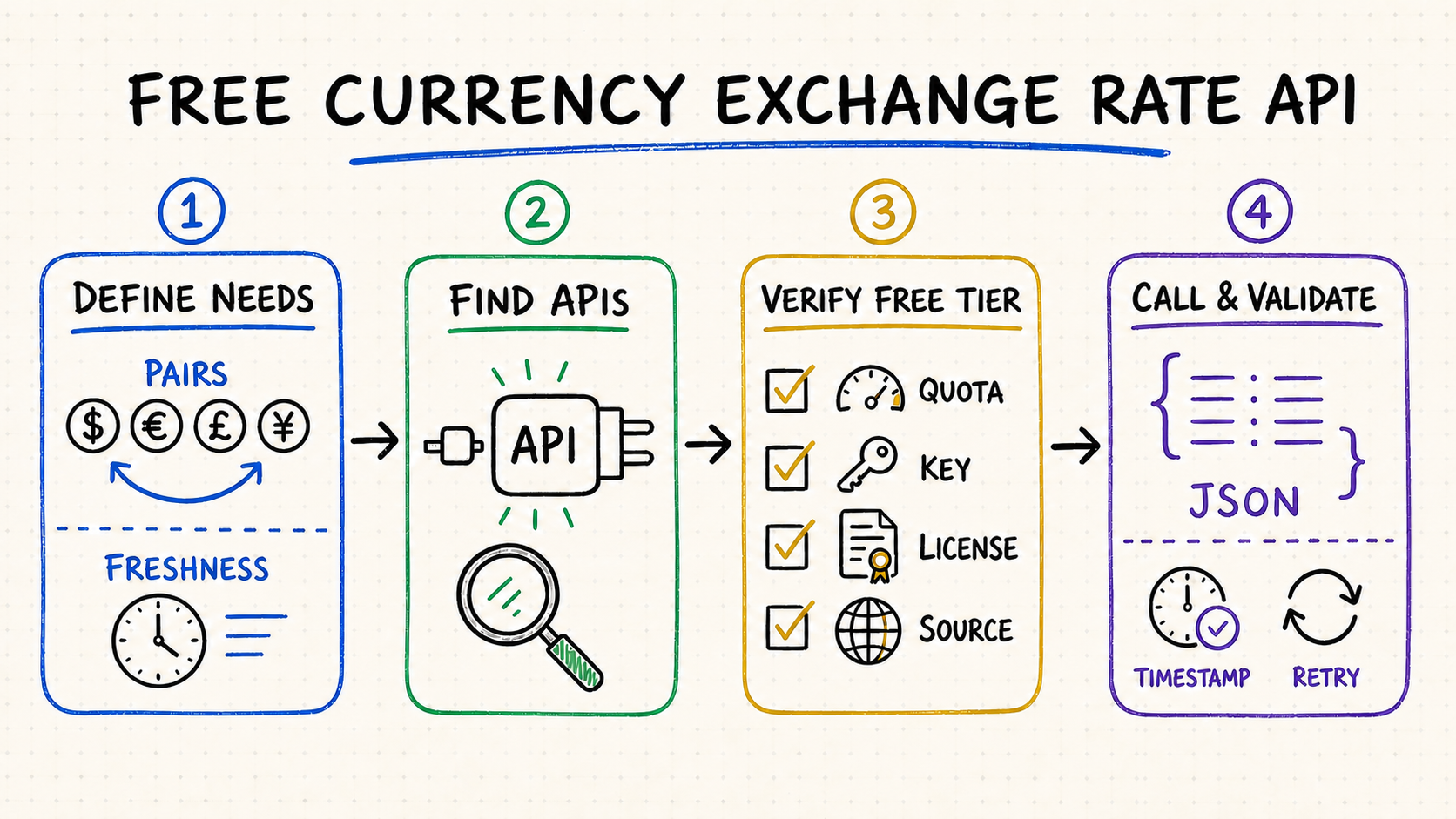
Free currency exchange rate API: what to check first免费货币汇率 API:先检查哪些条件
A useful free currency exchange rate API exposes a documented HTTPS endpoint, identifies the base and quote currencies, returns a source timestamp, and explains its source, update frequency, quota, authentication, license, and error behavior. “Free” can mean a public endpoint, a limited plan, or a trial, so verify the current documentation before building a dependency.
可用的免费货币汇率接口应提供有文档的 HTTPS 端点,明确基准币与目标币,返回来源时间,并说明数据来源、更新频率、额度、认证、许可和错误结构。“免费”可能指公共端点、限额套餐或试用,因此建立依赖前必须核对最新文档。
| Need需求 | Verify检查 | Common mismatch常见错配 |
|---|---|---|
| Current conversion当前换算 | Latest timestamp and base rules最新时间与基准币规则 | Daily reference rate presented as live把日频参考价当成实时价 |
| App or dashboard应用或看板 | Quota, CORS, caching, status page额度、CORS、缓存与状态页 | Trial mistaken for a permanent free tier把试用当成长期免费层 |
| Trading use交易用途 | Bid/ask, latency, venue, license买卖价、延迟、场所与许可 | Midpoint used as an executable quote把中间价当成可成交报价 |
Start with the business conversion rule, not the API brand先确定业务换算规则,再选择 API 品牌
Reference conversion is different from a tradable forex quote参考换算不同于可成交的外汇报价
This page targets invoices, multi-currency displays, checkout estimates, budgeting, expense normalization, and internal reporting. Those workflows usually need a defensible reference rate and a clear effective date—not a millisecond feed. If the application must show bid, ask, spread, venue, or tick-by-tick changes, use a forex-quote or live-market-data interface designed for that operational requirement.
本页适用于发票换算、多币种展示、结账估算、预算、费用归一化和内部报表。这些工作流通常需要来源可解释的参考汇率与明确的生效日期,而不是毫秒级行情。若应用必须展示买价、卖价、点差、交易场所或逐笔变化,就应改用面向外汇报价或实时行情的接口。
Define the accounting date, source policy, and rounding owner明确记账日期、来源政策与舍入责任
Specify whether a transaction uses the order time, settlement date, invoice date, month-end close, or the latest available business day. Decide whether finance chooses one approved source or allows a fallback. Store the original amount and currency, normalized rate direction, effective date, source identifier, converted amount, decimal precision, and rounding rule so the result can be audited later.
应明确交易采用下单时间、结算日、开票日、月末关账日,还是最近可用工作日的汇率;还要决定财务是否固定一个批准来源,或允许备用来源。保存原始金额与币种、标准化汇率方向、生效日期、来源标识、换算金额、小数精度和舍入规则,才能在之后复核。
Currency support includes lifecycle and non-trading cases币种覆盖还包括生命周期与非交易场景
Check not only a supported-currency list but also obsolete codes, redenominations, pegged currencies, special accounting units, and dates before a currency entered circulation. Normalize against ISO 4217, while retaining the provider’s raw identifier. A conversion service should return a clear error for an unsupported historical date rather than silently applying today’s rate.
不要只检查支持币种列表,还要关注废止代码、货币重估、锚定币种、特殊记账单位,以及某币种正式流通前的日期。可依据 ISO 4217 统一标识,同时保留供应商原始代码。遇到不支持的历史日期时,换算服务应明确报错,不能静默套用今天的汇率。
Compare exchange-rate APIs against a reproducible conversion record用可复现的换算记录比较汇率 API
| Criterion维度 | Question问题 | Evidence to keep保留证据 |
|---|---|---|
| Effective date生效日期 | Which business date does the returned rate represent?返回汇率代表哪个工作日? | Requested date, effective date, source timestamp请求日期、生效日期与来源时间 |
| Rate policy汇率政策 | Official fixing, daily average, close, or provider midpoint?官方定盘、日均、收盘还是供应商中间价? | Methodology and finance approval方法说明与财务批准记录 |
| Conversion math换算计算 | Is pair direction explicit and precision sufficient?币种对方向是否明确,精度是否足够? | Raw rate, normalized rate, formula, precision原始汇率、标准化汇率、公式与精度 |
| Calendar rules日历规则 | What happens on weekends, holidays, and missing dates?周末、节假日和缺失日期如何处理? | Fallback date and reason code回退日期与原因码 |
| Auditability可审计性 | Can the same result be reproduced after close?关账后能否复现相同结果? | Immutable conversion record and terms snapshot不可变换算记录与条款快照 |
Why predictable daily data can be better than nominally live data为什么稳定的日频数据有时优于名义上的实时数据
Accounting and reporting systems value consistency more than maximum update speed. A documented daily reference series with stable historical revisions can be safer than an opaque “live” rate that changes during reconciliation. Match refresh frequency to the business event: refresh a product display regularly, but freeze the exact rate used for an invoice or booked transaction.
会计与报表系统通常更看重一致性,而不是最高更新速度。具有明确方法和稳定历史修订规则的日频参考序列,可能比对账期间不断变化但来源不透明的“实时汇率”更安全。刷新频率应与业务事件匹配:商品展示可以定期更新,但发票或已入账交易必须冻结实际采用的汇率。
Match a free exchange rate API to your use case按使用场景选择免费货币汇率 API
The same API is rarely ideal for every workflow. A checkout display, monthly accounting close, travel calculator, and trading dashboard have different requirements for freshness, rate type, history, availability, and licensing. Start with the decision you need to support, then reject providers whose data contract cannot satisfy it.
同一个接口很少能同时适合所有工作流。结账页展示、月末会计核算、旅行换算器和交易看板,对时效、汇率类型、历史范围、可用性与许可的要求不同。应先确定需要支持的业务决策,再排除数据契约不符合要求的供应商。
| Use case场景 | Minimum data requirement最低数据要求 | Important checks重点检查 |
|---|---|---|
| E-commerce display电商价格展示 | Current reference or midpoint rates当前参考价或中间价 | Cache duration, rounding, disclosure, fallback缓存时间、舍入、说明与回退 |
| Accounting and invoices会计与发票 | Dated observations and reproducible source指定日期观测与可复现来源 | Business-day rules, timezone, audit trail工作日规则、时区与审计链 |
| Travel converter旅行换算器 | Broad currency coverage and simple conversion广泛币种覆盖与简单换算 | Offline cache, rate age, fee disclaimer离线缓存、汇率时效与费用说明 |
| Analytics and backtesting分析与回测 | Historical series with stable identifiers稳定标识的历史时间序列 | Revisions, missing dates, bulk limits, precision修订、缺失日期、批量限制与精度 |
| Trading interface交易界面 | Venue-specific bid/ask with low latency特定场所的低延迟买卖价 | Entitlements, latency, spread, executable status授权、延迟、点差与可成交性 |
Daily reference rates are often enough日频参考汇率何时已经足够
Reporting, educational tools, approximate price displays, and low-frequency budgeting may not benefit from minute-level calls. A transparent daily source can be more appropriate than an opaque feed described as “real time.” Align refresh frequency with the business decision instead of selecting the fastest label.
报表、教学工具、近似价格展示和低频预算通常不需要分钟级调用。来源透明的日频数据可能比口径不清的“实时”数据更合适。刷新频率应匹配业务决策,而不是只选择宣传中最快的接口。
When a free plan is only suitable for prototyping免费套餐何时只适合原型验证
Treat a free tier as a prototype option when it lacks a service commitment, provides no predictable error or quota headers, forbids the intended commercial use, or cannot retain the historical range your application needs. Document an upgrade or replacement path before the integration becomes difficult to change.
如果免费层没有服务承诺、缺少可预测的错误或额度响应头、禁止预期商用方式,或无法提供应用所需的历史范围,就应只把它用于原型验证。在接入难以替换前,应记录升级或更换方案。
Choose the right exchange rate data source and rate type选择正确的货币汇率数据源与汇率类型
API features are only useful when the underlying rate matches the job. Before comparing request limits or SDKs, identify whether the provider returns an official reference series, an aggregated midpoint, a delayed market snapshot, or venue-specific bid and ask prices. Two valid APIs can disagree because they observe different markets, fixing times, contributors, and calculation rules.
只有底层汇率口径符合任务,API 功能才有意义。比较请求额度或 SDK 前,应先确认供应商返回的是官方参考序列、聚合中间价、延迟市场快照,还是特定交易场所的买卖价。两个都有效的接口可能因为市场、定盘时间、报价来源和计算规则不同而出现差异。
| Source type来源类型 | What it represents代表什么 | Suitable uses适合场景 | Watch for注意事项 |
|---|---|---|---|
| Central-bank reference央行参考汇率 | A scheduled official fixing or reference value按计划发布的官方定盘或参考值 | Reporting, statistics, reconciliation报表、统计、对账 | Business-day schedule and limited intraday freshness工作日发布,盘中时效有限 |
| Aggregated midpoint聚合中间价 | A calculated value from one or more contributors由一个或多个报价来源计算的数值 | Displays, estimates, general conversion展示、估算、通用换算 | Methodology, source disclosure, and delay计算方法、来源披露与延迟 |
| Market bid and ask市场买价与卖价 | Observable quotes at a stated venue or feed指定场所或数据源的可观察报价 | Trading analysis and valuation交易分析与估值 | Latency, entitlement, spread, and redistribution延迟、授权、点差与再分发 |
| Derived cross rate推导交叉汇率 | A pair calculated through an intermediate currency通过中间币种计算得到的币种对 | Broad pair coverage扩展币种对覆盖 | Rounding, path choice, and source consistency舍入、计算路径与来源一致性 |
Midpoint, bid, ask, open, high, low, and close中间价、买价、卖价与 OHLC
A single rate field is ambiguous unless the documentation defines it. A trading-oriented feed may provide bid, ask, midpoint, and OHLC values for an interval, while a conversion API may expose one reference value. Store the rate type with every observation so downstream code does not treat a midpoint as an executable price.
如果文档没有定义,单独一个 rate 字段存在歧义。交易类数据源可能提供买价、卖价、中间价以及某个周期的 OHLC,而换算接口可能只返回一个参考值。应为每条观测保存汇率类型,避免下游代码把中间价当成可成交价格。
Base currency restrictions and cross-rate calculations基准币限制与交叉汇率计算
Some free plans allow only one base currency. Converting through that base can expand coverage, but it introduces two observations, extra rounding, and a dependency on consistent timestamps. Record whether a pair was supplied directly or derived, the calculation path, and the precision used.
部分免费套餐只允许一个基准币。通过该基准币换算可以扩大覆盖,但会引入两条观测、额外舍入,并依赖时间戳一致性。应记录币种对是直接返回还是推导得到、计算路径以及采用的精度。
Test a free currency exchange rate API JSON response测试免费货币汇率 API 的 JSON 响应
Provider-neutral latest-rates request与供应商无关的最新汇率请求
GET /latest?base=USD&symbols=EUR,JPY
Accept: application/json

{
  "base": "USD",
  "timestamp": "SOURCE_TIMESTAMP",
  "rates": {
    "EUR": "RATE_VALUE",
    "JPY": "RATE_VALUE"
  }
}
The endpoint and values are placeholders, not claims about a provider or current market rates. Replace them with the selected API documentation, then verify direction, timestamp, numeric type, missing symbols, and error behavior.
端点与数值均为占位示例,不代表任何供应商或当前市场汇率。请按选定接口文档替换,并校验方向、时间戳、数值类型、缺失币种和错误行为。
Python and JavaScript exchange rate API examplesPython 与 JavaScript 汇率 API 示例
# Python
import requests
data = requests.get(API_URL, timeout=10).json()
rate = data["rates"]["EUR"]

// JavaScript
const response = await fetch(API_URL);
if (!response.ok) throw new Error(`HTTP ${response.status}`);
const data = await response.json();
const rate = data.rates.EUR;
# Python:设置超时并解析 JSON
data = requests.get(API_URL, timeout=10).json()
// JavaScript:先检查 HTTP 状态
if (!response.ok) throw new Error(`HTTP ${response.status}`);Keep the API URL and credentials in configuration, validate the response schema, and never expose a private key in browser-side JavaScript. For a keyless endpoint, still apply caching and rate-limit handling.
应把 API URL 与凭证放在配置中,校验响应结构,且不要在浏览器端 JavaScript 暴露私密 Key。即使使用免 Key 端点,也要处理缓存与调用频率限制。
Fields a production response should make unambiguous生产响应中应明确的字段
| Field字段 | Validation校验要求 |
|---|---|
base / quote | Valid currency identifiers with an explicit pair direction有效币种标识,并明确币种对方向 |
rate / rates | Positive decimal values with a documented rate type and precision正数十进制值,并说明汇率类型和精度 |
timestamp | Source observation time, timezone, and freshness—not only server response time来源观测时间、时区与时效,而不只是服务器响应时间 |
source | Provider or methodology identifier sufficient for provenance足以追溯来源的供应商或方法标识 |
success / error | Machine-readable error code, message, and retry classification机器可读错误码、消息与是否可重试分类 |
Integration checklist for a free currency API免费货币汇率接口接入清单
- Validate base and quote codes before sending the request.
- Set an explicit timeout and handle 4xx, 5xx, and rate-limit responses separately.
- Store the source timestamp, retrieval time, provider, and raw response checksum.
- Use decimal arithmetic and make cache or database writes idempotent.
- Alert on stale timestamps, schema changes, missing pairs, and quota exhaustion.
- 发送请求前校验基准币与目标币代码。
- 设置明确超时,分别处理 4xx、5xx 与限频响应。
- 保存来源时间、抓取时间、供应商与原始响应校验值。
- 使用十进制运算,并让缓存或数据库写入具备幂等性。
- 对陈旧时间戳、结构变化、缺失币种对与额度耗尽告警。
Build a reliable currency conversion workflow构建可靠的货币换算工作流
Normalize rates into one internal contract把不同汇率响应统一成内部数据契约
Provider responses often use different field names and pair directions. Normalize them into a record containing base, quote, rate, rateType, observedAt, retrievedAt, source, and isDerived. Downstream code can then change providers without rewriting every calculation.
不同供应商经常使用不同字段名和币种对方向。可统一为包含 base、quote、rate、rateType、observedAt、retrievedAt、source 与 isDerived 的记录,使下游在更换供应商时不必重写全部计算。
Use decimal arithmetic and explicit rounding使用十进制运算并明确舍入规则
Binary floating-point can introduce visible errors in financial totals. Use a decimal library or integer minor units, define the calculation precision separately from display precision, and apply the correct currency-specific minor-unit rules. Store the unrounded rate when an audit trail must reproduce a result.
二进制浮点数可能在财务合计中产生可见误差。应使用十进制库或最小货币单位,分别定义计算精度与展示精度,并应用对应币种的小数位规则。需要复现计算时还应保存未舍入汇率。
Handle weekends, holidays, and missing historical dates处理周末、节假日与历史日期缺失
A dated endpoint may return no observation for a weekend or market holiday. Decide whether the application should reject the date, use the previous published observation, or follow a documented accounting convention. Never shift dates silently: retain both the requested date and the observation date.
按日期查询的端点在周末或市场节假日可能没有观测值。应用应明确选择拒绝该日期、使用前一发布日数据,或遵循既定会计规则;不能静默移动日期,并应同时保存请求日期与实际观测日期。
Test failure paths before launch上线前测试失败路径
Test invalid currency codes, reversed pairs, empty rate objects, stale timestamps, malformed numbers, 401/403 authentication failures, 429 quota responses, 5xx errors, timeouts, and schema changes. Confirm that the interface shows the data age and does not silently reuse an old value as if it were current.
应测试无效币种代码、反向币种对、空汇率对象、陈旧时间戳、异常数值、401/403 认证失败、429 限频、5xx、超时和结构变化,并确认界面会显示数据时效,不会把旧值静默伪装成当前值。
Validate exchange rate data before production use货币汇率数据投入生产前的校验
Reference rates are not executable prices参考汇率不是可成交价格
A midpoint or official reference rate does not include a bank spread, card fee, slippage, or a venue-specific bid and ask. Label the data accurately and do not present it as an execution guarantee.
中间价或官方参考价不包含银行点差、银行卡费用、滑点或特定交易场所的买卖价。应准确标注数据口径,不能将其描述为成交保证。
Freshness, continuity, and outlier checks时效、连续性与异常值检查
Reject non-positive or malformed rates, detect stale source timestamps, compare reciprocal pairs within a defined tolerance, and classify missing observations. A second source can trigger review, but should not silently manufacture a replacement value.
拒绝非正数或异常结构,检测陈旧来源时间,在设定容差内比较倒数币种对,并分类缺失观测。第二来源可触发复核,但不应静默创造替代值。
Quota-aware caching and refresh design基于调用额度的缓存与刷新策略
Match cache duration to the provider’s actual update schedule. Calling a daily reference endpoint every minute wastes quota without improving freshness. Keep a short-lived stale-on-error window for non-critical displays, but expose the observation timestamp so users and downstream services can distinguish cached data from a fresh response.
缓存时间应与供应商的实际更新计划匹配。每分钟调用一次日频参考接口只会浪费额度,不会提升时效。非关键展示可设置短暂的错误时沿用窗口,但必须展示观测时间,让用户和下游服务能够区分缓存数据与新响应。
Retries, circuit breakers, and provider fallback重试、熔断与供应商回退
Retry only transient failures with exponential backoff and jitter. Do not retry invalid currencies, authentication failures, or exhausted monthly quotas as if they were network timeouts. A fallback provider must be normalized to the same pair direction, timestamp rules, and rate type before its values can replace the primary source.
只对暂时性故障使用带随机抖动的指数退避。无效币种、认证失败或月度额度耗尽不能当作网络超时反复重试。备用供应商的数据必须先统一币种对方向、时间戳规则和汇率类型,才能替代主数据源。
Licensing, attribution, and redistribution许可、署名与再分发
Free access to an endpoint does not automatically grant the right to cache indefinitely, publish a bulk download, resell the data, or remove attribution. Keep the terms version and review date with the integration record, and re-check them before changing how the data is displayed or distributed.
免费访问端点并不自动授予无限期缓存、公开批量下载、转售数据或移除署名的权利。应在接入记录中保存条款版本和复核日期,并在改变数据展示或分发方式前重新检查。
How QVeris helps find a free currency exchange rate APIQVeris 如何帮助查找免费货币汇率 API
QVeris helps developers and agents discover and inspect callable capabilities. Open the QVeris tool details to inspect its inputs and outputs, then follow the QVeris documentation to connect them. QVeris can reduce discovery and schema-inspection work; it does not change a provider’s rates, license, quota, or service level.
QVeris 帮助开发者与 Agent 发现并检查可调用能力。可打开 QVeris 工具详情,查看相关能力,检查输入输出,再按 QVeris 文档完成接入。QVeris 能减少发现与结构检查工作,但不会改变供应商的汇率、许可、额度或服务水平。
Free currency exchange rate API questions免费货币汇率 API 常见问题
Yes. Public endpoints and free plans exist, but freshness, coverage, source, attribution, and quotas differ.
Yes, for reference rates and some market data. Verify whether the response is daily, delayed, intraday, midpoint, or bid/ask.
There is no universal best option. Match the provider to required pairs, freshness, source, quota, rights, and reliability.
Some endpoints are keyless, but they may require attribution, enforce limits, or restrict redistribution.
Do not treat a search converter as an official supported API. Choose a documented endpoint with explicit terms.
Not necessarily. “Latest” may be daily, hourly, delayed, or intraday; inspect the source timestamp and methodology.
有,但公共端点和免费套餐在时效、覆盖、来源、署名和额度上不同。
不一定。“最新”可能是日频、小时、延迟或盘中数据,应检查来源时间与方法。
按币种对、时效、来源、免费额度、许可、错误处理和运行可靠性选择。
不能默认可以。免密钥端点仍可能要求署名,或限制缓存、商用和再分发。
不能默认使用。参考价通常不包含买卖价差、费用、滑点和结算条件。
监控成功率、限频、陈旧时间戳、结构变化、缺失币种对与条款更新。