
Choose a Free Delayed Stock Quotes API
That Fits Your App选择适合应用的
免费延迟股票报价 API
Compare 15-minute delays, timestamps, quote fields, rate limits, and usage rights before you integrate a free market-data endpoint.
接入免费行情数据接口前,先比较 15 分钟延迟、报价时间、报价字段、
请求频率限制和数据使用许可。
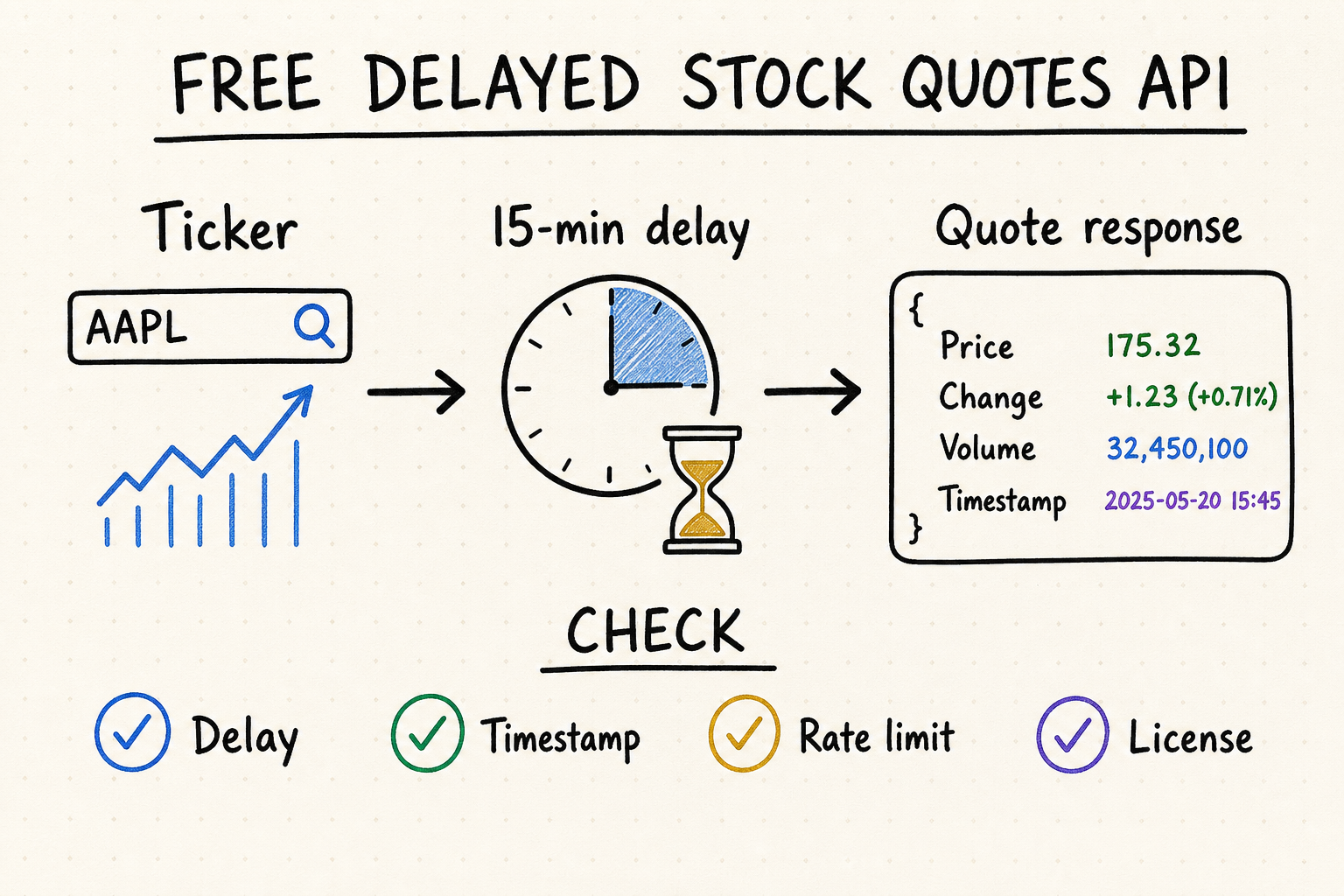
TL;DR核心摘要
A free delayed stock quotes API is usually enough for demos, personal dashboards, coursework, and low-traffic research tools.
“Real time” is not universal. Verify exchange, quote timestamp, session, and whether the response is delayed.
Latest trade, midpoint, bid, ask, and previous close are different values. Choose one explicitly for each product surface.
Cache repeated requests, batch symbols when allowed, and keep a provider adapter so you can switch later.
免费延迟股票报价 API 通常足以满足产品演示、个人仪表盘、课程作业和低访问量研究工具的需求。
“实时”没有统一定义。务必核对交易所、报价时间、交易时段,并确认接口返回的是实时报价还是延迟报价。
最新成交价、买卖报价中间价、买一价、卖一价和前收盘价代表不同含义。每个产品场景都应明确采用哪一种价格。
缓存重复请求;接口允许时,批量查询多个股票代码;同时保留数据服务商适配层,以便日后切换服务商。
Use delayed quotes when the product explains markets rather than executes against them: educational screens, public company pages, low-frequency portfolio summaries, internal prototypes, and research that does not depend on the latest seconds. Do not use them to trigger orders, promise executable prices, calculate time-sensitive risk, or compare against a real-time feed without aligning timestamps. A “15-minute delay” describes data eligibility; polling every second cannot make the underlying quote newer.
延迟报价适合用于解释市场而不是直接参与交易的产品,例如教学页面、上市公司信息页、低频投资组合摘要、内部原型,以及不依赖最近数秒行情的研究。它不应直接触发订单、承诺可成交价格、计算时效敏感的风险,或在未对齐时间戳时与实时行情比较。“延迟 15 分钟”描述的是数据何时可以发布,每秒轮询一次也不会让底层报价变得更新。
Fields a delayed stock quote should include延迟股票报价应包含哪些字段
A symbol and a number are not enough. Reliable applications need enough context to interpret the price correctly and avoid mixing incompatible values.
仅有股票代码和单一价格数值远远不够。可靠的应用还需要完整的行情信息,才能正确理解该价格的含义,并避免混用统计口径不一致的数据。
| Data数据 | Fields to expect应包含的字段 | Use用途 | Common trap常见误区 |
|---|---|---|---|
| Latest quote最新报价 | Price, timestamp, currency, exchange, session价格、报价时间、币种、交易所、交易时段 | Watchlists and snapshots自选股列表与报价快照 | Treating delayed data as live误将延迟数据当作实时数据 |
| Bid and ask买一价与卖一价 | Bid, ask, sizes, quote timestamp买一价、卖一价、买一量、卖一量、报价时间 | Spread and liquidity views展示买卖价差与流动性 | Confusing a stale quote with a trade误将过时报价当作成交数据 |
| Session context交易时段信息 | Market status, previous close, change, change %市场状态、前收盘价、涨跌额、涨跌幅 | Correct daily movement正确展示当日涨跌 | Mixing regular and extended hours混用正常交易时段与盘前、盘后时段 |
| Symbol metadata证券代码基础信息 | Canonical symbol, name, type, market, status标准证券代码、证券名称、证券类型、所属市场、交易状态 | Search and validation搜索与校验 | Ticker collisions across exchanges混淆不同交易所使用的相同证券代码 |
| Delay policy延迟政策 | Delay duration, eligible venues, asset scope, session exceptions延迟时长、适用场所、资产范围、交易时段例外 | Calculate when a quote becomes publishable判断报价何时可以展示 | Assuming every venue is delayed by the same amount假定所有场所的延迟时长完全一致 |
| Time lineage时间链路 | Market event time, provider release time, retrieval time, timezone市场事件时间、服务商发布时间、获取时间、时区 | Show quote age and prove the delay展示报价年龄并验证延迟 | Treating API response time as the quote time把 API 响应时间误当成报价发生时间 |
| Price type价格类型 | Bid, ask, midpoint, last eligible trade, official or previous close买价、卖价、中间价、最近符合条件的成交价、官方或前收盘价 | Label the value shown to users准确标注向用户展示的数值 | Calling every returned number “stock price”把所有返回数值都称为“股票价格” |
| Display status展示状态 | As-of label, delayed badge, market open or closed, stale threshold数据时点、延迟标识、开休市状态、陈旧阈值 | Prevent users from assuming live execution quality防止用户误以为具备实时交易时效 | Hiding delay inside a tooltip or terms page只在提示框或条款页面中说明延迟 |
What “free” and “delayed” really mean“免费”和“延迟”究竟意味着什么
Convert the advertised quota into your own workload: symbols × refreshes × users. A generous daily allowance can still fail if the provider enforces a tight per-minute burst limit.
Free feeds may be delayed, end-of-day only, or limited outside regular sessions. Label the timestamp and delay in the UI instead of implying live execution quality.
A quote can be correctly delayed by 15 minutes and still be older because the security did not trade, the market is closed, or the feed stopped updating. Track both mandated delay and observed quote age.
Determine whether the quote comes from a consolidated feed, one exchange, an alternative venue, or a provider aggregate. A delayed single-venue last trade may differ from a delayed market-wide reference.
Confirm required attribution, delay wording, display placement, and whether every user may view the data. Put the as-of time and delayed status beside the price, not only in legal text.
A daily close published after the session does not provide a rolling delayed quote. Test during market hours and after close so the application can distinguish delayed intraday, official close, and previous close.
将服务商公布的调用额度换算为实际负载:证券代码数量 × 刷新次数 × 用户数。即使每日配额看似充足,严格的每分钟突发请求上限仍可能导致调用失败。
免费行情可能存在延迟、仅提供日终数据,或对常规交易时段以外的行情覆盖有限。界面中应明确标注报价时间和延迟情况,避免让用户误以为这些报价具备实时交易所需的时效性。
一条报价即使按规定延迟 15 分钟,也可能因为证券长期未成交、市场休市或数据源停止更新而更旧。因此,应同时记录规定延迟和实际报价年龄。
确认报价来自综合行情、单一交易所、另类交易场所,还是服务商聚合结果。单场所的延迟最新成交价,可能与全市场延迟参考价不同。
核对署名要求、延迟说明用语、展示位置及哪些用户有权查看,并把数据时点和延迟状态直接放在价格旁边,不能只写在法律条款中。
收盘后发布的每日收盘价并不等于持续滚动的延迟报价。应分别在交易时段和收盘后测试,让应用能够区分延迟盘中价、官方收盘价和前收盘价。
A resilient free delayed stock quotes API integration如何可靠集成免费延迟股票报价 API
Map provider-specific responses into your own Quote, Bar, and Instrument models. Keep raw payloads for debugging, but do not spread vendor field names through product code.
Cache end-of-day history much longer than an active quote. Use explicit freshness rules and coalesce identical requests to protect the free quota.
Reject impossible timestamps, negative prices, inconsistent currencies, duplicate bars, and unexpected timezone shifts. Record the provider and retrieval time.
Store bid, ask, last trade, official close, previous close, source venue, event time, delay class, provider release time, and retrieval time as distinct fields rather than one generic price.
Polling faster than the release cadence wastes quota. Cache by symbol and price type until the next value can become eligible, while preserving a shorter failure retry policy.
Show delayed, as-of, market closed, stale, unavailable, and partial-coverage states. Do not display a cached value with a fresh page-load timestamp.
Separate delayed-data services from order routing and time-sensitive alerts in code and policy. A later feature should not accidentally reuse a low-cost display feed for trading decisions.
Verify the open, early close, regular close, daylight-saving changes, halts, and the exact moment a delayed event becomes available. Compare event time with expected release time.
将各数据服务商特有的响应映射到自己的 Quote、Bar 和 Instrument 模型。保留原始响应载荷用于排错,但不要让服务商字段名散布在产品代码中。
日终历史行情应设置远长于盘中报价的缓存时间。制定明确的数据时效规则,并合并并发的相同请求,以免过快耗尽免费调用额度。
拒绝时间戳不成立、价格为负、币种不一致、K 线重复或时区偏移意外变化的数据,并记录数据服务商和数据获取时间。
将买价、卖价、最新成交价、官方收盘价、前收盘价、来源场所、事件时间、延迟类别、服务商发布时间和获取时间分别保存,不能都塞进一个通用价格字段。
以高于数据发布时间的频率轮询只会浪费配额。应按证券和价格类型缓存到下一条数据可能发布的时刻,同时为失败重试设置更短且独立的策略。
界面应明确显示延迟、数据时点、市场休市、报价陈旧、暂不可用和覆盖不完整等状态,不能给缓存价格配上刚刷新页面的时间。
在代码和制度上把延迟行情服务与订单路由、时效敏感提醒分开,避免后续功能误把低成本展示行情用于交易决策。
验证开盘、提前收盘、常规收盘、夏令时切换、停牌,以及延迟事件恰好可以发布的时刻,并把事件时间与预期发布时间对照。
Code pattern: distinguish mandated delay from a stale feed代码示例:区分规定延迟与行情异常陈旧
The validator below keeps four ideas separate: when the market event happened, when the delayed quote became eligible for release, when the provider released it, and when your application retrieved it. The stale threshold is a product policy applied only while the market is open; it is not a claim that every symbol must trade continuously.
下面的校验器将四个时点分开处理:市场事件何时发生、延迟报价何时具备发布资格、服务商何时发布,以及应用何时获取。陈旧阈值只是在市场开市期间使用的产品规则,并不意味着每只证券都必须持续成交。
from datetime import datetime, timedelta

def parse_time(value: str) -> datetime:
    return datetime.fromisoformat(value.replace("Z", "+00:00"))

def classify_delayed_quote(quote: dict, now: datetime,
                           stale_after_minutes: int = 5) -> dict:
    event_time = parse_time(quote["event_time"])
    release_time = parse_time(quote["provider_release_time"])
    retrieved_at = parse_time(quote["retrieved_at"])
    delay = timedelta(minutes=quote["delay_minutes"])
    eligible_at = event_time + delay

    if quote["price"] <= 0:
        return {"status": "invalid", "reason": "non_positive_price"}
    if not event_time <= release_time <= retrieved_at <= now:
        return {"status": "invalid", "reason": "timestamp_order"}
    if release_time < eligible_at:
        return {"status": "invalid", "reason": "released_before_eligible"}

    quote_age = now - event_time
    allowed_age = delay + timedelta(minutes=stale_after_minutes)
    if quote.get("market_status") == "open" and quote_age > allowed_age:
        return {"status": "stale", "age_seconds": int(quote_age.total_seconds())}

    return {
        "status": "usable_delayed",
        "eligible_at": eligible_at.isoformat(),
        "age_seconds": int(quote_age.total_seconds()),
    }
Test the state, not only the price. A quote with event time 14:30Z, a 15-minute policy, provider release at 14:45Z, and retrieval at 14:45:02Z is valid delayed data. The same event returned at 14:55Z while the market is open is stale under the five-minute grace policy. If the market is closed or the symbol is halted, use that state instead of inventing a fresher price.
测试状态,不能只测试价格。若事件发生于 14:30Z,规定延迟 15 分钟,服务商于 14:45Z 发布,应用在 14:45:02Z 获取,这是一条有效的延迟报价。若市场仍在交易,同一事件到 14:55Z 才返回,在五分钟宽限规则下就应标记为陈旧。市场已休市或证券停牌时,应如实展示相应状态,而不是虚构一条更“新”的价格。
When to use QVeris for delayed quotes何时用 QVeris 查找延迟报价工具
QVeris helps developers and agents discover and inspect callable financial-data capabilities. Compare what a tool can return before wiring it into your application.
QVeris 可帮助开发者和智能体查找并评估具备金融数据调用能力的工具,以便在接入应用前比较各工具能够返回哪些数据。
- Search for quote, OHLCV, historical price, symbol lookup, and corporate-action capabilities.
- Inspect inputs and outputs before calling a tool from your code or agent.
- Keep provider selection separate from your normalized application model.
- 查找支持报价、OHLCV、历史价格、证券代码查询和公司行为数据的工具。
- 在通过代码或智能体调用工具前,核对工具的输入参数与返回结果。
- 将数据服务商的选择与应用内部的标准化数据模型解耦。
QVeris can help shortlist quote capabilities by fields, symbols, access requirements, and documented limits. The application still owns delay disclosure, timestamp lineage, venue interpretation, cache timing, stale-state policy, license compliance, and the separation between informational display and execution.
QVeris 可帮助应用按字段、证券、接入条件和公开限制筛选报价能力,但延迟披露、时间链路、交易场所解释、缓存时机、陈旧状态政策、许可合规,以及信息展示与交易执行的隔离,仍由应用方负责。
FAQ常见问题
Sometimes, but coverage, exchanges, entitlements, and delays vary. Verify the timestamp and license instead of relying on a “real-time” label.
Some APIs support batch symbols, while others allow only one symbol per request. Check both the batch size and how each symbol counts against the free quota.
有时可以,但不同服务覆盖的市场和交易所有所不同,数据使用权限与延迟情况也各不相同。不要只看“实时”标签,还应核对报价时间和数据许可条款。
部分 API 支持批量查询股票代码,另一些则每次只能查询一只股票。既要核对单次批量查询的股票数量上限,也要确认每只股票会占用多少免费额度。
It generally means an eligible market event is released no sooner than the applicable delay after its event time. Exact venues, sessions, fields, and policies vary, so inspect the documented delay class and timestamps.
They should not drive time-sensitive order decisions or represent an executable price. They can support education, display, and low-frequency analysis when users see the delay clearly.
The stock may not have traded, the market may be closed or halted, the field may update only on trades, or the feed may be stale. Compare event time, mandated delay, release time, and market status.
Show the price type, “Delayed” status, source or coverage when required, and an as-of timestamp in the market’s timezone. The label should appear beside the value, not only in a footer.
通常表示符合条件的市场事件,要在事件发生后的规定延迟期结束后才能发布。不同场所、时段、字段和政策可能不同,因此必须查看延迟类别和时间戳说明。
它不应驱动时效敏感的下单决策,也不能代表可成交价格。在清楚展示延迟的前提下,可用于教学、信息展示和低频分析。
证券可能长期未成交,市场可能已经休市或停牌,某字段可能只在成交时更新,数据源也可能陈旧。应同时检查事件时间、规定延迟、发布时间和市场状态。
应展示价格类型、“延迟”状态、必要的数据来源或覆盖范围,以及按市场时区表示的数据时点。标识应紧邻价格,不能只放在页脚。