
Free Earnings Transcripts API
Sources Compared
Free access may mean a preview, selected companies, or a limited request quota. Compare full text, speaker structure, freshness, and rights.
TL;DR
API Ninjas offers a free key and a structured transcript response with participants, sections, summaries, guidance, and sentiment fields.
Alpha Vantage documents more than 15 years of transcript history with turn-level sentiment, subject to current plan limits.
Finnhub labels transcript retrieval and live earnings-call audio as premium even though other company data has a free tier.
Choose by time-to-publish, speaker segmentation, full-text rights, historical depth, and whether summaries can be traced to passages.
What “free” and “real-time” mean for this API
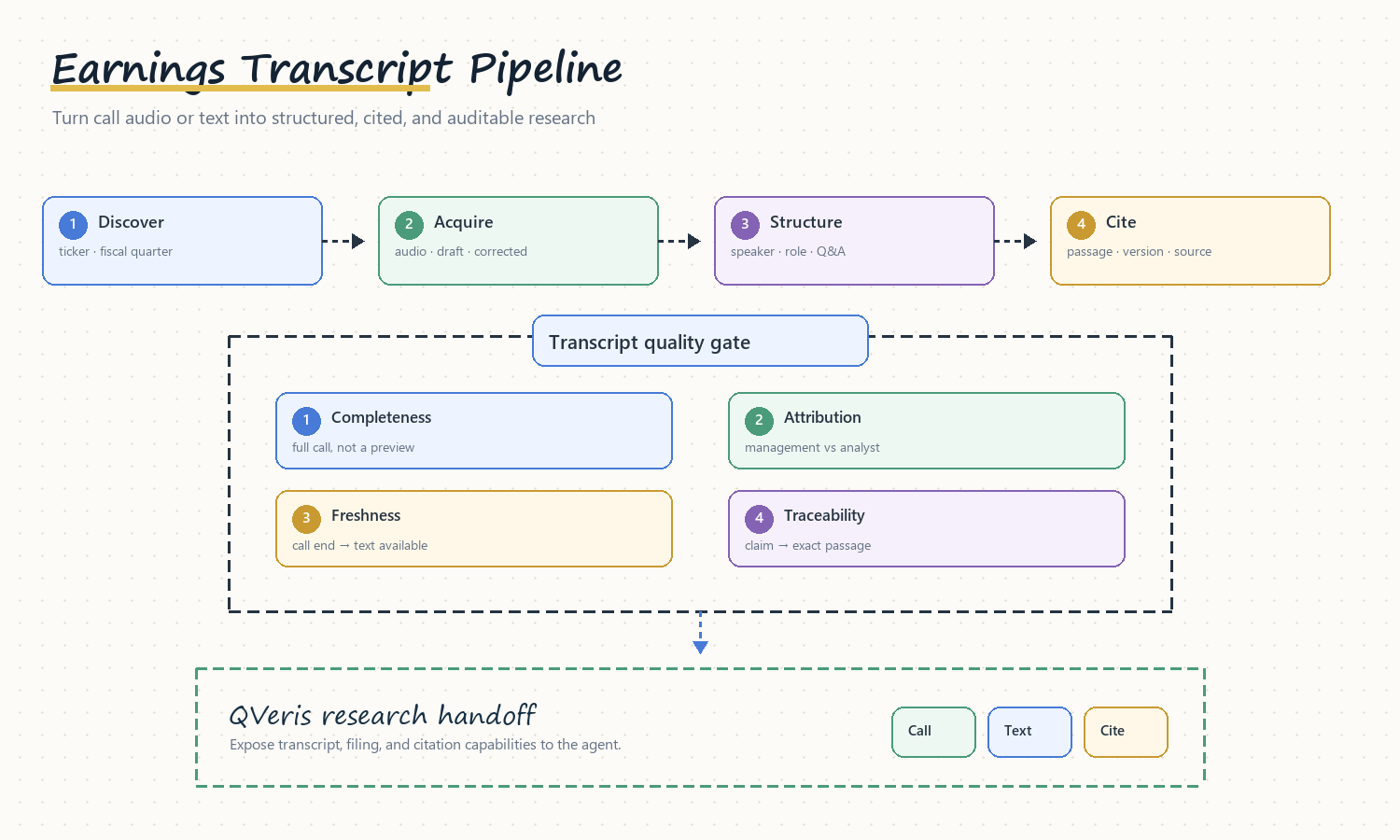
A free earnings transcripts API is not simply a text download. Research systems need to know which fiscal quarter the call belongs to, when it occurred, who spoke, whether a passage came from prepared remarks or Q&A, and whether the transcript is complete.
Free offers differ sharply. Some return full text under a request quota, some expose only metadata or a short preview, and some make transcripts a separate premium dataset. The phrase free transcript may also describe a webpage that can be read by a person but cannot legally or technically be automated.
For AI workflows, structure matters as much as coverage. Speaker names, roles, section boundaries, source URLs, publication timestamps, and passage-level citations make it possible to extract guidance without attributing an analyst's question to management.
Provider comparison: access, fields, and limits
| Source | Free access | Structure | Caveat |
|---|---|---|---|
| API Ninjas | Free API key; no card stated | Transcript, participants, sections, summary, guidance, sentiment | Verify current quota and commercial terms |
| Alpha Vantage | Free key with plan limits | Quarter transcript and turn-level sentiment | Rate limits and coverage require testing |
| EarningsCalls.dev | Metadata, preview, and summaries on free tier | Recent feed and structured components | Full transcript is paid |
| Finnhub | Other datasets have free access | Transcript, participants, audio, live call fields | Transcript and live call endpoints are premium |
Provider-by-provider notes: where the free tier stops
API Ninjas is a useful evaluation source because its example response goes beyond raw text: participants, roles, prepared remarks versus Q&A, summaries, guidance, risk factors, and sentiment are represented directly. The next step is to test quota, company coverage, transcript completeness, publication delay, and commercial terms with a representative quarter.
Alpha Vantage documents long transcript history and sentiment at the conversational-turn level. That can accelerate research prototypes, but a sentiment field should never replace the original passage. Benchmark speaker attribution, fiscal-quarter mapping, and response limits before using the score in a ranking model.
EarningsCalls.dev illustrates a common free-tier design: recent-call metadata, summaries, components, and a short preview can be available without full transcript access. It is useful for discovery and queue building, but a 250-character preview cannot support comprehensive call analysis or negative claims about topics management did not discuss.
Finnhub documents transcripts, participants, audio, and live earnings-call media with broad historical coverage, while clearly labeling these endpoints premium. It is a candidate when audio alignment and international coverage matter, but it should not be presented as a free transcript source simply because Finnhub has a separate free plan for other datasets.
The fields that decide whether the data is usable
Count companies, geographies, history, and newly added calls—not only a familiar ticker demo.
Measure the interval from call end to transcript availability and distinguish draft, machine, and corrected versions.
Validate names, roles, company versus analyst identity, prepared remarks, and Q&A boundaries.
Readable, searchable, downloadable, summarizable, and redistributable are different permissions.
Which option fits your workload?
Metadata, event calendars, recent feeds, and previews can be enough to detect that a new call is available and enqueue downstream work.
Require full text, reliable speaker roles, prepared-remarks/Q&A separation, fiscal metadata, and passage citations for every extracted target or range.
Version text, normalize speakers and KPIs, and preserve both fiscal and calendar dates so comparisons do not drift across reporting calendars.
Return cited passages, source URL, provider, transcript version, speaker, and section. The final prose should distinguish management statements from analyst questions.
A practical evaluation and implementation playbook
Include accents, multiple executives, operator transitions, guidance revisions, and long Q&A sessions.
Check speaker and section accuracy first. Sentiment is misleading when the wrong person owns the sentence.
Every extracted guidance, risk, KPI, or quote should point to the original transcript segment and call metadata.
Version transcript text and rerun downstream extraction when a corrected transcript replaces an early version.
Common mistakes that make a free API expensive
A release contains reported numbers; a call adds management explanation and analyst questions.
A free snippet cannot support claims about what management did not discuss.
Calendar dates and fiscal quarters can differ, especially across non-calendar fiscal years.
API access does not automatically grant broad republication rights.
Where QVeris fits in the workflow
QVeris is a capability discovery and routing layer for agents. It can help an agent find, inspect, and call financial capabilities, but it does not replace the underlying data provider's license, entitlement, or source-of-truth obligations.
- Use QVeris to discover transcript or filings capabilities and inspect the expected schema before the agent calls them.
- Attach ticker, fiscal year, fiscal quarter, event time, provider, version, speaker, and section to every extracted claim.
- Use the original provider's terms for full-text access and publication; QVeris does not create transcript redistribution rights.
FAQ
Yes, but free can mean a quota, selected coverage, metadata, summaries, or previews. Confirm whether full text is included.
It varies by source and may range from near-live machine text to later corrected versions. Measure it with calls you actually cover.
Yes if the system preserves speaker attribution, separates prepared remarks from Q&A, cites passages, and labels uncertainty.
Not automatically. Models, segmentation, and speaker attribution differ, so benchmark on a common labeled set.
Sources, methodology, and update policy
This guide compares public documentation and evaluates providers by workload, data freshness, structure, delivery, legal use, and upgrade path. It does not treat a marketing label as proof of real-time coverage.
Provider features and commercial terms can change. Official documentation linked below is the source of truth; run a representative data test and obtain appropriate rights before production deployment.