
Find a Free Economic Indicator API
and Validate
the Data查找并验证
免费经济指标 API
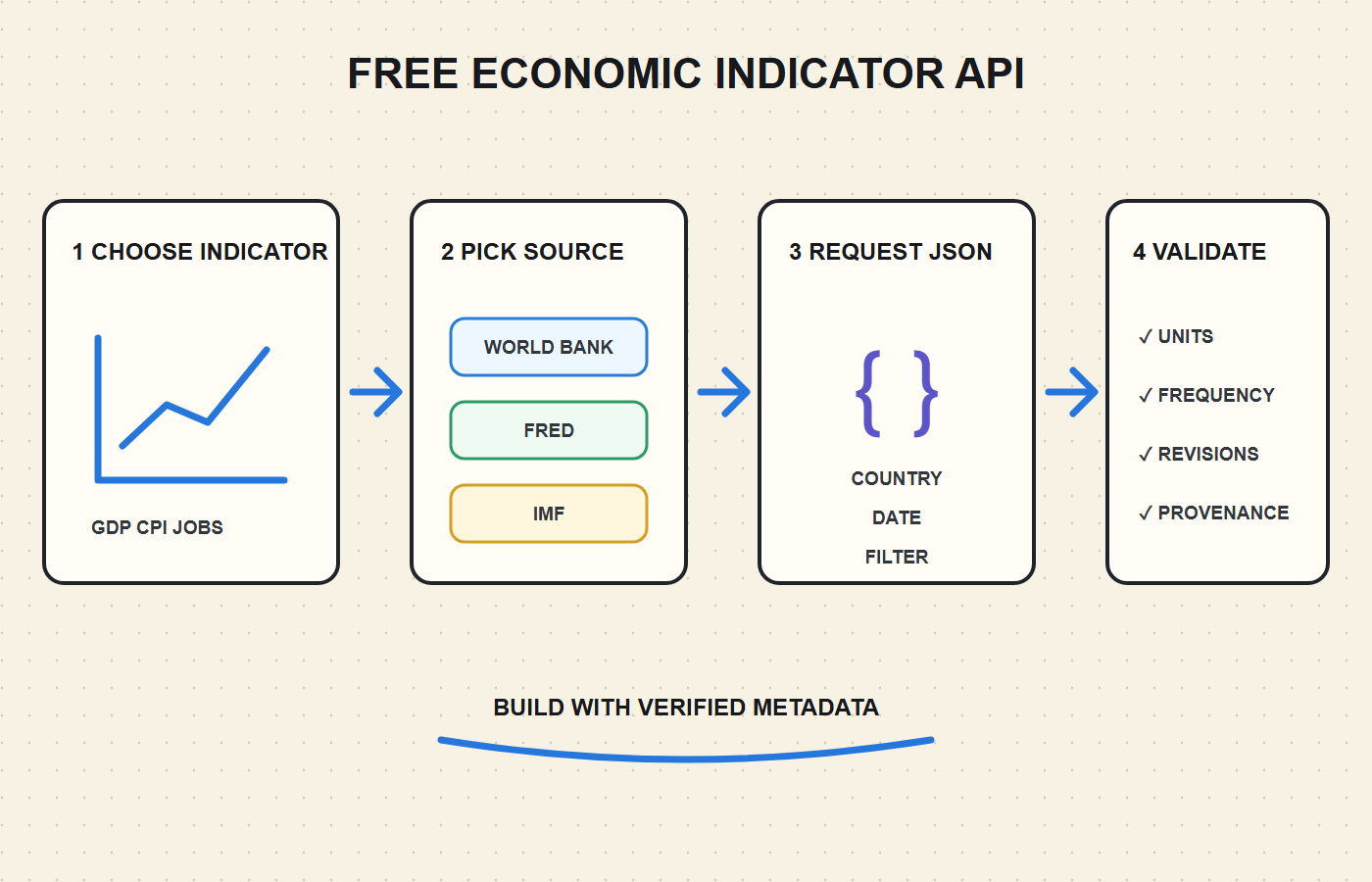
Compare free economic indicator API sources, request GDP, inflation, jobs, and rates in JSON, and validate every series before use.
比较免费经济指标 API,获取 GDP、通胀、就业和利率 JSON 数据,
并在使用前验证每个时间序列。
Free economic indicator API: quick answer免费经济指标 API:快速结论
Use FRED for deep US coverage, World Bank or IMF for cross-country indicators, Eurostat for EU data, and DBnomics to search across providers.
Authentication, coverage, formats, rate limits, licensing, update schedules, and revision history vary by source.
Check units, frequency, seasonal adjustment, geography, release date, missing values, and whether observations may be revised.
QVeris helps agents and developers discover and inspect relevant data capabilities before calling the provider that fits the task.
美国数据可先看 FRED,跨国指标看世界银行或 IMF,欧盟统计看 Eurostat,跨来源搜索可用 DBnomics。
不同接口的鉴权、覆盖、格式、调用限制、许可、更新节奏和修订历史并不一致。
检查单位、频率、季调状态、地区、发布日期、缺失值,以及数据是否会在发布后修订。
QVeris 帮助开发者与 Agent 先查找并检查合适的数据能力,再调用符合任务要求的提供方。
What users need from an economic indicators API用户需要经济指标 API 完成什么任务
Searchers usually want a usable economic data API free enough for a prototype, notebook, dashboard, or AI agent. The recurring need is not merely “find GDP.” It is to identify a trustworthy series, retrieve it programmatically, understand its metadata, and keep the integration stable when values are missing or revised.
中文搜索结果更常围绕“宏观经济数据 API”“免费经济数据接口”和具体机构接口展开。用户需要的不只是找到 GDP,而是确认数据出处、指标代码、返回格式、鉴权方式、更新频率和修订规则,并把数据稳定接入研究、看板或 Agent。
Entities and features repeated across current results当前结果反复覆盖的实体与功能
FRED, World Bank, IMF, Eurostat, OECD, national statistics offices, and DBnomics appear repeatedly because each covers a different geography or discovery need.
GDP, CPI and inflation, unemployment, policy rates, exchange rates, industrial production, population, and trade are the dominant entities.
REST endpoints, JSON or CSV output, API keys, Python examples, pagination, date filters, metadata, licensing, and rate limits shape the engineering choice.
Units, frequency, seasonal adjustment, source provenance, publication timestamps, revisions, and missing observations determine whether a series is safe to compare.
FRED、世界银行、IMF、Eurostat、OECD、各国统计机构和 DBnomics 反复出现,因为它们解决不同地区与发现需求。
GDP、CPI 与通胀、失业率、政策利率、汇率、工业生产、人口和贸易是最常见的数据实体。
REST、JSON/CSV、API Key、Python 示例、分页、日期筛选、元数据、许可与限流共同决定接入成本。
单位、频率、季调、来源、发布时间、修订和缺失观测决定不同序列能否安全比较。
Compare free economic indicator API sources比较免费经济指标 API 数据源
| Source来源 | Best fit适合场景 | Key / format鉴权 / 格式 | Important caveat重要限制 |
|---|---|---|---|
| FRED | Deep US and selected global economic time series.美国及部分全球经济时间序列。 | Free key; JSON/XML.免费 Key;JSON/XML。 | Series definitions and revisions must be checked.必须核对序列定义与修订。 |
| World Bank | Cross-country development and macro indicators.跨国发展与宏观指标。 | No key; JSON/XML.无需 Key;JSON/XML。 | Many series are annual and can lag releases.不少序列为年度频率且存在发布时滞。 |
| IMF DataMapper | Global macro indicators and WEO-style comparisons.全球宏观指标与 WEO 类跨国比较。 | No key; JSON.无需 Key;JSON。 | Coverage differs by indicator and economy.不同指标与经济体覆盖不一。 |
| Eurostat | Official EU statistics and detailed dimensions.欧盟官方统计与多维数据。 | No key; JSON-stat/SDMX.无需 Key;JSON-stat/SDMX。 | Dimension codes require careful handling.需要正确处理维度代码。 |
| DBnomics | Discovery across many official providers.跨多个官方提供方搜索数据。 | No key; JSON.无需 Key;JSON。 | Keep the original provider and series metadata.必须保留原始提供方和序列元数据。 |
Model economic indicators before combining providers合并多个来源前,先设计经济指标数据模型
A value and a date are not enough to identify an economic observation. “Inflation” may mean a price-index level, a month-over-month change, a year-over-year rate, headline CPI, or a core measure. GDP may be nominal or real, total or per capita, seasonally adjusted or not, and reported at an annualized rate. Keep these distinctions as fields rather than burying them in a chart label.
仅有“数值+日期”无法准确描述一条经济指标。“通胀”可能指价格指数水平、环比、同比、总体 CPI 或核心指标;GDP 也可能是名义值或实际值、总量或人均值、季调或未季调值,还可能经过年化。应把这些差异保存为字段,而不是只写在图表标题里。
| Field字段 | What to preserve需要保留的内容 | Common failure常见错误 |
|---|---|---|
provider / series_id | Original institution, database and exact series code.原始机构、数据库及完整序列代码。 | Merging similarly named series as if they were identical.把名称相近但定义不同的序列直接合并。 |
geography | Country or region code, boundary version and aggregate definition.国家或地区代码、边界版本及区域汇总口径。 | Mixing national totals with currency-area or income-group aggregates.把国家总量与货币区或收入组汇总值混为一谈。 |
unit / scale | Currency, index base, percent, persons, scale factor and price basis.币种、指数基期、百分比、人数、数量级和价格口径。 | Treating index points, percentages and percentage-point changes as equivalent.把指数点、百分比和百分点变化当成同一种单位。 |
frequency / adjustment | Daily, monthly, quarterly or annual frequency and seasonal adjustment status.日、月、季、年频率,以及是否季调。 | Comparing a seasonally adjusted monthly series with an unadjusted annual value.将季调月度序列与未季调年度值直接比较。 |
period / release_time | The period measured, publication timestamp and retrieval timestamp.统计期、实际发布时间与抓取时间。 | Using the period end as though the value was known on that date.误以为统计期结束当天就已经知道该数值。 |
vintage / status | Initial, revised or final value plus the vintage date when available.初值、修订值或终值,以及可获得时的版本日期。 | Overwriting old releases and creating look-ahead bias in research.覆盖历史发布值,导致研究出现前视偏差。 |
Do not join by label alone. Build a mapping that records why two provider series are comparable, what transformation was applied, and where they differ. If definitions cannot be reconciled, keep the series separate.
不要只按名称关联。应建立明确的映射表,记录两个来源为何可比、做过哪些转换、仍有哪些差异。定义无法统一时,应保留为不同序列。
How to use a free economic indicator API in Python如何用 Python 获取经济指标数据
A revision-aware workflow for GDP and inflation data APIs能够处理修订的 GDP 与 CPI 数据流程
Write down indicator, geography, unit, frequency, seasonal adjustment, price basis, and required history before choosing a provider.
Resolve the provider’s indicator and country codes, then save the title, source, unit, frequency, and update notes with the series ID.
Use a narrow date range first. Confirm status, schema, null handling, pagination, ordering, and whether dates represent periods or publication timestamps.
Cache responsibly, retry transient failures, preserve raw responses, and record retrieval time. Do not overwrite earlier values when revision history matters.
选提供方前写清指标、地区、单位、频率、季调、价格口径与所需历史长度。
解析指标与国家代码,把标题、来源、单位、频率和更新说明与序列 ID 一起保存。
从较短日期范围开始,验证状态、字段结构、空值、分页、排序,以及日期代表统计期还是发布时间。
合理缓存,只重试临时错误,保留原始响应并记录抓取时间;需要修订历史时不要直接覆盖旧值。
Production checks for an economic data API经济数据 API 投入生产前的检查清单
An integration can return HTTP 200 while serving stale, revised, incomplete, or semantically different data. Monitor the dataset’s publication behavior as well as the endpoint itself.
接口返回 HTTP 200,并不代表数据一定新鲜、完整或口径一致。生产监控既要检查接口状态,也要理解指标本身的发布时间与修订机制。
Compare the newest observation with the institution’s expected release schedule. Holidays and publication delays should not be mistaken for ingestion failures.
Alert on changed field names, dimension codes, frequency, units, seasonal adjustment or source notes—not only on missing numeric values.
Save each retrieval or use a vintage endpoint when decisions must be reconstructed with information available at that time.
Sample values against the publisher’s own page or download. Investigate differences before automatically substituting another provider.
Cache slow-moving series, respect 429 and Retry-After, use bounded backoff, and checkpoint paginated pulls so a retry does not duplicate rows.
Store provider, source URL, retrieval time and required attribution with the output. Free access is not a universal redistribution license.
按机构预计发布日检查最新观测值。节假日或推迟发布不能简单判断为采集故障。
除数值缺失外,还要监控字段名、维度代码、频率、单位、季调状态和来源说明的变化。
需要复盘历史决策时,应保存每次抓取结果,或使用支持 vintage 的接口,还原当时可见信息。
定期抽样对照发布方网页或下载文件。发现差异后应先核对定义,不能在没有说明的情况下直接改用另一来源。
缓存低频序列,遵守 429 与 Retry-After,设置有上限的退避,并为分页任务保存进度,避免重试产生重复行。
在下游数据中保留提供方、来源网址、抓取时间和署名要求。免费访问并不等于可以任意再分发。
How QVeris helps discover economic data APIsQVeris 如何帮助发现经济数据 API
QVeris does not change a provider’s data or promise broader coverage. It helps developers and agents search for relevant capabilities, inspect their documented inputs and outputs, and connect the chosen tool to a workflow. Start with the QVeris Tool Finder, then confirm provider documentation before production use.
QVeris 不会改变提供方的数据,也不承诺扩大覆盖范围。它帮助开发者和 Agent 查找相关能力、检查已记录的输入与输出,再把选定工具接入工作流。可以先从 QVeris 工具搜索开始,但在生产环境使用前,仍应核对提供方的官方文档。
- Search by task and indicator instead of guessing a provider name.
- Inspect authentication, required parameters, response shape, and documented limits.
- Keep the original provider, series code, unit, and retrieval timestamp in downstream output.
- 按任务与指标搜索,不必先猜测提供方名称。
- 检查鉴权、必填参数、响应结构与已记录的调用限制。
- 在下游结果中保留原始提供方、序列代码、单位与抓取时间。
FAQ常见问题
Yes. FRED, World Bank, IMF DataMapper, Eurostat, and DBnomics provide free access paths, but their keys, coverage, formats, limits, and licenses differ.
World Bank, IMF DataMapper, Eurostat, and DBnomics can be queried without a key. Recheck current policies, fair-use guidance, and limits before production deployment.
Use requests or a maintained client, begin with metadata and a small date range, validate units and dates, then add caching, retries, provenance, and revision-aware storage.
FRED API access is free, while most requests require a free API key. See the dedicated free FRED data API guide.
有。常见选择包括 FRED、世界银行、IMF DataMapper、Eurostat 与 DBnomics,应按地区、指标、频率和修订需求选择。
世界银行、IMF DataMapper、Eurostat 和 DBnomics 可无需 Key 调用;生产部署前仍需复核当前政策与限制。
先获取元数据与小范围样本,验证单位、日期和空值,再加入缓存、重试、出处记录与修订处理。
FRED API 免费,但多数请求需要免费 API Key。可阅读 免费 FRED 数据 API 指南。