
Choose a Free Economic News API选择合适的免费财经新闻 API
Compare economic-news sources, topic filters, freshness, free limits, licensing, and JSON fields before integrating an API.
比较财经新闻来源、宏观主题筛选、更新速度、免费额度、授权许可和 JSON 字段,再决定如何接入接口。
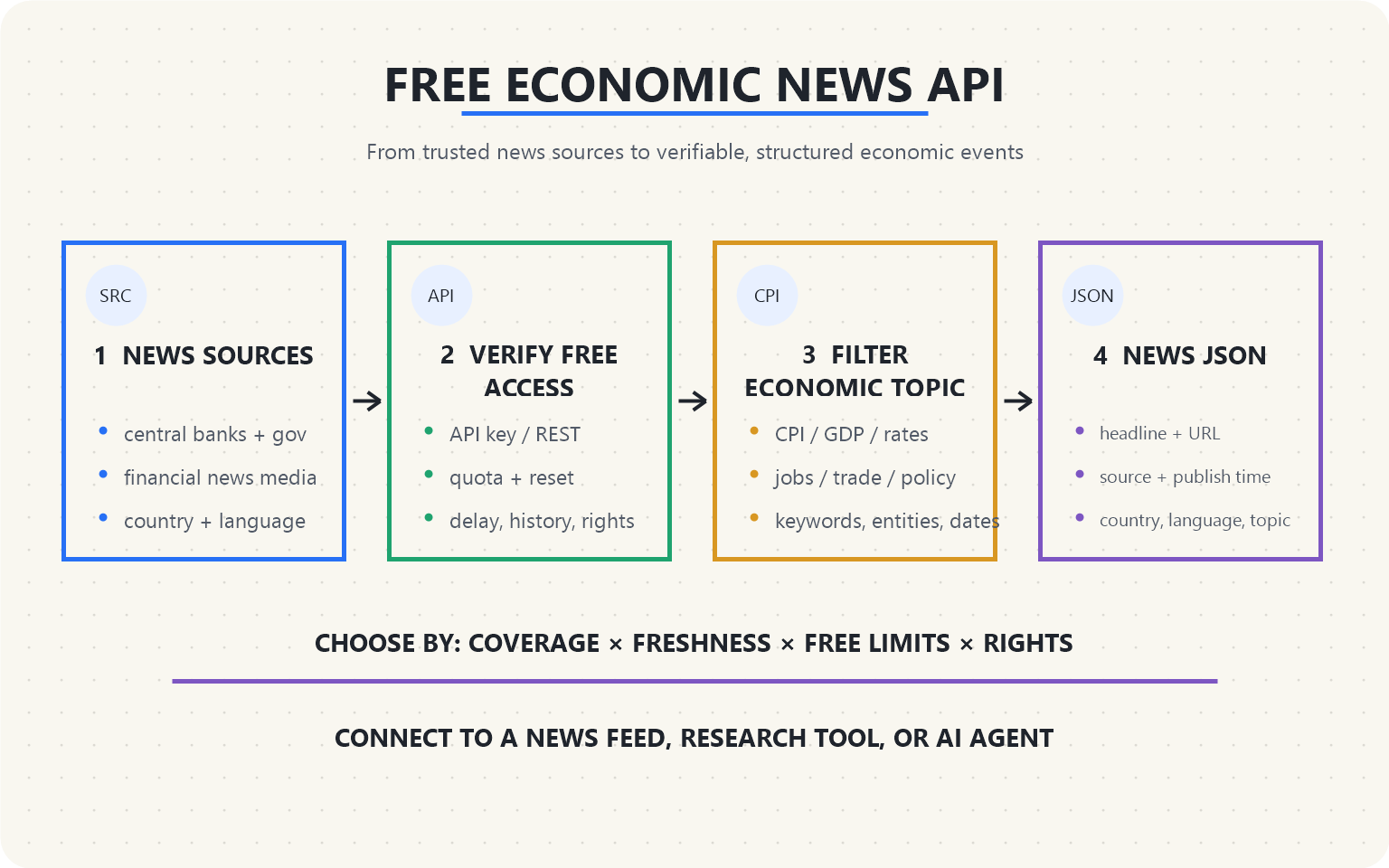
What a free economic news API should help you build免费财经新闻 API 应该支持哪些产品需求
Developers need an API they can test, a clear free-plan boundary, an inspectable response, and enough source evidence to decide whether it fits a news feed, macro monitor, research Agent, or prototype. The first design decision is whether the product needs articles, scheduled events, official indicator values, or a linked combination of all three.
开发者需要的是可直接测试的接口、明确的免费边界、能够检查的响应结构,以及足以验证来源的证据,从而判断它是否适用于新闻流、宏观监控、研究 Agent 或产品原型。第一步不是先选供应商,而是确认产品需要新闻文章、计划事件、官方指标数值,还是三者相互关联的组合。
Articles and headlines differ from numeric releases such as GDP, CPI, rates, and employment. Confirm which content the endpoint returns.
文章与快讯不同于 GDP、CPI、利率和就业等数值指标,应先确认端点返回哪一类内容。
A trial or free tier may restrict requests, history, freshness, sources, full text, or production use.
试用或免费套餐可能限制请求量、历史、实时性、来源、全文或生产用途。
Test timestamps, pagination, empty results, duplicates, rate-limit headers, and attribution fields before selecting a provider.
选型前应实测时间戳、分页、空结果、重复内容、限流响应头和署名字段。
Economic news API coverage and filter options财经新闻 API 的覆盖范围与筛选功能
Useful coverage includes recent headlines, REST or JSON delivery, named sources, countries, languages, economic categories, entity or ticker tags, sentiment, and date filters. Every coverage claim is provider-specific: confirm it with real queries and current documentation rather than assuming an “economy” category includes official releases, calendars, and explanatory reporting.
实用的覆盖能力包括近期标题、REST 或 JSON 返回、明确来源、国家、语言、宏观主题、实体或股票代码标签、情感字段与日期筛选。所有覆盖描述都只适用于具体供应商,应通过真实查询与当前文档核对,不能因为接口提供“财经”分类,就默认它同时包含官方发布、经济日历和解释性报道。
Global economic news API coverage
Check countries, languages, publishers, update cadence, and whether sources include central banks, government releases, business media, or blogs.
Economic news API with topic filters
Look for keywords, categories, entities, tickers, country, language, source, and date filters. Test if “economy” includes monetary policy, inflation, jobs, trade, and fiscal policy.
Economic calendar and indicator boundaries
An economic calendar may return a scheduled release time, country, indicator, period, importance, consensus, previous value, actual value, and later revisions rather than journalism. A statistical-series API may return only observations and vintages. Verify timezone and whether “previous” is the originally published or revised value; keep these records separate from articles unless the endpoint explicitly links both.
Release lifecycle and rescheduling
Keep scheduled time, first actual publication time, provider ingestion time, update time, and status as separate fields. Releases can be postponed, canceled, corrected, or published early around holidays and emergencies. A calendar row should not be marked complete merely because the scheduled clock passed.
Consensus, surprise, and unit semantics
Store actual, consensus, prior-original, prior-revised, unit, frequency, seasonal-adjustment status, and transformation such as level, percent, annualized rate, or year-over-year change. Calculate surprise only after units and vintages are aligned; subtracting a percentage from an index level produces a plausible but meaningless number.
Primary releases and explanatory coverage
Central banks, statistical agencies, treasuries, and regulators are primary evidence. News articles explain market interpretation and revisions but should remain linked, separate records. Preserve the official release URL and document version so an agent can cite the number and the analysis appropriately.
全球财经新闻 API 的来源覆盖
检查国家、语言、发布机构、更新周期,以及是否包含央行、政府数据发布、商业媒体或博客。
支持主题筛选的财经新闻接口
检查关键词、分类、实体、股票代码、国家、语言、来源和日期参数,并实测“经济”分类是否覆盖货币政策、通胀、就业、贸易与财政政策。
区分经济日历、指标序列与新闻
经济日历通常返回计划发布时间、国家、指标、统计期、重要程度、市场预期、前值、实际值和后续修订,而不是新闻文章;统计序列接口还可能只返回观测值与数据版本。必须核对时区,并确认“前值”指最初公布值还是修订值。除非端点明确关联两者,否则这些记录应与新闻文章分开保存。
发布生命周期与改期
计划发布时间、首次实际发布时间、供应商收录时间、更新时间和状态应分别保存。节假日或突发情况可能导致数据推迟、取消、修正或提前发布,不能仅因计划时点已经过去,就把日历记录标记为已完成。
预期差与单位语义
保存实际值、市场预期、原始前值、修订前值、单位、频率、季调状态,以及数值是水平值、百分比、年化率还是同比变化。只有单位和数据版本一致时才能计算预期差;用百分比减去指数水平会得到看似合理但毫无意义的数字。
官方发布与解释性报道
央行、统计机构、财政部门和监管机构属于一手证据;新闻报道可解释市场反应与数据修订,但应作为单独记录与官方材料关联。保留官方发布链接和文档版本,Agent 才能分别引用原始数字与媒体分析。
Choose the right source for economic news and data为财经新闻与宏观数据选择正确来源
A robust macro product usually combines several source types instead of forcing one endpoint to do everything. Official APIs establish the numeric record, release feeds establish what the institution published, news aggregators add interpretation and cross-source coverage, and calendar services add consensus and scheduled-event structure.
可靠的宏观产品通常需要组合多类来源,而不是让一个接口承担所有任务。官方 API 用于确定数值记录,机构发布源用于确认原始公告,新闻聚合接口提供解释和跨媒体覆盖,经济日历服务则补充市场预期与计划事件结构。
| Source route来源路线 | Use it for适合用途 | Do not assume不能默认 |
|---|---|---|
| Official statistical APIs官方统计 API BLS, BEA, FREDBLS、BEA、FRED | CPI, employment, GDP, rates, observations, series metadata, and where supported, release or vintage history.CPI、就业、GDP、利率、观测值、序列元数据,以及在支持时获取发布或版本历史。 | That a series API includes consensus estimates, news summaries, or a complete point-in-time vintage without using the relevant vintage endpoint.序列接口一定包含市场预期、新闻摘要,或无需专门版本接口就能得到完整时点数据。 |
| Central-bank and agency release feeds央行与机构发布源 | Statements, minutes, press releases, methodology notes, tables, and corrections directly from the publisher.直接获取声明、会议纪要、新闻稿、方法说明、数据表与更正。 | That every publisher exposes the same schema, timestamp semantics, archive depth, or machine-readable full text.各发布机构具有相同字段、时间戳语义、归档深度或机器可读全文。 |
| News aggregation APIs新闻聚合 API GDELT, NewsAPI and financial-news providersGDELT、NewsAPI 与金融新闻供应商 | Cross-publisher headlines, country or language discovery, topic filtering, narrative context, and links to reporting.跨媒体标题、国家或语言发现、主题筛选、事件叙事与报道链接。 | That the first article is the primary source, full text may be republished, sentiment is factual, or duplicate coverage represents separate events.首篇文章就是一手来源、全文可以转载、情感字段等于事实,或多篇重复报道代表多个独立事件。 |
| Economic calendar services经济日历服务 For example, Trading Economics例如 Trading Economics | Scheduled times, importance, consensus, prior, actual, event status, and a normalized multi-country calendar.计划时间、重要程度、预期值、前值、实际值、事件状态与标准化多国日历。 | That consensus is an official statistic, prior means unrevised prior, timestamps share one timezone, or free access permits production redistribution.市场预期属于官方统计、前值一定未经修订、时间戳采用同一时区,或免费权限允许生产环境再分发。 |
Worked example: a CPI surprise needs units and vintages实例:计算 CPI 预期差必须先统一单位与数据版本
Suppose the calendar consensus is 0.3% month over month and the official release reports 0.4% month over month. The surprise is +0.1 percentage point, not “0.1% higher” unless the product explicitly uses a relative calculation. If another feed reports 3.2% year over year, subtracting 0.3 from 3.2 is meaningless because the transformations differ. Store the period, seasonal-adjustment flag, transformation, unit, consensus snapshot time, first released value, and later revision.
假设经济日历给出的市场预期为环比 0.3%,官方初值为环比 0.4%,预期差应表达为高出 0.1 个百分点;除非产品明确采用相对变化算法,否则不能写成“高 0.1%”。如果另一个接口返回同比 3.2%,也不能用 3.2 减去 0.3,因为两者的变换口径不同。应保存统计期、季调标记、变换方式、单位、预期值截取时间、首次公布值和后续修订值。
Now assume the previous month's value was initially 0.2% and later revised to 0.3%. A live alert should preserve the originally available prior when explaining the immediate reaction, while a current dashboard may show the revised history with an explicit revision marker. Overwriting the prior value erases what market participants actually knew at the release time and contaminates event-study backtests.
再假设上月数据最初公布为 0.2%,随后修订为 0.3%。解释即时市场反应的实时提醒,应保留发布当时可见的原始前值;当前看板可以展示修订后的历史,但必须明确标记修订。直接覆盖前值会抹掉市场参与者在发布时真正掌握的信息,并污染事件研究回测。
Choose by product outcome按照产品输出选择数据组合
Start with an official or calendar event record, then attach one explanatory article. Require actual, consensus, prior vintage, unit, status, and source time.
Use an aggregation API with source diversity, language filters, URL-level deduplication, topic classification, and headline or summary rights.
Keep scheduled, released, ingested, and revised times; freeze consensus snapshots and numeric vintages; link articles without replacing official observations.
Give the Agent separate tools for official values and news context, require citations for both, and surface disagreements or stale data instead of merging them silently.
以官方或日历事件为主记录,再附一篇解释性报道;必须包含实际值、预期值、原始前值、单位、状态和来源时间。
选择来源多样、支持语言筛选、URL 级去重和主题分类的聚合接口,并核对标题或摘要的使用权限。
分别保存计划、发布、收录和修订时间,冻结预期快照与数值版本;新闻只作关联,不能替代官方观测。
为 Agent 分别提供官方数值与新闻语境工具,两者都要求引用;遇到冲突或陈旧数据时明确暴露,不能静默合并。
How to compare free economic news API options如何比较免费财经新闻 API
| Check检查项 | Why it matters为什么重要 | Evidence to record应记录的证据 |
|---|---|---|
| Coverage覆盖范围 | Sources, countries, and languages determine blind spots.来源、国家和语言决定信息盲区。 | Source list and sample queries来源清单与样例查询 |
| Freshness更新速度 | “Live” may still be delayed on a free plan.免费套餐中的“实时”仍可能延迟。 | Published and indexed timestamps发布时间与收录时间 |
| Free limits免费额度 | Requests, articles, credits, and trial days are different units.请求数、文章数、积分和试用天数并非同一单位。 | Quota, reset, 429 behavior配额、重置周期、429 行为 |
| JSON schemaJSON 字段 | Apps need stable IDs, URLs, timestamps, source, language, and pagination.应用需要稳定 ID、URL、时间戳、来源、语言和分页。 | Docs and real response samples文档与真实响应样例 |
| Rights授权许可 | Headline access does not automatically grant full-text republication.可读取标题并不自动意味着可转载全文。 | License, attribution, storage terms许可、署名与存储条款 |
Free economic news API Python integration pattern免费财经新闻 API 的 Python 接入步骤
Start with a narrow economic news query
Choose one country, language, topic, and recent time window. Keep the key in an environment variable and set a finite timeout.
Validate the economic news JSON response
Require a stable ID, headline, source, URL, publication timestamp, language, and pagination marker. Treat article body, topics, and sentiment as optional.
Handle rate limits and duplicate stories
Respect 429 and Retry-After, deduplicate syndicated URLs or hashes, and record gaps instead of silently assuming no news occurred.
Normalize articles and releases separately
Use an article schema for headlines and a release schema for calendar observations. Link them by country, indicator, period, and official source only when evidence supports the match. Do not force an actual numeric value into a news-summary field or lose revision history in article deduplication.
Preserve point-in-time versions
Append initial and revised observations rather than overwriting them. Record when each version became available so alerts and backtests use the value known at that moment. Recalculate derived surprises only from the corresponding vintage and retain the earlier result for audit.
Monitor scheduled-release completeness
For a fixed country and indicator set, compare expected calendar events with actual arrivals. Track missing releases, reschedules, correction delay, publication-to-ingestion latency, unit changes, null consensus fields, schema drift, and quota headroom around high-volume release windows.
先发送范围明确的财经新闻查询
选择一个国家、语言、主题和较短时间窗口,把 API Key 放入环境变量,并设置有限超时。
验证财经新闻 JSON 响应
至少检查稳定 ID、标题、来源、URL、发布时间、语言和分页标记;正文、主题和情感字段可视为可选。
处理限流与重复新闻
遵守 429 与 Retry-After,通过 URL 或内容哈希去重,并记录数据缺口,不把缺失结果解释为没有新闻。
分别规范化新闻与数据发布
标题与报道使用文章 Schema,经济日历观测使用数据发布 Schema。只有证据充分时,才按国家、指标、统计期和官方来源关联两者。不要把实际数值硬塞进新闻摘要字段,也不能在文章去重时丢失修订历史。
保留时点版本
初值与修订值应追加保存,不能相互覆盖,并记录每个版本真正可用的时间,让提醒和回测使用当时已知数据。派生预期差只能按对应数据版本重新计算,旧结果仍应保留供审计。
监控计划发布的完整性
对固定国家与指标集合,比较预期日历事件和实际到达记录,跟踪漏发、改期、更正延迟、从发布到收录的时间、单位变化、预期值空缺、Schema 漂移,以及数据密集发布窗口的额度余量。
import os, requests

response = requests.get(
    "https://provider.example/v1/news",
    headers={"Authorization": f"Bearer {os.environ['API_KEY']}"},
    params={"topic": "economy", "language": "en", "limit": 25},
    timeout=20,
)
response.raise_for_status()
for item in response.json().get("results", []):
    required = {"id", "title", "source", "url", "published_at"}
    if not required.issubset(item):
        raise ValueError("Unexpected economic news schema")
The hostname is illustrative. Replace it with the documented endpoint from the provider you evaluate.
以上域名仅用于说明请求结构,请替换为所评估服务商文档中的真实端点。
How QVeris helps discover economic news capabilitiesQVeris 如何帮助发现财经新闻能力
QVeris is a capability routing network. It does not claim that every discoverable provider is free, real time, or licensed for every use. It helps agents find relevant capabilities, inspect inputs and outputs, and route calls through a consistent workflow.
QVeris 是能力路由网络,不承诺每个可发现服务商都免费、实时或适用于所有用途。它帮助智能体发现相关能力、检查输入输出,并通过一致工作流进行调用。
- Open the QVeris tool details to inspect by economic-news capability.
- Review authentication, parameters, response fields, limits, and provider terms before production use.
- Follow the QVeris documentation to connect a discoverable tool to an agent workflow.
- 使用 QVeris 工具详情按财经新闻能力搜索。
- 用于生产前,检查鉴权、参数、返回字段、限额和服务商条款。
- 参考 QVeris 文档,把可发现工具接入智能体工作流。
Frequently asked questions常见问题
Is there a free economic news API?
Yes. Several news and financial-data providers publish a free tier or trial. Free access usually has request, history, delay, attribution, or production-use limits, so verify the current documentation.
What is the difference between an economic news API and an economic data API?
An economic news API returns articles, headlines, summaries, sources, and timestamps. An economic data API returns observations such as CPI, rates, GDP, or employment values. Some providers expose both, but the endpoints and licenses differ.
Can I get real-time economic news for free?
Sometimes, but free does not guarantee real time. Results may be delayed, cached, sampled, or available only in a small quota. Compare publication and ingestion timestamps to measure freshness.
How do I filter economic news by country or topic?
Look for country, language, category, keyword, entity, source, and date parameters. Test whether filters are server-side and whether the response exposes normalized entities or only matching text.
How do I use an economic news API in Python?
Send an authenticated GET request with narrow topic and date parameters, check status and rate-limit headers, validate required JSON fields, follow pagination, and store source and publication timestamps.
What should I check before production use?
Check coverage, latency, quotas, pagination, history, deduplication, full-text rights, attribution, commercial-use terms, error behavior, and whether the free plan permits production traffic.
有免费的财经新闻 API 吗?
有些新闻或金融数据服务商提供免费额度或试用,但通常限制请求量、历史范围、实时性、署名方式或生产用途。应以服务商当前文档为准。
财经新闻 API 与宏观经济数据 API 有什么区别?
财经新闻 API 返回文章、标题、摘要、来源和发布时间;宏观经济数据 API 返回 CPI、利率、GDP、就业等观测值。部分服务同时提供两类端点,但字段和许可不同。
免费的财经新闻 API 是实时的吗?
不一定。免费结果可能延迟、缓存、抽样或受较小额度限制。应比较新闻发布时间与接口收录时间,实测更新速度。
如何按国家或主题筛选财经新闻?
检查接口是否支持国家、语言、分类、关键词、实体、来源和日期参数,并验证筛选是否由服务端执行以及返回结果是否包含标准化实体。
如何用 Python 调用财经新闻 API?
携带鉴权信息发送范围明确的 GET 请求,检查状态码与限流响应头,验证必要 JSON 字段,处理分页,并保存来源和发布时间。
用于生产前应检查什么?
检查覆盖范围、延迟、额度、分页、历史数据、去重、全文权限、署名要求、商用条款、错误处理,以及免费套餐是否允许生产流量。