
Free ETF Flows API
Data, Fields & Integration免费 ETF 资金流 API
数据字段与接入方法
Use a free ETF flows API to retrieve daily fund inflows and outflows, then verify coverage, freshness, fields, and limits before integration.
通过免费 ETF 资金流 API 获取每日资金流入与流出,
并在接入前核对覆盖范围、更新时效、字段与调用限制。
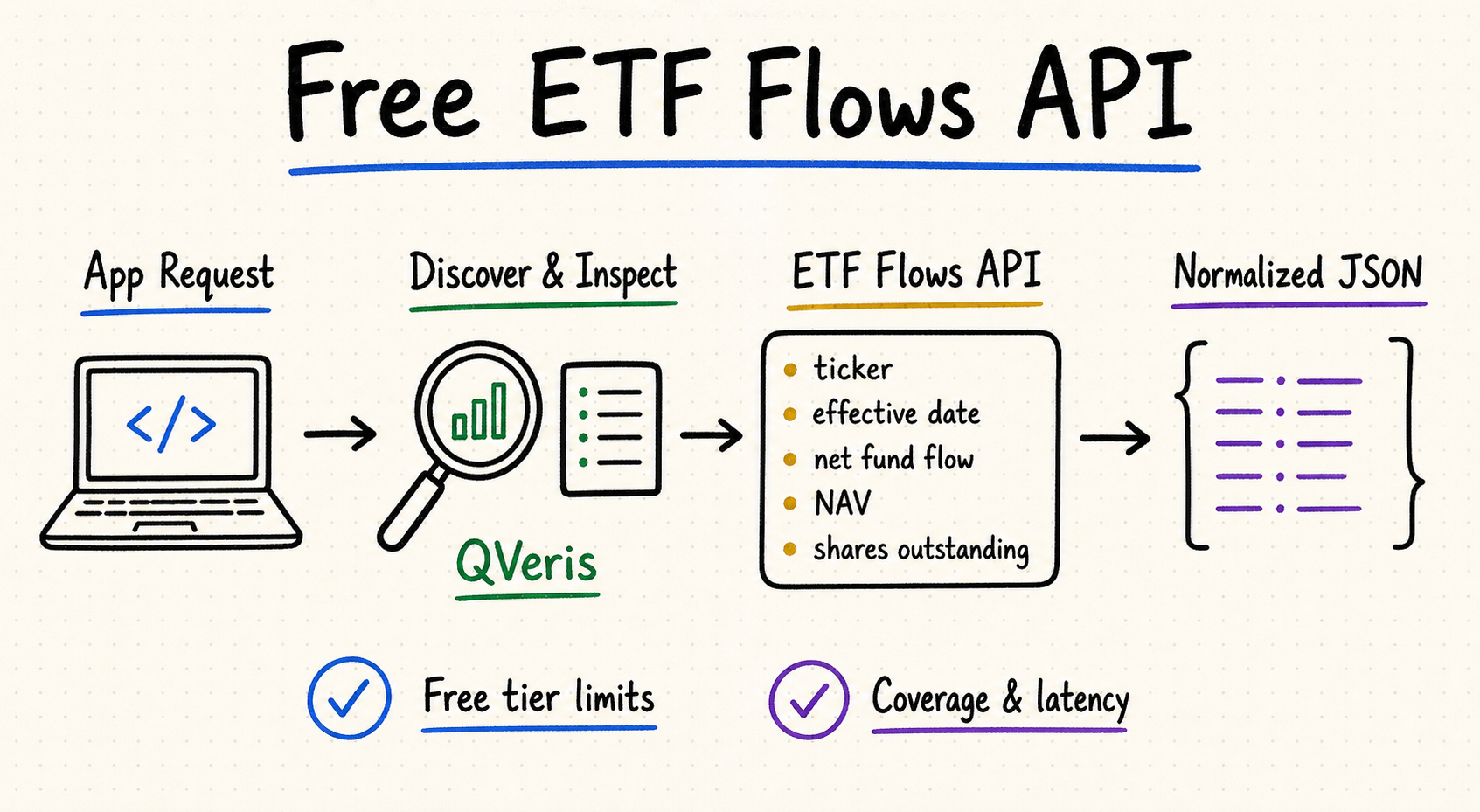
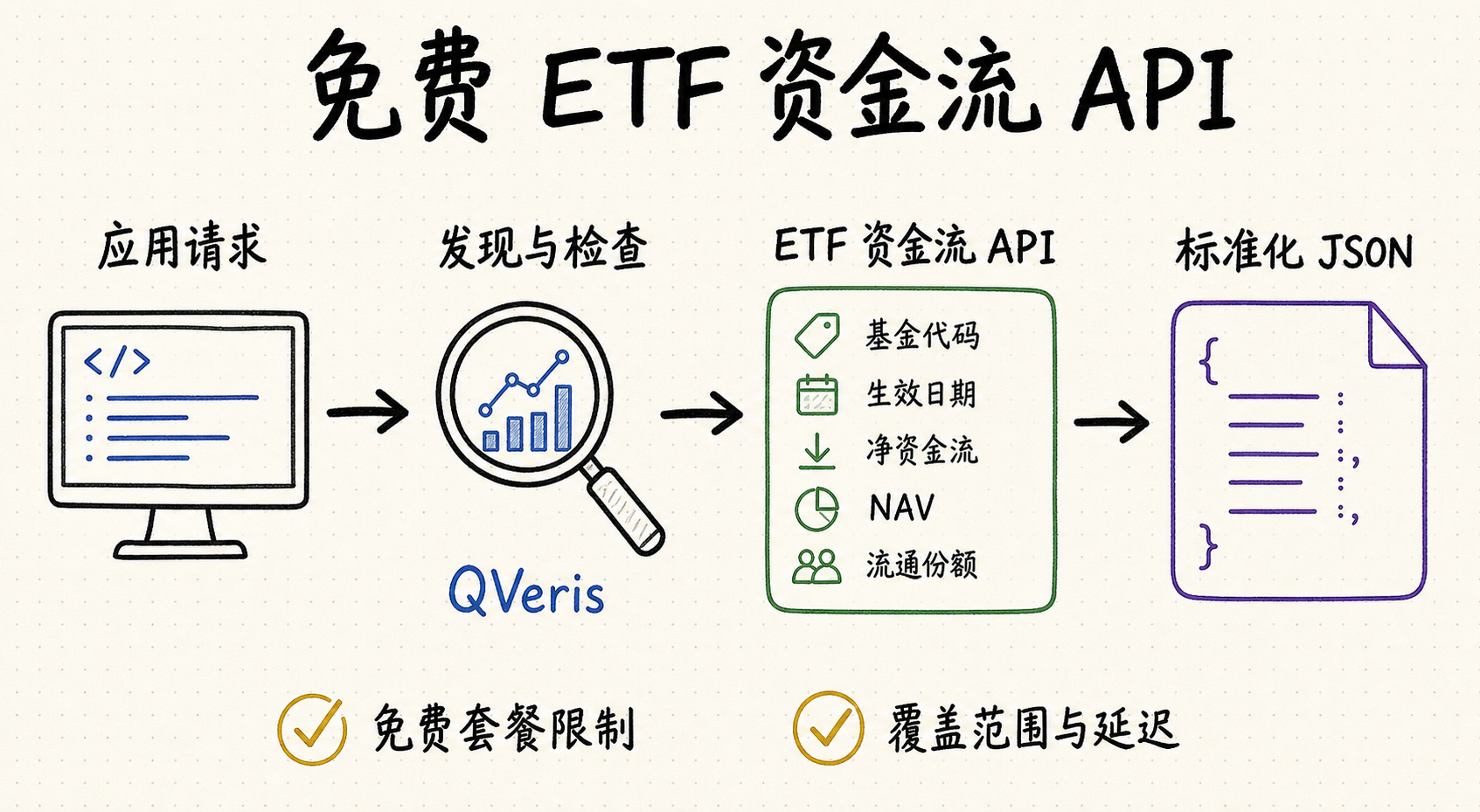
Free ETF flows API: what to expect免费 ETF 资金流 API 能提供什么
Retrieve daily or historical creations and redemptions for the correct fund and share class, with the dates and inputs needed to explain each flow.
Expect stable fund ID, effective and publication dates, shares created or redeemed, shares outstanding, NAV, net flow, currency, methodology, and revision.
Confirm request quotas, delayed data, history depth, coverage, attribution, and commercial-use rights before production use.
ETF flows reflect primary-market share creation and redemption. They are not secondary-market turnover, investor buy-versus-sell volume, performance-driven AUM change, or a holdings-change feed.
为正确基金与份额类别获取每日或历史申购赎回,并保留能够解释每笔资金流的日期与计算输入。
通常需要稳定基金 ID、生效与发布日期、申购或赎回份额、流通份额、NAV、净流量、币种、算法和修订号。
正式使用前应核对调用额度、延迟、历史深度、覆盖范围、署名与商业使用许可。
ETF 资金流反映一级市场份额申购赎回,不等于二级市场换手、投资者主动买卖量、价格推动的规模变化,也不是持仓变化数据。
What ETF fund flow data actually measuresETF 资金流数据实际衡量什么
ETF fund flows estimate capital entering or leaving a fund through share creation and redemption. A positive value generally indicates inflow; a negative value indicates outflow. The effective date matters because a provider may process or publish the observation later.
ETF 资金流通过基金份额的申购与赎回来衡量资金进入或离开。正值通常表示流入,负值通常表示流出。生效日期尤其重要,因为供应商可能在之后才处理或发布这条记录。
Some datasets report issuer-supplied flow; others estimate it from the change in shares outstanding multiplied by NAV or another price. That estimate must define whether the share change is adjusted for splits, which day's NAV is used, how currency is converted, and how a missing or revised share count is handled. Two providers can disagree without either using a simple arithmetic error.
有些数据集直接使用发行人提供的资金流,另一些则以流通份额变化乘以 NAV 或其他价格进行估算。估算方法必须说明份额变化是否做拆分调整、使用哪一天的净值、怎样换算币种,以及份额数缺失或修订时如何处理。两个供应商结果不同,并不一定只是简单计算错误。
Daily ETF inflows and outflows versus trading volume每日 ETF 流入流出与成交量的区别
Trading volume counts secondary-market shares changing hands. It can be high even when fund shares outstanding do not change. For a daily ETF fund flows API, inspect whether the value is directly supplied, calculated from shares outstanding and NAV, or revised after issuer files arrive.
成交量统计二级市场换手,即使基金流通份额不变,成交量也可能很高。评估每日 ETF 资金流 API 时,要确认资金流是直接提供、通过流通份额与 NAV 推算,还是会在发行人文件到达后修订。
Historical ETF flow data and revision handling历史 ETF 资金流与修订处理
Store both effective and processed dates when available. This avoids look-ahead bias in backtests and makes delayed issuer reporting visible. Also record currency and unit metadata rather than assuming every response is in U.S. dollars.
如果接口提供,应同时保存生效日期和处理日期,以减少回测中的前视偏差,并显式呈现发行人延迟。还应保存币种和单位,不要假设所有响应都以美元计价。
Fund flow versus change in AUM资金流与资产规模变化的区别
AUM can rise because the portfolio appreciated even when no new shares were created, and it can fall because of market losses without a redemption. To isolate flow, use share changes and a documented valuation basis, then keep performance, distributions, FX, and flow as separate explanatory components.
即使没有新份额申购,组合上涨也会推高资产规模;即使没有赎回,市场下跌也会让规模减少。识别资金流应使用份额变化和明确估值基准,并把绩效、分派、汇率和资金流作为不同解释项保存。
An ETF moves from 10 million to 11 million shares outstanding. Using the prior NAV of $24.00 produces an estimated inflow of $24 million; using the current NAV of $25.20 produces $25.2 million. Both calculations use the same one-million-share creation but differ by $1.2 million because the valuation point differs. The response should therefore expose the share-count dates, NAV date, chosen formula, currency, and whether the value is issuer-reported or vendor-estimated.
假设某 ETF 的流通份额从 1,000 万份增加到 1,100 万份。若使用前一日 24.00 美元的 NAV,估算流入为 2,400 万美元;若使用当日 25.20 美元的 NAV,结果为 2,520 万美元。同样是新增 100 万份,仅因估值时点不同,结果就相差 120 万美元。因此,接口应给出两个份额快照日期、NAV 日期、计算公式、币种,以及该数值来自发行人还是供应商估算。
Check whether ending AUM can be explained by beginning AUM, net creations or redemptions, portfolio return, distributions, FX translation, fees, and known revisions. Treat the remaining difference as an unresolved residual.
If shares double because of a 2-for-1 split while economic units stay unchanged, a raw share-count difference must not become an inflow. Apply the split factor before measuring creations.
Zero flow means the source reports no net creation or redemption. A missing share snapshot, late issuer file, unsupported fund, or failed calculation must remain unknown.
检查期末规模能否由期初规模、净申购赎回、组合收益、分派、汇率换算、费用与已知修订共同解释;剩余差额应标记为尚未解释,不能强行归入资金流。
如果基金份额因 1 拆 2 而翻倍,但经济单位没有变化,原始份额差额不能被算成流入。必须先应用拆分因子,再测量申购份额。
零资金流表示来源明确报告没有净申购赎回;份额快照缺失、发行人文件延迟、基金不受支持或计算失败时,都应保留为未知。
How to evaluate a free ETF flow data API如何评估免费 ETF 资金流数据 API
| Check检查项 | What to verify需要核对 | Why it matters重要原因 |
|---|---|---|
| Coverage覆盖范围 | Markets, active and delisted funds, asset classes, ticker history.市场、存续与退市基金、资产类别、代码历史。 | Prevents silent gaps in comparisons and backtests.避免比较和回测出现无提示的数据缺口。 |
| Freshness更新时效 | Effective date, processed date, delay, revision policy.生效日期、处理日期、延迟与修订规则。 | A “daily” endpoint may still publish delayed observations.“每日”接口仍可能发布延迟数据。 |
| Fields字段 | Net flow, NAV, shares outstanding, currency, units, identifiers.净资金流、NAV、流通份额、币种、单位与标识符。 | Supports validation and provider switching.便于校验和切换供应商。 |
| Free limits免费限制 | Quota, history depth, attribution, caching, commercial use.额度、历史深度、署名、缓存与商业使用。 | A trial is not always a durable free tier.试用不一定等于长期免费套餐。 |
| Operations运行质量 | Authentication, pagination, errors, rate-limit headers, support.鉴权、分页、错误、限流响应头与支持渠道。 | Determines production reliability and maintenance effort.决定生产可靠性与维护成本。 |
| Methodology计算方法 | Direct or estimated flow, share-change rule, NAV date, split and FX handling.直接或估算、份额变化规则、净值日期、拆分与汇率处理。 | Makes provider differences explainable.使供应商差异可以解释。 |
| Identity基金身份 | Fund, share class, listing, stable ID, ticker history, mergers.基金、份额类别、上市、稳定 ID、代码历史与合并。 | Prevents double counting and broken histories.避免重复计算和历史断裂。 |
| Revisions修订 | First publication, processed time, version, correction reason.首次发布、处理时间、版本与更正原因。 | Supports point-in-time research and audit.支持时点研究与审计。 |
Integrate historical and daily ETF flows data接入历史与每日 ETF 资金流数据
Step 1: inspect an ETF fund flows endpoint步骤 1:检查 ETF 资金流接口
Read the provider schema before coding. Confirm required ticker and date filters, pagination, whether zero and null have different meanings, and whether the endpoint exposes processed date separately from effective date.
编码前先阅读供应商 Schema。确认代码与日期筛选、分页方式、零值和空值是否含义不同,以及接口是否分别提供处理日期与生效日期。
Step 2: normalize the response步骤 2:标准化响应
Map provider fields into a stable internal model such as ticker, effective_date, processed_date, net_flow, currency, nav, and shares_outstanding. Preserve the raw response for audit and troubleshooting.
把供应商字段映射到稳定的内部模型,例如 ticker、effective_date、processed_date、net_flow、currency、nav 和 shares_outstanding,同时保留原始响应供审计与排障。
Step 3: validate before production use步骤 3:生产使用前校验
Test several liquid and less-liquid tickers across inflow, outflow, zero, missing, and revised days. Log rate-limit responses, cache according to license terms, and alert on unexpected schema or unit changes.
选择流动性高低不同的 ETF,覆盖流入、流出、零值、缺失值和修订日期。记录限流响应,按许可条款缓存,并对 Schema 或单位的意外变化告警。
Step 4: independently rebuild estimated flows步骤 4:独立重算估算资金流
Where the methodology permits, calculate the change in adjusted shares and multiply by the documented NAV basis. Compare signs, dates, currency, and rounding; do not force agreement when the provider uses direct creation-unit data or later corrections.
在方法允许时,用复权后的份额变化乘以文档规定的净值基准,比较正负号、日期、币种和舍入;如果供应商使用直接申赎单位数据或后续更正,则不应强行要求完全一致。
Step 5: aggregate without mixing data availability步骤 5:聚合时保留数据可得时间
Build weekly or monthly totals from daily effective dates, but carry publication and revision times. A period total used in a backtest must include only observations available by the simulated decision time.
周度或月度总量可以按每日生效日期聚合,但必须继续保留发布时间和修订时间。回测使用的期间总量,只能包含模拟决策时点已经可得的观测。
Step 6: monitor identity and continuity步骤 6:监控基金身份与连续性
Flag unexplained sign reversals, duplicated dates, missing business days, large flows without share-count changes, ticker changes, fund mergers, liquidations, and currency switches. Preserve raw and revised versions instead of overwriting history.
标记无法解释的正负反转、重复日期、缺失工作日、份额未变却出现大额资金流、代码变更、基金合并、清盘和币种切换,并保留原始与修订版本,不能覆盖历史。
Use QVeris to find and call ETF data capabilities用 QVeris 查找并调用 ETF 数据能力
QVeris helps developers and agents discover, inspect, and call available financial-data capabilities. Use the QVeris provider details to assess relevant providers, then inspect inputs and outputs before wiring a capability into your application.
QVeris 帮助开发者与 Agent 发现、检查并调用可用的金融数据能力。先通过QVeris 服务商详情评估相关供应商,再检查输入输出后接入应用。
- Search for ETF fund-flow capabilities instead of assuming a general market-data API includes flows.
- Inspect fund identity, direct-versus-estimated methodology, share and NAV dates, units, revision model, required parameters, fields, and limits before calling.
- Require effective and publication date ranges, currency, aggregation window, revision policy, and raw calculation inputs in the tool request.
- Keep provider-specific methodology behind a normalized, revision-aware application interface so it can be audited or replaced.
- 明确查找 ETF 资金流能力,不要默认通用行情 API 一定包含资金流。
- 调用前检查基金身份、直接或估算方法、份额与净值日期、单位、修订模型、必填参数、字段与限制。
- 在工具请求中明确生效与发布日期范围、币种、聚合窗口、修订规则和原始计算输入。
- 把供应商特定方法放在标准化、可识别修订的应用接口之后,便于审计或替换。
FAQ
Some providers advertise free access, free plans, trials, or free datasets. Verify current quotas, history, licensing, and whether fund-flow endpoints are included rather than only ETF profiles or prices.
Useful responses include ticker, effective date, processed date, net fund flow, NAV, shares outstanding, currency, units, and source or revision metadata.
Flows are commonly derived from changes in shares outstanding multiplied by an appropriate NAV measure, though vendor methodology and revision handling differ.
Many specialist endpoints support ticker and date filters, but history depth, delisted-fund coverage, corrections, and pagination vary by provider.
No. Volume measures secondary-market trading; fund flow reflects primary-market creations and redemptions that change shares outstanding.
No. QVeris can help discover and inspect available capabilities, but provider availability, pricing, limits, and licensing remain provider-controlled and can change.
No. AUM also changes with portfolio returns, distributions, and FX. Flow is tied to creation or redemption of shares and should be separated from performance-driven asset changes.
They may use direct issuer records or estimates, different share-count snapshots, NAV dates, split adjustments, FX, publication cutoffs, and revisions. Compare methodology and raw inputs before judging the result.
Not necessarily. Creations can support inventory, hedging, arbitrage, or allocation changes, and flow says nothing by itself about future return. Interpret it with mandate, market context, price, volume, and holdings.
部分供应商提供免费套餐、试用或免费数据集。需要核对当前额度、历史范围、许可,以及免费范围是否真的包含资金流接口,而不只是 ETF 基本资料或价格。
实用字段包括代码、生效日期、处理日期、净资金流、NAV、流通份额、币种、单位,以及来源或修订元数据。
常见方法是用流通份额变化乘以适当的 NAV 指标,但不同供应商的方法和修订处理可能不同。
许多专业接口支持代码和日期筛选,但历史深度、退市基金覆盖、修正数据与分页方式因供应商而异。
不一样。成交量衡量二级市场交易;资金流反映会改变流通份额的一级市场申购和赎回。
不能。QVeris 可以帮助发现和检查能力,但供应商的可用性、价格、限制与许可由供应商控制,并可能变化。
不等于。资产规模还会受到组合收益、分派和汇率影响;资金流与份额申购赎回相关,应与价格推动的规模变化分开。
它们可能使用发行人直接记录或估算、不同份额快照、净值日期、拆分调整、汇率、发布截止点和修订。判断前应比较方法与原始输入。
不一定。申购可能用于库存、对冲、套利或配置调整,资金流本身也不能预测未来收益。应结合基金目标、市场环境、价格、成交量和持仓理解。