
Free ETF IOPV API
Data, Fields & Validation免费 ETF 实时参考净值 API
数据、字段与验证方法
Find, evaluate, and integrate a free ETF IOPV API without confusing IOPV with official NAV, market price, holdings, or fund flows.
查找、评估并接入免费的 ETF 实时参考净值 API,明确区分 IOPV、正式净值、市场价格、持仓与资金流数据。
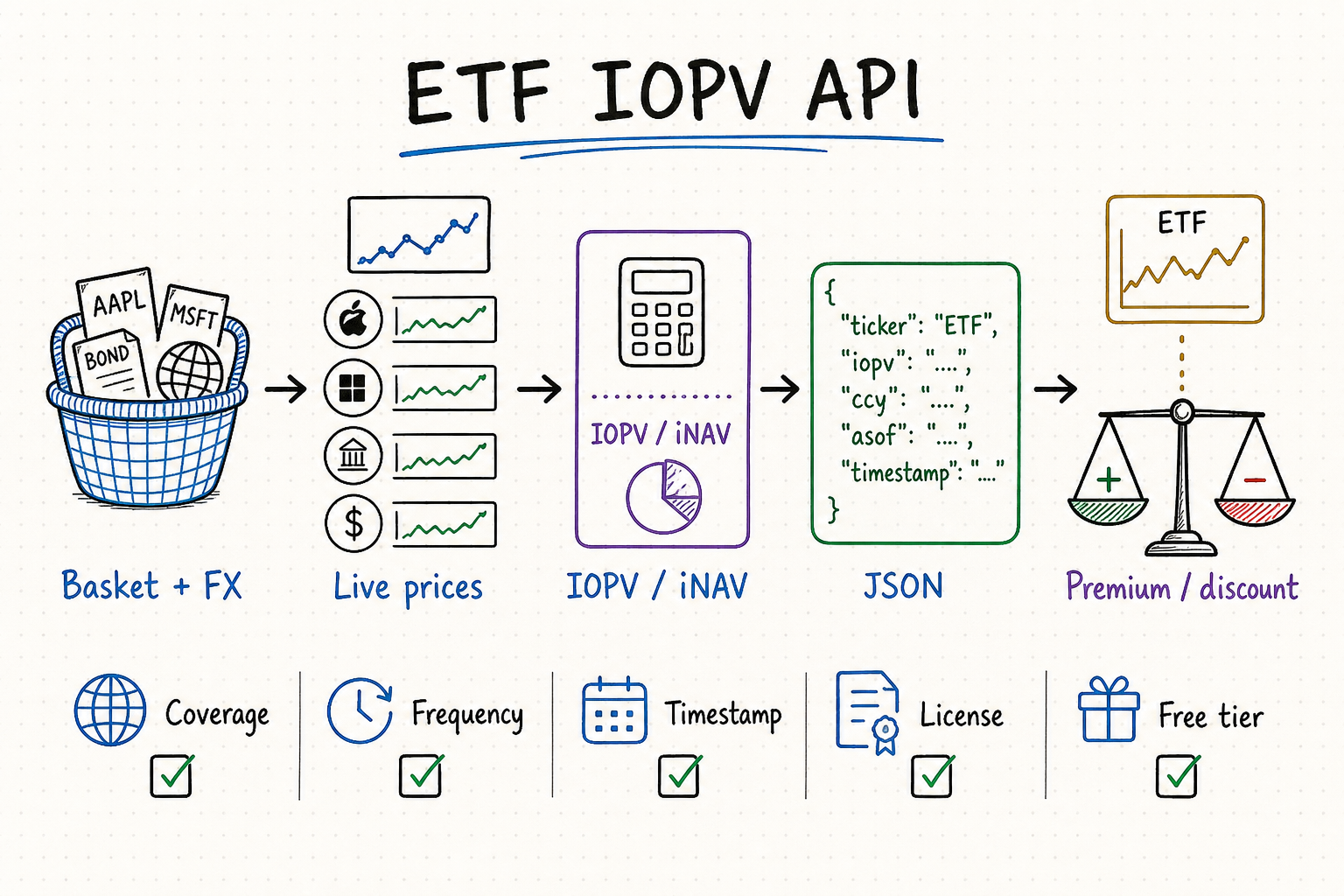
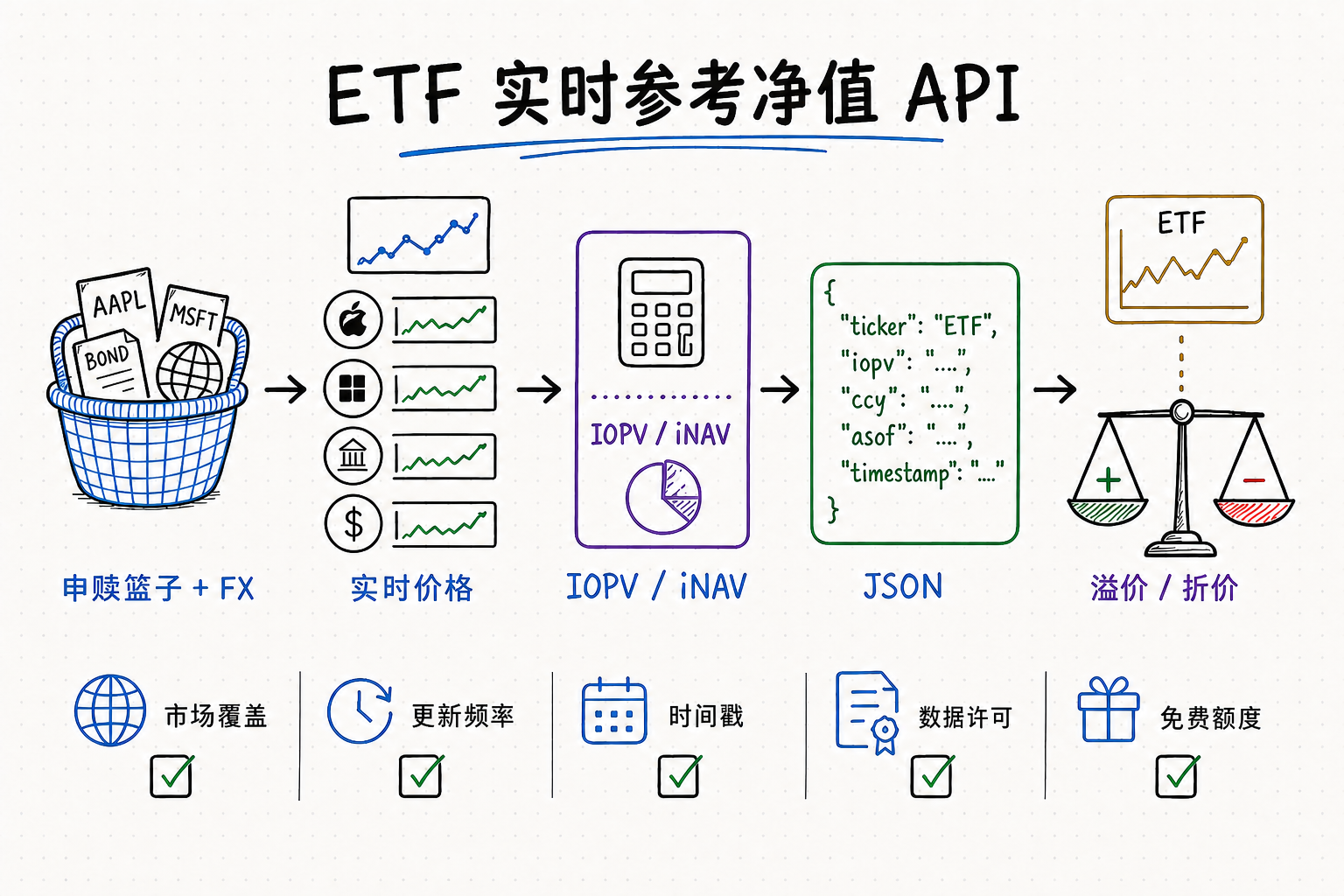
Free ETF IOPV API: what developers are looking for免费 ETF 实时参考净值(IOPV)API:开发者真正需要什么
A useful endpoint returns an ETF intraday indicative value plus enough metadata to decide whether that value is current and comparable. IOPV is also described as iNAV, IIV, intraday indicative value, or indicative optimized portfolio value. It is an estimate, not the fund’s final official NAV.
可用的接口不仅要返回 ETF 盘中参考净值,还要提供足够的元数据,帮助判断该数值是否及时、是否可以比较。IOPV 也常被称为 iNAV、IIV 或基金份额参考净值;它是盘中估算值,不等于基金正式公布的单位净值。
Its usefulness depends on the calculation inputs, not only the update interval. The basket may contain securities whose markets are closed, thin, halted, or priced through a proxy; foreign-currency assets require an FX observation; bonds and derivatives may rely on evaluated or modeled prices. A value refreshed every few seconds can still carry old economic information.
IOPV 是否有用,取决于计算输入,而不只取决于刷新间隔。申赎篮子中的证券可能已经休市、成交稀疏、停牌或使用代理价格;外币资产还需要汇率观测;债券和衍生品可能依赖估值或模型价格。因此,即使数值每几秒更新一次,底层经济信息仍可能陈旧。
Find a documented indicative-value feed, understand its basket and pricing methodology, verify effective freshness, and test whether the license supports the intended display or analysis.
An ETF price, holdings, or daily NAV endpoint does not automatically provide IOPV—and an IOPV should not be presented as executable fair value or guaranteed arbitrage.
找到有文档的参考净值数据源,理解其篮子与定价方法,验证实际时效,并确认许可是否允许目标展示或分析用途。
ETF 行情、持仓或每日净值端点并不必然提供 IOPV;IOPV 也不能被描述成可执行公允价值或必然套利机会。
ETF indicative value API fields and related entitiesETF 实时参考净值 API 字段与相关实体
| Field or entity字段或实体 | Why it matters作用 | Validation question验证问题 |
|---|---|---|
| symbol / exchange | Identifies the fund and listing venue.确定基金与上市交易所。 | Is the identifier exchange-qualified?代码是否包含交易所信息? |
| iopv / inav / iiv | Carries the intraday indicative estimate.承载盘中参考净值估算。 | Is it truly IOPV rather than last price or NAV?它是否真是 IOPV,而非最新价或单位净值? |
| timestamp / asOf | Shows when the value was calculated or published.说明计算或发布时间。 | What timezone and freshness guarantee apply?使用哪个时区,时效承诺是什么? |
| currency / FX | Matters for cross-market baskets and conversions.跨市场篮子和汇率换算需要该信息。 | Which FX source and timestamp are used?使用哪个汇率源和时间点? |
| market price | Enables a premium or discount comparison.用于计算市场价相对参考净值的溢折价。 | Are price and IOPV timestamps aligned?市场价与 IOPV 的时间戳是否对齐? |
| status / quality | Signals stale, halted, estimated, or unavailable data.标记陈旧、停牌、估算或不可用数据。 | Can stale data be detected programmatically?能否通过程序识别陈旧数据? |
| basket / methodology | Explains the positions, proxies, and calculation basis.说明篮子头寸、代理价格和计算基础。 | Does the feed disclose the basket date and methodology version?是否披露篮子日期与方法版本? |
| component freshness | Shows whether underlying prices are open, closed, stale, or modeled.说明底层价格是开市、休市、陈旧还是模型估值。 | Can the newest IOPV hide old component inputs?最新 IOPV 是否可能掩盖陈旧成分输入? |
| calculatedAt / publishedAt / receivedAt | Separates computation, distribution, and ingestion delay.区分计算、发布与接收延迟。 | Which time drives the freshness rule?时效规则应使用哪个时间? |
How to evaluate a free ETF IOPV API如何评估免费 ETF 实时参考净值 API
Confirm that the endpoint returns IOPV, iNAV, or IIV
Read the field definition. A generic ETF quote or daily net asset value is not a substitute for an intraday indicative value.
Check market coverage and calculation frequency
Verify supported exchanges and funds, trading-session behavior, delayed versus real-time status, update cadence, and treatment of foreign-market or closed components.
Inspect free-tier and licensing limits
Record authentication, request quotas, redistribution rights, attribution rules, commercial-use restrictions, and whether the “free” offer is a trial.
Validate timestamps and premium or discount logic
Compare aligned timestamps and currencies. Treat a large gap as a signal to investigate stale components, FX, trading halts, or methodology—not as guaranteed arbitrage.
Inspect basket and proxy-price methodology
Determine whether the calculation uses the current creation basket, last disclosed holdings, cash substitutions, evaluated bond prices, futures, ADRs, or other proxies. Record the basket date and methodology version with every observation.
Measure effective rather than headline freshness
Track value calculation, publication, receipt, market-price, FX, and component timestamps separately. The oldest material input can be more relevant than the newest top-level IOPV timestamp.
确认接口返回 IOPV、iNAV 或 IIV
逐项阅读字段定义。普通 ETF 最新价或每日单位净值不能替代盘中实时参考净值。
检查市场覆盖与计算频率
核对交易所、基金范围、交易时段、实时或延迟状态、更新节奏,以及境外市场休市成分的处理方式。
检查免费额度与数据许可
记录鉴权方式、请求限额、再分发权、署名要求、商业使用限制,以及“免费”究竟是长期额度还是限时试用。
验证时间戳与 ETF 溢折价
只有时间与币种对齐才能合理比较。较大偏差可能来自成分价格陈旧、汇率、停牌或计算方法,不能直接视为套利机会。
检查篮子与代理价格方法
确认计算使用当前申赎篮子、上一披露持仓、现金替代、债券估值、期货、存托凭证还是其他代理,并把篮子日期和方法版本与每条观测一起保存。
衡量实际时效,而不是宣传时效
分别跟踪数值计算、发布、接收、市场价格、汇率和成分时间戳。相比最外层 IOPV 的最新时间,最陈旧的重要输入可能更能决定数据是否可用。
Validate ETF IOPV with aligned prices and explicit quality rules用对齐行情和明确质量规则验证 ETF IOPV
Worked premium or discount exampleETF 溢折价计算示例
Assume an ETF has a bid of 49.96, an ask of 50.04, and an IOPV of 49.90 at the same observation time. The midpoint is 50.00, so the indicative premium is (50.00 ÷ 49.90 − 1) × 100 ≈ 0.20%. The calculation should retain the bid, ask, IOPV, currency, venue, and all timestamps—not just the resulting percentage.
假设某 ETF 同一观测时点的买价为 49.96、卖价为 50.04、IOPV 为 49.90,则买卖中间价为 50.00,参考溢价约为 (50.00 ÷ 49.90 − 1) × 100 ≈ 0.20%。系统应保留买价、卖价、IOPV、币种、交易所和全部时间戳,而不能只保存最后的百分比。
That 0.20% is not automatically executable. A market buy occurs near the ask, a sale near the bid, and both sides may move before an order arrives. If the IOPV is 45 seconds old while the quote is current, or if a material component is halted, label the result stale or incomparable instead of presenting it as a live arbitrage spread.
这 0.20% 并不等于可执行收益:买入通常接近卖价,卖出通常接近买价,订单到达前两侧价格都可能变化。如果 IOPV 已滞后 45 秒,而买卖报价是当前值,或重要成分处于停牌状态,就应把结果标记为陈旧或不可比,而不是展示为实时套利空间。
Cross-market example: a fresh timestamp can still contain stale economics跨市场示例:时间戳很新,经济信息仍可能陈旧
Consider a US-listed ETF holding Japanese equities. During the US session, Tokyo may already be closed. The distributor can refresh IOPV every few seconds by applying a current USD/JPY rate to Japanese closing prices, yet those equity prices do not reflect news released after the Tokyo close. Futures, ADRs, or statistical proxies may improve the estimate, but they also change its methodology and uncertainty.
例如,一只在美国上市、主要持有日本股票的 ETF,在美股交易时段内东京市场可能已经收盘。数据商可以把最新美元兑日元汇率应用到日本股票收盘价,从而每几秒刷新一次 IOPV,但这些股票价格并未反映东京收盘后的新信息。期货、存托凭证或统计代理能够改善估算,却也会改变方法和不确定性。
Where an IOPV feed can come fromIOPV 数据可能来自哪里
| Source route来源路径 | What it can establish可确认的内容 | Main limitation主要限制 |
|---|---|---|
| Exchange or fund documentation交易所或基金文件 | Official symbol, definition, dissemination code, cadence, and methodology notes正式代码、定义、发布标识、刷新节奏与方法说明 | Documentation may not provide a freely callable real-time endpoint文档未必提供可免费实时调用的端点 |
| Licensed market-data vendor授权行情供应商 | Normalized coverage, timestamps, status flags, and operational delivery标准化覆盖、时间戳、状态标记与稳定传输 | Real-time display and redistribution commonly require contracts or fees实时展示与再分发通常需要合同或付费许可 |
| General ETF quote API普通 ETF 行情 API | Last trade, bid, ask, volume, and sometimes daily NAV最新成交、买卖价、成交量,有时包含每日净值 | Those fields do not prove that an intraday indicative value is present这些字段不能证明接口提供盘中参考净值 |
Turn quality metadata into display and rejection rules把质量元数据转化为展示与拒绝规则
Fund, venue, currency, session, and timestamps align; the observation is within the configured age; no material component or FX warnings are present.
The value is delayed, the underlying market is closed, proxies are in use, or a small portion of the basket is stale—but the methodology and limitation are known.
The field definition is ambiguous, currency or listing differs, timestamps cannot be aligned, a material component is halted, or quality status is missing during a stressed market.
基金、市场、币种、时段与时间戳一致,观测值未超过时效阈值,也没有重要成分或汇率警告。
数据存在延迟、底层市场已经休市、使用了代理价格,或少量成分陈旧,但方法和限制能够明确说明。
字段定义含糊、币种或上市地点不同、时间戳无法对齐、重要成分停牌,或压力行情下缺少质量状态。
Integrate real-time ETF IOPV data safely安全接入 ETF 实时参考净值(IOPV)数据
Step 1: inspect the API schema
Discover the operation and confirm required inputs, authentication, response fields, units, nullable values, error codes, and examples before sending production traffic.
Step 2: normalize the response
Map provider-specific names into a stable internal model such as symbol, venue, indicativeValue, currency, calculatedAt, receivedAt, delaySeconds, and qualityStatus.
Step 3: reject stale or incomparable values
Set freshness thresholds by venue, preserve the raw timestamp, align FX and market-price times, and surface missing or halted components instead of silently filling them.
Step 4: calculate a qualified premium or discount
Use an aligned bid, ask, midpoint, or trade price and label the choice. Confirm listing, share class, currency, and session, then attach time gaps and quality flags to the percentage instead of returning a bare number.
Step 5: test stressed and cross-market cases
Sample foreign-market closes, local holidays, component halts, fast FX moves, wide ETF spreads, bond funds, commodity products, and stale baskets. Verify that the integration degrades to “unreliable” rather than manufacturing precision.
Step 6: retain evidence and monitor drift
Store the raw response, calculation and receipt times, methodology, basket date, component-quality summary, FX source, market-price snapshot, and license state. Alert on schema changes, cadence gaps, or a persistent divergence from official NAV.
步骤 1:检查 API Schema
先确认输入、鉴权、响应字段、单位、空值、错误码和示例,再发送生产流量。
步骤 2:标准化响应
把供应商字段映射为稳定的内部模型,例如代码、市场、参考净值、币种、计算时间、接收时间、延迟秒数和质量状态。
步骤 3:拒绝陈旧或不可比数据
按市场设置时效阈值,保留原始时间戳,对齐汇率与行情时间,并明确暴露停牌或缺失成分。
步骤 4:计算带条件说明的溢折价
使用对齐后的买价、卖价、中间价或成交价,并标明选择;确认上市、份额类别、币种和交易时段,再把时间差与质量标记附在百分比旁,而不是只返回裸数值。
步骤 5:测试压力与跨市场场景
覆盖境外市场收市、本地休市、成分停牌、汇率快速变化、ETF 点差扩大、债券基金、商品产品和陈旧篮子,确认系统会降级为“不可靠”,而不是制造虚假精度。
步骤 6:保留证据并监控漂移
保存原始响应、计算与接收时间、方法、篮子日期、成分质量摘要、汇率来源、市场价格快照和许可状态,并监控结构变化、刷新中断或相对官方净值的持续偏离。
Use QVeris to find and call ETF IOPV capabilities使用 QVeris 查找并调用 ETF 实时参考净值能力
QVeris can help an agent discover relevant financial-data capabilities, inspect their schemas, and call an available operation through a consistent workflow. Availability, coverage, pricing, licensing, and data quality remain properties of the selected provider and must be verified before use.
QVeris 可帮助 Agent 发现相关金融数据能力、检查 Schema,并通过一致的工作流调用可用操作。实际可用性、覆盖、价格、许可和数据质量仍取决于所选供应商,使用前必须核验。
- Require the exact indicative-value type, exchange-qualified fund ID, currency, session, maximum age, and quality fields in the capability request.
- Inspect whether the provider exposes basket date, methodology, component freshness, FX source, and separate calculation and receipt times.
- Route stale, halted, cross-market, or methodologically incomparable observations to review instead of converting them into trading instructions.
- 在能力请求中明确参考净值类型、带交易所的基金标识、币种、时段、最大可接受时延和质量字段。
- 检查供应商是否提供篮子日期、计算方法、成分时效、汇率来源,以及独立的计算与接收时间。
- 陈旧、停牌、跨市场或方法上不可比的观测应转人工复核,不能直接转化为交易指令。
Free ETF IOPV API FAQ免费 ETF 实时参考净值 API 常见问题
Is there a free ETF IOPV API?
Some providers may offer trials or limited free access, but real-time exchange-derived indicative values often carry coverage, licensing, or redistribution restrictions. Verify the current plan and field definition.
What is ETF IOPV?
IOPV is an intraday estimate of an ETF’s value based on its basket and current component prices. It is not the official end-of-day NAV and may not equal the traded price.
Is IOPV the same as iNAV or IIV?
The terms often refer to closely related intraday indicative values, but providers and exchanges can use different methodologies and labels. Check the documentation.
How often is ETF IOPV updated?
The cadence depends on the venue and provider. Never infer it from the word “real-time”; inspect the documented frequency and timestamps returned by the endpoint.
Can IOPV be used as an executable fair value?
Not by itself. It is an indicative calculation whose inputs may be stale, modeled, closed, or incomplete. Trading decisions also require current bid, ask, depth, spread, session, and an understanding of the methodology.
Why does IOPV become less reliable for international ETFs?
Underlying markets may be closed while the ETF and FX continue trading. Proxy prices or stale closes can therefore make the estimate lag new information even when the top-level value refreshes frequently.
What timestamps should an IOPV API return?
At minimum, calculation and provider publication times; ideally receipt time, market-price time, FX time, basket date, and a summary of component freshness. One generic timestamp hides important latency.
有免费的 ETF 实时参考净值 API 吗?
部分供应商可能提供试用或有限免费额度,但实时参考净值往往受交易所覆盖、许可和再分发规则限制,应核对当前套餐与字段定义。
ETF 实时参考净值(IOPV)是什么?
IOPV 是根据 ETF 申赎篮子和成分实时价格估算的盘中参考价值,不是正式日终净值,也不一定等于成交价。
IOPV 与 iNAV、IIV 相同吗?
这些名称通常指相近的盘中参考价值,但交易所或供应商可能采用不同标签和方法,必须查看文档。
ETF 实时参考净值多久更新一次?
更新频率取决于市场和供应商。不能只根据“实时”二字推断,应检查文档频率和接口返回的时间戳。
IOPV 可以直接当作可执行公允价值吗?
不可以。它是参考估算,输入可能陈旧、依赖模型、处于休市或不完整。交易判断还需要当前买卖价、盘口深度、点差、时段和对计算方法的理解。
为什么国际 ETF 的 IOPV 可靠性可能更低?
底层市场可能已经休市,而 ETF 与汇率仍在交易。代理价格或陈旧收盘会让估算滞后于新信息,即使最外层数值频繁刷新也是如此。
IOPV API 应返回哪些时间戳?
至少应有计算时间和供应商发布时间,最好还包含接收时间、市场价格时间、汇率时间、篮子日期和成分时效摘要。单一通用时间戳会掩盖关键延迟。