
Free ETF Price API
Quotes, OHLCV & Python免费 ETF 行情 API
报价、K 线与 Python 接入
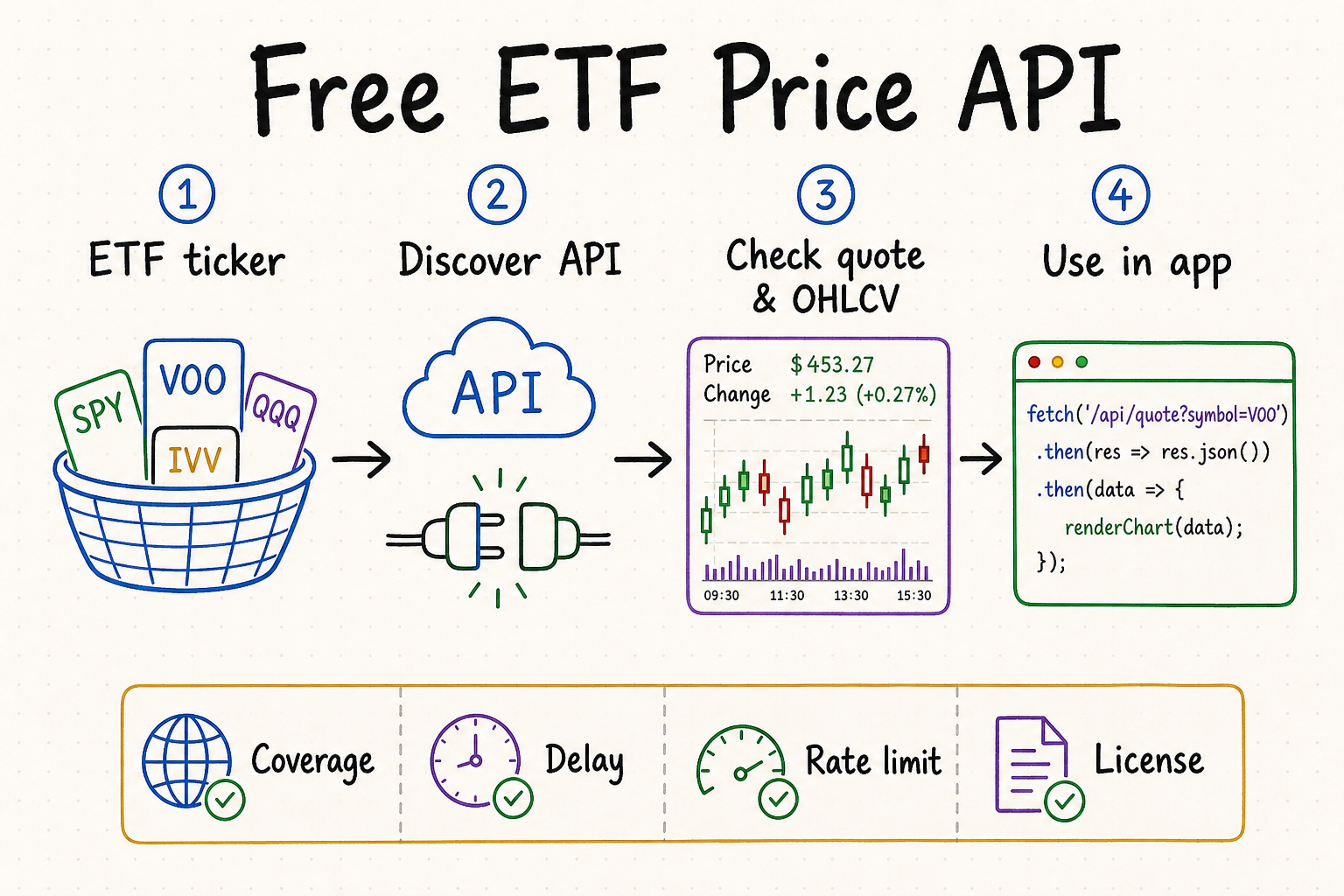
Find a free ETF price API for current quotes or historical OHLCV, then verify coverage, delay, quotas, licensing, and response fields before you build.
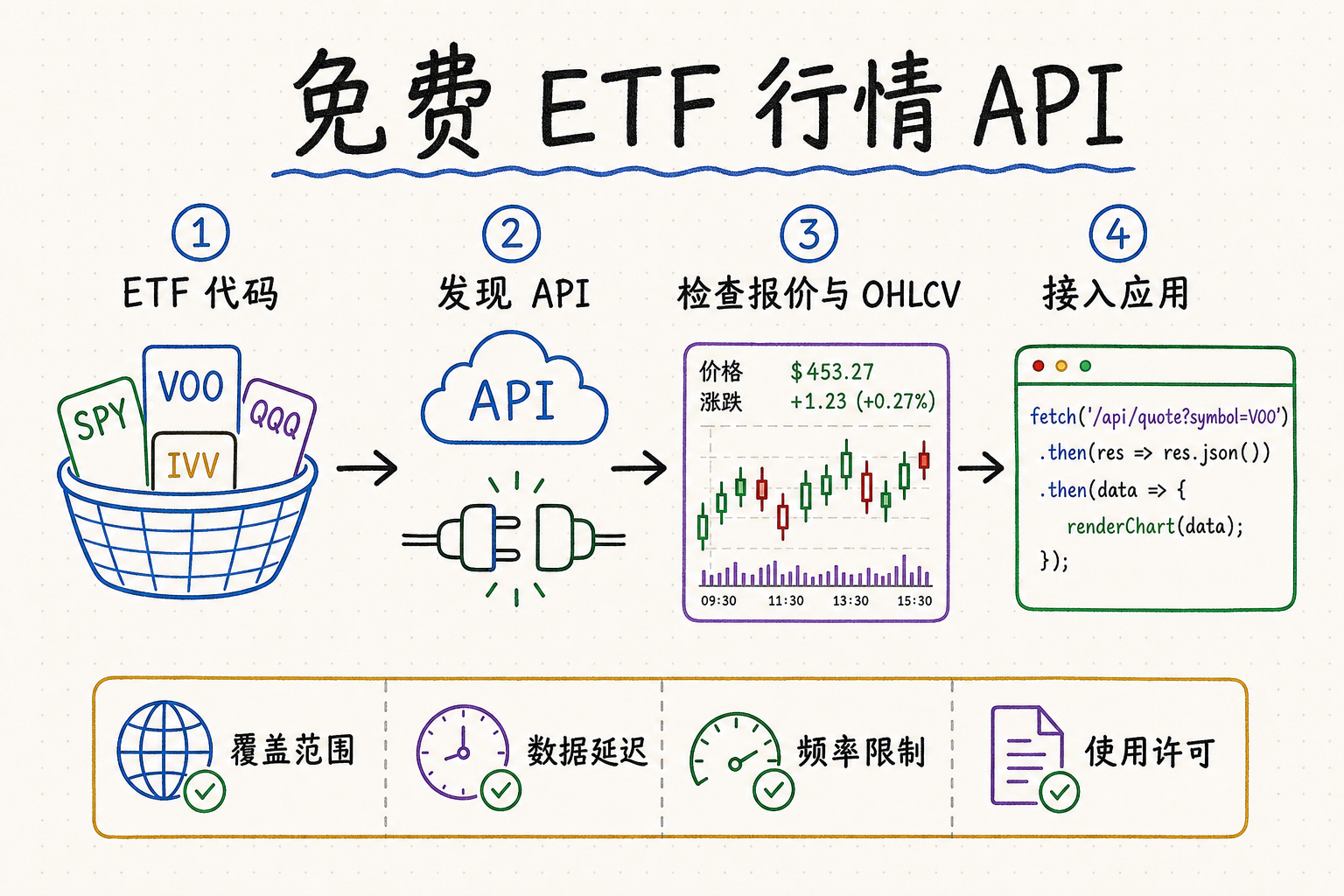
寻找可用的免费 ETF 行情 API,获取实时报价或历史 K 线,
并在接入前核对覆盖范围、延迟、配额、使用许可与响应字段。
TL;DR概览
A free API for ETF prices that returns a current quote, historical bars, or both in a documented response.
Usually a limited tier: delayed data, restricted exchanges, small request quotas, or personal-use licensing.
Coverage, timestamps, adjustment rules, latency, rate limits, redistribution rights, and error behavior.
QVeris helps agents discover and inspect relevant financial-data capabilities before calling them.
找到能返回 ETF 当前报价、历史 K 线或两者兼有的免费接口,并快速验证响应。
通常是受限免费层:延迟行情、交易所范围、调用配额或个人用途许可都可能有限制。
覆盖范围、时间戳、复权规则、行情延迟、频率限制、再分发许可与错误处理。
QVeris 可帮助 Agent 发现并检查相关金融数据能力,再决定是否调用。
Free ETF price API data: quotes versus OHLCV免费 ETF 行情 API:报价与历史 K 线数据
An ETF quote API commonly returns the latest trade or close, change, currency, volume, and a timestamp. An ETF OHLCV API returns open, high, low, close, and volume by interval. Treat “real time” as a claim to verify: free plans may be delayed or limited to specific venues.
ETF 报价 API 通常返回最新成交价或收盘价、涨跌、币种、成交量和时间戳;ETF K 线数据 API 按周期返回开高低收与成交量。不要默认“实时”一定无延迟,免费层可能只提供延迟行情或有限市场。
Decide which market observation the application needs. A last trade can be old, a midpoint depends on a valid bid and ask, an official close follows venue rules, and a bar aggregates transactions under a stated session and interval. Premarket, regular, and after-hours data should not be merged without explicit session labels and comparable volume definitions.
应用必须先明确需要哪一种市场观测。最新成交可能已经陈旧,中间价依赖有效买卖报价,官方收盘遵循交易所规则,K 线则在明确时段与周期内汇总成交。盘前、常规盘和盘后数据不能在缺少时段标签与可比成交量口径时直接混合。
Current ETF quote fields
Check price, previous close, bid/ask when available, volume, exchange, currency, market status, and an explicit provider timestamp.
Historical ETF price API fields
For charts and backtests, confirm interval support, OHLCV history depth, split and dividend adjustments, timezone, and missing-session behavior.
Real-time, delayed, or end-of-day
Record the documented delay for every exchange. A fast HTTP response does not prove that the underlying market observation is live.
Symbol and exchange identity
A ticker can be ambiguous across venues. Prefer a stable instrument identifier plus exchange code when the API supports it.
Trade and quote conditions
Preserve last trade time, bid, ask, sizes, quote time, condition codes, market status, and halt state. Out-of-sequence, corrected, auction, or odd-lot prints may not represent the current executable market.
Raw, adjusted, and total-return history
Keep raw OHLCV separate from split-adjusted, distribution-adjusted, and total-return series. Document whether distributions are reinvested, how volume is adjusted, and when corporate actions become effective.
Fund and listing identity
Separate legal fund, share class, exchange listing, trading currency, and ticker history. Multiple listings may represent the same strategy but have different prices, sessions, FX exposure, liquidity, and data rights.
ETF 当前报价字段
核对价格、昨收、可用时的买卖价、成交量、交易所、币种、市场状态和明确的数据时间戳。
ETF 历史行情 API 字段
用于图表或回测时,要确认周期、历史深度、分红与拆分调整规则、时区以及缺失交易日的处理方式。
实时、延迟还是日终
记录每个市场的官方延迟说明。HTTP 响应很快,并不等于底层行情就是实时数据。
证券代码与交易所身份
同一代码可能出现在不同市场;接口支持时,应同时保存稳定标识符和交易所代码。
成交与报价条件
保存最新成交时间、买卖价与数量、报价时间、条件代码、市场状态和停牌状态。乱序、更正、竞价或零股成交未必代表当前可执行市场。
原始、复权与总回报历史
把原始 OHLCV 与拆分复权、分派复权和总回报序列分开,并说明是否再投资分派、成交量如何调整,以及公司行动何时生效。
基金与上市身份
区分法律基金、份额类别、交易所上市、交易币种和代码历史。多地上市可能代表同一策略,但价格、时段、汇率敞口、流动性和数据权利不同。
How to compare a free ETF market data API如何比较免费 ETF 行情数据 API
| Requirement要求 | What to inspect检查内容 | Why it matters为什么重要 | Failure signal风险信号 |
|---|---|---|---|
| Coverage覆盖范围 | ETF universe, exchanges, currencies, delisted symbols.ETF 标的范围、交易所、币种、退市代码。 | Determines whether your symbols resolve consistently.决定目标代码能否稳定解析。 | “Global” with no venue list.只写“全球”却没有市场清单。 |
| Freshness时效 | Real-time entitlement, delay, update cadence, timestamp.实时权限、延迟、更新频率、时间戳。 | Prevents stale values from being shown as live.避免把过期行情显示为实时。 | No source timestamp.没有数据源时间戳。 |
| Quota配额 | Requests per minute/day, symbol cost, 429 behavior.分钟/每日额度、单次代码成本、429 行为。 | Defines feasible polling and caching.决定轮询和缓存方案是否可行。 | “Unlimited” without policy.宣称“不限量”却无政策说明。 |
| License许可 | Personal, commercial, display, storage, redistribution.个人/商用、展示、存储、再分发许可。 | Market-data rights differ from API access.API 可调用不代表行情可再分发。 | No written usage terms.没有书面使用条款。 |
| Sessions交易时段 | Premarket, regular, after-hours, auctions, holidays.盘前、常规盘、盘后、竞价与休市日。 | Controls baselines, bars, and displayed freshness.决定基准价、K 线与所示时效。 | All prints share one unlabeled timeline.所有成交混在无标签时间线中。 |
| Conditions条件代码 | Trade and quote conditions, corrections, halts, sequence.成交与报价条件、更正、停牌和顺序。 | Separates valid market state from exceptional prints.区分有效市场状态与异常成交。 | No way to identify stale or corrected values.无法识别陈旧或更正数据。 |
| Adjustments复权 | Splits, distributions, raw versus adjusted fields, version.拆分、分派、原始与复权字段、版本。 | Prevents false returns and broken histories.避免虚假收益与历史断点。 | Only one unexplained close series.只有一条无口径说明的收盘序列。 |
ETF price API for Python: a safe integration pathPython 获取 ETF 行情:安全接入步骤
Map the provider response into the fields below before displaying a quote. This validator treats the source timestamp—not HTTP arrival speed—as the freshness clock and returns a midpoint only for a non-crossed, sufficiently recent market.
展示报价前,先把供应商响应映射为下面使用的字段。校验器以数据源时间戳而不是 HTTP 到达速度判断时效;只有买卖价没有倒挂且报价足够新时,才返回中间价。
from datetime import datetime, timezone
from decimal import Decimal, InvalidOperation


def parse_time(value: str) -> datetime:
    parsed = datetime.fromisoformat(value.replace("Z", "+00:00"))
    if parsed.tzinfo is None:
        raise ValueError("source timestamp must include a timezone")
    return parsed


def validate_etf_quote(quote: dict, max_age_seconds: int = 60) -> dict:
    required = {
        "instrument_id", "symbol", "exchange", "currency",
        "session", "market_status", "source_timestamp", "bid", "ask"
    }
    missing = required - quote.keys()
    if missing:
        raise ValueError(f"missing quote fields: {sorted(missing)}")
    try:
        bid = Decimal(str(quote["bid"]))
        ask = Decimal(str(quote["ask"]))
        last = None if quote.get("last") is None else Decimal(str(quote["last"]))
    except InvalidOperation as exc:
        raise ValueError("quote contains a non-numeric price") from exc
    if bid <= 0 or ask <= 0 or (last is not None and last <= 0):
        raise ValueError("prices must be positive")
    if bid > ask:
        raise ValueError("crossed market: bid is above ask")

    source_time = parse_time(quote["source_timestamp"])
    now = datetime.now(timezone.utc)
    age_seconds = (now - source_time.astimezone(timezone.utc)).total_seconds()
    if age_seconds < 0:
        raise ValueError("source timestamp is in the future")
    is_live_session = quote["market_status"] == "open"
    is_stale = is_live_session and age_seconds > max_age_seconds
    return {
        "instrument_id": quote["instrument_id"],
        "midpoint": (bid + ask) / Decimal("2"),
        "last_trade": last,
        "spread": ask - bid,
        "source_time": source_time,
        "age_seconds": age_seconds,
        "is_stale": is_stale,
        "session": quote["session"],
    }
Do not silently substitute values. If the quote is stale or the market is crossed, return that state and preserve the last trade separately. Falling back from bid/ask to last without changing the label turns a validation failure into a plausible but misleading “current price.”
不能静默替换数值。若报价陈旧或买卖倒挂,应返回相应状态,并把最新成交单独保存。验证失败后若直接用 last 代替买卖报价,却不改变字段标签,就会把异常包装成看似合理但具有误导性的“当前价格”。
1. Confirm the ETF symbol and venue
Resolve the instrument first. Store the exchange, currency, and provider identifier instead of relying only on a display ticker.
2. Request one quote and one OHLCV series
Use the provider’s documented Python or HTTP example. Start with one symbol and inspect the unmodified JSON before building a mapper.
3. Validate timestamps and numeric fields
Parse timestamps with timezone awareness; reject missing prices; distinguish null from zero; and keep raw plus adjusted close separate.
4. Add caching, backoff, and provenance
Respect documented quotas, back off after 429 responses, cache by data cadence, and retain provider and retrieval timestamps.
5. Rebuild bars and returns on event days
Test distributions, splits, ticker changes, listing moves, halts, auctions, and half sessions. Recompute returns from raw and adjusted data and verify that intraday bars use the intended session and timezone.
6. Monitor quote quality and continuity
Flag crossed or locked markets, stale timestamps, impossible OHLC relationships, duplicate bars, missing sessions, negative volume, and discontinuities not explained by corporate actions. Preserve condition codes for investigation.
7. Store point-in-time evidence
Keep the raw response, provider timestamp, receipt time, entitlement, session, listing ID, condition codes, adjustment version, and retrieval code. Historical revisions should not silently overwrite the values used by earlier research.
1. 确认 ETF 代码与交易所
先解析具体标的,保存交易所、币种和供应商标识符,不要只依赖展示代码。
2. 分别请求报价与 K 线
使用供应商文档里的 Python 或 HTTP 示例,从单个代码开始,先检查原始 JSON 再设计映射。
3. 验证时间戳与数值字段
按时区解析时间戳,拒绝缺失价格,区分空值与零,并分别保存原始收盘价与复权收盘价。
4. 添加缓存、退避与来源记录
遵守配额,遇到 429 时退避,按数据更新频率缓存,并保留供应商与抓取时间。
5. 在事件日重建 K 线与收益
测试分派、拆分、代码变更、转板、停牌、竞价和半日交易,用原始与复权数据重算收益,并确认盘中 K 线使用目标时段和时区。
6. 监控报价质量与连续性
标记买卖倒挂或锁定、陈旧时间戳、不可能的 OHLC 关系、重复 K 线、缺失交易日、负成交量,以及无法由公司行动解释的断点,并保留条件代码供排查。
7. 保存时点证据
保留原始响应、供应商时间、接收时间、行情权限、时段、上市 ID、条件代码、复权版本和抓取代码;历史修订不能无声覆盖早期研究实际使用的数值。
Use QVeris to discover ETF quote API capabilities用 QVeris 发现 ETF 报价 API 能力
QVeris is a capability-routing layer, not an ETF exchange or a promise of free real-time entitlements. It can help an agent search for relevant financial-data capabilities, inspect their inputs and outputs, and call a selected tool under that tool’s documented terms.
QVeris 是能力路由层,不是 ETF 交易所,也不承诺提供免费的实时行情权限。它可以帮助 Agent 搜索相关金融数据能力、检查输入输出,并遵循目标工具的公开条款进行调用。
- Open the QVeris provider details for quote and historical-price capabilities.
- Inspect identifiers, venue, session, quote or bar type, timestamps, condition codes, adjustment policy, response schema, and stated limitations before calling.
- Require the exact listing, currency, data type, interval, session, freshness tolerance, and raw-versus-adjusted choice in the tool request.
- Use the QVeris documentation to connect the selected capability while preserving source evidence and safe failure states.
- 在 QVeris 服务商详情中查找报价与历史行情能力。
- 调用前检查标识、市场、时段、报价或 K 线类型、时间戳、条件代码、复权规则、响应结构和公开限制。
- 在工具请求中明确上市、币种、数据类型、周期、时段、时效容忍度和原始或复权选择。
- 参考 QVeris 文档接入选定能力,并保留来源证据与安全失败状态。
Free ETF price API FAQ免费 ETF 行情 API 常见问题
Is there a free API for ETF prices?
Yes. Some services offer free tiers for ETF quotes or historical prices. Verify supported exchanges, delay, request limits, and usage rights because “free” rarely means unrestricted.
Can I get real-time ETF prices via API?
Sometimes, but exchange entitlements and plan rules vary. Confirm the provider’s written latency and timestamp rather than inferring freshness from response speed.
Which API provides historical ETF prices?
Several market-data APIs expose ETF OHLCV history. Choose by exchange coverage, interval, depth, adjustment method, quota, and license—not by history length alone.
What should I compare in a free ETF API?
Compare coverage, quote fields, OHLCV intervals, timestamps, corporate-action adjustments, limits, authentication, reliability, storage, display, and redistribution terms.
Is the last ETF trade the current price?
It is the most recent reported transaction, which may be old or carry a special condition. For an executable view, inspect current bid, ask, sizes, quote time, session, and halt status alongside the last trade.
Should ETF historical prices be adjusted for distributions?
It depends on the task. Preserve raw prices for market reconstruction and a separately documented adjusted or total-return series for performance analysis; never replace one with the other without a label.
Why do two ETF price APIs show different closes?
They may use different venues, official versus last-trade closes, sessions, timestamps, correction states, consolidation rules, or adjustment versions. Compare the listing and raw event records first.
有免费的 ETF 行情 API 吗?
有些服务提供免费报价或历史行情额度,但通常限制市场、延迟、调用频率或用途,接入前应阅读公开条款。
如何用 API 获取 ETF 实时价格?
先确认代码与市场,再调用报价端点并检查行情时间戳。不要仅凭响应速度判断数据是否实时。
ETF 历史行情 API 返回哪些字段?
常见字段包括时间、开盘、最高、最低、收盘、成交量,也可能包含复权收盘价;具体结构以供应商文档为准。
免费 ETF API 有哪些限制?
常见限制包括延迟行情、少量调用、有限交易所、较短历史、禁止商用展示或再分发。
ETF 最新成交就是当前价格吗?
它只是最近一笔已报告交易,可能已经陈旧或带有特殊条件。判断当前可执行价格时,还要同时检查买卖价与数量、报价时间、交易时段和停牌状态。
ETF 历史价格是否应该做分派复权?
取决于用途。市场重建应保留原始价格,绩效分析可另存口径明确的复权或总回报序列,不能在没有标签的情况下互相替换。
为什么两个 ETF 行情 API 的收盘价不同?
交易市场、官方或最新成交收盘、时段、时间戳、更正状态、行情汇总规则或复权版本都可能不同,应先比较上市标识与原始事件记录。