
Free Financial API Comparison: Data, Limits and Licenses (2026)
Compare free APIs for company fundamentals, stock prices, crypto, forex, financial news and macro data — with current access models, freshness, API-key requirements and licensing caveats.
What "Free Financial API" Really Means in 2026
A free financial API can be an open public-data service, a permanent but limited developer plan, a demo with attribution or non-commercial restrictions, or a time-limited credit offer. Compare the license, data freshness and coverage—not just the price shown on the signup page.
This guide uses four access models: Open/Public Data for authoritative datasets governed by their own terms; Permanent Free Tier for ongoing access with quotas or coverage limits; Demo/Sandbox for evaluation access with attribution or production restrictions; and Trial Credits for temporary value that expires or is exhausted. “No credit card” does not automatically mean commercial display or redistribution is allowed.
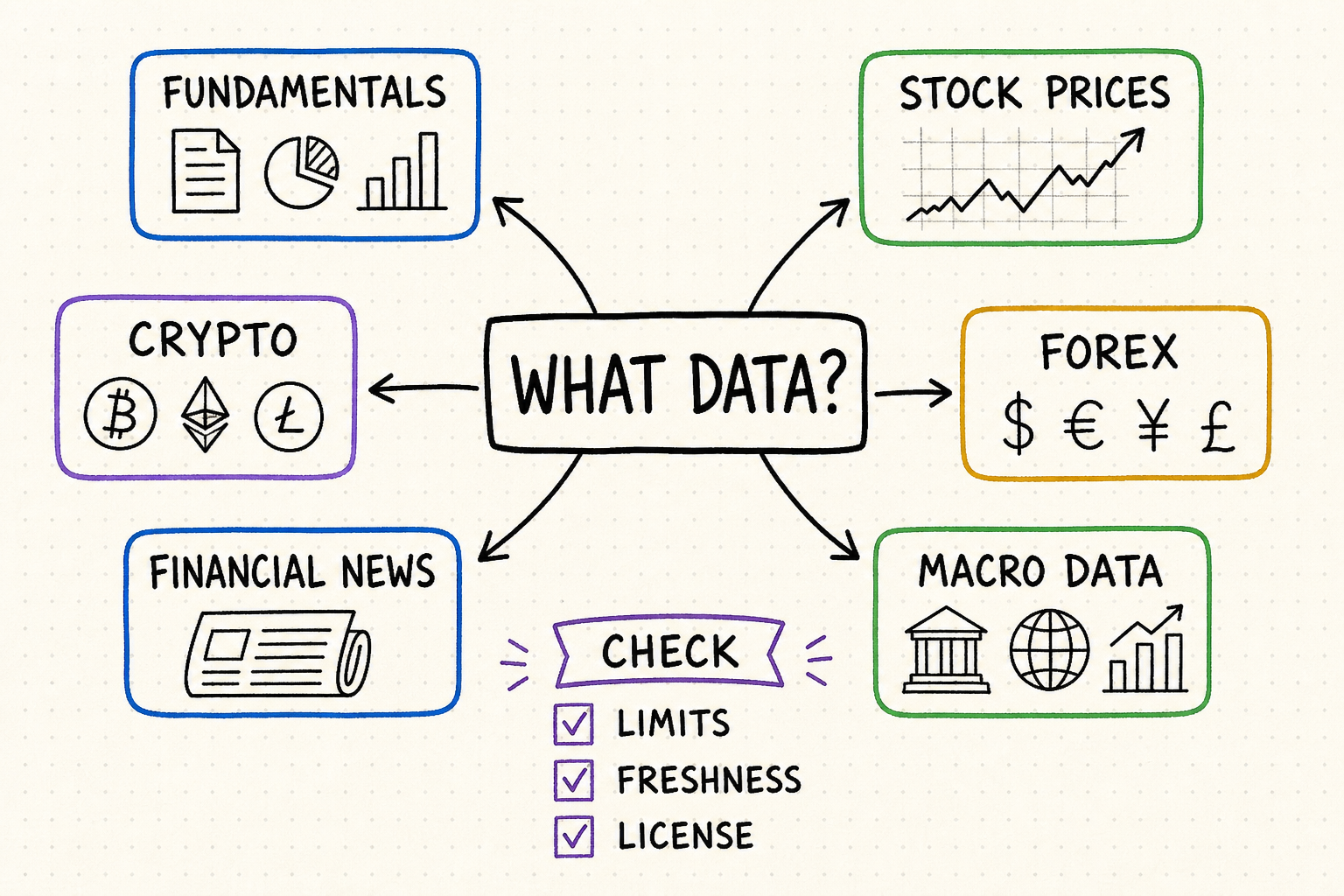
The comparison covers six search intents: company fundamentals and filings, stock prices, crypto, forex, financial news, and macroeconomic data. Each category is evaluated by request budget, freshness, authentication, source coverage, attribution and licensing. Limits were rechecked against official documentation on July 27, 2026; providers can still change plans, so production teams should verify the linked source before deployment.
Company Fundamentals & Filings APIs — Financial Statements, Ratios and SEC Data
Many searches for a free financial API are really requests for income statements, balance sheets, cash-flow statements, company facts, ratios or SEC filings. This workload differs from price data: updates follow filing events, schemas must normalize issuer-specific tags, and restatements can change previously reported values.
| Source来源 | Free model免费模式 | Best for适合场景 | Important limitation重要限制 |
|---|---|---|---|
| SEC EDGAR APIs | Open public filing access开放的公共申报数据 | Raw filings, submissions, XBRL company facts and filing history原始申报文件、提交记录、XBRL 公司事实和申报历史 | You must build entity mapping, tag normalization, restatement handling and SEC fair-access controls.需要自行处理公司映射、标签标准化、重述数据和 SEC 公平访问规则。 |
| Financial Modeling Prep | Limited developer tier有限开发者免费层 | Normalized statements, ratios, company profiles and screening prototypes标准化财务报表、比率、公司资料和筛选器原型 | Endpoint access, quotas and redistribution rights depend on the current plan.端点权限、调用额度和再分发权取决于当前套餐。 |
| Alpha Vantage Fundamentals | Permanent limited tier长期有限免费层 | Company overview, earnings and low-frequency statement lookups公司概览、财报和低频财务报表查询 | The published free allowance is small; a multi-company research agent can exhaust it quickly.公开免费额度较小,多公司研究 Agent 很快就会耗尽。 |
| SimFin | Free/basic research access免费/基础研究访问 | Standardized statements and research datasets标准化财务报表和研究数据集 | Coverage, history, update speed and permitted product use vary by dataset and plan.覆盖范围、历史深度、更新速度和产品用途权限因数据集及套餐而异。 |
Choose raw or normalized data deliberately. SEC EDGAR is authoritative and inexpensive in API fees, but the engineering cost is higher because issuers use different XBRL tags and amended filings can revise history. A normalized provider reduces that work, but its free plan may restrict companies, endpoints, history or commercial redistribution. For an AI financial-analysis workflow, retain accession number, filing date, fiscal period, currency, source URL and whether a value was restated.
Free Stock Price APIs — Category Summary
This cross-category page summarizes stock access only. For detailed provider limits, WebSocket support, historical coverage and upgrade paths, use the dedicated free stock API comparison. The key distinction here is feed coverage: a real-time quote from one exchange is not the same as a consolidated real-time US market feed.
| API | Free Tier | Daily Limit | Rate Limit | Real-Time | Credit Card | Commercial Use |
|---|---|---|---|---|---|---|
| Alpaca | Permanent Free | Plan-based | 200 req/min | Real-time IEX subset | Not required | Dev use free |
| Finnhub | Developer Free | Account/endpoint based | Verify dashboard/headers | Dataset-dependent | Not required | Restricted |
| Twelve Data | Limited Free | 800 req/day | 8 req/min | Delayed (free) | Not required | Non-commercial |
| Alpha Vantage | Limited Free | 25 req/day | 5 req/min | Delayed 15min | Not required | Non-commercial |
| Massive (formerly Polygon.io) | Free Basic | No daily quota stated | 5 req/min | End-of-day on Basic | Not required | License-dependent |
Alpaca is useful when IEX coverage is acceptable, but its free feed is not the full consolidated SIP market. Massive now offers a $0 Basic stock plan with end-of-day data, five requests per minute and two years of history; its $29 and $79 stock plans remain delayed, while real-time stock access is a higher tier. Finnhub limits and entitlements vary by account and dataset, so a single “calls per day” number should not be treated as universal. Use this section to shortlist an access model, then confirm the full comparison on the stock-specific page.
Crypto Data APIs — The Most Generous Free Tiers
Crypto APIs often provide easier evaluation access than exchange-licensed stock feeds, but free access does not automatically include a commercial license. Aggregated market prices, exchange-native trades and redistributable product data are different products with different terms.
| API | Free Tier | Daily Limit | Rate Limit | Real-Time | Credit Card | Commercial Use |
|---|---|---|---|---|---|---|
| CoinGecko | Free Demo | 10,000 calls/mo | 100 calls/min | From 60 sec freshness | Not required | Attribution required; commercial plan separate |
| CoinMarketCap | Limited Free | 333 calls/day | 30 calls/min | Delayed 5min | Not required | Non-commercial |
| Binance | Public exchange API | 1,200 calls/min | High | Real-time | Not required | Use/redistribution terms apply |
CoinGecko's Demo plan is useful for prototyping aggregated crypto research: it lists 10,000 monthly call credits, 100 calls per minute and data freshness from 60 seconds, with attribution required. Its pricing table reserves a standard commercial license for paid plans. Binance is exchange-native and better suited to venue-specific trades or books, but teams must review API and data-use terms before redistributing the output. CoinMarketCap remains useful for low-frequency portfolio context. Always preserve exchange, pair, quote currency and timestamp because “BTC price” is not identical across venues.
Forex APIs — Limited But Functional
Free forex APIs are scarce compared to stocks and crypto. Only two providers offer meaningful free tiers, and real-time forex data is almost non-existent on free plans — most update hourly or daily.
| API | Free Tier | Daily Limit | Rate Limit | Real-Time | Credit Card | Commercial Use |
|---|---|---|---|---|---|---|
| ExchangeRate-API | Permanent limited tier | 1,500 calls/mo | Low | Updated hourly | Not required | Verify plan and attribution terms |
| Alpha Vantage Forex | Limited Free | 25 req/day | 5 req/min | Delayed | Not required | Non-commercial |
Exchange-rate APIs are appropriate for conversion, reporting and low-frequency portfolio normalization when hourly or daily refresh is acceptable. They are not substitutes for executable institutional FX quotes. ExchangeRate-API and Alpha Vantage can support prototypes, but production teams must verify base-currency coverage, update timestamps, historical depth and commercial terms. If the workflow needs streaming bid/ask prices, compare paid market-data entitlements rather than assuming a free conversion API is real-time.
Financial News APIs — Sentiment Data for AI Agents
Financial news APIs unlock sentiment analysis, event-driven trading signals, and market context for AI agents. Two providers dominate the free tier, but both have significant limitations for production use.
| API | Free Tier | Daily Limit | Rate Limit | Real-Time | Credit Card | Commercial Use |
|---|---|---|---|---|---|---|
| Finnhub News | Limited Free | Account/endpoint based | Verify dashboard/headers | Dataset-dependent | Not required | Restricted |
| NewsAPI | Limited Free | 100 req/day | Low | 24hr delay (free) | Not required | Non-commercial |
Finnhub can support company-news prototypes, but limits and entitlements vary by account and endpoint; verify the dashboard and response headers rather than relying on one universal daily number. NewsAPI's developer tier is designed for development and carries delay and usage restrictions. For a production news agent, compare publication rights, full-text availability, source attribution, deduplication, timestamps and whether generated summaries may be shown to customers. The dedicated financial news API guide covers this intent in depth.
Macro & Economic Data APIs — The Hidden Gems
Authoritative macro APIs are valuable because the source and release calendar are explicit. Access can be free, but authentication, attribution and dataset-specific terms still apply.
| API | Free Tier | Daily Limit | Rate Limit | Real-Time | Credit Card | Commercial Use |
|---|---|---|---|---|---|---|
| FRED API | Public API access | No public daily quota stated | Rate limited | Updated daily | API key required | Terms and attribution apply |
| World Bank API | Public API access | Reasonable-use policy | Reasonable | Updated daily | Not required | Dataset-specific terms |
FRED is an authoritative source for economic series, but its API requires a registered key. Applications must also follow the FRED API terms, including the required notice and links for end users. The World Bank Indicators API complements FRED with global development data; commercial and derivative uses depend on the particular dataset's terms rather than a blanket API-wide permission. For either source, retain series ID, release date, observation date, units, seasonal-adjustment status and source attribution.
Free Tier Limits That Actually Matter for AI Agents
Free tier limits are not just numbers — they directly constrain what your AI agent can do. Here is what each limit means in practical AI agent terms:
25 calls/day (Alpha Vantage)
Sufficient for a single user manually testing an API. For an AI agent querying 5 stocks with price + indicator data, you exhaust the daily limit in 2-3 queries. Verdict: Prototyping only — not viable for any automated agent workload.
5 calls/minute + EOD (Massive Basic)
The free plan can support reference lookups, daily bars and low-frequency research, but it is not a consolidated real-time feed. Verdict: Useful for EOD prototypes; choose a real-time entitlement for live monitoring.
800 calls/day (Twelve Data)
An agent monitoring 10 symbols every 30 minutes uses 480 calls/day — within the limit with room for technical indicators. Verdict: Best REST free tier for moderate-frequency agents, but delayed data limits real-time use cases.
Coverage and license limits
A high request allowance does not fix partial exchange coverage, delayed data, attribution rules or redistribution restrictions. Verdict: Treat quota, freshness, coverage and license as four separate acceptance tests.
Call-volume rule of thumb: ten symbols polled every five minutes require roughly 2,880 price requests per day before indicators, news or retries. But call count alone is not a production test: the same workflow must also validate feed coverage, event timestamp, market session and permitted display or redistribution. Free tiers are excellent for evaluation; production suitability is a separate decision.
How to Choose a Free Financial API — Decision Matrix by Use Case
| Use Case | Best Free Option | Why |
|---|---|---|
| Company filings and raw fundamentals | SEC EDGAR | Authoritative filings and XBRL facts; budget engineering time for normalization |
| US stock prototype | Alpaca IEX | Live IEX subset; not the full consolidated US market |
| EOD stock research | Massive Basic | $0 plan with EOD data, five requests/minute and two years of history |
| Crypto research prototype | CoinGecko Demo | 10K monthly credits and attribution; check commercial-license needs |
| Currency conversion | ExchangeRate-API | Low-frequency reference rates; verify plan terms and update schedule |
| Macro research | FRED API | Authoritative economic series; registered API key and attribution requirements |
| Multi-source workflow | QVeris | Discover and inspect capabilities, then apply application-side quality and license controls |
Start with the decision that can invalidate the project: required dataset, freshness and right to use the output. Then estimate call volume and engineering cost. For multi-source workflows, a capability layer can reduce discovery and tool-contract friction, but the application must still preserve source, timestamp, quality flags and licensing constraints.
The Multi-Provider Problem: Why AI Agents Need Unified Access
Combining financial APIs creates friction beyond authentication: symbols can refer to different instruments, timestamps use different zones, prices may be delayed or venue-specific, and “commercial use” may not include redistribution. A reliable agent needs a versioned internal contract and explicit failure rules before it combines results.
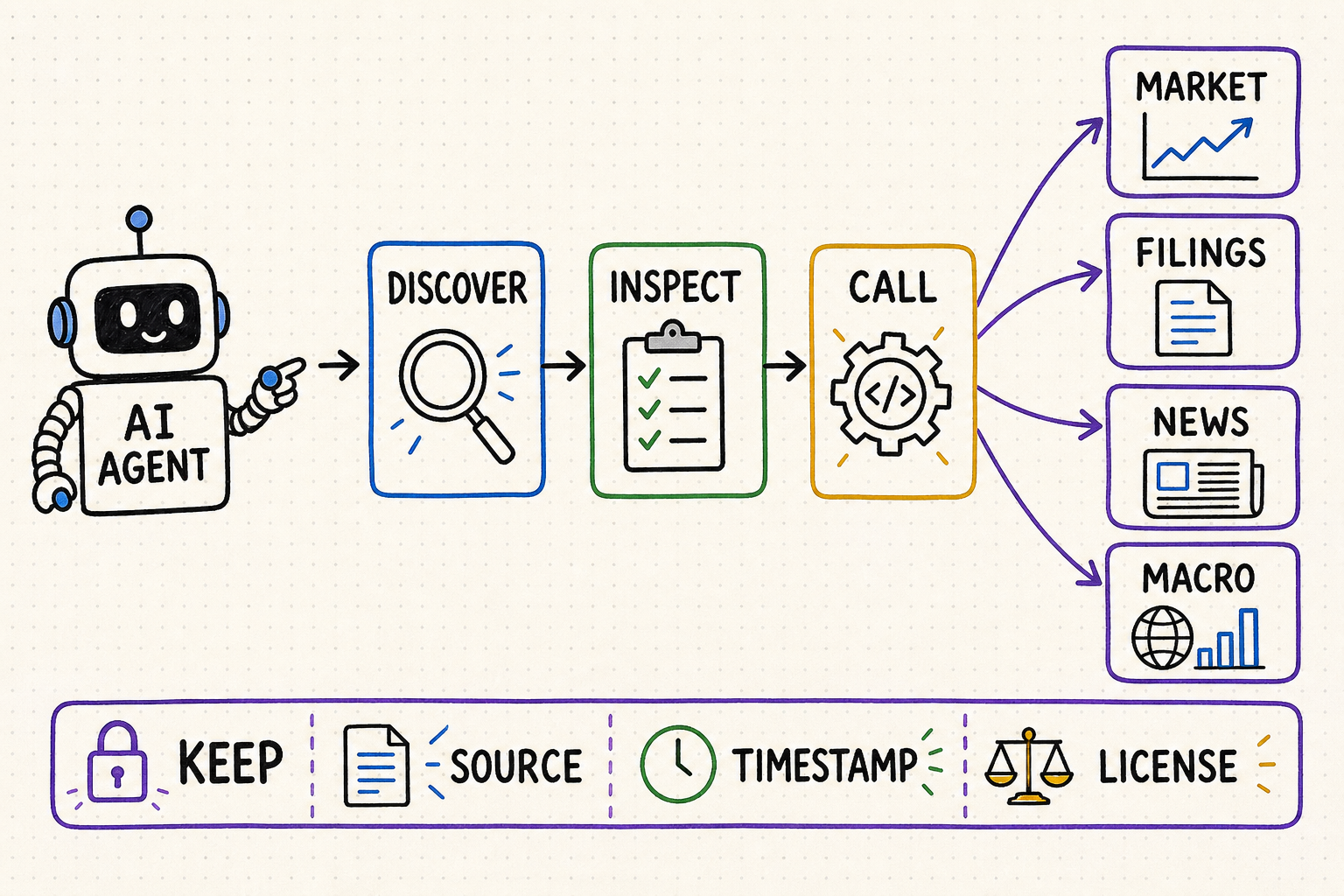
QVeris provides a Discover → Inspect → Call workflow for finding capabilities and reading tool contracts before execution. Application-side controls should still validate instrument identity, freshness, source attribution, license status and fallback compatibility before a value reaches the model or user.
# Instead of managing 12 different API clients:
#   - 12 API keys to track and rotate
#   - 12 different response formats to parse
#   - 12 different rate limit windows to manage
#
# With QVeris — one unified protocol for all financial data:

import requests

# Stock price — unified interface
response = requests.post(
    "https://api.qveris.ai/v1/call",
    headers={"Authorization": f"Bearer {QVERIS_API_KEY}"},
    json={
        "capability": "stock_price",
        "parameters": {"symbol": "AAPL"}
    }
)

# Crypto price — same interface, different capability
response = requests.post(
    "https://api.qveris.ai/v1/call",
    headers={"Authorization": f"Bearer {QVERIS_API_KEY}"},
    json={
        "capability": "crypto_price",
        "parameters": {"symbol": "BTC"}
    }
)

# Macro data — same interface again
response = requests.post(
    "https://api.qveris.ai/v1/call",
    headers={"Authorization": f"Bearer {QVERIS_API_KEY}"},
    json={
        "capability": "fred_series",
        "parameters": {"series_id": "GDP"}
    }
)

# Preserve provider, timestamp and quality flags in every result.
# Validate licensing and fallback rules in the application.
Use QVeris to discover, inspect and call suitable capabilities; use your application contract to enforce data quality and permitted use. This separation keeps routing decisions traceable without pretending that every provider response has identical semantics. Read the docs → or view pricing →.
Getting Started Checklist
QVeris provides a capability routing layer. Underlying financial data comes from third-party providers. Free tier limits are subject to change — always verify against official documentation.
Unify Your AI Agent's Financial Data Access
Use one capability workflow to discover and inspect financial-data tools, then keep freshness, source and licensing controls explicit in your application.
Explore QVeris → View PricingReal-Time Stock Price API for AI Agents →
Compare 6 real-time stock price APIs with WebSocket support and AI agent integration patterns.
Stock API Free Comparison →
Deep dive into every free stock API — Alpha Vantage, Finnhub, Alpaca, Twelve Data, and more.
Free Financial API FAQ
What is the best free financial API for AI agents in 2026?
Which free financial APIs allow commercial use?
Do free financial APIs provide real-time data?
How many API calls do I need for an AI agent?
What happens when I exceed free tier limits?
Is the FRED API free, and does it require an API key?
What is the best free financial statements API?哪个免费财务报表 API 最合适?
References & Sources
- Alpha Vantage Documentation — alphavantage.co/documentation
- Finnhub Documentation — finnhub.io/docs
- Alpaca Market Data Coverage — free IEX versus paid SIP coverage
- Twelve Data Documentation — twelvedata.com/docs
- Massive Stocks Plans — free Basic, delayed and real-time entitlements
- CoinGecko API Pricing — Demo limits, attribution and commercial-license tiers
- CoinMarketCap API Documentation — coinmarketcap.com/api/documentation
- Binance API Documentation — binance-docs.github.io
- ExchangeRate-API Documentation — exchangerate-api.com/docs
- NewsAPI Documentation — newsapi.org/docs
- FRED API Key Requirements — registered key required for web-service requests
- FRED API Terms of Use — notice, attribution and application requirements
- World Bank Indicators API — request formats and query structure
- World Bank Terms and Conditions — API and dataset-specific permissions
- SEC EDGAR APIs — submissions and XBRL company facts
- Financial Modeling Prep Documentation — normalized fundamentals endpoints
- SimFin Pricing — access models and dataset coverage