
Choose a Free Financial API
Data, Sources & Examples选择合适的免费金融 API
数据、来源与示例
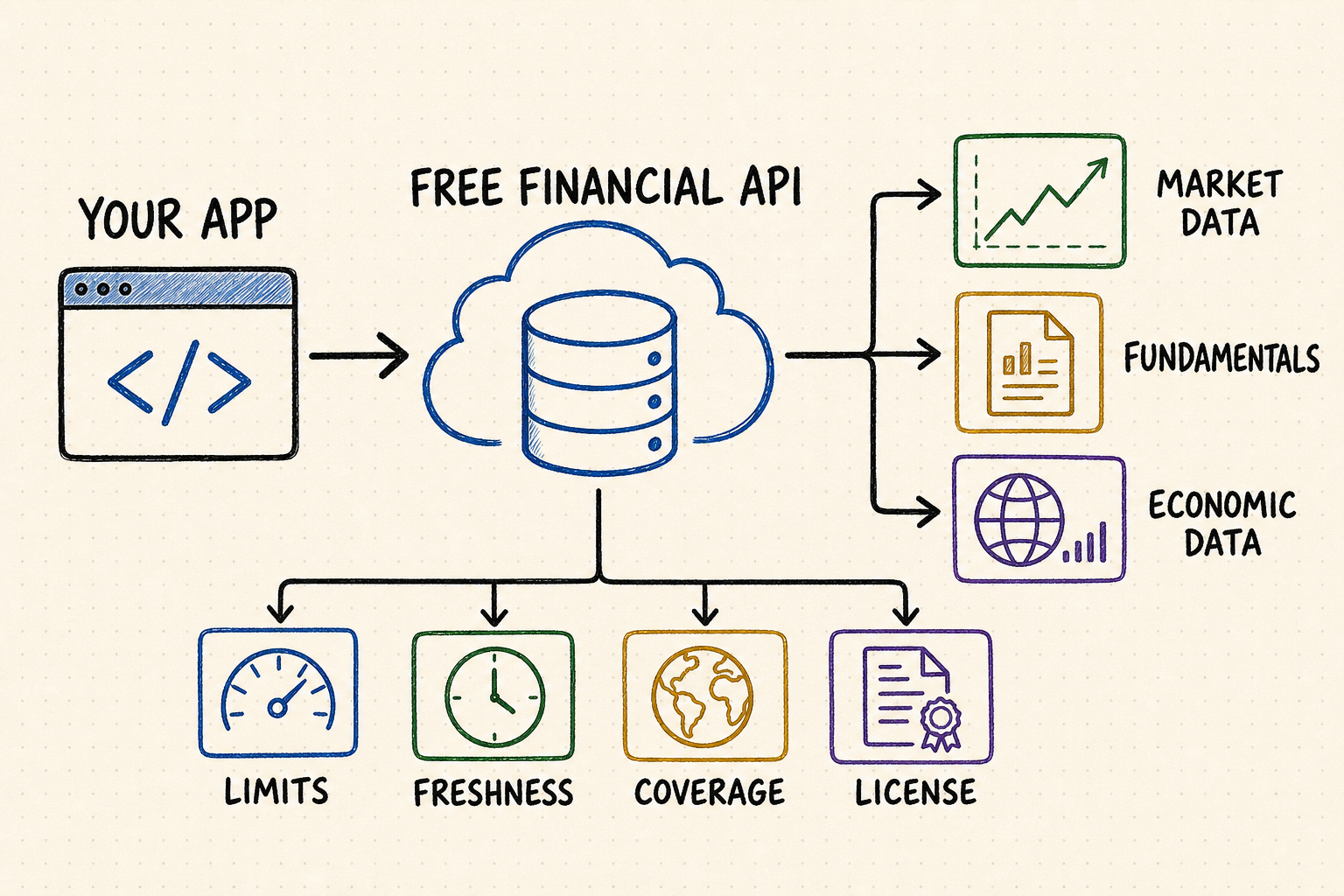
Compare free APIs for market prices, company fundamentals, and economic indicators—then validate limits, freshness, coverage, and licensing.
比较市场价格、公司基本面与经济指标 API,
并在接入前核对限额、时效、覆盖范围与授权。
Quick Summary快速摘要
Free tiers commonly expose delayed quotes, daily OHLCV history, company profiles, and selected fundamentals.
Check exchange coverage, timestamps, adjustment rules, request limits, redistribution rights, and commercial-use terms.
CSV is convenient for spreadsheets and research; JSON APIs are better for apps, agents, and repeatable pipelines.
Free does not always mean real-time or unrestricted. Never assume demo data is suitable for live trading decisions.
免费套餐通常提供延迟行情、日线 OHLCV、公司资料以及部分基本面数据。
确认交易所覆盖、时间戳、复权规则、调用限额、再分发权利和商业使用条款。
CSV 适合表格和研究;JSON API 更适合应用、Agent 和可重复的数据流程。
免费不等于实时或无限制,演示数据不应直接用于真实交易决策。
Choose a free financial API by use case按使用场景选择免费金融 API
The best API is the one whose data contract matches the decision your product must make. A dashboard, a valuation notebook, a backtest, and an AI research agent can all request “financial data,” yet they require different timestamps, identifiers, update schedules, and usage rights. Define the output first, then work backward to the source.
最合适的 API,应当让数据契约与产品要完成的决策相匹配。看板、估值 Notebook、回测系统和 AI 研究 Agent 都会请求“金融数据”,但它们需要的时间戳、标识符、更新频率和使用权并不相同。应先定义输出,再反推所需数据源。
| Use case使用场景 | Minimum dataset最低数据需求 | What decides the choice核心选择条件 | Common mistake常见错误 |
|---|---|---|---|
| Portfolio dashboard投资组合看板 | Quotes, positions, FX rates, corporate actions.行情、持仓、汇率和公司行动。 | Freshness, exchange coverage, stable identifiers.时效、交易所覆盖和稳定标识符。 | Mixing delayed prices with live portfolio values.用延迟行情计算组合市值,却将结果标为实时。 |
| Fundamental research基本面研究 | Statements, filings, estimates, ratios, period metadata.财务报表、申报文件、分析师预期、财务比率和报告期元数据。 | Restatements, fiscal periods, units, source lineage.重述、财年口径、单位和数据血缘。 | Comparing annual and trailing values as if they match.把年度值和滚动值当作同一口径比较。 |
| Backtesting策略回测 | Point-in-time prices, delistings, dividends, splits, calendars.时点价格、退市记录、分红、拆股和交易日历。 | Historical depth, adjustment policy, survivorship controls.历史深度、复权政策和幸存者偏差控制。 | Using today's constituents and revised data in the past.用今天的成分股和修订后数据回看历史。 |
| Economic research宏观经济研究 | Series values, units, release dates, vintage revisions.序列值、单位、发布日期和历史修订版本。 | Release calendar, revision history, geographic coverage.发布日历、修订历史和地区覆盖。 | Treating the latest revised value as originally known.把最新修订值当作当时已经公布的数据。 |
| AI financial agentAI 金融 Agent | Structured values plus citations, timestamps, and provider identity.结构化数值,以及引用、时间戳和供应商身份。 | Discoverability, schema stability, provenance, error visibility.可发现性、字段稳定性、来源和错误可见性。 | Returning a number without its date, unit, or source.只返回数字,不说明日期、单位和来源。 |
A practical shortlist should contain no more than two or three providers for the first test. If the job is daily company research, prioritize filings, fundamentals, corporate actions, and batch endpoints. If the job is an intraday alert, prioritize feed coverage, latency, connection behavior, and the license for displaying results. A provider can be excellent for one workflow and unsuitable for the other.
第一轮测试最好只保留两到三个候选供应商。日频公司研究应优先检查申报文件、基本面、公司行动和批量接口;日内提醒则应优先检查行情源覆盖、延迟、连接行为以及展示结果所需的许可证。同一供应商可能非常适合一种流程,却完全不适合另一种流程。
Which financial API endpoints do you need?你需要哪些金融 API 接口?
Start with the decision or product you are building. A portfolio app needs current prices; a valuation model needs fundamentals; macro research needs rates, inflation, employment, and GDP; an agent workflow needs stable schemas and source metadata.
先明确你的决策或产品目标。投资组合应用需要当前价格,估值模型需要基本面,宏观研究需要利率、通胀、就业与 GDP,Agent 工作流则需要稳定字段与来源元数据。
A free financial API is rarely one endpoint. Market routes may return quotes or interval bars, company routes follow reporting cycles, and economic series follow official release calendars. Define the asset class, geography, frequency, history depth, acceptable delay, and response format before comparing providers.
免费的金融 API 通常不止一个接口。市场接口返回行情或周期数据,公司接口跟随财报周期更新,经济指标则依据官方发布日历更新。比较供应商之前,应先明确资产类别、地区、频率、历史深度、可接受延迟和响应格式。
For research, price fields alone are rarely enough. You may also need trading calendars, symbol changes, delistings, currency, exchange identifiers, and corporate actions. These reference fields prevent survivorship bias and make it possible to join prices with fundamentals correctly. A smaller dataset with explicit lineage and consistent identifiers is often more useful than a larger feed whose origin and adjustment rules are unclear.
对于研究任务,只有价格字段通常不够。你还可能需要交易日历、代码变更、退市记录、币种、交易所标识和公司行动。这些参考字段能减少幸存者偏差,也能让价格与基本面正确关联。来源清楚、标识一致的小型数据集,往往比来源不明、复权规则模糊的大型数据源更有价值。
Last price, change, bid/ask, session status, and timestamp. Confirm whether values are real-time, delayed, reference quotes, or end-of-day.
Open, high, low, close, and volume by interval. For return calculations, verify splits, dividends, and adjusted-close methodology.
Income statements, balance sheets, cash flow, ratios, and company facts. Check reporting periods, currencies, and restatements.
Interest rates, inflation, employment, GDP, exchange rates, and official release dates. Preserve units, frequency, and revision history.
Ticker mappings, exchanges, time zones, data lineage, and provider identity make downstream results easier to explain and audit.
最新价、涨跌、买卖价、交易状态和时间戳。务必确认数据是实时行情、延迟行情、参考性报价还是收盘数据。
按周期提供开高低收和成交量。计算收益率前,要核对拆股、分红与复权收盘价的方法。
利润表、资产负债表、现金流、比率和公司资料。注意报告期、币种以及后续重述。
利率、通胀、就业、GDP、汇率与官方发布日期。应保留单位、频率和修订历史。
代码映射、交易所、时区、数据血缘和供应商身份,让结果更容易解释与审计。
How free financial APIs compare如何比较免费的金融 API
No single source is best for every workflow. Exchanges and regulators are closest to primary records, but their files may require more cleaning. Market-data APIs make common fields easier to query, although free plans usually trade convenience for lower request limits, delayed prices, shorter history, or narrower exchange coverage. Broker feeds can be useful for personal execution workflows, while downloadable files are efficient for reproducible analysis.
没有一种来源适合所有工作流。交易所和监管机构最接近一手记录,但文件往往需要更多清洗;市场数据 API 查询方便,不过免费套餐通常以较低调用限额、延迟行情、较短历史或较窄市场覆盖来换取便利。券商数据适合个人交易流程,而可下载文件更适合可重复的研究分析。
| Source来源 | What it offers提供内容 | Best for适合场景 | Watch for注意事项 |
|---|---|---|---|
| Exchange or regulator交易所或监管机构 | Authoritative listings, notices, and filings.权威的上市信息、公告与申报文件。 | Verification and primary-source research.核验与一手资料研究。 | May be fragmented or not API-friendly.可能分散,且不一定便于 API 调用。 |
| Free market-data API免费市场数据 API | Normalized quotes, history, and fundamentals.标准化的行情、历史与基本面。 | Apps, agents, prototypes, and repeatable research.应用、Agent、原型与可重复研究。 | Rate limits, delays, and license restrictions.有调用限额、延迟和授权限制。 |
| Broker data券商数据 | Account-linked quotes and trading context.与账户关联的行情和交易上下文。 | Personal portfolio and execution workflows.个人投资组合与交易执行流程。 | Access may require an eligible account.可能要求符合条件的账户。 |
| CSV or bulk datasetCSV 或批量数据集 | Portable files for analysis and archival.便于分析与归档的可移植文件。 | Spreadsheets, notebooks, and backtests.表格、Notebook 与回测。 | Often less current than a live API.通常不如实时 API 更新及时。 |
Compare sources with the same small test set rather than relying on feature lists. Request a liquid stock, a thinly traded security, a symbol that changed, and a date containing a split or dividend. Compare timestamps, missing records, precision, adjustment behavior, and error messages. This test quickly reveals whether two providers use different sessions or definitions even when their column names look identical.
不要只看功能清单,最好用同一组小样本横向测试:选择一只高流动性股票、一只成交稀疏的证券、一个曾更换代码的标的,以及包含拆股或分红的日期。对比时间戳、缺失记录、数值精度、复权方式和错误信息。即使字段名称相同,这种测试也能快速发现不同供应商对交易时段和指标定义的差异。
How to evaluate a free financial API before integration接入前如何评估免费金融 API
Feature lists are easy to copy and hard to compare. A better evaluation uses the same representative requests, expected outputs, and failure tests for every candidate. Record each result in a scorecard so “free,” “real-time,” and “global” are translated into testable definitions rather than marketing labels.
功能清单容易复制,却很难直接比较。更可靠的评估方法,是对每个候选 API 使用相同的代表性请求、预期输出和失败测试,并把结果记录在评分表中。这样,“免费”“实时”和“全球覆盖”就会变成可验证的定义,而不是营销标签。
1. Coverage and identifiers1. 覆盖范围与标识符
List the exact exchanges, countries, asset classes, security types, and symbol states you need. Test active and delisted instruments, primary and secondary listings, ETFs, preferred shares, and symbols that changed. Prefer permanent identifiers or explicit mapping tables over ticker-only joins, because tickers can be reused or differ by venue.
列出真正需要的交易所、国家、资产类别、证券类型和代码状态。测试正常上市与退市标的、主次上市、ETF、优先股以及曾经变更代码的证券。连接数据时,应优先使用永久标识符或明确的映射表,而不是只靠股票代码,因为代码可能被重复使用,也可能因交易场所不同而变化。
2. Freshness, timestamps, and market sessions2. 时效、时间戳与交易时段
Ask what each timestamp represents: event time, exchange time, bar close, provider ingestion, or delivery time. Verify regular, pre-market, and after-hours sessions separately. “Real-time” describes latency, not necessarily complete market coverage; a live single-venue feed and a consolidated feed can produce different prices and volumes.
要明确每个时间戳表示事件发生时间、交易所时间、K 线结束时间、供应商入库时间,还是发送时间。盘前、正常交易和盘后时段应分别验证。“实时”描述的是延迟,并不必然代表完整市场覆盖;实时单一场所行情与综合行情可能返回不同的价格和成交量。
3. Point-in-time quality and revisions3. 时点数据质量与修订
For fundamentals and economics, determine whether the API preserves the value known on a past date or only serves the latest revised value. Record filing dates, accepted timestamps, fiscal periods, units, and revision or restatement status. Point-in-time data is essential when a model claims to reproduce a historical decision.
对于基本面和宏观数据,要判断 API 是否保留历史某一时点已知的数值,还是只提供最新修订值。需要记录申报日期、接收时间、财务期间、单位以及修订或重述状态。只要模型声称能够重现历史决策,时点数据就是必要条件。
4. Reliability and failure behavior4. 可靠性与失败行为
Test invalid symbols, missing dates, quota exhaustion, timeouts, and partial responses. The client should distinguish “no observation exists” from “the provider failed.” Capture HTTP status, retry headers, provider error messages, and the age of cached data. Silent fallback to stale or zero values is more dangerous than an explicit error.
应测试无效代码、缺失日期、额度耗尽、超时和部分返回。客户端必须区分“确实没有观测值”和“供应商请求失败”。记录 HTTP 状态、重试响应头、供应商错误信息和缓存数据的新旧程度。在没有提示的情况下改用过期数据或零值,往往比明确报错更危险。
5. Licensing and permitted outputs5. 许可与输出权限
Separate personal analysis, internal business use, public display, non-display use, derived data, model training, and redistribution. A working API key proves technical access, not permission to publish or resell the result. Save the applicable plan and license URL alongside the integration decision, then review it when the product or audience changes.
个人分析、企业内部使用、公开展示、非展示用途、衍生数据、模型训练和再分发应分别核对。API Key 能正常调用,只能证明技术访问成功,并不能证明可以发布或转售结果。应把适用套餐和许可链接与接入决策一起保存,并在产品或用户群发生变化时重新检查。
A practical financial API integration workflow实用的金融 API 接入流程
A reliable workflow separates discovery from production use. First inspect the provider documentation and a sample response. Then make a small request, save the raw payload, and transform it into your own stable schema. Add validation before the data enters a chart, model, spreadsheet, or agent. This makes it easier to replace a source later without rewriting the rest of the product.
可靠的工作流会把“发现数据源”和“正式使用”分开。先查看供应商文档与示例响应,再发起小规模请求,保存原始返回,并转换为自己的稳定字段结构。数据进入图表、模型、表格或 Agent 之前应先经过验证。这样未来更换数据源时,无需重写整个产品。
Start with an asset, company, or economic series and the required dataset: price, history, fundamentals, corporate actions, regulatory filings, or indicators.
Review schema, exchange coverage, delay, sample response, request cost, limits, data lineage and sources, and commercial-use rules.
Send the symbol, interval, start and end dates, adjustment mode, and output format. Store the provider timestamp with every result.
Check missing sessions, duplicates, time zones, split adjustments, null values, and unexpected schema changes before analysis.
先确定资产、公司或经济指标,以及所需的数据类型:价格、历史、基本面、公司行动、监管申报文件或指标序列。
检查字段结构、交易所覆盖、延迟、示例响应、调用成本、限额、数据血缘与来源,以及商业使用规则。
传入代码、周期、起止日期、复权模式和输出格式,并保存每条结果对应的供应商时间戳。
分析前检查缺失交易日、重复记录、时区、拆股复权、空值和意外的字段变化。
For API access, cache responses that do not need second-by-second freshness, apply exponential backoff to temporary failures, and log the request time, parameters, status code, and provider timestamp. For CSV, preserve the original file separately from the cleaned table and record its download date, delimiter, encoding, and time zone. Both approaches need a repeatable update policy so old and new observations are not silently mixed.
使用 API 时,应缓存不要求秒级更新的结果,对临时失败采用指数退避,并记录请求时间、参数、状态码和供应商时间戳。使用 CSV 时,应把原始文件与清洗后的表格分开保存,同时记录下载日期、分隔符、编码和时区。两种方式都需要可重复的更新策略,避免新旧数据在无提示的情况下混合。
Free financial API Python example with validation带验证步骤的免费金融 API Python 示例
A useful first script should do more than print a value. The example below requests company facts from the SEC EDGAR API, stores the source and retrieval time, checks the response type, and exposes the filing metadata that helps an analyst interpret a number. SEC documentation states that data.sec.gov provides JSON APIs without an API key; automated access must still follow the SEC's access policy and identify the requester.
有用的第一段脚本不应只打印一个数值。下面的示例从 SEC EDGAR API 请求公司事实数据,保留来源和获取时间,检查返回类型,并展示帮助分析师解释数值的申报元数据。SEC 文档说明,data.sec.gov 提供无需 API Key 的 JSON API;自动访问仍须遵守 SEC 访问政策,并正确标识请求者。
import os
from datetime import datetime, timezone

import requests

cik = "0000320193"  # Apple Inc.; CIK must contain 10 digits
url = f"https://data.sec.gov/api/xbrl/companyfacts/CIK{cik}.json"
headers = {
    "User-Agent": os.environ["SEC_USER_AGENT"],
    "Accept-Encoding": "gzip, deflate",
}

response = requests.get(url, headers=headers, timeout=20)
response.raise_for_status()
payload = response.json()

if "facts" not in payload or "entityName" not in payload:
    raise ValueError("Unexpected SEC response schema")

revenue = payload["facts"]["us-gaap"]["RevenueFromContractWithCustomerExcludingAssessedTax"]
recent_usd_facts = revenue["units"]["USD"][-5:]

result = {
    "source": "SEC EDGAR Company Facts",
    "retrieved_at": datetime.now(timezone.utc).isoformat(),
    "entity": payload["entityName"],
    "taxonomy_label": revenue["label"],
    "recent_facts": recent_usd_facts,
}

print(result)
Set SEC_USER_AGENT to the application name and a monitored contact address before running the script. In production, do not assume the last array item is the “correct” value. Filter by form, fiscal period, filing date, unit, frame, and accepted timestamp, then decide how amendments and duplicate facts should be handled. For large-scale extraction, use the SEC bulk archives instead of repeating one-company calls.
运行前,将 SEC_USER_AGENT 设置为应用名称和可联系的邮箱。生产环境中不能直接假设数组最后一项就是“正确值”,而应按表单、财务期间、申报日期、单位、frame 和接收时间过滤,并明确如何处理修订文件和重复事实。大规模提取时,应使用 SEC 批量归档,而不是持续重复调用单家公司接口。
Where QVeris fits: use the QVeris Tool Finder or Capability Map to discover relevant financial-data capabilities and inspect candidate tools. Keep provider documentation and primary-source verification in the workflow; QVeris helps with discovery and access, but it does not remove the need to validate timestamps, definitions, and licenses.
QVeris 在流程中的作用:可以使用 QVeris 工具查找器或能力地图发现相关金融数据能力并查看候选工具。工作流中仍要保留供应商文档和一手来源核验;QVeris 可以帮助发现和访问能力,但不能替代对时间戳、指标定义和许可证的验证。
Model the real request budget and hidden cost计算真实请求预算与隐藏成本
A headline quota such as requests per minute or requests per day is not enough to predict whether a free tier will work. Calculate the full path required to produce one answer:
仅看每分钟或每天请求次数,无法判断免费套餐是否够用。应计算生成一次完整答案所需的全部调用路径:
Daily calls = symbols × endpoints per symbol × refreshes per day × retry factor + shared reference calls.
每日调用量 = 标的数量 × 每个标的的接口数 × 每日刷新次数 × 重试系数 + 公共参考数据调用。
Suppose a watchlist contains 25 companies and each refresh needs a quote, company profile, income statement, ratios, and recent news. Four refreshes per day already require 500 calls before retries. A 10% retry allowance raises the budget to 550, while exchange calendars, FX conversion, and symbol mapping add shared calls. Batch endpoints, caching, and separating slow-changing fundamentals from fast-changing prices can reduce the total dramatically.
假设观察列表有 25 家公司,每次刷新需要行情、公司资料、利润表、财务比率和近期新闻五个接口,每天刷新四次,在重试前就需要 500 次调用。预留 10% 重试空间后变成 550 次,交易日历、汇率换算和代码映射还会增加公共调用。批量接口、缓存,以及把低频变化的基本面与高频变化的价格分开更新,都能显著降低请求量。
Costs that do not appear in the API priceAPI 标价之外的成本
- Normalization: mapping provider-specific fields, identifiers, currencies, time zones, and null conventions into a stable internal schema.
- Quality control: detecting gaps, duplicates, revisions, stale observations, incorrect adjustment behavior, and unexpected outliers.
- Operations: caching, retry queues, monitoring, provider-status checks, key rotation, and incident investigation.
- Licensing: obtaining the rights needed for public display, professional users, derived outputs, or redistribution.
- 标准化:把供应商特有字段、标识符、币种、时区和空值规则映射为稳定的内部结构。
- 质量控制:发现缺口、重复、修订、过期观测、错误复权和异常值。
- 运行维护:缓存、重试队列、监控、供应商状态检查、密钥轮换和故障调查。
- 许可:取得公开展示、专业用户、衍生输出或再分发所需的权利。
Create an upgrade trigger before launch. Typical triggers include sustained usage above a safe share of the quota, a need for lower latency or consolidated coverage, insufficient history, missing corporate actions, or a customer-facing license requirement. The decision should be tied to product behavior and risk—not an arbitrary date.
上线前应提前定义升级触发条件,例如正常使用量持续接近安全额度上限、需要更低延迟或综合行情、历史深度不足、缺少公司行动,或需要面向客户的许可。升级决策应由产品行为和风险触发,而不是设定一个随意日期。
Run a 15-minute free-tier fit test用 15 分钟判断免费套餐是否真的适合
A short, repeatable smoke test is more useful than browsing another feature list. It will not prove production reliability, but it can expose the most common reasons a free financial API fails a real workload: incomplete coverage, ambiguous timestamps, unstable identifiers, silent nulls, unusable quotas, and rights that do not match the product.
与其继续浏览功能清单,不如做一次可重复的小型冒烟测试。15 分钟当然不能证明接口已经达到生产可靠性,但足以暴露最常见的问题:覆盖不完整、时间戳含义不清、证券标识不稳定、空值没有说明、额度无法支撑实际负载,或使用许可与产品场景不匹配。
Minutes 0–3: request representative records
Query one active company, one recently split security, one inactive or delisted symbol, and one non-U.S. instrument if international coverage matters. For macro data, request a series with revisions; for fundamentals, request both the latest filing and an older fiscal period.
Minutes 3–6: inspect meaning, not only values
Check identifier, exchange, currency, unit, fiscal period, observation date, release or filing date, source timestamp, retrieval timestamp, and adjustment method. A plausible number without these fields is difficult to validate or reproduce.
Minutes 6–9: trigger controlled failures
Send an invalid symbol and a date with no observation. Confirm that authentication, 404, 429, and server errors remain distinguishable. The client must not convert a missing response into zero, reuse an expired cached value without a stale flag, or retry indefinitely.
Minutes 9–12: test the measured quota
Run a small burst at the refresh rate your product expects. Record remaining-quota headers, latency, endpoint weights, batch behavior, and retry instructions. Keep planned normal usage below roughly 70% of the documented allowance so retries, cache misses, and backfills have room.
Minutes 12–15: apply release gates
Mark each gate pass, fail, or unknown: coverage, freshness, accuracy, quota, license, failure recovery, and provenance. “Unknown” is not a pass. Assign an owner and evidence for every unresolved item before production approval.
第 0–3 分钟:请求有代表性的记录
选择一家正常交易的公司、一只近期发生拆股的证券、一个停牌或退市代码;如果需要国际覆盖,再加入非美国市场标的。宏观数据应选择存在历史修订的序列,基本面数据则同时读取最近披露和较早报告期。
第 3–6 分钟:检查数据含义,不只看数字
核对证券标识、交易所、币种、单位、报告期、观测日期、发布日期或披露日期、来源时间戳、抓取时间和复权方式。一个看起来合理却缺少这些上下文的数字,很难被验证,也很难在以后复现。
第 6–9 分钟:主动制造可控失败
发送无效代码,并请求一个没有观测值的日期。确认鉴权失败、404、429 和服务端错误能够被区分。客户端不能把缺失响应转换成零,也不能在没有“数据已过期”提示时继续使用旧缓存,更不能无限重试。
第 9–12 分钟:按真实刷新频率测试额度
按照产品预期刷新速度发起一轮小规模突发请求,记录剩余额度响应头、延迟、接口积分权重、批量请求行为和重试说明。正常计划用量最好控制在公开额度的约 70% 以内,为重试、缓存未命中和历史回补留下空间。
第 12–15 分钟:逐项判断上线门槛
把覆盖、时效、准确性、额度、许可、故障恢复和数据来源分别标记为通过、失败或未知。“未知”不能算作通过。所有未解决项目都应指定负责人并补充证据,之后才能批准进入生产环境。
Delivery rule: approve the API only when the intended workload passes every release gate and the result can be traced to a source. A visually correct demo is evidence of rendering, not evidence of data fitness.
交付规则:只有当目标负载通过全部上线门槛,而且每个结果都能追溯到来源时,才应批准接入。页面显示正常只能证明渲染成功,不能证明数据已经适合生产。
Free financial API checklist免费金融 API 检查清单
A useful source makes coverage, freshness, provider identity, request limits, pricing, and licensing visible before you depend on it.
可靠的数据源会在你正式依赖它之前,清楚展示覆盖范围、更新时间、供应商身份、请求限额、价格与授权条款。
Data quality is not only about whether a number looks plausible. Confirm that every observation refers to the intended venue, session, currency, and time zone. Check whether timestamps represent trade time, bar close, or provider delivery time. When building indicators or backtests, document how missing sessions, zero volume, duplicate rows, outliers, splits, dividends, and restated fundamentals are handled.
数据质量不只是判断一个数字“看起来是否合理”。每条记录都应对应正确的交易场所、交易时段、币种和时区,还要确认时间戳表示成交时间、K 线结束时间,还是供应商发送时间。构建指标或回测时,应记录如何处理缺失交易日、零成交量、重复行、异常值、拆股、分红以及重述后的财务数据。
- Confirm the market, exchange, asset class, interval, and historical depth.
- Record whether prices are raw or adjusted and how corporate actions are handled.
- Preserve source, timestamp, currency, time zone, and request parameters with every result.
- 确认市场、交易所、资产类别、周期和历史深度。
- 记录价格是否复权,以及拆股和分红等公司行动的处理方式。
- 为每条结果保留来源、时间戳、币种、时区和请求参数。
Finally, read the license as carefully as the schema. Free access may permit personal analysis but restrict public display, redistribution, automated extraction, model training, or commercial products. Keep a link or copy of the applicable terms with the project and review them when the provider changes plans. If the data supports trading, compliance, or customer-facing decisions, validate critical values against an authoritative source.
最后,许可证应当和字段说明一样认真阅读。免费访问可能允许个人分析,却限制公开展示、再分发、自动抓取、模型训练或商业产品。建议在项目中保存适用条款的链接或副本,并在供应商调整套餐时重新检查。如果数据用于交易、合规或面向客户的决策,关键数值还应与权威来源交叉核验。
FAQ常见问题
Yes. Providers and public institutions offer free tiers for market prices, fundamentals, filings, exchange rates, and economic indicators, usually with limits or usage conditions.
Sometimes, but market feeds are often delayed and economic data follows release schedules. Always inspect timestamps, revision policies, entitlements, and coverage notes.
Many providers support CSV export for prices, exchange rates, company accounts, and economic series. Verify frequency, units, time zone, revisions, and adjustment rules.
It depends on the license. API access does not automatically grant display, redistribution, derived-data, or commercial rights.
JSON is usually easier for applications that request data repeatedly and need structured metadata. CSV is simpler for spreadsheets, bulk downloads, notebooks, and portable archives. Choose based on the workflow, then normalize field names, date formats, data types, and null-value rules before combining files or providers.
Compare representative assets, companies, currencies, and economic series with exchanges, regulators, issuer filings, central banks, or another independent source. Check timestamps, units, revisions, missing observations, and update frequency continuously.
A free API may be a commercial provider's limited plan, while public data is released by an institution such as a regulator, central bank, or statistical agency. Public data can be authoritative but may require more cleaning; a commercial API may normalize several sources but impose quotas and licensing conditions.
Yes for prototypes and bounded research tasks, provided the agent preserves the provider, source, unit, timestamp, and error state. Production suitability depends on schema stability, request volume, latency, licensing, and whether the application can tolerate missing or delayed data.
Upgrade when quota pressure affects normal operation, the required feed or history is unavailable, support or SLA becomes necessary, or the product needs display and redistribution rights that the free plan does not grant.
有。供应商和公共机构会提供市场价格、基本面、公告、汇率与经济指标的免费接口,但通常带有调用限额或使用条件。
有些接口提供实时数据,但免费市场数据通常存在延迟,经济数据也会按照官方日历发布。务必检查时间戳、修订政策、数据授权与覆盖说明。
许多供应商支持导出价格、汇率、公司财务和经济序列。下载后要核对频率、单位、时区、修订记录与复权规则。
取决于许可证。能够调用 API 不代表自动拥有展示、再分发、衍生数据或商业使用权。
JSON 更适合需要重复请求并保留结构化元数据的应用;CSV 更适合电子表格、批量下载、Notebook 和便携归档。无论选择哪种格式,在合并多个文件或供应商之前,都应统一字段名称、日期格式、数值类型和空值规则。
选择有代表性的资产、公司、货币和经济指标,与交易所、监管机构、公司申报、中央银行或另一独立来源对照。持续检查时间戳、单位、修订记录、缺失观测值与更新频率。
免费 API 可能是商业供应商的受限套餐,而公共数据通常由监管机构、中央银行或统计部门发布。公共数据可能更权威,但需要更多清洗;商业 API 往往会标准化多个来源,同时设置额度和许可条件。
可以用于原型和边界清晰的研究任务,前提是 Agent 保留供应商、来源、单位、时间戳和错误状态。是否适合生产环境,还取决于字段稳定性、调用量、延迟、许可,以及应用能否容忍缺失或延迟数据。
当额度压力开始影响正常运行、免费套餐不包含所需行情或历史数据、需要技术支持或 SLA,或者产品需要免费套餐没有授予的展示和再分发权时,就应考虑升级。