
Free Financial Data API
with Python
A practical path from free market-data endpoints to clean pandas DataFrames, with validation, caching, and rate-limit handling built in.
TL;DR
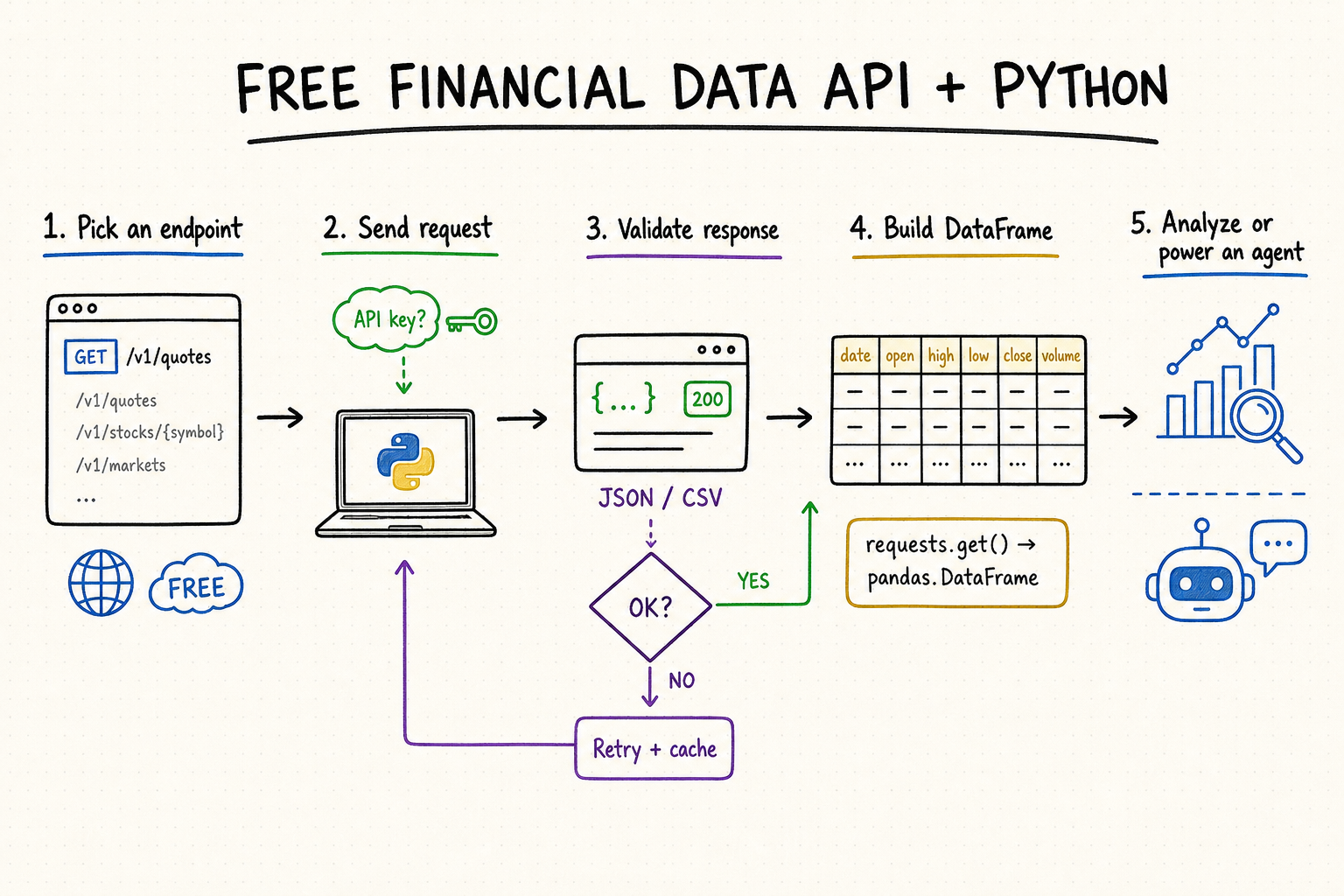
Use requests for HTTP, pandas for tabular data, and a small validation layer before analysis.
Check delayed vs real-time coverage, monthly credits, per-minute limits, attribution, and commercial-use terms.
Convert provider-specific fields into stable columns such as timestamp, open, high, low, close, volume, and symbol.
Cache repeat requests, retry only transient failures, record provenance, and never treat a 200 response as proof of valid data.
How to choose a free financial data API for Python
Start with the dataset, not the brand. A stock quote prototype, ten years of daily bars, company fundamentals, economic indicators, and options chains have different coverage and latency requirements. Confirm that the free tier exposes the endpoint you actually need.
List instruments, exchanges, regions, history depth, corporate actions, and whether quotes are real-time, delayed, or end-of-day.
Record requests per minute, daily or monthly credits, payload caps, burst behavior, and the exact status or error object returned at the limit.
Prefer stable REST or SDK contracts, ISO timestamps, explicit time zones, consistent pagination, and JSON that converts cleanly into a DataFrame.
Free developer access may prohibit redistribution or production use. Read the provider terms before displaying data to customers.
Python example: request, validate, and build a DataFrame
Keep provider-specific details at the boundary. The pattern below uses a generic endpoint: set the URL, key, symbol, and response path from your chosen provider's documentation.
import os, requests, pandas as pd

url = "https://api.example.com/v1/bars"
params = {"symbol": "AAPL", "interval": "1day"}
headers = {"Authorization": f"Bearer {os.environ['FIN_DATA_API_KEY']}"}

response = requests.get(url, params=params, headers=headers, timeout=15)
response.raise_for_status()
payload = response.json()
rows = payload.get("data", [])
if not rows:
    raise ValueError("No market data returned")

df = pd.DataFrame(rows)
df["timestamp"] = pd.to_datetime(df["timestamp"], utc=True)
df = df.sort_values("timestamp").drop_duplicates("timestamp")
The API key stays in an environment variable; the request has a timeout, HTTP errors are checked, empty data is rejected, and timestamps are normalized to UTC. Never place secrets in source code or frontend pages.
| Check | Why it matters | Python action |
|---|---|---|
| HTTP status | Separates transport failures from valid payloads. | raise_for_status() |
| Schema | Providers may return an error object with HTTP 200. | Check required keys and row types. |
| Time zone | Naive timestamps cause incorrect joins and bars. | pd.to_datetime(..., utc=True) |
| Duplicates | Pagination and retries can repeat rows. | drop_duplicates() |
Handle pagination and rate limits in Python
A DataFrame built from only the first page can look perfectly valid while missing most of the dataset. Read the provider’s paging contract, stop only on its documented terminal condition, and validate the combined record count.
| Pagination style | Continue with | Terminal condition | Common bug |
|---|---|---|---|
| Page number | Increment page while preserving filters and sort order. | Documented total pages or an empty final page. | Starting at 0 when the API starts at 1. |
| Offset / limit | Advance offset by the number actually returned. | Returned count is below limit or total is reached. | Advancing by requested limit after a partial page. |
| Cursor | Send the opaque next cursor exactly as returned. | No next cursor or an explicit end flag. | Parsing or modifying the cursor value. |
| Time window | Advance from the last observed timestamp with documented inclusivity. | Window reaches requested end date. | Duplicating or skipping the boundary bar. |
When a provider returns 429, use its Retry-After guidance when present. Otherwise apply bounded exponential backoff with jitter. Cap attempts so a broken job fails visibly instead of running forever.
GET requests are usually idempotent, but still avoid retrying 400, 401, 403, invalid symbols or schema-validation failures. Those require a code, credential or input change.
Persist the last completed cursor or time window and raw response metadata. A job that fails on page 500 should not restart from page one and consume the quota again.
Make a free financial data workflow reliable
Retry timeouts, 429s, and temporary 5xx responses with exponential backoff and jitter. Do not retry bad symbols, invalid keys, or permanent schema errors.
Build cache keys from provider, endpoint, symbol, interval, date range, and adjusted/unadjusted mode. Match cache lifetime to data freshness.
Store provider, endpoint, retrieval time, requested range, currency, exchange, timezone, and adjustment rules beside the data.
Map raw responses into your own schema so a renamed field or provider migration does not spread through every notebook and service.
Archive the provider payload or a checksum plus request metadata before transformation. It is the evidence you need when a value is questioned later.
Use stable internal names, explicit dtypes, source timestamps and a documented primary key. Do not let object dtype hide mixed numbers and strings.
Write validated snapshots to a typed format or database. Keep model features separate from the provider adapter and raw fields.
Record code version, provider, endpoint, parameters, retrieval time, row count, date range, validation result and output checksum.
Validate financial API data before analysis
Type checks are necessary but not enough. Financial datasets fail through wrong units, stale timestamps, corporate actions, missing entities and historical revisions. Validate structure and domain behavior separately.
| Validation layer | Python check | Failure it catches |
|---|---|---|
| Schema | Required columns, dtypes, enum values and nullable rules. | Error payloads, renamed fields and mixed types. |
| Identity | Symbol plus exchange, stable ID mapping and expected entity count. | Ticker collisions, symbol changes and missing delisted names. |
| Time | Monotonic timestamps, duplicates, expected calendar, source age and release time. | Stale data, weekend gaps, duplicate pages and look-ahead bias. |
| Values | Finite values, sign rules, OHLC relationships, currencies, units and plausible ranges. | Percent/decimal confusion, unit shifts and malformed rows. |
| Corporate actions | Known splits, dividends, adjustments and continuity around event dates. | Unadjusted returns and breaks in price history. |
| Reconciliation | Sample recent and historical records against an official or independent source. | Wrong endpoint, stale mirror, parser offsets and currency errors. |
Backtest warning: today’s corrected history is not automatically the dataset available to a strategy in the past. For macro releases and fundamentals, keep release times, filing dates, amendments and vintages whenever decisions depend on point-in-time truth.
Use QVeris to discover financial data capabilities
QVeris helps developers and agents find, inspect, and call financial-data capabilities through a consistent discovery layer. Use it when provider discovery, tool schemas, and auditable calls matter more than wiring one hard-coded endpoint.
- Search by capability and inspect schemas before choosing an integration.
- Keep secrets server-side and validate every external response.
- Record provider and tool metadata so analysis remains traceable.
FAQ
Yes. Many providers offer limited free quotes or historical bars. Coverage, latency, limits, and commercial rights vary, so verify the current plan before building around it.
Requests keeps the HTTP contract visible and portable. An SDK can reduce boilerplate, but check maintenance quality, versioning, and whether it exposes every endpoint you need.
Throttle calls, cache repeat queries, batch symbols when supported, honor Retry-After, and use exponential backoff for temporary 429 responses.
Free data may be delayed, incomplete, or licensed only for development. Validate it independently and do not assume it is suitable for live execution.