
Free Financial Data CSV
Sources & Downloads免费金融数据 CSV
来源与下载指南
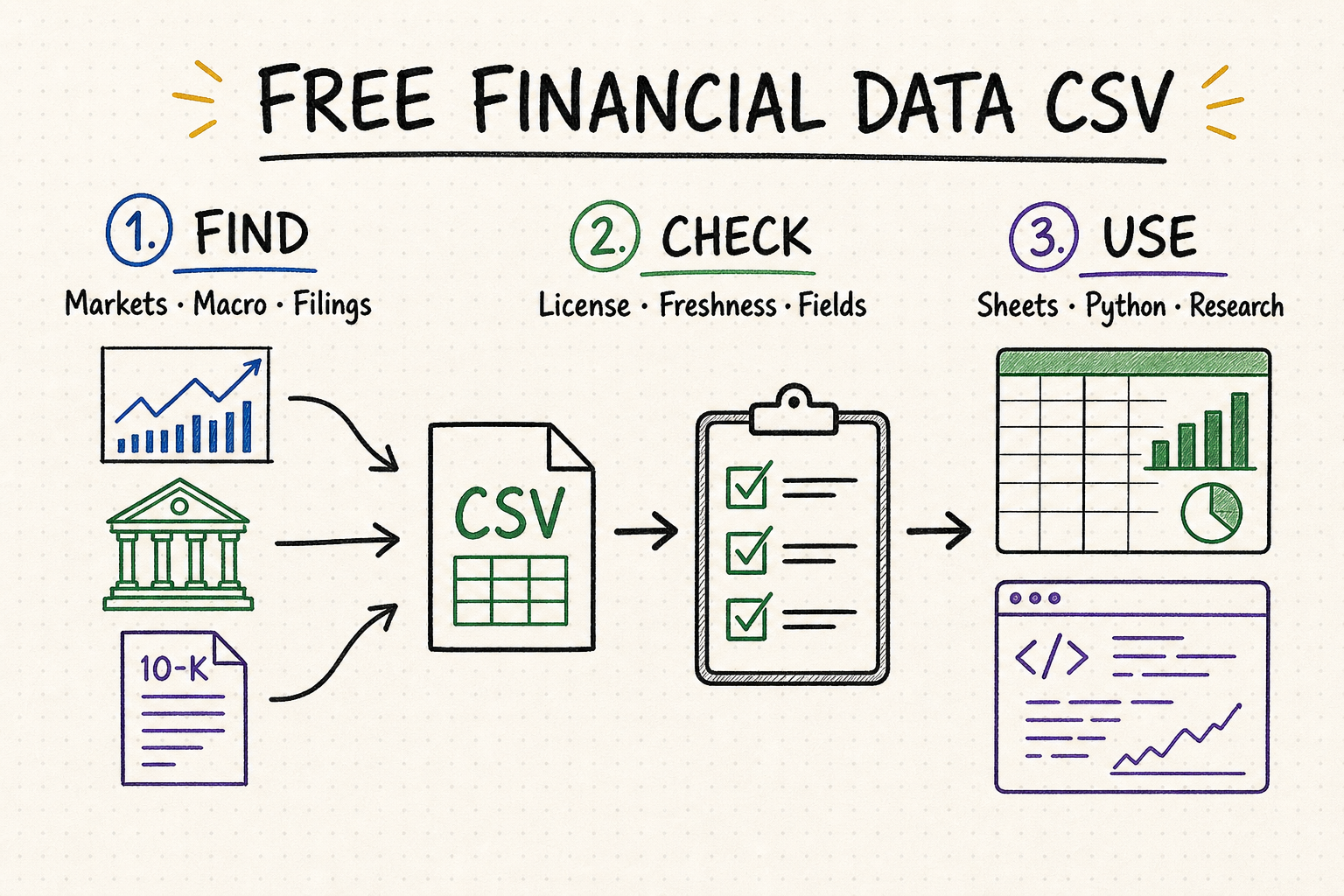
Find reliable CSV downloads for markets, macroeconomics, company filings, forex, and crypto—then validate them before analysis.
查找市场、宏观经济、公司申报文件、外汇和加密资产的可靠 CSV 下载,
并在分析前检查许可、时效与字段质量。
TL;DR核心摘要
Use official regulators, central banks, exchanges, and public-data portals before aggregator mirrors.
CSV is portable, spreadsheet-friendly, easy to version, and simple to load in Python, R, or SQL.
“Free” does not guarantee current, adjusted, complete, or commercially reusable data.
Check the license, timestamp, units, frequency, symbols, missing values, and adjustment policy.
先找监管机构、央行、交易所和政府开放数据门户,再考虑聚合站镜像。
CSV 便携、适合电子表格,也容易导入 Python、R 或 SQL。
“免费”不保证数据为最新、已复权、完整或允许商业再利用。
核对许可、时间戳、单位、频率、代码、缺失值和复权规则。
Best sources for free financial data CSV files免费金融数据 CSV 的最佳来源
Choose a source by dataset type, not by one universal “best” provider. Official portals usually offer the clearest provenance; aggregators can simplify access but may add limits or different licenses.
应按数据类型选择来源,而不是寻找一个万能供应商。官方门户通常提供最清晰的数据出处;聚合平台访问更方便,但可能附加访问限制或采用不同许可。
Use them for rates, inflation, employment, GDP, yields, and other time series with documented release schedules.
Use official filing data for company facts and disclosures. Raw filings often require normalization before they become analysis-ready rows.
Check whether prices are delayed, end-of-day, adjusted, delisted-inclusive, and licensed for your intended use.
Verify venue coverage, quote currency, candle boundaries, time zone, and whether historical gaps are backfilled.
适合利率、通胀、就业、GDP、收益率等有明确发布时间表的序列。
使用官方申报数据获取公司事实与披露信息。原始申报文件通常需要标准化,才能整理成可直接分析的数据行。
确认价格是否延迟、是否为日终数据、是否复权、是否包含退市标的,以及目标用途是否获许可。
核对交易场所覆盖、计价币种、K 线边界、时区和历史缺口补齐规则。
| Official source官方来源 | Useful for适合的数据 | What the download actually contains下载内容与注意点 | Best first use适合的初始用途 |
|---|---|---|---|
| FRED / ALFRED | Rates, inflation, labor, GDP and financial conditions利率、通胀、就业、GDP 与金融条件 | FRED can return a zipped CSV plus a README. ALFRED vintages help reconstruct what was known on an earlier date.FRED 可返回压缩后的 CSV 与 README;ALFRED 的历史版本可用于还原各个历史时点能够看到的数据。 | Macro dashboards, teaching and reproducible research宏观仪表盘、教学与可复现研究 |
| World Bank Indicators | Cross-country development and economic indicators跨国家的发展与经济指标 | A CSV download is delivered as a ZIP with data, country metadata and indicator metadata. Keep all three files together.CSV 下载包内通常同时包含数据、国家元数据和指标元数据,三类文件应一并保存。 | Country comparisons and long-run panels国家比较与长期面板数据 |
| SEC EDGAR | US filings, submission histories and XBRL company facts美国公司申报、申报历史与 XBRL 财务事实 | The SEC publishes JSON APIs and nightly bulk ZIP archives rather than one ready-made analysis CSV. Convert with filing, period, unit and accession context intact.SEC 主要提供 JSON API 与夜间更新的批量 ZIP,而不是直接可分析的统一 CSV;转换时要保留申报表单、报告期、单位和 accession 信息。 | Auditable fundamentals and filing research可追溯的基本面与申报研究 |
| Exchange or regulator files交易所或监管机构文件 | Listings, symbols, reference data and selected market statistics上市证券、代码、参考数据与部分市场统计 | File layouts and redistribution terms vary. Read the accompanying specification instead of inferring columns from a sample.文件结构与再分发条款差异较大,应以配套说明为准,不能只看几行样本就猜字段含义。 | Symbol masters and reference-data checks证券主数据与标识符核验 |
A source can be authoritative without being analysis-ready. Public agencies optimize files for disclosure and dissemination, not for your database schema. The safest workflow preserves the official raw package and creates a separate, documented analysis table.
权威来源不等于拿来就能分析。公共机构首先考虑的是披露和发布,并不会按你的数据库结构整理文件。更稳妥的做法是完整保留官方原始包,再生成一份有字段说明和转换记录的分析表。
Fields every financial CSV should document金融 CSV 应说明的关键字段
| Field字段 | What to verify检查内容 | Common failure常见问题 | Action处理方式 |
|---|---|---|---|
| Date / time日期/时间 | Format, time zone, period end格式、时区、期末时点 | Daily rows shifted by venue time交易场所时区导致日期偏移 | Convert to one explicit time zone统一到一个明确时区 |
| Identifier标识符 | Ticker, exchange, FIGI/CIK/ISIN证券代码、交易所、FIGI/CIK/ISIN | Ticker reuse or symbol changes证券代码被复用或发生变更 | Keep a stable identifier map维护稳定的标识符映射 |
| Value / unit数值/单位 | Currency, scale, nominal vs real币种、数量级、名义值与实际值(不变价) | Mixed units silently combined不同单位在未提示的情况下被合并 | Normalize and preserve source units统一单位并保留来源单位 |
| Adjustment调整 | Splits, dividends, revisions拆股、分红与数据修订 | Unadjusted history used for returns使用未复权历史数据计算收益率 | Store raw and adjusted series同时保存原始序列与调整后序列 |
A column called close may mean an unadjusted venue close, an adjusted historical close, or a consolidated reference price. Store the provider definition, not only the label.
CIKs, postal-style codes, symbols with leading zeros, and mixed identifiers can be damaged by automatic numeric conversion. Define identifier columns as text before importing.
Economic data often has a period the value describes and a later date when it was released or revised. One date column cannot represent both without look-ahead risk.
同样叫作 close,可能指未复权的交易所收盘价、历史复权收盘价,也可能是综合参考价。除了字段名,还应保存供应商对字段的正式定义。
CIK、带前导零的代码以及数字字母混合标识,很容易被电子表格自动转成数值。导入前应把这类列明确设为文本。
经济数据既有“数值对应哪个时期”,也有“何时发布或修订”。如果只留一个日期列,很容易在回测中不小心使用当时尚未公布的数据。
Choose CSV, an API, or a bulk archive by job按任务选择 CSV、API 或批量归档
CSV is a delivery format, not a guarantee of quality. Decide first whether you need a stable snapshot, a parameterized request, or a large recurring ingest. That decision determines how much pagination, versioning, and monitoring you must build.
CSV 只是交付格式,并不能替数据质量背书。先判断你需要的是固定快照、按参数查询,还是周期性批量入库,再决定是否要处理分页、版本管理和更新监控。
| Access pattern访问方式 | Choose it when适用情况 | Strength优势 | Hidden work容易忽略的工作 |
|---|---|---|---|
| CSV | You need a reviewable snapshot for a spreadsheet, notebook or one-off model.需要一份可人工检查的快照,用于表格、Notebook 或一次性模型。 | Portable, easy to diff, archive and hand off.便于传递、归档、比对和交接。 | Schema drift, stale files and locale-sensitive parsing.字段漂移、文件过期和地区格式导致的解析问题。 |
| API | Users choose symbols, dates or indicators and freshness matters.用户会选择证券、日期或指标,而且数据时效很重要。 | Targeted requests and machine-readable metadata.可按需请求,也更容易获得结构化元数据。 | Authentication, pagination, quotas, retries and changing responses.鉴权、分页、额度、重试以及响应结构变化。 |
| Bulk ZIP or archive批量 ZIP/归档 | You regularly ingest an entire universe or rebuild a warehouse.需要定期导入完整数据范围,或重建数据仓库。 | Efficient for large, repeatable transfers.大规模、重复传输时效率更高。 | Decompression, manifests, incremental updates and failure recovery.解压、清单、增量更新和失败恢复。 |
Practical rule: use CSV for inspection and frozen research inputs, an API for interactive or fresh queries, and bulk archives for scheduled ingestion. Many reliable systems use all three rather than forcing one format to do every job.
实用判断:需要人工检查或冻结研究输入时用 CSV;需要交互查询或较新数据时用 API;需要定期全量入库时用批量归档。成熟的数据流程往往三者并用,而不是让一种格式承担所有任务。
A reliable CSV download and cleaning workflow可靠的 CSV 下载与清洗流程
Record the source URL, dataset name, license, download time, query parameters, and checksum beside every CSV.
Inspect headers, inferred types, row count, duplicate keys, date range, null rate, and outliers before changing values.
Keep the original file immutable. Write cleaned outputs separately with explicit schemas and transformation notes.
Compare recent and historical points with an official release or independent source before using the dataset in research or production.
记录来源 URL、数据集名称、许可、下载时间、查询参数和校验和。
修改数值前,先检查表头、推断的数据类型、行数、重复键、日期范围、缺失率和异常值。
保持原始 CSV 不变,将清洗结果连同明确的数据模式和转换说明另存。
在研究或生产使用前,用官方发布或独立来源核对近期与历史样本。
Save the original bytes, filename, source URL, HTTP headers where useful, retrieval time and checksum. Never silently overwrite this copy.
Decode text, standardize headers, parse dates and numbers, and record rejected rows without changing business meaning.
Apply identifier maps, units, adjustments and domain rules in a versioned table with explicit primary keys.
Expose only fields with documented lineage, validation results and a known refresh timestamp.
保存原始字节、文件名、来源 URL、抓取时间、校验和,以及必要的 HTTP 响应头;不能在没有留下版本记录的情况下覆盖这份副本。
处理编码、统一表头、解析日期和数值,并单独记录被拒绝的行,但暂不改变业务口径。
应用标识符映射、单位、复权和业务规则,写入带版本且有明确主键的数据表。
只输出来源记录、验证结果和刷新时间都清楚可查的字段。
Import financial CSV data into Excel or Python safely在 Excel 或 Python 中稳妥导入金融 CSV
Most CSV failures happen during automatic type inference rather than download. Inspect the delimiter and encoding first, then make identifiers, dates, decimals and missing-value rules explicit.
很多 CSV 问题并不是出在下载阶段,而是导入软件自动猜类型时发生的。应先确认分隔符和编码,再明确标识符、日期、小数与缺失值的处理规则。
Use the data import flow so you can choose UTF-8, the delimiter, decimal convention and data type for each column. Mark ticker, CIK, ISIN and other identifiers as text before loading. If a value such as 1-2 could become a date, prevent automatic conversion.
With pandas.read_csv, specify identifier dtypes, parse date columns deliberately, define provider-specific missing markers, and inspect warnings. Load a small sample first when the file is large or unfamiliar.
Read in chunks, select only required columns, or convert validated data to a typed analytical format after ingestion. Keep the CSV as the source snapshot rather than repeatedly parsing it for every query.
A comma may separate columns or represent a decimal/thousands convention. Confirm the publisher’s locale and never remove punctuation globally before testing representative rows.
通过“从文本/CSV”导入,手动选择 UTF-8、分隔符、小数格式和每一列的数据类型。证券代码、CIK、ISIN 等标识符要提前设为文本;像 1-2 这类值也要防止被自动识别成日期。
使用 pandas.read_csv 时,明确指定标识符列的数据类型,有选择地解析日期,并把供应商特有的缺失值标记列出来。文件很大或来源陌生时,先读取少量样本检查。
可以分块读取、只选需要的列,或在验证后转换成带类型的分析格式。CSV 更适合作为来源快照,不必让每次查询都重新解析整份文本。
逗号既可能是列分隔符,也可能是小数或千位格式的一部分。应先确认发布方采用的地区格式,不能在没抽样验证前全局删除标点。
Validate a financial CSV before analysis分析前如何验证一份金融 CSV
A file can open cleanly and still be wrong for the intended model. Validate structure, business meaning, time behavior and licensing separately, then retain the evidence with the dataset.
文件能顺利打开,并不代表它适合你的模型。结构、业务含义、时间逻辑和许可应分别检查,验证记录也要与数据一起保存。
| Test检查项 | What to measure具体检查内容 | Why it catches real errors能发现什么问题 |
|---|---|---|
| Shape and keys结构与主键 | Expected columns, row count, unique key rate, duplicate rows and sortedness预期列、行数、主键唯一率、重复行和排序状态 | Detects partial downloads, accidental concatenation and duplicate pagination.可发现下载不完整、错误拼接和分页重复。 |
| Coverage覆盖范围 | Minimum/maximum date, expected entities, trading days, release frequency and gaps起止日期、预期实体、交易日、发布频率和缺口 | Shows whether the dataset silently excludes delisted symbols, countries or old history.可判断数据是否悄悄漏掉退市证券、部分国家或早期历史。 |
| Value rules数值规则 | Null rate, finite values, sign constraints, currency, scale and plausible ranges缺失率、有限值、正负约束、币种、数量级和合理范围 | Finds unit mistakes, percent/decimal confusion and placeholder values.可发现单位错误、百分数与小数混淆,以及占位数值。 |
| Time integrity时间完整性 | Observation time, release time, revision time, time zone and point-in-time availability观测期、发布时间、修订时间、时区,以及各历史时点能否获得该数据 | Prevents look-ahead bias and mixing final revised data into historical decisions.可避免前视偏差,也能防止把最终修订值错误带入历史决策。 |
| Source reconciliation来源对账 | A small sample matched against the official page, filing or a second source抽取少量数据,与官方网站、原始申报或第二来源核对 | Exposes parsing shifts, wrong series IDs and stale mirrors.可发现列错位、序列代码用错和镜像过期。 |
Delivery gate: do not publish a model, dashboard or agent workflow until the dataset has an owner, source URL, license note, refresh time, schema version and a recorded validation result. “The CSV loaded” is only the first check.
交付门槛:在模型、仪表盘或 Agent 工作流上线前,数据集至少要有负责人、来源 URL、许可说明、刷新时间、结构版本和可追溯的验证结果。“CSV 能读进来”只能算第一关。
Use QVeris when static CSV is not enough当静态 CSV 不够用时使用 QVeris
CSV is ideal for portable snapshots and reproducible research. When an agent needs fresher data, parameterized queries, or repeatable provider calls, QVeris helps it discover and invoke financial-data capabilities through one auditable layer.
CSV 适合保存便携快照和开展可复现研究。当 Agent 需要更新更及时的数据、按参数查询,或重复调用供应商接口时,可以通过 QVeris 以统一且可审计的方式查找并调用所需数据能力。
- Keep CSV snapshots for reproducibility, review, and offline analysis.
- Use live APIs when freshness or user-selected parameters matter.
- Use QVeris to discover financial tools and inspect their inputs before an agent calls them.
- 保留 CSV 快照,用于复现、审查和离线分析。
- 当数据时效或用户所选参数很重要时,使用在线 API。
- 让 QVeris 帮助 Agent 发现金融工具并在调用前检查输入。
FAQ常见问题
Start with FRED, SEC EDGAR, official statistics portals, exchanges, and reputable dataset catalogs. Check each dataset’s terms and update schedule.
Only when its license permits your intended display, redistribution, derived-data, and commercial use.
Often not. It may be delayed or end-of-day. Always inspect timestamps, venue coverage, and provider documentation.
Normalize dates, identifiers, units, types, nulls, time zones, frequencies, and adjustment flags while preserving the raw file.
Use CSV for reviewable snapshots and reproducible inputs, an API for fresh parameterized queries, and bulk archives for scheduled full-universe ingestion.
Sources may use different venues, close definitions, currencies, corporate-action adjustments, time zones, or update times. Compare definitions before comparing values.
优先查看 FRED、SEC EDGAR、官方统计门户、交易所和可信数据目录,并检查许可和更新时间。
仅在许可允许展示、再分发、衍生数据和商业用途时可以。
通常不是,可能为延迟或日终数据。务必检查时间戳、场所覆盖和供应商说明。
统一日期、标识、单位、类型、空值、时区、频率和复权标志,同时保留原始文件。
需要可审查快照和可复现输入时用 CSV;需要较新、可按参数查询的数据时用 API;需要周期性全量入库时使用批量归档。
可能是交易场所、收盘价口径、币种、公司行动复权、时区或更新时间不同。比较数值前,先比较字段定义。