
Find the Right Free Financial Database
for Research and AI
Compare free sources for prices, fundamentals, and filings—then check coverage, limits, licensing, and API access before you build.
TL;DR
A free financial database provides market or company data at no cost, usually with limits on coverage, history, calls, or commercial use.
Official filings, public economic datasets, exchange resources, and freemium APIs cover different parts of the research stack.
“Free” rarely means unlimited. Data quality, licensing, update speed, and stable access matter more than row count alone.
Use a capability layer when an agent must discover the right source, inspect its contract, and call it with an auditable trail.
Free financial database, dataset, or API?
People use “financial database” to describe very different products: a website where they can search records, a downloadable dataset, an API that returns current values, or a database they operate themselves. Choose the form by the task rather than expecting one free service to satisfy every need.
| Form | Best when | What you control | Main limitation |
|---|---|---|---|
| Searchable portal | A person needs to look up a filing, series or company occasionally. | Filters, exports and citations offered by the publisher. | Hard to automate or reproduce at scale. |
| Downloadable dataset | You need a fixed snapshot for research, teaching or a one-off model. | Local validation, versioning and transformations. | The snapshot becomes stale unless you refresh it. |
| API | An app needs parameterized or frequently refreshed data. | Request timing, cache and your internal response model. | Quotas, network failures and provider schema changes. |
| Self-managed database | You join sources, query repeatedly, preserve history or serve several applications. | Schema, quality rules, point-in-time history, indexes and access. | You own ingestion, monitoring, licensing records and maintenance. |
Useful rule: start with a portal for discovery, preserve a dataset snapshot for reproducibility, use APIs for incremental refreshes, and build your own database only when repeated joins, history or product access justify the maintenance.
What a free financial database can cover
No single free source reliably covers every asset, field, geography, and time horizon. Define the decision you need to support, then choose the smallest combination of sources that supplies the required data on acceptable terms.
Daily or intraday prices, volume, splits, dividends, symbols, exchanges, currencies, and trading calendars form the base for screening and charting.
Income statements, balance sheets, cash flow, ratios, shares outstanding, and corporate actions support valuation and financial analysis.
Regulatory filings and issuer announcements are often the most authoritative source for company-reported facts, but parsing them takes work.
Rates, inflation, labor, trade, and sector indicators provide context. News, sentiment, and alternative datasets usually carry stricter terms.
Free financial database sources compared
Prefer an original publisher for the facts it owns, then add a normalized API only where convenience is worth the extra dependency. The examples below are starting points, not interchangeable substitutes.
| Source | Typical data | Best for | Watch for |
|---|---|---|---|
| SEC EDGAR | US filings, submissions and XBRL company facts. | Primary-source company research and auditable fundamentals. | Taxonomy, units, filing periods, amendments and issuer calendars. |
| FRED / ALFRED | Rates, inflation, labor, GDP, financial conditions and vintages. | Macroeconomic research and point-in-time release analysis. | Series-specific units, revisions, frequencies and upstream rights. |
| World Bank | Cross-country development, macro and financial indicators. | Country panels and long-run comparisons. | Indicator metadata, source notes, missing years and revisions. |
| Freemium market APIs | Prices, symbols, fundamentals and derived indicators. | Prototypes, dashboards and incremental refreshes. | Quotas, delays, exchange rights, adjusted history and delisted coverage. |
Choose a storage architecture that matches the workload
“Database” does not automatically mean a large cloud warehouse. A local analytical file can be enough for one researcher; a relational database is often better for shared identifiers and fundamentals; a warehouse or lake becomes useful when history, many sources and scheduled pipelines grow.
| Storage pattern | Good fit | Strength | When to move on |
|---|---|---|---|
| CSV / Parquet snapshots | One analyst, immutable research inputs and batch notebooks. | Low setup cost, portable and easy to archive. | Concurrent edits, repeated joins or many small updates become painful. |
| Embedded analytical database | Local SQL across files and medium-size research datasets. | Fast analytical queries without running a server. | Many writers, central permissions or always-on application traffic appear. |
| Relational database | Shared symbols, entities, filings, fundamentals and application queries. | Constraints, transactions, indexes, permissions and dependable joins. | Very large append-only histories or broad analytical scans dominate. |
| Warehouse / lakehouse | Many sources, long histories, scheduled pipelines and team analytics. | Scalable storage, partitioned scans and workload separation. | Do not start here unless scale and governance justify the cost. |
A practical schema for a free financial database
Design around stable entities and events rather than one provider’s response. Keep identity, observations, source lineage and revisions separate so a ticker change or restatement does not overwrite history.
Give companies, legal entities, securities, listings and exchanges separate identifiers. A ticker belongs to a listing and can change; it should not be the permanent company key.
Store observation time, release time, ingestion time, value, unit, currency, frequency, adjustment status and source. Use a composite key that reflects the real grain.
Preserve accession or document ID, form, filed date, report period, fiscal period, taxonomy concept, unit and amendment status. A normalized metric should still link back to the filed fact.
Record request URL or file, retrieval time, checksum, adapter version and validation result. Revisions should create a new version instead of silently mutating the old row.
Point-in-time rule: if the database supports backtests or historical decisions, keep both the period a value describes and the time it became available. A clean final series without release or revision history can create look-ahead bias.
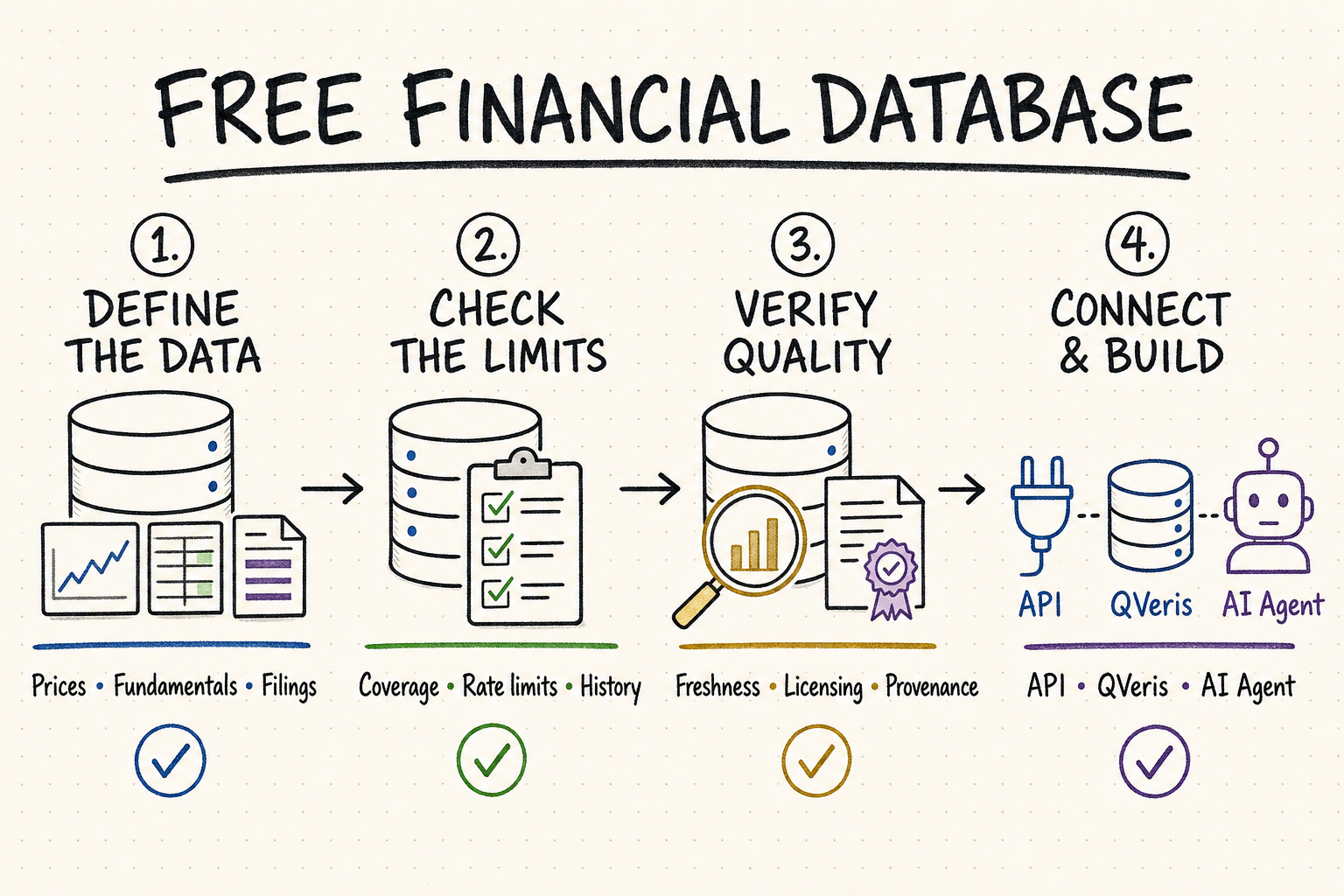
How to choose a free financial database
Write down assets, markets, fields, frequency, historical depth, and acceptable delay before comparing providers.
Confirm whether storage, derived data, public display, commercial use, model training, and redistribution are allowed.
Check splits, dividends, ticker changes, amended filings, missing values, time zones, and point-in-time behavior.
Cache responsibly, respect quotas, record provenance, and isolate provider fields behind your own schema.
Include parsing, storage, refresh jobs, monitoring, data reviews and license checks. A zero-dollar feed can still be expensive to make dependable.
Measure missing records, latency, schema changes, correction frequency, quota use and manual repair time before a production commitment.
Use free financial data with QVeris
A database stores data; an agent still needs to find the right capability, inspect its inputs, call it, and preserve provenance. QVeris provides that capability-routing layer across financial APIs and tools.
- Discover relevant financial capabilities instead of hardcoding one provider too early.
- Inspect schemas and requirements before an agent sends a live request.
- Keep calls and results traceable when research depends on external data.
FAQ
Yes for specific datasets and research uses, but rarely as one unlimited source. Most free options restrict coverage, history, volume, or commercial use.
Regulatory filings are the primary source in many markets, though normalized fields and comparisons usually require parsing.
Only when the license and exchange rules allow it. Check display, storage, derived works, attribution, and redistribution separately.
Yes. Use a documented API contract, validate outputs, respect quotas, and retain timestamps and provenance.