
Free Form 4 API
SEC Insider Data Guide免费 Form 4 API
SEC 内部人交易数据指南
Use a free Form 4 API to turn SEC ownership XML into source-faithful JSON, then verify table structure, footnotes, amendments, latency, limits, and webhook behavior before integration.
通过免费 Form 4 API 把 SEC 所有权 XML 转换成保留来源语义的 JSON,并在接入前核对表格结构、脚注、修订、延迟、限额和 webhook 行为。
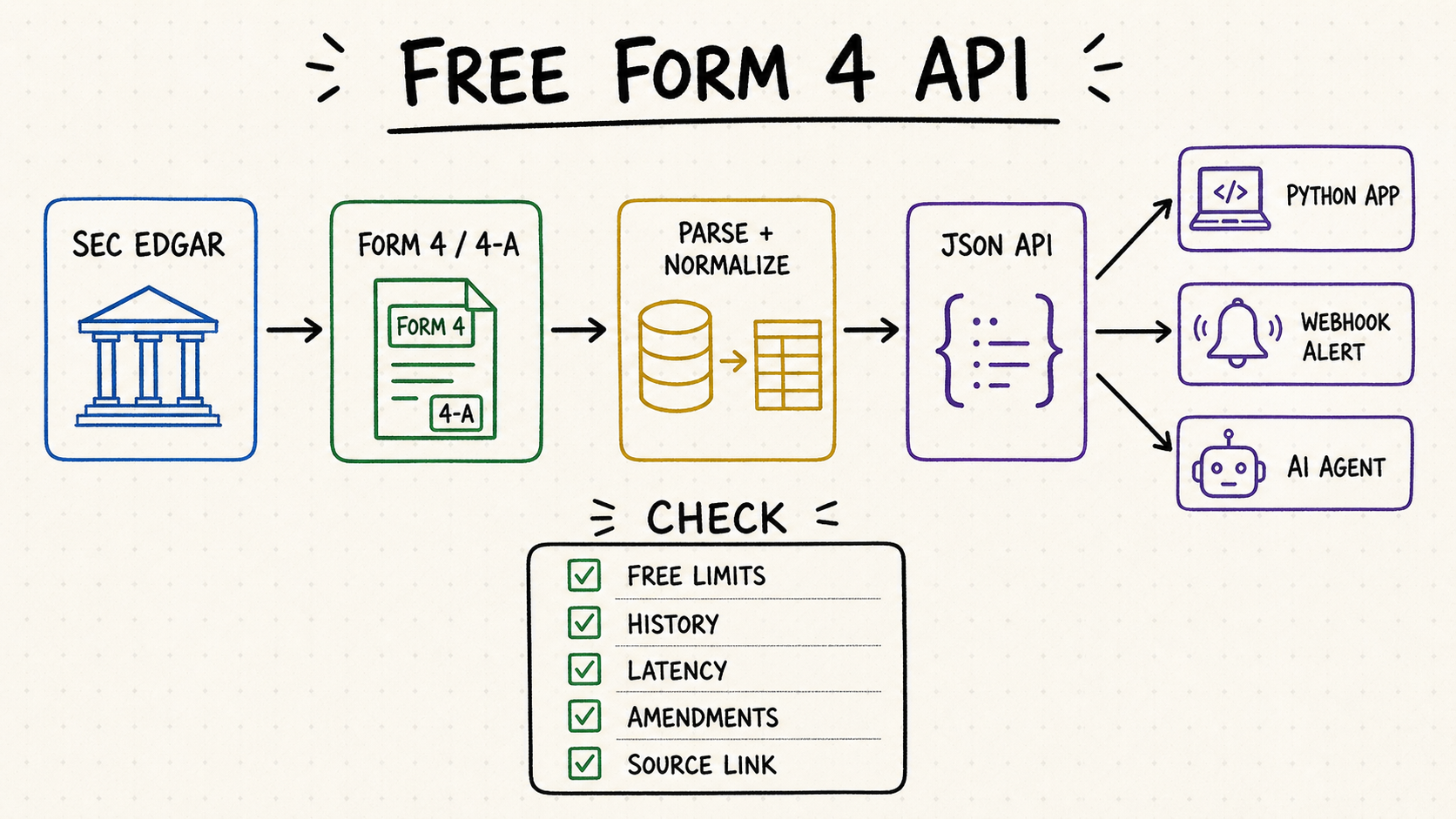
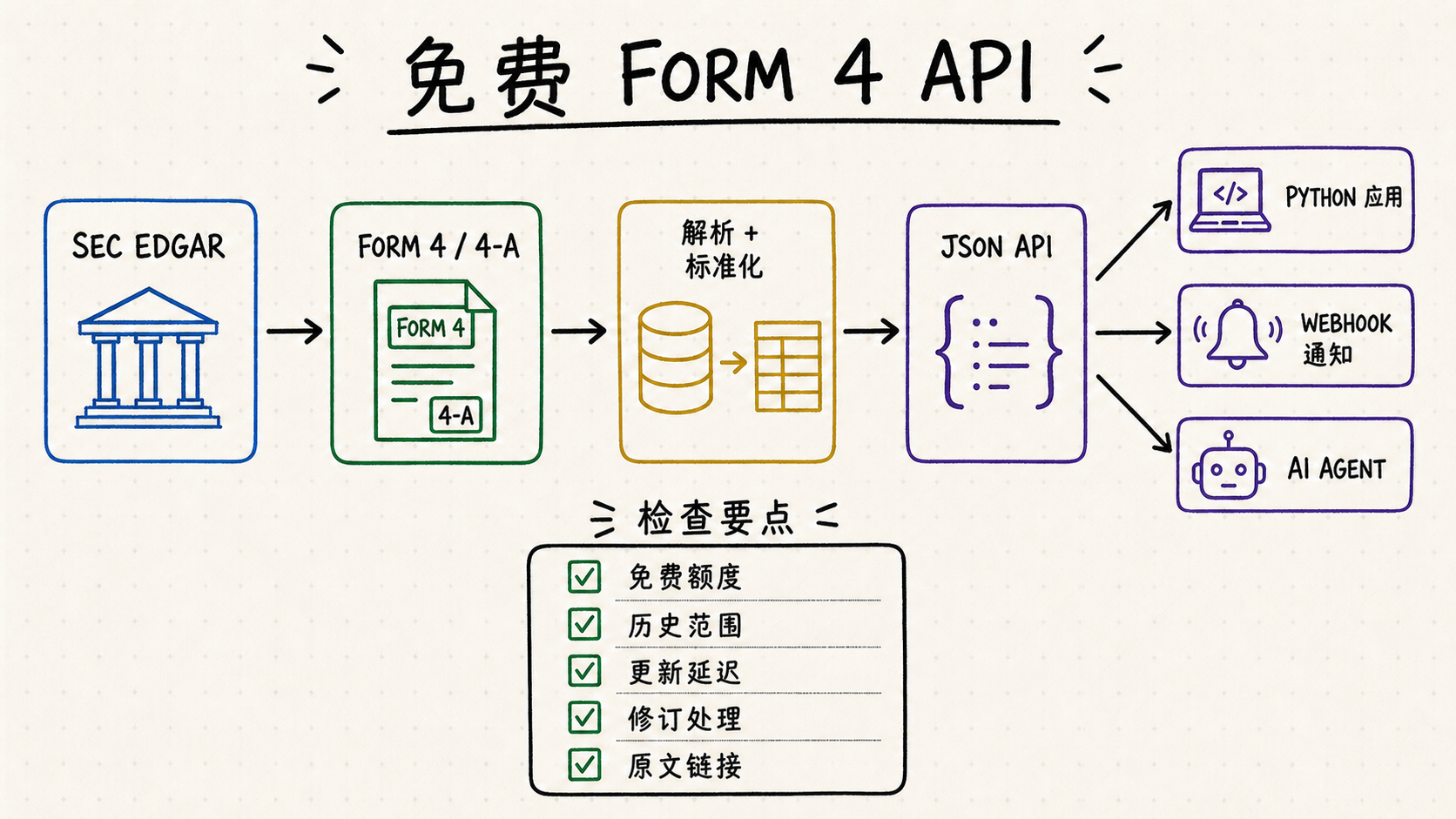
Free Form 4 API: the task behind the search免费 Form 4 API:搜索背后的真实任务
A developer searching for a free Form 4 API usually wants more than a list of filings. The practical goal is a stable SEC insider trading data API that turns EDGAR ownership documents into queryable records, supports ticker or CIK filters, and preserves enough provenance to audit every result.
搜索免费 SEC Form 4 API 的开发者通常不只是想看申报列表,而是要把 EDGAR 所有权文件转成可查询记录,支持股票代码或 CIK 筛选,并保留足够的来源信息以审计每条结果。
The engineering challenge is lossless normalization. A filing can contain several reporting owners, relationship flags, non-derivative Table I rows, derivative Table II rows, holdings-only rows, transaction rows, numbered footnotes, joint-filing context, a trading-plan indicator, and an amendment to an earlier submission. A convenient JSON schema is useful only if those relationships remain reconstructable.
真正的工程难点是无损标准化。一份申报可能包含多个申报人、身份关系标记、非衍生证券 Table I、衍生证券 Table II、仅持仓行、交易行、编号脚注、联合申报语境、交易计划标记,以及对早期文件的修订。JSON 结构再方便,也必须保证这些关系可以重新还原。
Choose between two operating models. A source-first pipeline retrieves SEC submission metadata and ownership XML, stores immutable files, and parses them locally. A normalized provider API reduces parsing and indexing work, and may add ticker search or webhooks, but must still expose accession, source URL, original values, filing version, and a clear contract for corrections.
接入方式通常有两种。来源优先的管道自行获取 SEC 提交元数据和所有权 XML,不可变地保存文件并在本地解析;标准化供应商 API 可以减少解析与索引工作,还可能提供 ticker 查询或 webhook,但仍必须暴露申报编号、来源链接、原始值、文件版本和明确的更正规则。
Normalize Form 4 and Form 4/A ownership XML into consistent JSON fields.把 Form 4 与 Form 4/A 所有权 XML 标准化为一致的 JSON 字段。
Filter by ticker, CIK, insider, filing date, transaction code, or accession.按股票代码、CIK、内部人、申报日期、交易代码或申报编号筛选。
Keep accession numbers, acceptance times, amendments, and original SEC links.保留申报编号、接收时间、修订记录和 SEC 原文链接。
Distinguish a lasting free plan from a trial or beta and confirm production rights.区分长期免费套餐、试用与测试期,并确认生产使用条件。
SEC Form 4 filings API fields, codes, and amendmentsSEC Form 4 申报数据 API 的字段、代码与修订
A useful JSON API should retain issuer and reporting-owner CIKs, owner roles, form and amendment identity, earliest transaction and acceptance times, security table and title, transaction and deemed execution dates, code and voluntary indicator, shares, price, acquired-or-disposed state, direct or indirect ownership, nature of indirect ownership, post-transaction holdings, derivative terms, underlying security, footnotes, accession, and source URL.
实用的 JSON 接口应保留发行人与申报人 CIK、申报人身份、表单与修订身份、最早交易日和接收时间、证券表与名称、交易日和视同执行日、交易代码与自愿标记、股数、价格、取得或处置状态、直接或间接持有、间接持有性质、交易后持仓、衍生证券条款、标的证券、脚注、申报编号和来源链接。
What transaction codes P and S mean交易代码 P 与 S 表示什么
Code P commonly identifies an open-market or private purchase, while S identifies a sale. Do not discard other codes or infer meaning from acquired/disposed alone: grants, exercises, gifts, conversions, expirations, tax-related dispositions, and transfers can change holdings without carrying the same interpretation. Preserve the source code and footnotes before deriving a display label.
代码 P 通常表示公开市场或私下买入,S 表示卖出。不能丢弃其他代码,也不能只凭取得或处置方向推断含义:授予、行权、赠与、转换、到期、税务相关处置和转移都会改变持仓,但经济含义不同。生成展示标签前,必须保留来源代码和脚注。
Preserve Table I and Table II relationships保留 Table I 与 Table II 的关系
Table I describes non-derivative securities; Table II describes derivative securities and their underlying instruments. Keep exercise or conversion price, exercisable and expiration dates, derivative units, underlying title and amount, and post-transaction derivative holdings. Do not merge a derivative unit with its underlying common-share amount or count both as the same exposure.
Table I 描述非衍生证券,Table II 描述衍生证券及其对应标的。应保留行权或转换价格、可行权日与到期日、衍生证券单位、标的名称与数量,以及交易后衍生证券持仓。不能把衍生证券单位与标的普通股数量合并,也不能把两者重复计算为同一敞口。
Footnotes are part of the data model脚注本身就是数据模型的一部分
Footnotes can explain weighted-average prices, price ranges, ownership through trusts or entities, vesting, conversion terms, tax withholding, or trading-plan context. Store footnotes once, retain row-to-footnote references, and expose them with the normalized transaction. Flattening footnote text into an unrelated filing note breaks auditability.
脚注可能解释加权平均价格与成交区间、通过信托或实体间接持有、归属安排、转换条款、代扣税或交易计划语境。脚注应单独保存,同时保留交易行到脚注的引用,并随标准化事件提供。把脚注压成与具体行无关的文件备注,会破坏可审计性。
Interpret the Rule 10b5-1 checkbox precisely准确解释 Rule 10b5‑1 复选框
Current Forms 4 and 5 ask whether a reported transaction was made under a contract, instruction, or written plan intended to satisfy the affirmative-defense conditions of Rule 10b5-1(c), together with the plan adoption date. Preserve the checkbox and adoption date as source fields. A checked box describes the filer’s stated plan context; it does not by itself prove that every legal condition was satisfied, make the transaction non-material, or turn a sale into a new discretionary bearish opinion.
现行 Form 4 与 Form 5 会要求申报人说明:所报告交易是否依据一项拟满足 Rule 10b5‑1(c) 抗辩条件的合同、指令或书面计划执行,并填写该计划的采纳日期。接口应把复选框和计划采纳日期作为来源字段保存。复选框被勾选,只表示申报人披露了相应计划背景;它本身不能证明所有法律条件一定已经满足,也不代表交易不重要,更不能把一次计划内卖出直接解释为新的主观看空判断。
Worked interpretation: suppose an officer reports code S for 10,000 directly owned shares at a weighted-average price of $52.40, with 90,000 shares owned after the transaction. A linked footnote states that executions ranged from $52.10 to $52.75, and the Rule 10b5-1 box is checked with an adoption date. The normalized event should retain all five ideas separately: sale code, disposed quantity, weighted price plus range footnote, direct post-transaction holdings, and stated trading-plan context. Do not manufacture several trades from the price range or discard the range because the main row contains one average.
解读示例:假设某高管申报一笔代码为 S 的交易,直接持有账户卖出 10,000 股,加权平均成交价为 52.40 美元,交易后仍直接持有 90,000 股。关联脚注明确实际成交区间为 52.10–52.75 美元,Rule 10b5‑1 复选框已勾选,并提供计划采纳日期。标准化事件应分别保留卖出代码、处置数量、加权均价及区间脚注、交易后直接持仓和申报人声明的交易计划背景。不能把价格区间虚构成多笔交易,也不能因为主表只有一个均价就丢弃区间信息。
How to handle Form 4/A amendments如何处理 Form 4/A 修订申报
Store the raw filing and accession, link each amendment to the original record, and apply corrections without silently overwriting history. Deduplicate at the transaction level so a corrected filing does not create a second trade.
保存原始申报和申报编号,把修订记录关联到原记录,并在不覆盖历史的前提下应用更正。应在交易层去重,避免修订申报被重复统计为第二笔交易。
How to evaluate a free insider trading API如何评估免费的美股内部人交易 API
| Check检查项 | Verify需要核对 | Risk if missing缺失风险 |
|---|---|---|
| Free access免费访问 | Daily/monthly quota, expiry, card requirement, commercial license.日/月额度、到期规则、是否需信用卡、商业许可。 | A demo may not support production.演示套餐可能不能用于生产。 |
| Coverage覆盖范围 | Companies, history, Form 4/A, derivative and non-derivative tables.公司、历史、Form 4/A、衍生与非衍生交易表。 | Silent gaps distort signals.无提示的数据缺口会扭曲信号。 |
| Latency延迟 | Observed time from EDGAR acceptance to API or webhook delivery.从 EDGAR 接收到 API 或 webhook 送达的实测时间。 | “Real time” may be undefined.“实时”可能没有明确定义。 |
| Provenance来源 | Accession, filing URL, timestamps, raw identifiers.申报编号、原文 URL、时间戳、原始标识符。 | Results cannot be audited.结果无法复核。 |
| Schema fidelity结构保真 | Multiple owners, Table I/II, holdings-only rows, row-footnote links, derivative-underlying relationships.多申报人、Table I/II、仅持仓行、行与脚注关联、衍生证券与标的关系。 | Flattening changes the meaning of the filing.结构压平会改变申报含义。 |
| Correction contract更正规则 | Original and Form 4/A lineage, changed fields, current version, replay behavior.原申报与 Form 4/A 版本链、变化字段、当前版本和回放行为。 | Amendments can duplicate or erase valid history.修订可能导致重复或抹去有效历史。 |
| Quality evidence质量证据 | Filing, owner, row and footnote counts; unresolved rows; source hash.申报、申报人、交易行与脚注数量;未解析记录;来源哈希。 | A valid response may still be incomplete.响应有效仍可能不完整。 |
| Operations运维 | Pagination, retries, rate headers, status page, webhook signatures.分页、重试、限流响应头、状态页、webhook 签名。 | Integrations fail unpredictably.接入会发生不可预测的失败。 |
Integrate a free Form 4 API with Python and JSON用 Python 和 JSON 接入免费 Form 4 API
Step 1: query SEC Form 4 data by ticker or CIK步骤 1:按股票代码或 CIK 查询 Form 4
Start with one company and a narrow date range. Confirm authentication, response status, pagination, sort order, timezone, latest filing date, and whether the response returns transactions or only filing headers.
先用一家公司和较短日期范围测试。确认鉴权、HTTP 状态、分页、排序、时区、最新申报日期,以及响应返回的是交易明细还是只有申报头。
Step 2: normalize Form 4 insider transactions JSON步骤 2:标准化 Form 4 内部人交易 JSON
Model filing, reporting owner, security, transaction row, holding row, derivative terms, footnote, and source version as related entities rather than one flat record. Keep raw XML or provider JSON for replay, preserve source text values, and derive typed numbers only with explicit null and unit rules.
应把申报、申报人、证券、交易行、持仓行、衍生证券条款、脚注和来源版本建模为关联实体,而不是一条扁平记录。保留原始 XML 或供应商 JSON 以便回放,同时保存来源文本值;只有在空值和单位规则明确时,才能生成带类型的数值字段。
Step 3: add Form 4 API webhook alerts safely步骤 3:安全添加 Form 4 webhook 通知
Verify webhook signatures, acknowledge quickly, process asynchronously, and make the consumer idempotent using an event ID or accession plus transaction identity. Reconcile webhook events against a periodic API pull.
验证 webhook 签名,快速确认接收,再异步处理;使用事件 ID,或申报编号加交易标识实现幂等,并用定期 API 拉取结果与通知事件对账。
Step 4: reconcile normalized output with source XML步骤 4:把标准化结果与来源 XML 核对
For each fixture, compare reporting-owner count, Table I and II row counts, holdings-only rows, transaction rows, footnotes, amendments, and source hash. Include joint ownership, weighted prices, indirect holdings, derivatives, null prices, and multiple same-day transactions.
对每个测试样本,应核对申报人数、Table I 与 Table II 行数、仅持仓行、交易行、脚注、修订和来源哈希。样本需覆盖联合持有、加权价格、间接持有、衍生证券、价格为空和同日多笔交易。
Step 5: version corrections without losing public history步骤 5:对更正进行版本化,同时保留公开历史
Link Form 4/A to the original lineage, identify which owners, rows, holdings, or footnotes changed, and publish a deterministic current view. Keep the earlier public version for point-in-time research and emit a correction event for downstream consumers.
把 Form 4/A 关联到原申报链,识别发生变化的申报人、交易行、持仓或脚注,再发布确定性的当前视图。此前公开版本仍应保留,供时点化研究使用,并向下游发送更正事件。
Step 6: measure webhook completeness and replay步骤 6:衡量 webhook 完整性与回放能力
Track SEC acceptance-to-delivery latency, duplicate rate, missed events, out-of-order amendments, retry attempts, and replay support. Periodic source reconciliation is required even when the webhook appears reliable.
应跟踪 SEC 接收到 webhook 送达的延迟、重复率、漏报、修订乱序、重试次数和回放能力。即使 webhook 看起来稳定,也必须定期同来源数据对账。
Use QVeris to discover Form 4 data capabilities用 QVeris 发现 Form 4 数据能力
QVeris helps developers and AI agents discover and inspect available capabilities. Open the QVeris tool details for raw SEC ownership filings, parsed Form 4 JSON, ticker search, or webhook delivery, then inspect XML/JSON fidelity, owner and row identity, Table I/II support, footnotes, amendments, source links, filters, latency, replay, limits, and provider terms before routing a call. See the QVeris documentation for integration concepts.
QVeris 帮助开发者和 AI Agent 发现并检查可用能力。可在QVeris 工具详情中搜索原始 SEC 所有权申报、已解析 Form 4 JSON、ticker 查询或 webhook 传递,再检查 XML/JSON 保真、申报人与行身份、Table I/II 支持、脚注、修订、来源链接、筛选、延迟、回放、限额和供应商条款,之后再路由调用。接入概念可参考 QVeris 文档。
FAQ
Is there a free API for SEC Form 4 filings?
Some providers offer a continuing free tier or temporary beta; SEC source files are public. Check quotas, history, license, authentication, schema fidelity, amendments, source links, and production rights.
Does the SEC have an API for Form 4?
SEC interfaces expose submission metadata and public filings, and the SEC publishes insider transaction datasets. Developers may still need to retrieve and parse ownership XML under SEC access guidance.
What is the difference between Table I and Table II?
Table I covers non-derivative securities. Table II covers derivative securities and their exercise, expiry, and underlying-security terms. They should remain separate but linked within the filing.
Why are Form 4 footnotes essential?
They can explain weighted prices, indirect ownership, vesting, conversion, tax, and trading-plan context. An API should preserve row-to-footnote references, not only filing-level text.
How quickly are Form 4 filings available?
They are generally filed after a reportable transaction under the applicable deadline. Measure SEC acceptance-to-API or webhook delivery separately from transaction-to-filing delay.
How do I handle Form 4/A amendments?
Link the amendment to the original lineage, preserve both raw versions, identify changed owners, rows and footnotes, publish a deterministic current view, and avoid duplicate events.
How should a Form 4 API be tested?
Use fixtures with multiple owners, both tables, holdings-only rows, indirect ownership, derivatives, weighted prices, null prices, footnotes, joint filing, and an amendment; reconcile counts to source XML.
有免费的 SEC Form 4 API 吗?
部分服务提供长期免费套餐或临时测试,SEC 来源文件本身公开。应核对额度、历史、许可、鉴权、结构保真、修订、来源链接和生产权限。
SEC 是否提供 Form 4 API?
SEC 接口提供提交元数据和公开申报,SEC 也发布内部人交易数据集。开发者仍可能需要在遵守访问规范的前提下获取并解析所有权 XML。
Table I 和 Table II 有什么区别?
Table I 覆盖非衍生证券;Table II 覆盖衍生证券及其行权、到期和标的证券条款。两者应保持分离,同时在同一申报内正确关联。
为什么 Form 4 脚注不可缺少?
脚注可能解释加权价格、间接持有、归属、转换、税务和交易计划语境。接口应保留交易行到脚注的引用,而不只是文件级文本。
Form 4 申报多久可以查询?
它按照适用期限在应申报事件后提交。应把 SEC 接收到 API 或 webhook 送达的延迟,与交易发生到申报的延迟分开衡量。
如何处理 Form 4/A 修订?
把修订关联到原版本链,保留两份原始版本,识别变化的申报人、行和脚注,发布确定性的当前视图,并避免产生重复事件。
怎样测试 Form 4 API?
样本应包含多申报人、两张表、仅持仓行、间接持有、衍生证券、加权价格、空价格、脚注、联合申报和修订,并把数量与来源 XML 核对。
Authoritative references and next steps权威参考与下一步
Use the SEC EDGAR application programming interfaces, SEC Exchange Act Rules interpretations, and SEC privacy and security policy as sources for official access and field context. Provider documentation can explain a normalized schema, but it does not replace the original filing.
官方访问规则和字段语境应以 SEC EDGAR API 文档、SEC《交易法》规则解释和 SEC 隐私与安全政策为准。供应商文档可解释标准化字段,但不能取代原始申报。