
Free Futures Data API
Sources, Limits & Examples
Find a free futures data API that matches your contracts, latency, history, licensing, and integration needs before you build.
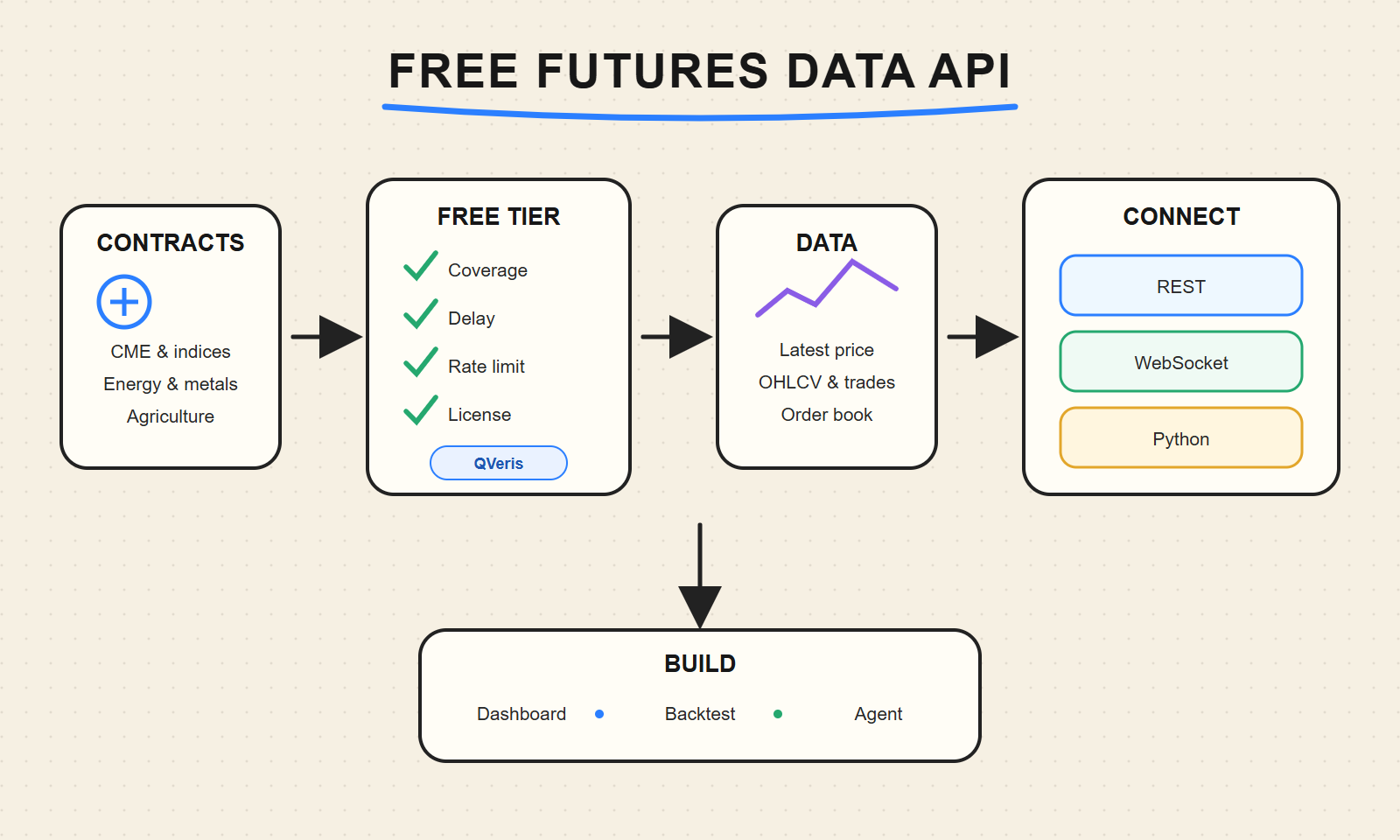
TL;DR
Developers want usable futures prices through an API, not another chart page or brokerage signup funnel.
A free tier may mean delayed data, a trial credit, limited symbols, low request quotas, or historical-only access.
Latest price, OHLCV bars, trades, order books, settlement, volume, and open interest serve different workflows.
Confirm exchange coverage, contract symbology, latency, entitlements, redistribution rights, and rate limits.
What a free futures data API must provide
The best option is the one whose data rights and technical limits fit your application. “Real time” can mean direct exchange data, a vendor-normalized stream, or merely frequent updates. For regulated exchange data, fees and entitlements may still apply even when an API account has a free plan.
Real-time futures price API or delayed quotes?
Use delayed or end-of-day data for learning, prototypes, and some research. Monitoring, alerts, or execution-sensitive systems need a clearly stated timestamp, delay policy, and exchange entitlement.
Historical futures data API coverage
Check first and last dates, intraday granularity, expired contracts, roll conventions, continuous-contract methodology, corporate/reference fields, and whether corrections are published.
REST snapshots or futures WebSocket API?
REST works well for snapshots and backfills. WebSocket or another streaming protocol is better for continuous prices, trades, and order-book updates, but adds reconnection and sequence-handling work.
Compare free futures market data API options
| Check | Questions to ask | Good for | Common limit |
|---|---|---|---|
| Coverage | Which exchanges, asset classes, contracts, and expired symbols? | Avoiding symbol gaps. | Selected venues or symbols only. |
| Freshness | Real time, delayed, end of day, or cached? | Matching research or live workflows. | Exchange entitlement. |
| Fields | Price, OHLCV, trades, order book, open interest, settlement? | Charts, backtests, monitoring. | Free tier may expose snapshots only. |
| Access | REST, WebSocket, SDK, authentication, quota, and SLA? | Reliable production integration. | Trials expire; quotas change. |
How to use a futures data API in Python
1. Define the futures contract and fields
Write down the venue, root symbol, contract month, desired timestamps, timezone, and fields. Do not assume two providers use the same symbol or continuous-contract rule.
2. Test one free futures API request
Use the provider’s official example and a sandbox or free key. Store credentials outside source code, set a timeout, and log response headers that describe quota and freshness.
3. Validate before storing the data
Reject missing timestamps, normalize timezones, preserve the raw symbol, detect stale responses, and compare a small sample with an official exchange or licensed vendor reference.
4. Add retries without breaking rate limits
Retry transient failures with exponential backoff and jitter. Respect 429 responses and provider guidance; do not turn a small free quota into a polling loop.
Use QVeris to find and inspect market data capabilities
QVeris helps developers and agents discover callable capabilities and inspect their inputs before integration. It does not make a paid exchange license free or guarantee that a provider’s data is suitable for trading.
- Search the QVeris Tool Finder for market-data capabilities instead of hard-coding an unverified endpoint.
- Inspect required symbols, parameters, authentication, and output schema before allowing an agent to call a provider.
- Keep licensing, latency, and suitability checks in your application’s approval process.
FAQ
Is there a truly free real-time futures API?
Sometimes for selected symbols or a trial, but exchange entitlements, delays, quotas, and redistribution rules vary. Read the current provider terms before relying on it.
Can I get historical futures data free by API?
Some providers expose limited daily or intraday history, samples, or credits. Confirm expired-contract coverage and continuous-series methodology.
Which fields should a futures market data API return?
At minimum: symbol, venue, timestamp, price semantics, and freshness. Depending on the task, add OHLCV, trades, quotes, depth, settlement, or open interest.
Can I use a free futures data API for trading?
Only after verifying license, latency, reliability, corrections, and suitability. Free access alone is not evidence that data is execution-grade.