
Choose a Free Implied Volatility API
Data, Limits & Setup选择合适的免费隐含波动率 API
全面了解数据、限制与接入方式
Find IV data for options research, compare free-tier limits, and validate each value before it enters a screen, model, or backtest.
查找适用于期权研究的隐含波动率数据,比较免费套餐的使用限制,
并在将数据用于筛选、建模或回测之前完成验证。
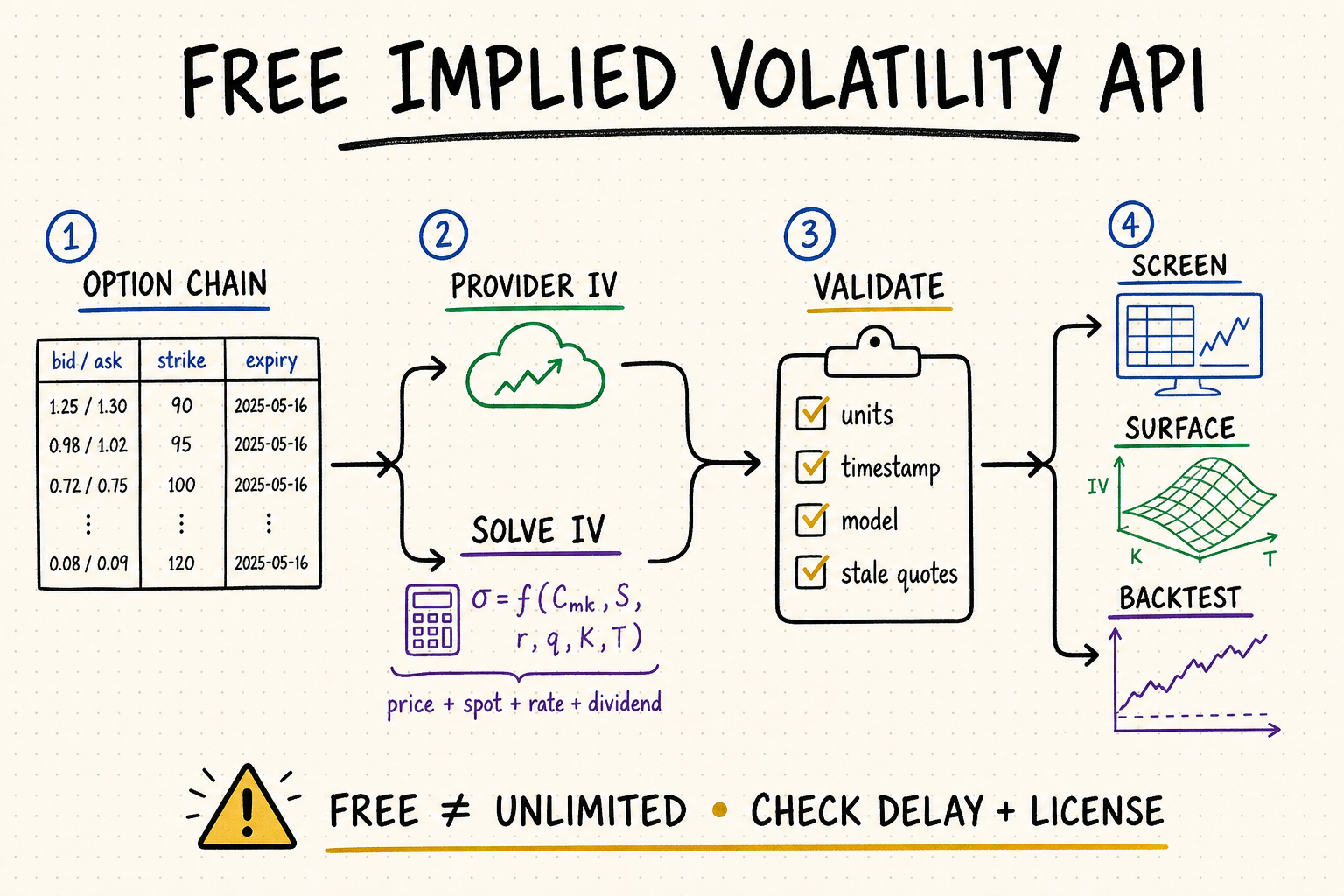
Free implied volatility API: the short answer免费隐含波动率 API:核心结论
A free plan may expose current option-chain IV, a small request quota, delayed values, a calculator endpoint, or a limited symbol universe.
Use a provider-calculated IV field, or retrieve a reliable option price and solve for volatility with a documented pricing model.
免费套餐可能仅提供当前期权链的 IV,并设有较低的请求频率上限;也可能只提供延迟行情、IV 计算接口,或仅支持少量标的。
可以直接使用数据供应商计算的 IV 字段;也可以先获取可靠的期权价格,再使用有明确方法说明的定价模型求解隐含波动率。
Use a provider IV field when speed and broad chain screening matter, but preserve enough inputs to audit it. Use a calculator when the application controls price selection, rates, dividends, time convention, and model. For historical research, require point-in-time quotes and inputs rather than today’s recalculated IV. Implied volatility is an annualized model parameter that reconciles an option price; it does not predict direction and is not directly comparable across contracts without matching expiry, strike or delta, and methodology.
当速度和整条期权链筛选更重要时,可以使用服务商预先计算的 IV,但仍要保留足够输入以便核验;当应用需要自行控制价格选择、利率、股息、时间口径和定价模型时,应使用计算接口;历史研究则需要历史时点的报价和输入,而不能采用今天重新计算的 IV。隐含波动率是使模型价格与期权价格一致的年化参数,它不预测涨跌方向;到期日、行权价或 Delta 和计算方法不一致时,也不能直接横向比较。
What a useful implied volatility API must return实用的隐含波动率 API 应返回哪些数据
An IV number without its inputs is hard to audit. Start with the option contract and the market observation used to calculate it. A robust response identifies the underlying, expiration, strike, call or put, contract multiplier, quote or trade price, underlying spot price, calculation time, and whether IV is a decimal or percentage.
如果没有计算所用的输入数据,IV 数值就很难核验。首先要明确具体的期权合约,以及计算该数值时采用的市场行情。一份完整可靠的响应应包含标的资产代码、到期日、行权价、期权类型(看涨或看跌)、合约乘数、报价或成交价、标的资产现货价格、计算时点,以及 IV 采用小数还是百分比表示。
Underlying, contract symbol, expiration, strike, call/put flag, exercise style, multiplier, deliverable, venue, and currency.
Bid, ask, midpoint or last price, quote time, underlying spot, market session, delay status, and provider delivery time.
Specify decimal or percent, annualization factor, calendar or trading-day convention, time to expiry, solver tolerance, rounding, and whether the value represents bid IV, ask IV, mid IV, trade IV, or a fitted surface.
Record Black-Scholes, Black-76, binomial, or another model; European versus American exercise; cash or physical settlement; rates, borrow, dividends, forward price, and early-exercise treatment.
Identify the selected option price and filtering rule. Zero bids, one-sided or crossed markets, stale quotes, wide spreads, auction prints, and old last trades can produce unstable or meaningless IV.
Return convergence status, arbitrage-bound checks, iteration or tolerance information, null reason, and any clipping or fallback. A numeric value should not hide an invalid input or failed solve.
Keep expiry, strike, moneyness or delta, forward reference, source contract, raw versus smoothed flag, fit time, data version, and provider identity so smile and term-structure comparisons remain reproducible.
标的资产代码、期权合约代码、到期日、行权价、期权类型(看涨或看跌)、行权方式、合约乘数、交割标的、交易场所和计价币种。
买入报价、卖出报价、中间价或最新成交价,以及行情时间戳、标的资产现货价格、所处交易时段、延迟状态和数据供应商发送该条数据的时间。
说明 IV 使用小数还是百分比、年化因子、自然日或交易日口径、剩余期限、求解容差和舍入方式,并区分买价 IV、卖价 IV、中间价 IV、成交 IV 或拟合曲面值。
记录使用 Black-Scholes、Black-76、二叉树还是其他模型,并明确欧式或美式行权、现金或实物结算、利率、借券成本、股息、远期价格和提前行权处理。
明确使用哪一种期权价格及过滤规则。零买价、单边或倒挂行情、陈旧报价、过宽价差、集合竞价成交和很久以前的最新成交,都可能产生不稳定甚至没有意义的 IV。
返回是否收敛、无套利边界检查、迭代或容差信息、空值原因,以及是否进行截断或回退。不能用一个数值掩盖无效输入或求解失败。
保存到期日、行权价、价内外程度或 Delta、远期参考价、来源合约、原始或平滑标记、拟合时间、数据版本和服务商身份,使微笑与期限结构比较可以复现。
Worked example: one quote can imply an IV range实算示例:一组报价对应的是 IV 区间
Consider a 30-calendar-day European call with spot 100, strike 100, a continuously compounded risk-free rate of 4.5%, no dividend, and a contemporaneous market quote of 3.00 bid / 3.40 ask. Under Black–Scholes, using 30/365 years, the bid implies approximately 24.63% IV, the 3.20 midpoint implies 26.39%, and the ask implies 28.14%. The useful output is therefore not just “26.39%”; it is the selected price, the 24.63%–28.14% quote-implied range, every model input, and the calculation timestamp.
假设一张欧式看涨期权还有 30 个自然日到期,标的现价为 100、行权价为 100,连续复利无风险利率为 4.5%,不派息,同一时点的市场报价为买价 3.00、卖价 3.40。使用 Black–Scholes 模型,并以 30/365 年计算剩余期限,买价对应的 IV 约为 24.63%,中间价 3.20 对应约 26.39%,卖价对应约 28.14%。因此,有价值的结果不能只有“26.39%”这一个数,还应同时返回所选价格、24.63%–28.14% 的报价隐含区间、全部模型输入和计算时间。
Return null when the inputs do not support a defensible solve. For a European call, reject a selected price below max(0, S·e−qT − K·e−rT) or above S·e−qT. Also return a reason code when the market is crossed, the quote is stale, the solver does not converge, or vega is so small that a tiny price change produces an extreme IV change. Near expiry and far from the money, a wide IV interval is often more honest than a precise-looking point estimate.
输入不足以支持可靠求解时,应返回空值。 对欧式看涨期权,如果所选价格低于 max(0, S·e−qT − K·e−rT),或高于 S·e−qT,就应拒绝计算。行情倒挂、报价陈旧、求解器不收敛,或 Vega 过低导致价格微小变化就引发 IV 剧烈波动时,也应返回明确的原因代码。临近到期或深度价内外合约中,一个较宽但真实的 IV 区间,往往比看似精确的单点值更可信。
Ways to get free implied volatility data免费获取隐含波动率数据的几种方式
Raw market-data APIs, provider-calculated analytics, broker-entitled feeds, and standalone IV calculators solve different problems. Compare them with the same contract set and do not assume a field named iv has the same source or methodology everywhere.
原始行情 API、数据供应商预先计算的分析数据、需券商账户权限的数据源和独立 IV 计算 API 解决的是不同问题。比较时应采用同一组期权合约,也不能仅因字段都名为 iv,就认定各来源使用相同的原始数据和计算方法。
| Source type来源类型 | Typical output典型输出 | Best for适合场景 | Watch for注意事项 |
|---|---|---|---|
| Options analytics API期权分析数据 API | Pre-calculated IV, Greeks, skew, term structure, or volatility surface.预先计算的 IV、希腊值、波动率偏斜、期限结构或波动率曲面。 | Fast prototypes and scanners.快速构建原型和期权筛选工具。 | Free tier may omit full chains, history, or methodology.免费套餐可能不提供完整期权链、历史数据或计算方法说明。 |
| Options market-data API期权行情 API | Chain quotes and sometimes vendor IV and Greeks.期权链报价,有时也包含数据供应商计算的 IV 和希腊值。 | Apps that also need quotes and liquidity.同时需要报价和流动性数据的应用。 | Delay, exchange coverage, rate limits, and display rights.数据延迟、交易所覆盖范围、请求频率限制和行情展示权限。 |
| Broker API券商 API | Account-entitled option chains, quotes, Greeks, and positions.券商账户权限所覆盖的期权链、报价、希腊值和持仓数据。 | Personal analysis and execution workflows.个人分析和交易执行流程。 | Account requirements and redistribution restrictions.账户准入条件和数据再分发限制。 |
| IV calculator APIIV 计算 API | IV solved from supplied option price and model inputs.根据传入的期权价格和模型参数反推出 IV。 | Transparent, reproducible calculations.需要透明且可复现计算过程的场景。 | You must source clean prices, rates, dividends, and exercise assumptions.需要自行获取可靠的价格、利率和分红数据,并设定行权方式等模型假设。 |
Validate every candidate on the same contracts and observation time. Include liquid at-the-money options, wide-spread wings, zero-bid contracts, short and long expiries, dividend-paying stocks, index options, and an adjusted contract. Compare selected option price, spot or forward, rate, dividend input, time to expiry, model, convergence, and IV output. Differences are useful only after the input and methodology differences are visible.
应在同一批合约和同一观察时点验证所有候选服务,包括高流动性的平值期权、价差较宽的两翼合约、零买价合约、短期和长期到期日、派息股票、指数期权及调整后合约。逐项比较所用期权价格、现货或远期价格、利率、股息输入、剩余期限、模型、收敛状态和 IV 输出。只有先看清输入与方法差异,结果差异才有解释价值。
Compare the same expiry and strike for contract-level checks, or the same expiry and delta or forward moneyness for smile analysis. A raw strike comparison across changing spot prices can mislead.
Store quote-derived IV, filters, excluded contracts, interpolation method, smoothing parameters, and fitted surface values as separate layers. Never overwrite observed contract analytics with the smooth result.
Freeze quotes, underlying or forward, rates, dividends, calendars, model code, and corrections at each observation time. Recomputing history with today’s curve creates a different dataset.
Reject impossible prices, nonconvergence, stale or crossed inputs, excessive spread, arbitrage violations, discontinuous units, and curves built from too few valid contracts.
Alert when provider fields, annualization, input price, smoothing, rate source, dividend treatment, or null behavior changes, even if the schema name remains iv.
合约级核验应比较相同到期日和行权价;波动率微笑分析则更适合比较相同到期日与 Delta 或远期价内外程度。标的价格变化时,直接按固定行权价横向比较可能产生误导。
将报价反推 IV、过滤条件、被排除合约、插值方法、平滑参数和拟合曲面值分层保存,不能用平滑结果覆盖实际合约分析值。
冻结每个观察时点的报价、标的或远期价格、利率、股息、日历、模型代码和更正记录。使用今天的曲线重新计算历史,会生成另一个数据集。
拒绝不可能价格、求解不收敛、陈旧或倒挂输入、价差过宽、违反无套利关系、单位突变,以及有效合约太少却仍生成的曲面。
即使字段名仍为 iv,服务商一旦改变年化方法、输入价格、平滑、利率来源、股息处理、空值逻辑或字段含义,也应触发告警。
Use QVeris to discover IV-capable APIs使用 QVeris 查找可提供 IV 数据的 API
QVeris helps agents discover and inspect financial-data capabilities before calling them. Search by the outcome you need—option chain, implied volatility, Greeks, volatility surface, or historical options—then review each provider's schema and terms.
QVeris 可帮助智能体在调用前查找并核验金融数据服务能力。可根据实际需要搜索期权链、隐含波动率、希腊值、波动率曲面或历史期权数据,再检查各数据供应商的字段定义与使用条款。
- Search capabilities by required output instead of relying on a provider name.
- Inspect parameters, response fields, freshness, access requirements, and limits before a call.
- Keep provider identity and timestamps attached to every IV value used by an agent.
- 按所需输出结果搜索数据服务能力,而不是只凭数据供应商名称查找。
- 调用前检查请求参数、响应字段、数据时效、访问条件和使用限制。
- 智能体使用的每个 IV 数值都应附带数据供应商身份和数据时间戳。
QVeris can simplify discovery and routing across IV, Greeks, option-chain, and historical-options capabilities. The application still owns price selection, model assumptions, solver validation, surface construction, historical input versions, licensing, and how uncertainty or failed calculations are presented.
QVeris 能够简化 IV、希腊值、期权链和历史期权能力的查找与路由,但价格选择、模型假设、求解验证、曲面构建、历史输入版本、许可,以及不确定性或计算失败的展示方式,仍由应用方负责。
FAQ常见问题
Yes. Some options-data and analytics providers offer free quotas, trials, calculators, or limited IV fields. Coverage, history, delay, and usage rights vary.
Yes, if the quote is reliable and you also have spot, strike, expiration, rate, dividend assumptions, option type, and an appropriate pricing model.
有。部分期权数据和分析服务商会提供免费调用额度、试用服务、IV 计算工具或有限的 IV 字段,但各家的标的覆盖范围、历史数据、行情延迟和使用权限并不相同。
可以,前提是报价可靠,同时具备标的现价、行权价、到期日、利率与分红假设、期权类型等必要信息,并选用合适的定价模型。
There is no universal choice. Midpoint is common for liquid two-sided markets; bid and ask produce a range; last trade may be stale. Store the selected price and quote state with the result.
They may use different quotes, underlying or forward prices, rates, dividends, calendars, exercise models, solvers, filters, or smoothing. Compare inputs before treating either value as wrong.
Definitions vary. IV rank commonly scales current IV within a historical minimum and maximum; percentile measures the share of observations below it. Record lookback, IV series, sampling, and formula.
A conventional volatility input cannot be negative. Values above 100% can be valid for highly volatile contracts because 100% is 1.0 annualized volatility, not a probability ceiling. Always verify units.
没有适用于所有场景的唯一选择。流动性良好的双边市场常用中间价;买价和卖价可以形成区间;最新成交价可能已经陈旧。结果旁必须保存所选价格及报价状态。
它们可能使用不同报价、标的或远期价格、利率、股息、日历、行权模型、求解器、过滤或平滑方法。判断某个值错误前,应先比较输入。
具体定义可能不同。IV Rank 通常按历史最低和最高 IV 缩放当前值;Percentile 衡量历史观测中低于当前值的比例。必须记录回溯期、所用 IV 序列、采样和公式。
常规定义下波动率输入不能为负。对于高波动合约,超过 100% 可以成立,因为 100% 表示年化波动率 1.0,并不是概率上限。必须核对单位。