
Free Institutional Holdings API
13F Data & Integration免费机构持仓 API
13F 数据查询与接入
Use a free institutional holdings API to query SEC 13F portfolios or stock holders, preserve filing versions, compare point-in-time changes, and verify scope, identifiers, dates, limits, and licensing.
通过免费机构持仓 API 查询 SEC 13F 组合或个股机构持有人、保留申报版本、比较时点化变化,并核对范围、标识、日期、限制与许可。
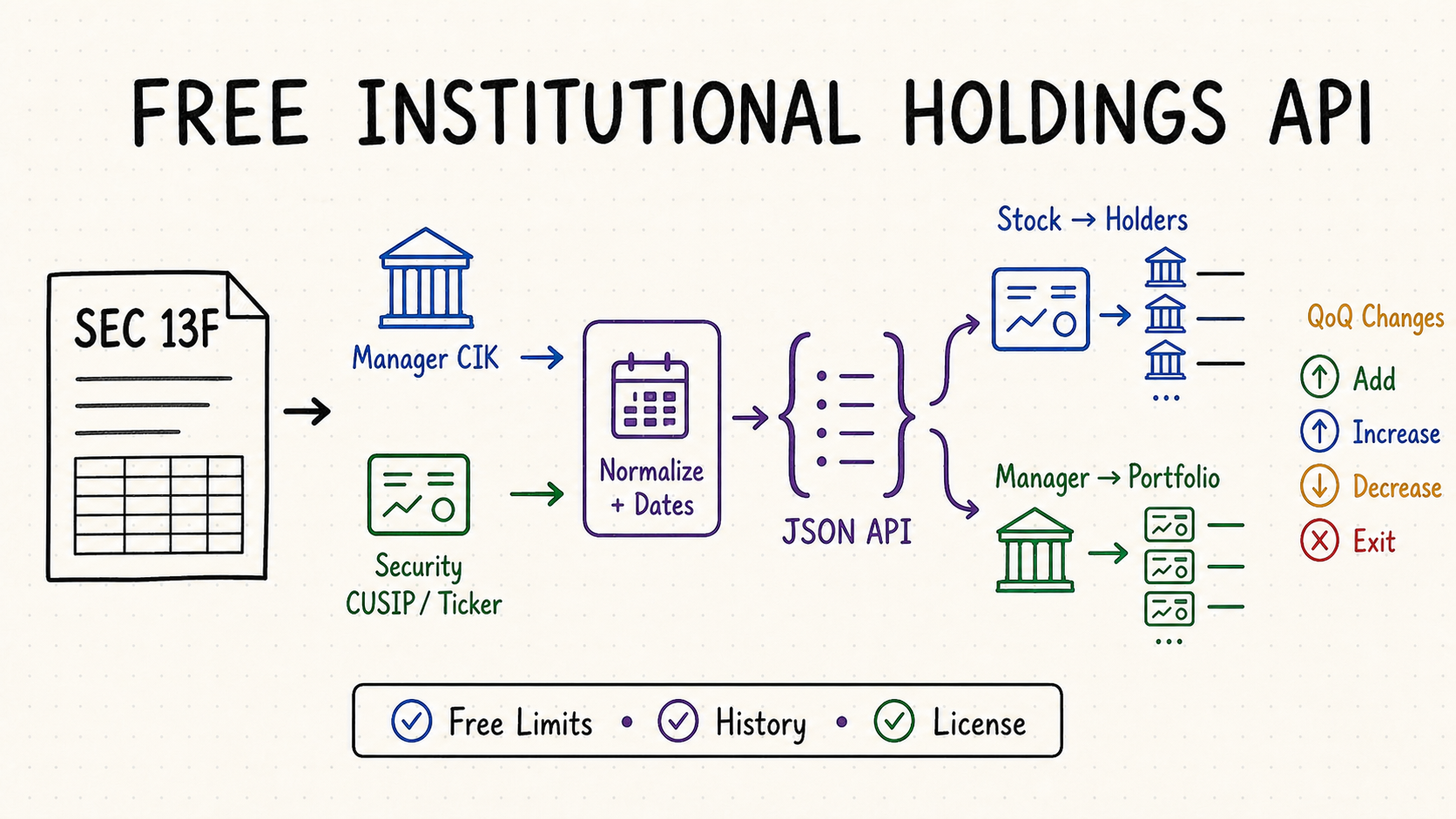
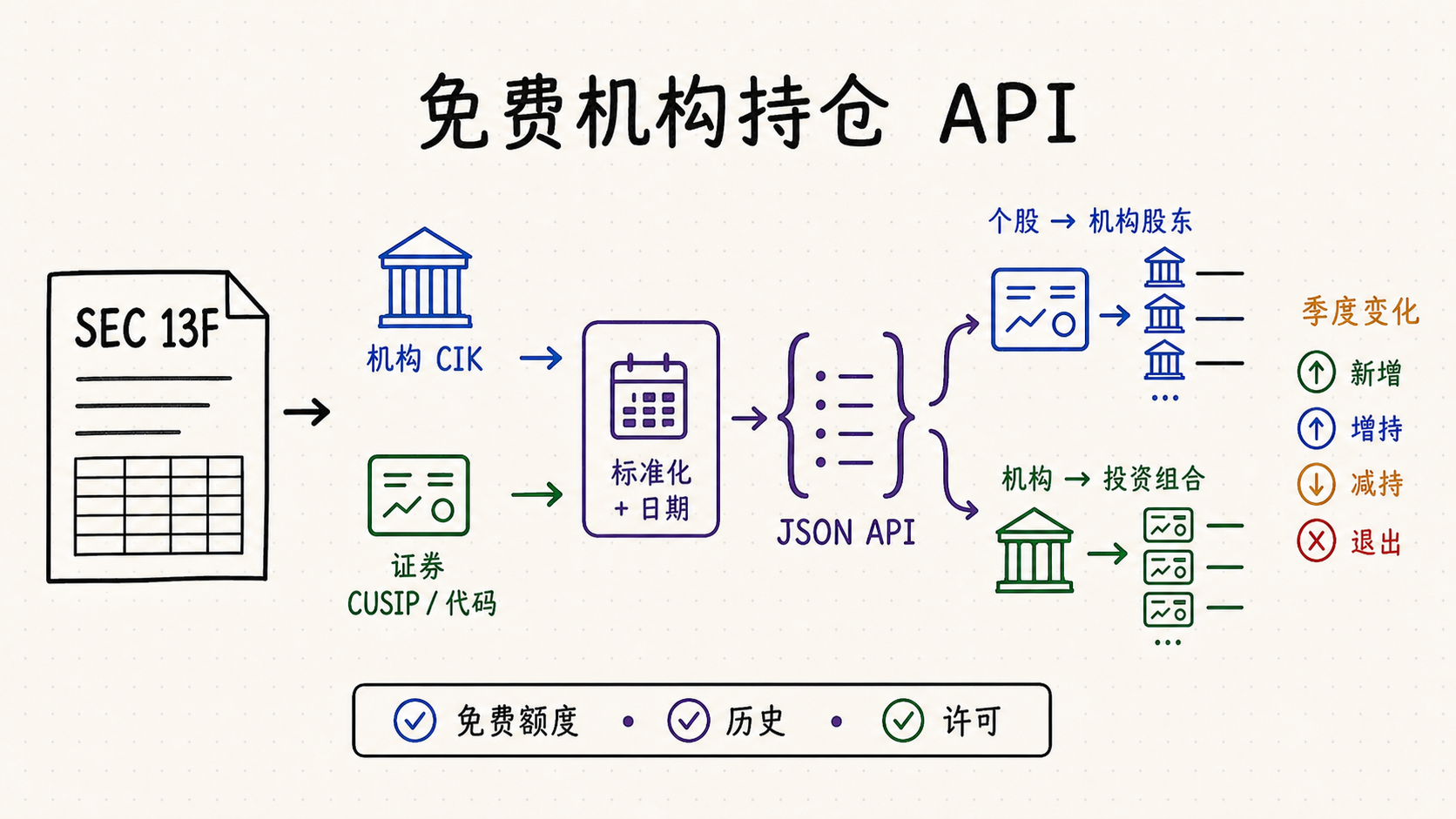
Free institutional holdings API: what users need免费机构持仓 API 应满足哪些需求
Most U.S. institutional-holdings APIs normalize Form 13F filings. Under the SEC framework, institutional investment managers that exercise investment discretion over at least the applicable $100 million threshold in Section 13(f) securities file quarterly reports. The information table reports specified securities held at quarter end; it is not a live transaction feed, acquisition-cost ledger, short-position report, or complete view of every asset managed.
美国机构持仓 API 大多以 Form 13F 申报为基础进行标准化。按照 SEC 的现行说明,对达到适用的 1 亿美元门槛且对 Section 13(f) 证券拥有投资决策权的机构投资管理人,需要按季度申报。信息表反映季末特定证券持仓,并不是实时成交、买入成本、空头仓位或全部管理资产的完整记录。
A production-quality API must preserve the distinction between report period, filing timestamp, provider processing time, and amendment time. It should also expose whether a filing is a holdings report, notice, combination report, or amendment. Without that context, a portfolio can appear empty, duplicated, or newly changed when the filing structure—not the manager’s economics—caused the difference.
生产级接口必须区分报告期、提交时间、供应商处理时间和修订时间,并尽量说明申报属于持仓报告、通知报告、组合报告还是修订。缺少这些语境时,组合可能看似为空、重复或突然变化,而真正原因只是申报结构不同,并非机构经济仓位发生了相同变化。
Look up reporting managers for one mapped security, or retrieve one manager’s disclosed portfolio by CIK and filing period.
Results describe reportable positions at quarter end. They are not real-time trades or a complete view of every asset class.
Reliable APIs connect manager CIK, issuer, CUSIP, ticker, filing accession, and report period without hiding the source record.
Confirm whether “free” is a lasting plan or trial, which quarters are accessible, and whether commercial use, caching, or redistribution is allowed.
既可按完成映射的证券查询申报机构,也可按 CIK 和报告期获取某家机构披露的 13F 组合。
结果描述季度末可报告仓位,不是实时交易,也不代表机构所有资产类别的完整组合。
可靠接口会关联机构 CIK、发行人、CUSIP、股票代码、申报编号和报告期,并保留源记录。
确认免费是长期套餐还是试用、可访问哪些季度,以及商业使用、缓存和再分发是否允许。
13F institutional holdings data API fields and timing13F 机构持仓数据接口的字段与时点
A useful API preserves the form type, report period, filing and amendment timestamps, accession number, manager CIK and file number, issuer, security class, CUSIP, optional FIGI when filed, shares or principal amount, reported fair value and units, investment discretion, voting authority, and put/call indication where present. It should retain the original information-table row and source link rather than exposing only a ticker and derived percentage.
实用接口应保留表单类型、报告期、提交与修订时间、申报编号、机构 CIK 与文件号、发行人、证券类别、CUSIP、申报中存在时的 FIGI、股数或本金金额、申报公允价值及单位、投资决策权、投票权,以及适用时的看涨/看跌标记。接口还应保留原始信息表行与来源链接,而不是只返回股票代码和推导比例。
Query institutional holders by stock ticker or CUSIP按股票代码或 CUSIP 查询机构股东
Ticker search is convenient, but the filing identifies an issuer, class, and CUSIP; FIGI may appear in addition to, not instead of, CUSIP. Check effective-dated ticker mapping, multiple share classes, options, amended filings, shared reporting managers, pagination, and the difference between quarter-end reported value and a value repriced with today’s market data.
股票代码查询更方便,但申报记录的核心是发行人、证券类别和 CUSIP;FIGI 即使出现,也是补充而不是替代 CUSIP。应检查带有效期的代码映射、多种股份类别、期权、修订申报、共同申报机构、分页,以及季末申报市值与按今日行情重估市值之间的区别。
Retrieve an institution's 13F portfolio by CIK按 CIK 获取机构的 13F 投资组合
For manager-level analysis, retain the filing identity and period, resolve holdings or combination-report structure, and apply amendments before comparing adjacent quarters. Derive new, increased, reduced, and exited labels only after adjusting for identifier changes and corporate actions. These are filing-to-filing differences, not observed trades or trade timestamps.
进行机构层面分析时,应保留申报主体和报告期,解析持仓报告或组合报告结构,并在季度比较前应用修订。只有处理证券标识变化和公司行动后,才能推导新建、增持、减持和退出标签。这些属于申报间差异,不是实际成交或成交时间。
Understand what is excluded or delayed理解未覆盖或延后公开的内容
Only securities on the applicable Section 13(f) list are reportable in the information table; many other assets are outside its scope. Confidential-treatment requests can also affect what appears publicly and when. An API should not label a missing row as zero ownership unless it has distinguished scope, filing structure, mapping failure, and unavailable or confidential data.
只有列入适用 Section 13(f) 清单的证券才应出现在信息表中,许多其他资产不属于该表覆盖范围;保密处理申请还可能影响公开内容及时间。接口只有在区分数据范围、申报结构、映射失败以及未公开或保密内容后,才能判断缺失记录,不能直接把它解释为持仓为零。
How to evaluate a free 13F holdings API如何评估免费 13F 持仓 API
| Check检查项 | Verify需要核对 | Why it matters重要原因 |
|---|---|---|
| Coverage覆盖 | Managers, issuers, quarters, amendments, historical depth.机构、发行人、季度、修订申报与历史深度。 | Avoids silent gaps.避免无提示的数据缺口。 |
| Lookup查询 | Ticker, CUSIP, manager name, CIK, pagination.股票代码、CUSIP、机构名称、CIK 与分页。 | Supports both ownership views.支持双向持仓视图。 |
| Provenance来源 | Accession, filing URL, report and processed dates.申报编号、原文链接、报告期与处理日期。 | Makes records auditable.让数据可追溯审计。 |
| Normalization标准化 | CIK and CUSIP mapping, duplicates, amendments, units.CIK 与 CUSIP 映射、重复、修订和单位。 | Prevents false changes.避免产生虚假的持仓变化。 |
| Filing structure申报结构 | Holdings, notice, combination, amendment, other reporting managers.持仓、通知、组合、修订及其他申报机构。 | Prevents an empty notice from being treated as zero assets.避免把通知报告中的空表误认为资产为零。 |
| Completeness完整性 | Source row count and value total, unmapped rows, options, confidential-treatment flag.来源行数与市值合计、未映射行、期权和保密处理标记。 | Reveals silent drops and partial public views.发现静默丢行和不完整的公开视图。 |
| Point-in-time access时点化访问 | Can the API reproduce what was available on a chosen analysis date?接口能否复现某个分析日期当时已经公开的信息? | Avoids look-ahead bias in historical research.避免历史研究中的前视偏差。 |
| Free limits免费限制 | Quota, recent-quarter restriction, license, caching.额度、最近季度限制、许可与缓存。 | A trial may not fit production.试用未必适合生产。 |
Integrate a free institutional holdings API with JSON接入返回 JSON 的免费机构持仓 API
Step 1: test stock-holder and manager-portfolio queries步骤 1:测试个股机构股东与机构组合查询
Call one documented endpoint by ticker or CUSIP and another by manager CIK. Inspect authentication, HTTP status, pagination, total count, latest available report period, and rate-limit headers.
分别按股票代码或 CUSIP、机构 CIK 调用文档化端点,并检查鉴权、HTTP 状态、分页、总数、最新可用报告期和限流响应头。
Step 2: normalize 13F holdings fields步骤 2:标准化 13F 持仓字段
Map responses into stable fields such as manager_cik, report_period, filing_date, cusip, ticker, shares, reported_value, and accession_number. Keep the raw response and source URL.
将响应映射到稳定字段,例如 manager_cik、report_period、filing_date、cusip、ticker、shares、reported_value 和 accession_number,同时保留原始响应和来源链接。
Step 3: compare quarterly holdings without look-ahead步骤 3:避免前视偏差地比较季度持仓
Store each filing by report period and filing timestamp, apply amendments, and compare only information available as of the analysis date. Do not overwrite prior snapshots or label delayed disclosure as real-time activity.
按报告期和申报时间保存每份文件,应用修订记录,并只比较分析时点已经公开的信息。不要覆盖历史快照,也不要把延迟披露标记成实时交易。
Step 4: reconcile the normalized portfolio步骤 4:核对标准化组合
Compare normalized row counts and reported-value totals with the source summary, retain unmapped rows, and explain any difference. Treat 13F-NT and combination reports separately, and make amendment processing idempotent so repeated ingestion does not double-count positions.
把标准化后的行数与申报市值合计同来源摘要核对,保留无法映射的记录,并解释所有差异。13F-NT 与组合报告应单独处理,修订写入必须具备幂等性,避免重复采集造成持仓重复计算。
Step 5: publish dates and limitations with results步骤 5:与结果一起展示日期和局限
Expose report period, filing and amendment time, ingestion time, source accession, mapping version, and whether values are reported or repriced. Label quarter changes as disclosure changes and state that non-reportable assets, shorts, and confidential or delayed rows may be absent.
展示报告期、提交与修订时间、采集时间、来源申报编号、映射版本,以及市值属于申报值还是重新估值。季度变化应标注为披露变化,并说明不在申报范围内的资产、空头以及保密或延后公开记录可能缺失。
Use QVeris to find institutional holdings data capabilities用 QVeris 查找机构持仓数据能力
QVeris helps developers and agents discover, inspect, and call available financial-data capabilities. Open the QVeris tool details to inspect 13F manager portfolios or holder-by-security capabilities, then inspect CIK, CUSIP and period inputs, form and amendment metadata, pagination, source links, historical access, quotas, and provider terms. QVeris can route a capability, but it does not turn a delayed filing into a current portfolio.
QVeris 帮助开发者和 Agent 发现、检查并调用可用的金融数据能力。可通过QVeris 工具详情 查看 13F 机构组合或按证券查询持有人的能力,再检查 CIK、CUSIP 与报告期参数、表单和修订元信息、分页、来源链接、历史访问、额度与供应商条款。QVeris 可以路由能力,但不会把延迟申报变成当前持仓。
- Search specifically for 13F holdings or institutional ownership, not ETF constituents or insider trades.
- Inspect query identifiers, historical coverage, pagination, quotas, and licensing before calling.
- Keep provider-specific logic behind a normalized application interface.
- 明确搜索 13F 持仓或机构股东,不要混入 ETF 成分股或内幕交易。
- 调用前检查查询标识符、历史覆盖、分页、额度和许可。
- 将供应商特定逻辑封装在标准化应用接口之后。
FAQ
Is there a free institutional holdings API?
Some providers expose a free tier, evaluation endpoint, or no-cost recent 13F access. Verify request limits, quarters, source links, caching, redistribution, licensing, and commercial use.
What does a 13F holdings API return?
It can return manager and filing identity, issuer, class, CUSIP, shares or principal amount, reported fair value, discretion, voting authority, put/call indication, period, and source accession.
Can I query institutional holders by ticker?
Often, but ticker lookup is a provider mapping layered over filing identifiers. Keep CUSIP, class, manager CIK, mapping date, and source row so ticker changes remain auditable.
Does a 13F API show the manager’s complete portfolio?
No. It covers reportable Section 13(f) securities and may involve notice, combination, amendment, or confidential-treatment context. Other assets and short positions are not a complete part of this view.
How current is 13F data?
It is quarterly disclosure data, generally filed after quarter end under the applicable deadline. Fast API processing reduces filing-to-API delay, not the age of the underlying position.
How should quarterly changes be interpreted?
Call them filing-to-filing changes. Corporate actions, identifier mapping, amendments, reporting structure, and security scope can change the row even without a directly observed trade.
How do I avoid look-ahead bias?
Version filings by report and public filing time, apply only amendments available by the analysis date, and never replace an older research snapshot with today’s normalized latest state.
有免费的机构持仓 API 吗?
部分服务商提供免费套餐、评估端点或最近一期 13F 的免费访问。应核对调用、季度范围、来源链接、缓存、再分发、许可与商业使用条件。
13F 持仓 API 返回哪些字段?
可包含机构与申报身份、发行人、证券类别、CUSIP、股数或本金金额、申报公允价值、决策权、投票权、看涨/看跌标记、报告期和来源编号。
能否按股票代码查询机构持有人?
通常可以,但代码查询是供应商叠加在申报标识之上的映射。应保留 CUSIP、证券类别、机构 CIK、映射日期和来源行,以便审计代码变更。
13F API 会显示机构完整组合吗?
不会。它覆盖可申报的 Section 13(f) 证券,还可能涉及通知、组合、修订或保密处理语境;其他资产和空头仓位并未完整包含在该视图中。
13F 数据有多新?
它属于季度披露数据,通常按适用期限在季末后提交。API 处理更快只能缩短申报到接口的延迟,不能改变底层仓位对应的历史时点。
如何理解季度持仓变化?
应称为“申报间变化”。公司行动、标识映射、修订、申报结构和证券范围都可能改变记录,不能直接把差值解释为已观察到的交易。
如何避免前视偏差?
按报告期和公开提交时间保存版本,只应用分析日当时已经公开的修订,不能用今天的最新标准化状态覆盖过去的研究快照。
Authoritative references and next steps权威参考与下一步
Use the SEC source to understand what Form 13F represents, then confirm any third-party API's current free-plan contract before relying on it.
先通过 SEC 来源理解 Form 13F 的披露范围,再核对第三方 API 当前的免费套餐约定。