
Choose a Free Interest Rate API
and Make a Verified Call
Compare free sources for policy rates, SOFR, and historical interest rates, then make a verified JSON or Python request.
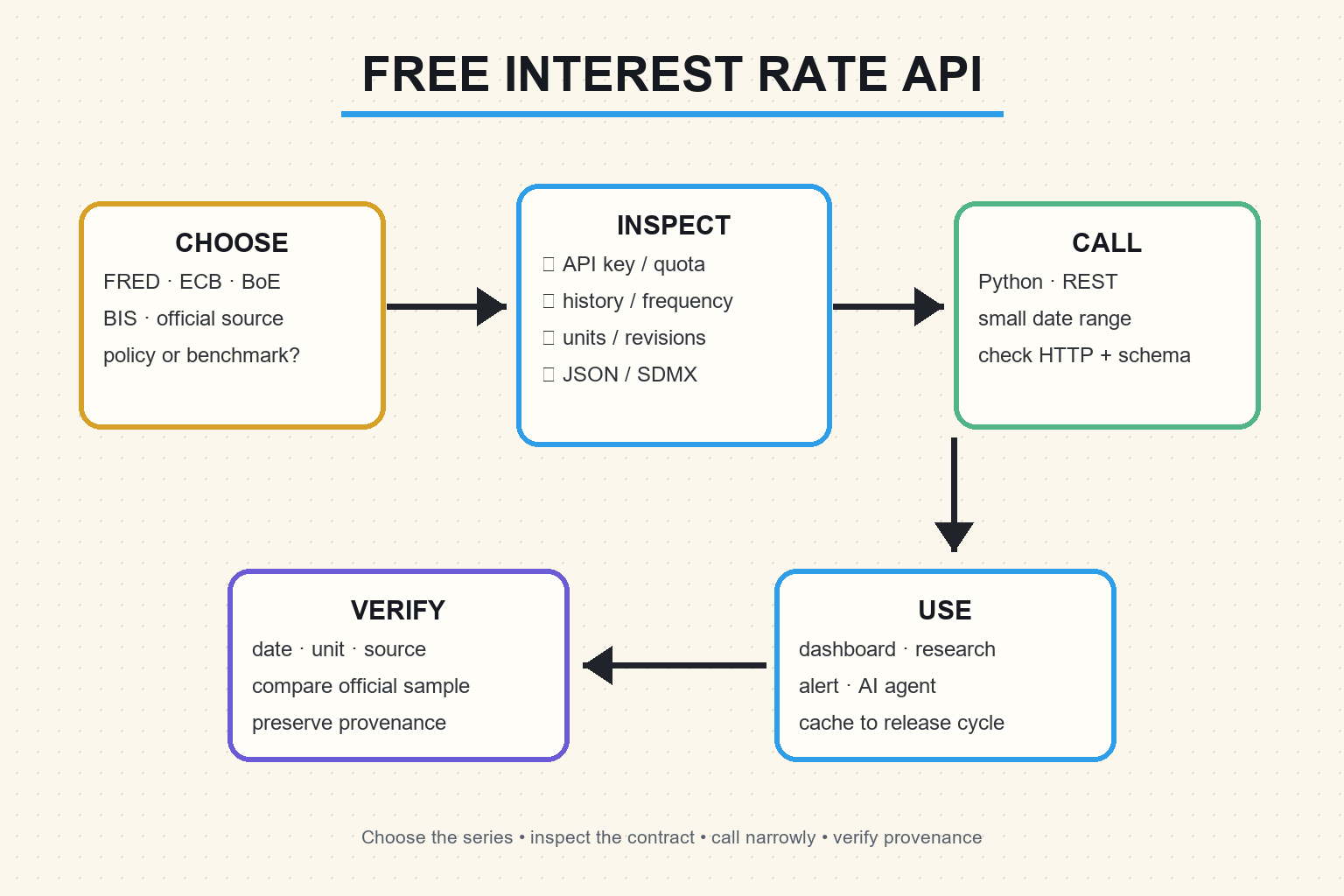
TL;DR
A practical shortlist of free official or aggregated APIs, plus enough detail to make a first verified request.
Central-bank policy rates, Fed Funds, SOFR, €STR, SONIA, benchmark rates, and historical time series.
Check registration, API keys, quotas, licensing, attribution, formats, and production restrictions.
Choose one source, inspect metadata, make a small request, validate provenance, then add caching.
What people want from a free interest rate API
Current results are dominated by API documentation, open-data portals, source directories, and implementation guides. The main intent is informational with a practical task: identify a trustworthy source and retrieve official economic time-series data programmatically. A smaller commercial-investigation intent appears when users compare one normalized API with several central-bank-specific services.
Data and features repeated across ranking pages
Recurring entities include the ECB Data Portal, FRED, World Bank, DBnomics, and national central-bank open-data systems. Repeated evaluation points include policy rates, inflation, exchange rates, money and banking statistics, historical coverage, REST or SDMX access, JSON or CSV output, API keys, quotas, metadata, and licensing.
Free interest rate API sources to evaluate
| Source | Typical coverage | Interface | Check before use |
|---|---|---|---|
| FRED API | Fed Funds, Treasury yields, SOFR, mortgage rates, and long histories. | REST XML or JSON; free API key required. | Series definition, observation frequency, units, and revisions. |
| ECB Data Portal | ECB policy rates, €STR, euro-area bank and market rates. | Keyless SDMX REST service. | Dataset keys, dimensions, frequency, and status flags. |
| Bank of England IADB | Bank Rate, SONIA, yield curves, and UK lending rates. | Download endpoints with CSV and other formats. | Series codes, date range, frequency, and usage terms. |
| BIS Data Portal | Cross-country central-bank policy rates and financial statistics. | SDMX API and downloadable data. | Country comparability, frequency, metadata, and citation. |
“Free” does not mean identical terms. Verify each provider’s documentation on the day you integrate it because authentication, quotas, acceptable use, and dataset availability can change.
How to use a free interest rate API with Python
1. Define the indicator and geography
Specify the concept—policy rate, CPI, exchange rate, reserves, or money supply—plus geography, frequency, units, and required history. Similar labels can represent different methods.
2. Inspect metadata, authentication, and limits
Confirm the series ID, dimensions, units, seasonal adjustment, revision policy, API-key requirement, rate limits, reuse license, and attribution before writing production code.
3. Make a small request and validate it
curl "https://api.example.org/data/SERIES_ID?format=json&start=2025-01-01" is an example shape only. Use the provider’s documented URL and identifiers, compare sample observations with its visible portal, and inspect missing-value or revision flags.
4. Add caching, retries, and provenance
Cache to match the release schedule, respect retry guidance, record retrieval time and series metadata, preserve the source URL, and monitor schema changes.
Validate a central bank API response before publishing it
A successful HTTP status only proves that the server answered. It does not prove that the requested policy rate, exchange rate, inflation series, or reserve measure is the one your application intended to use. Inspect the provider, dataset, series identifier, frequency, unit, multiplier, geography, seasonal-adjustment status, observation date, and release status in every response. Treat missing values as missing rather than zero, preserve status flags, and compare several observations with the institution’s visible data portal before approving an integration.
Keep raw data, provenance, and revision history
Store the raw response together with the request URL, parameters, retrieval timestamp, HTTP status, and relevant headers. A normalized record should retain the original provider code and series ID so a reviewer can reproduce the call. Central bank time series may be corrected, rebased, seasonally adjusted again, or replaced with final observations. Decide whether the product always shows the latest vintage or preserves the value available on each retrieval date. Log schema changes and unexpected empty responses separately from network failures, and use bounded retries only for temporary errors.
For high-impact dashboards, alerts, or agent answers, add a release-date check before delivery. Confirm that the latest period is actually published, that a revised observation did not trigger a duplicate alert, and that a fallback source uses the same statistical concept. Display the observation date and retrieval time separately so users can distinguish when a value applies from when the application fetched it. Record the check result for later operational review and incident analysis.
Official central bank APIs vs aggregated economic data APIs
An official central bank API is usually the strongest choice when authority, methodology, and release timing matter more than convenience. The institution publishes the definitions, statistical notes, revision policy, and release calendar alongside the series. This makes the source suitable for regulatory research, policy analysis, citations, and any workflow where a reviewer must trace a value back to its producer. The trade-off is integration work: every institution may use different identifiers, dimensions, date formats, languages, authentication rules, and response structures. A project covering several economies can quickly accumulate multiple adapters and monitoring routines.
When an aggregator is the better engineering choice
An aggregator is useful when the application needs one query model across several providers or countries. A normalized catalog can reduce discovery time, standardize common fields, and simplify prototypes, dashboards, comparative research, or agent tools. That convenience does not transfer authority to the aggregator. Always retain the original provider code, dataset code, series identifier, unit, frequency, retrieval timestamp, and source URL. Review whether the aggregator transforms values, renames dimensions, changes missing-value markers, delays updates, or applies a separate license. For high-impact outputs, compare representative observations with the original portal and define a fallback path to the producer’s service.
Validate metadata, revisions, and data quality before use
Do not treat a series label as a complete definition
Two series can share a familiar label while measuring different concepts. An “interest rate” may be a policy target, an effective overnight rate, a lending facility rate, a deposit facility rate, or a monthly average. Inflation may be headline or core, monthly or annual, seasonally adjusted or unadjusted, preliminary or final. Before storing observations, capture the title, description, unit, multiplier, frequency, seasonal-adjustment status, geography, counterpart, valuation basis, and collection method. If the API provides dimension labels or codelists, store those mappings rather than relying only on compact codes.
Design explicitly for revisions and missing observations
Economic time series are revised. A provider may correct an error, incorporate a benchmark survey, rebase an index, change seasonal factors, or replace an estimate with a final value. Decide whether your product needs the latest vintage or the value known at a historical point in time. Preserve retrieval timestamps and, when available, release or vintage identifiers. Do not silently convert missing values to zero. Keep provider status flags, distinguish “not available” from “not applicable,” and test how the parser handles blank strings, symbols, nulls, and suppressed values. Validation rules should detect unexpected frequency changes, duplicate periods, unit changes, large discontinuities, and disappearing series.
Build a reliable production integration
Separate discovery, retrieval, normalization, and delivery
A maintainable pipeline gives each stage one responsibility. Discovery resolves a human request to a provider, dataset, and series. Retrieval calls the documented endpoint and stores the raw response with HTTP status, headers, request parameters, and retrieval time. Normalization converts dates, units, codes, and missing-value conventions into an internal schema without destroying the source representation. Delivery exposes the verified records to a dashboard, research notebook, database, API, or agent capability. Keeping the raw payload makes later debugging and reprocessing possible when a provider changes its schema or a transformation rule is corrected.
Match polling, caching, and retries to the release schedule
Most central bank statistics do not require continuous polling. Use the provider’s release calendar and series frequency to choose a refresh interval. Cache successful responses, send conditional requests when supported, and avoid rebuilding a full history when only the latest period can change. Apply bounded retries with backoff for timeouts and temporary server errors, but do not retry invalid identifiers or permission failures indefinitely. Record quota headers when they exist, protect API keys outside client-side code, and set alerts for repeated failures, stale data, or unexpected empty responses. A fallback should be an explicitly approved source, not an unreviewed scrape that silently changes provenance.
Common applications for central bank data
Research, dashboards, alerts, and AI agents
Researchers may combine policy rates, inflation, exchange rates, and monetary aggregates to study transmission mechanisms or compare economic cycles. Product teams may use the same series in internal dashboards, country profiles, treasury tools, or release alerts. Each use case needs a different freshness and revision policy. A historical paper may require a reproducible snapshot, while an operational dashboard usually needs the latest published value plus a visible “last updated” time. An alerting system needs idempotent release detection so a revision does not look like a new period.
For an AI agent, expose narrow, documented operations such as “get the latest policy rate,” “retrieve a series for a date range,” or “search series metadata.” Define required parameters, supported geographies, output fields, units, error states, and provenance. Limit the amount of data returned by default and require explicit date ranges for large downloads. The agent should cite the producer and series, state the observation date, and distinguish retrieved facts from its own interpretation. QVeris can help discover, inspect, call, and audit such capabilities, while the central bank or original statistical producer remains the authority for values and methodology.
How QVeris helps with interest rate APIs
QVeris can help an agent discover, inspect, call, and audit real-world capabilities. For interest-rate data, each API should remain an inspectable capability with documented inputs, outputs, and provenance. QVeris does not own or change the underlying official data.
- Use the QVeris Tool Finder to explore capabilities relevant to economic or financial data.
- Inspect an operation’s parameters and response shape before an agent calls it.
- Keep the provider URL, timestamp, series ID, and license context in downstream records.
FAQ
Yes. ECB offers keyless SDMX access, while FRED offers free access with an API key. Free terms, quotas, and licensing differ, so verify the current documentation.
FRED is useful for many US series, ECB for euro-area rates, the Bank of England for UK rates, and BIS for cross-country policy-rate research.
Yes. FRED exposes many rate series through its API, including Fed Funds, Treasury yields, SOFR, and mortgage rates. A free API key is generally required.
Use requests or a maintained client, send a small date-bounded query, check HTTP status and JSON fields, then store the series ID, units, date, and source.
No. QVeris helps agents discover and call capabilities; the provider remains authoritative for data, methods, licensing, and releases.