
Use a Free Live Stock Data API
Without Hidden Surprises使用免费实时股票数据 API时
避开隐藏问题
Verify quote freshness, exchange feeds, entitlements, streaming support, limits, and fallback behavior before you ship.
上线前应核对报价时效、交易所数据源、数据使用授权、流式传输支持、
调用额度与降级策略。
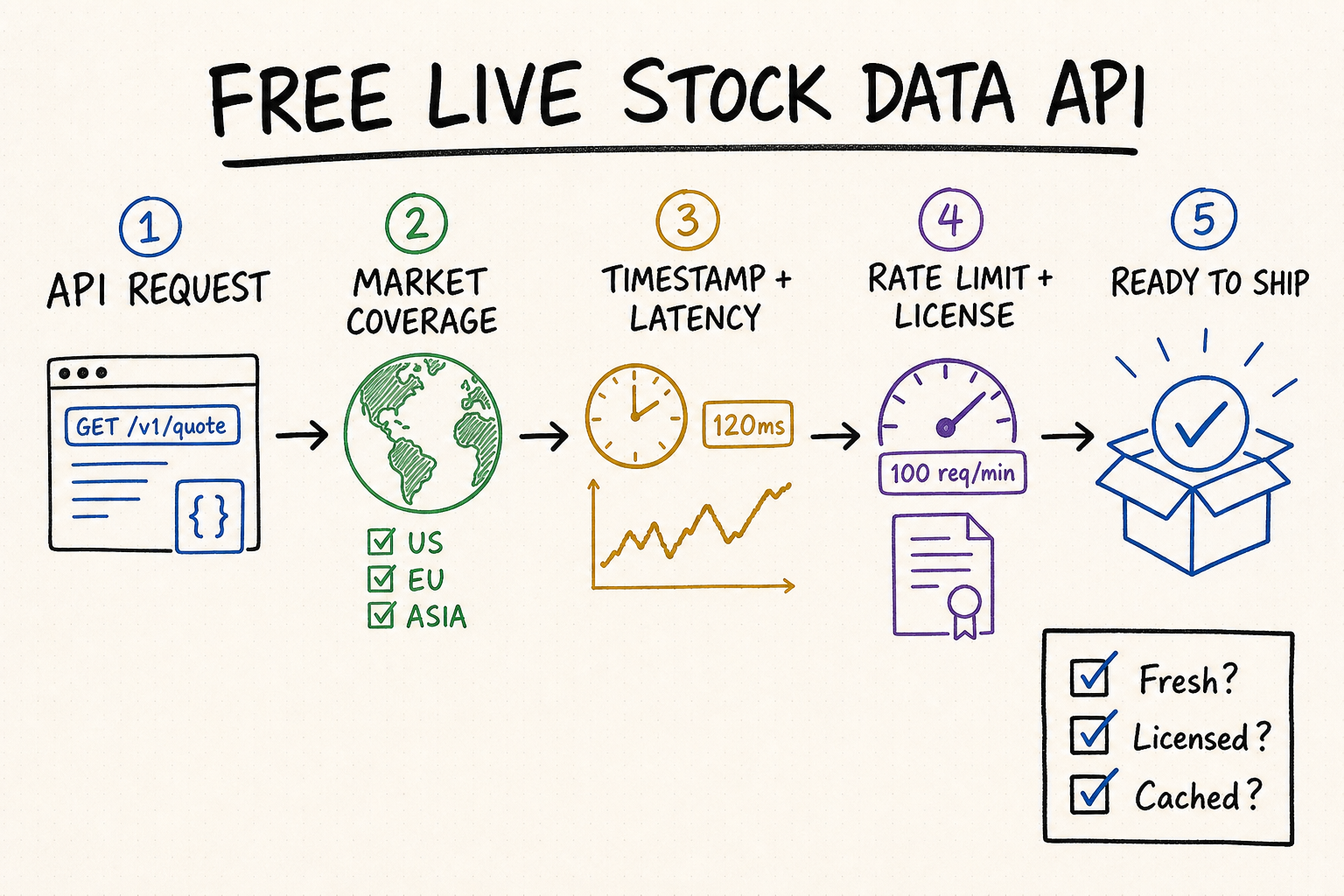
TL;DR核心摘要
A free live stock data API can support demos, watchlists, paper trading, and low-traffic research tools when its feed and license match your use case.
“Real time” is not universal. Verify exchange, quote timestamp, session, and whether the response is delayed.
Use REST snapshots for light refreshes and a documented WebSocket stream only when your product truly needs continuous updates.
Cache repeated requests, batch symbols when allowed, and keep a provider adapter so you can switch later.
只要行情源和数据许可符合使用场景,免费实时股票数据 API 就能用于产品演示、自选股、模拟交易和访问量较低的研究工具。
“实时”并没有统一标准。务必核对交易所、报价时间戳和交易时段,并确认返回的数据是否存在延迟。
更新频率较低时使用 REST 快照;只有产品确实需要持续更新时,才使用说明完善的 WebSocket 实时数据流。
缓存重复请求的结果,在接口允许时批量查询股票代码,并保留数据服务商适配层,以便日后切换服务商。
For a watchlist or portfolio page, delayed consolidated quotes or periodic snapshots may be enough if the UI labels them honestly. For alerts, compare the provider’s source timestamp with application arrival time and define a stale threshold. For execution-adjacent workflows, confirm whether the feed represents SIP/NBBO, one exchange, an alternative venue, or the provider’s own aggregation; a fast single-venue quote is not the same as the best displayed market-wide price.
用于自选股或投资组合页面时,只要界面如实标注,延迟的综合报价或定期快照可能已经足够;用于提醒时,应比较服务商来源时间与应用到达时间,并设定陈旧阈值;接近交易执行的工作流则必须确认行情代表 SIP/NBBO、单一交易所、另类交易场所,还是服务商自行聚合的结果。速度很快的单场所报价,并不等于全市场最佳显示价格。
How to verify real-time stock data如何验证股票数据是否真正实时
A “real-time” label is not enough.
仅凭“实时”标签,并不足以判断数据是否真正实时。
| Data数据类型 | Fields to expect应包含的字段 | Use用途 | Common trap常见误区 |
|---|---|---|---|
| Latest quote最新报价 | Price, timestamp, currency, exchange, session价格、报价时间戳、币种、交易所、交易时段 | Watchlists and snapshots自选股与行情快照 | Treating delayed data as live将延迟行情误当作实时行情 |
| Freshness数据时效 | Exchange time, received time, timezone, delay交易所报价时间、数据接收时间、时区、延迟 | Measure end-to-end latency测量端到端数据延迟 | Comparing server time to local time忽略时区差异,直接比较服务器时间与本地时间 |
| Market feed行情数据源 | Exchange, venue, feed type, session交易所、交易场所、行情源类型、交易时段 | Understand quote scope明确行情覆盖范围 | Assuming one feed represents the full market误以为单一行情源能够代表整个市场 |
| Delivery数据传输方式 | REST cadence, WebSocket events, reconnect rulesREST 请求频率、WebSocket 事件、重连规则 | Snapshots or streaming行情快照或流式行情 | Polling faster than the source updates轮询速度超过数据源的更新速度 |
| Bid and ask买卖报价 | Bid, ask, sizes, source venue, conditions, event time买价、卖价、报价量、来源场所、状态代码、事件时间 | Spreads, alerts, and executable context价差、提醒与可成交环境 | Using last trade as a current two-sided quote把最新成交价误当作当前双边报价 |
| Consolidation行情整合口径 | SIP, NBBO, exchange-only, alternative venue, or provider aggregateSIP、NBBO、单一交易所、另类场所或服务商聚合 | Interpret market-wide price scope判断价格是否代表全市场 | Comparing unlike feeds as if coverage were identical把覆盖范围不同的行情源直接比较 |
| Market status市场状态 | Regular, pre-market, after-hours, halt, auction, correction常规时段、盘前、盘后、停牌、集合竞价、更正 | Explain why a quote is absent or unusual解释报价缺失或异常的原因 | Treating a halt or closed session as feed failure把停牌或休市误判为数据源故障 |
| Instrument identity证券身份 | Stable ID, ticker, exchange, share class, currency, effective dates稳定 ID、代码、交易所、股份类别、币种、有效日期 | Resolve symbols before subscribing订阅前准确识别证券 | Mixing listings or reusing an obsolete ticker混淆不同上市地或继续使用失效代码 |
What “free” means for real-time stock data所谓“免费”实时股票数据究竟意味着什么
Convert the advertised quota into your own workload: symbols × refreshes × users. A generous daily allowance can still fail if the provider enforces a tight per-minute burst limit.
Free feeds may be delayed, end-of-day only, or limited outside regular sessions. Label the timestamp and delay in the UI instead of implying live execution quality.
Separate API access from upstream market-data rights. A free endpoint may cover one venue, delayed SIP data, or real-time data only for users who sign agreements or qualify as nonprofessional.
Check symbols per request, simultaneous subscriptions, connection count, message rate, reconnect cooldown, and whether changing a watchlist consumes additional quota.
Confirm whether quotes may be shown publicly, delivered to multiple users, cached, stored, used by an automated agent, or redistributed. Attribution alone does not grant these rights.
Free tiers may omit uptime commitments, support, correction notices, replay, or incident status. Define how long the product can serve stale data and when it must show unavailable state.
将数据服务商公布的调用额度换算成实际负载:股票代码数 × 刷新次数 × 用户数。即使每日配额看似充足,较低的每分钟突发请求上限仍可能导致调用失败。
免费数据源可能提供延迟报价、仅提供日终价格,或对常规交易时段以外的数据覆盖有限。界面应明确标注报价时间戳和延迟情况,避免让用户误以为这些数据能够满足实盘交易要求。
API 访问权与上游行情数据权应分别确认。免费接口可能只覆盖一个场所、提供延迟 SIP 数据,或仅向签署协议并符合非专业用户条件的账户开放实时行情。
核对单次请求的证券数量、同时订阅数、连接数、消息速率、重连冷却时间,以及修改自选股列表是否会额外消耗配额。
确认报价能否公开展示、提供给多个用户、缓存、长期保存、供自动化智能体使用或再分发。仅按要求署名,并不代表这些用途自动获准。
免费套餐可能没有可用性承诺、技术支持、更正通知、数据重放或故障状态页。产品需要明确允许展示陈旧数据多久,以及何时必须显示暂不可用。
A resilient real-time stock data integration如何可靠集成实时股票数据
Map provider-specific responses into your own Quote, Bar, and Instrument models. Keep raw payloads for debugging, but do not spread vendor field names through product code.
Cache end-of-day history much longer than an active quote. Use explicit freshness rules and coalesce identical requests to protect the free quota.
Map user input to stable listing IDs with exchange, share class, currency, and effective dates. Reject ambiguous symbols rather than silently choosing a venue.
Initialize from a timestamped snapshot, apply ordered events, monitor heartbeat and sequence gaps, deduplicate updates, and request a fresh snapshot whenever continuity cannot be proven.
Store source event time, provider receipt time when available, and application arrival time. Calculate age by symbol and show delay or stale status to downstream users.
Use session calendars, halts, auction status, quote conditions, and last-update time to distinguish an inactive security from a disconnected or incomplete feed.
Test disconnects, rate limits, expired credentials, schema changes, and provider outages. Decide whether to serve a labelled cached value, switch source, degrade features, or stop the workflow.
将不同数据服务商返回的数据统一映射为自有的 Quote、Bar 和 Instrument 模型。保留原始响应数据用于排查问题,但不要让服务商专有字段名散落在产品代码各处。
日终历史数据可以缓存更长时间,频繁更新的实时报价则应采用更短的缓存时间。明确规定各类数据的有效时长,并合并并发的重复请求,避免不必要地消耗免费调用额度。
将用户输入映射到包含交易所、股份类别、币种和有效日期的稳定上市 ID。遇到含义不明确的股票代码时应要求澄清,不能静默选择某个交易场所。
先用带时间戳的快照初始化状态,再按顺序应用事件,监控心跳和序号缺口并去除重复更新;一旦无法证明连续性,就重新获取完整快照。
保存来源事件时间、可取得时的服务商接收时间和应用到达时间,按证券计算数据年龄,并向下游用户显示延迟或陈旧状态。
结合交易时段日历、停牌、集合竞价状态、报价条件和最后更新时间,判断证券只是缺乏交易,还是数据流已经断开或返回不完整。
测试断线、限流、凭据过期、结构变化和服务商故障,并预先决定是展示带标签的缓存值、切换数据源、降级功能,还是停止工作流。
Find real-time stock data capabilities with QVeris借助 QVeris 查找实时股票数据能力
QVeris helps developers and agents discover and inspect callable financial-data capabilities. Compare what a tool can return before wiring it into your application.
QVeris 可帮助开发者和智能体发现并检查可调用的金融数据接口,让你在接入应用前先比较各项工具实际能返回哪些数据。
- Search for quote, OHLCV, historical price, symbol lookup, and corporate-action capabilities.
- Inspect inputs and outputs before calling a tool from your code or agent.
- Keep provider selection separate from your normalized application model.
- 搜索报价、OHLCV、历史价格、证券代码查询和公司行动数据等能力。
- 通过代码或智能体调用工具前,先检查其输入、输出和调用要求。
- 将数据服务商的选择与应用内部的标准化数据模型分离。
After discovery, compare timestamp semantics, SIP or venue coverage, delivery mode, instrument identifiers, authentication, quotas, and licensing before choosing the real-time stock capability to call. QVeris can simplify discovery and routing; the application still owns entitlement checks, state recovery, freshness policy, consolidated-feed interpretation, fallback behavior, and downstream display rights.
找到候选能力后,还应比较时间戳含义、SIP 或单场所覆盖、交付方式、证券标识、身份验证、配额和许可,再决定实际调用哪项实时股票能力。QVeris 能够简化查找与路由,但行情权限核验、状态恢复、时效政策、综合行情解释、备用方案和下游展示权,仍由应用方负责。
FAQ常见问题
Sometimes, but coverage, exchanges, entitlements, and delays vary. Verify the timestamp and license instead of relying on a “real-time” label.
Use time-series OHLCV bars with a documented interval, timezone, session policy, and adjusted-price option.
有时可以,但可覆盖的市场和交易所、数据使用授权及延迟情况因服务而异。不要只看“实时”标签,还应核对报价时间戳和数据许可条款。
应使用明确说明 K 线时间间隔、时区、交易时段规则及复权价格选项的 OHLCV 时间序列接口。
It is the price of the most recent eligible trade, which may be old or from one venue. For current tradable context, inspect bid, ask, sizes, venue, conditions, and timestamps.
SIP consolidates eligible US equity information across participating venues; exchange-only feeds show activity from a narrower source. Coverage, speed, entitlements, and displayed best prices can differ.
Define it by workflow and session. A portfolio page may tolerate minutes, an alert may allow seconds, and execution-adjacent logic may require much tighter bounds. Expose age rather than hiding it.
Do not assume continuity. Detect the gap, obtain a new timestamped snapshot or replay supported events, reset sequence state, and mark data unavailable until the state is coherent.
它只是最近一笔符合条件的成交价格,可能已经陈旧,也可能只来自某个场所。判断当前可成交环境时,还应查看买价、卖价、报价量、场所、状态代码和时间戳。
SIP 汇总参与场所中符合条件的美国股票信息;单一交易所行情只反映更窄的数据来源。两者在覆盖、速度、权限和最佳显示价格上都可能不同。
阈值应根据工作流和交易时段定义。投资组合页面可能容忍数分钟,提醒可能只允许数秒,接近交易执行的逻辑则需要更严格限制。应直接展示数据年龄,不能隐藏。
不能假定数据仍然连续。应检测缺口,重新获取带时间戳的快照或重放受支持的事件,重置序号状态,并在状态一致之前把数据标记为不可用。