
Free Market Data
Sources & APIs
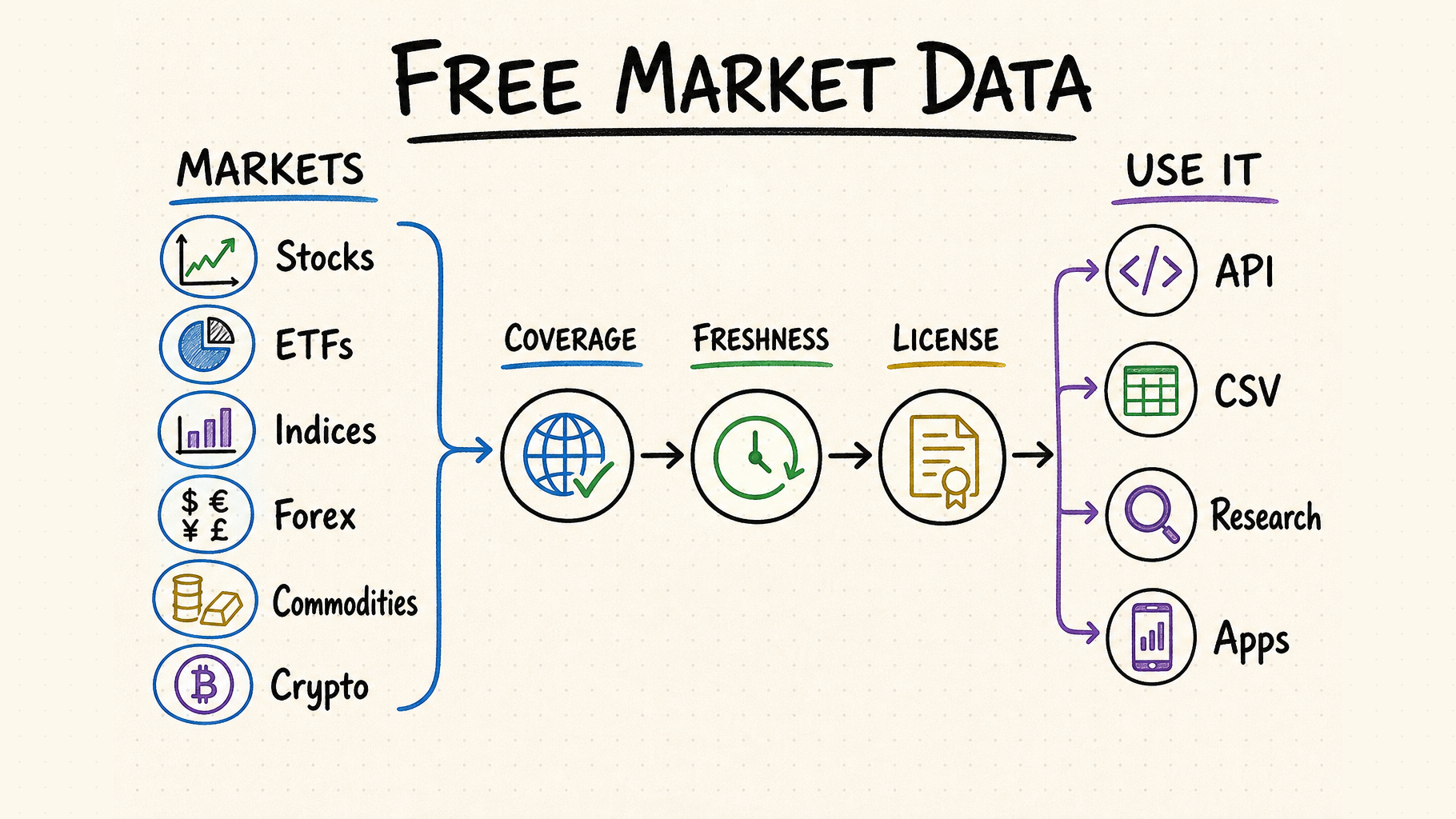
Find free stock, ETF, index, forex, commodity, and crypto data—then verify coverage, freshness, limits, and licensing before you build.
Quick Summary
Free sources cover quotes and history for stocks, ETFs, indices, forex, commodities, and selected crypto markets.
Check exchange coverage, timestamps, adjustment rules, request limits, redistribution rights, and commercial-use terms.
CSV is convenient for spreadsheets and research; JSON APIs are better for apps, agents, and repeatable pipelines.
Free does not always mean real-time or unrestricted. Never assume demo data is suitable for live trading decisions.
Which free market data do you actually need?
Start with the decision or product you are building. A watchlist needs quotes and session status; charting needs consistent bars; backtesting needs deep adjusted history; a multi-asset dashboard needs stable symbols, currencies, and calendars.
The phrase free market data covers feeds with very different update cycles and structures. Equities follow exchange sessions, forex trades nearly around the clock, commodity prices may come from futures or reference benchmarks, and crypto venues never close. Define the asset class, venue, geography, interval, history depth, and acceptable delay before comparing providers.
For research, price fields alone are rarely enough. You may also need trading calendars, symbol changes, delistings, currency, exchange identifiers, and corporate actions. These reference fields prevent survivorship bias and make it possible to join prices with fundamentals correctly. A smaller dataset with explicit lineage and consistent identifiers is often more useful than a larger feed whose origin and adjustment rules are unclear.
Last price, change, bid/ask, session status, and timestamp. Confirm whether values are real-time, delayed, indicative, or end-of-day.
Open, high, low, close, volume, and adjusted close. Check interval support, session boundaries, time zones, and corporate actions.
Stocks, ETFs, indices, currencies, commodities, and crypto use different identifiers and calendars. Confirm the exact venues and instruments included.
Ticker mappings, exchanges, time zones, data lineage, and provider identity make downstream results easier to explain and audit.
How free market data sources compare
No single source is best for every workflow. Exchanges and official benchmark publishers are closest to primary market records, but their files may require more cleaning. Aggregator APIs make cross-asset data easier to query, although free plans usually trade convenience for request limits, delayed values, shorter history, or narrower venue coverage.
| Source | What it offers | Best for | Watch for |
|---|---|---|---|
| Exchange or benchmark | Official quotes, indices, calendars, and reference files. | Verification and primary-source research. | Entitlements, mixed formats, and delayed access. |
| Free market-data API | Normalized quotes, history, and fundamentals. | Apps, agents, prototypes, and repeatable research. | Rate limits, delays, and license restrictions. |
| Community library | Convenient wrappers and normalized access to public feeds. | Exploration, notebooks, and prototypes. | Upstream changes, unofficial support, and unclear rights. |
| CSV or bulk dataset | Portable files for analysis and archival. | Spreadsheets, notebooks, and backtests. | Often less current than a live API. |
Compare sources with the same small test set rather than relying on feature lists. Request a liquid stock, a thinly traded security, a symbol that changed, and a date containing a split or dividend. Compare timestamps, missing records, precision, adjustment behavior, and error messages. This test quickly reveals whether two providers use different sessions or definitions even when their column names look identical.
A practical API and CSV workflow
A reliable workflow separates discovery from production use. First inspect the provider documentation and a sample response. Then make a small request, save the raw payload, and transform it into your own stable schema. Add validation before the data enters a chart, model, spreadsheet, or agent. This makes it easier to replace a source later without rewriting the rest of the product.
Start with the entity and dataset: instrument, company, country, indicator, currency pair, or crypto asset. Avoid choosing a provider before you define the need.
Review schema, exchange coverage, delay, sample response, request cost, limits, source lineage, and commercial-use rules.
Send the symbol, interval, start and end dates, adjustment mode, and output format. Store the provider timestamp with every result.
Check missing sessions, duplicates, time zones, split adjustments, null values, and unexpected schema changes before analysis.
For API access, cache responses that do not need second-by-second freshness, apply exponential backoff to temporary failures, and log the request time, parameters, status code, and provider timestamp. For CSV, preserve the original file separately from the cleaned table and record its download date, delimiter, encoding, and time zone. Both approaches need a repeatable update policy so old and new observations are not silently mixed.
Free market data quality checklist
A useful source makes coverage, freshness, provider identity, request limits, pricing, and licensing visible before you depend on it.
Data quality is not only about whether a number looks plausible. Confirm that every observation refers to the intended venue, session, currency, and time zone. Check whether timestamps represent trade time, bar close, or provider delivery time. When building indicators or backtests, document how missing sessions, zero volume, duplicate rows, outliers, splits, dividends, and restated fundamentals are handled.
- Confirm the market, exchange, asset class, interval, and historical depth.
- Record whether prices are raw or adjusted and how corporate actions are handled.
- Preserve source, timestamp, currency, time zone, and request parameters with every result.
Finally, read the license as carefully as the schema. Free access may permit personal analysis but restrict public display, redistribution, automated extraction, model training, or commercial products. Keep a link or copy of the applicable terms with the project and review them when the provider changes plans. If the data supports trading, compliance, or customer-facing decisions, validate critical values against an authoritative source.
FAQ
Start with central banks, statistical agencies, regulators, and exchanges, then compare free APIs and open-data portals for normalized access.
Market feeds may be live or delayed; company and economic data follow release schedules. Always read timestamps and revision notes.
Many providers support CSV export. Verify units, frequency, time zone, missing observations, adjustments, and revisions.
It depends on the license. API access does not automatically grant display, redistribution, derived-data, or commercial rights.
JSON is usually easier for applications that request data repeatedly and need structured metadata. CSV is simpler for spreadsheets, bulk downloads, notebooks, and portable archives. Choose based on the workflow, then normalize field names, date formats, numeric types, and null-value rules before combining files or providers.
Compare sample values with an official release or another independent source. Check timestamps, units, precision, adjustments, missing observations, revisions, and update frequency.