
Free Market Movers API
for Gainers, Losers & Active Stocks免费股票异动榜 API
获取涨幅、跌幅与活跃股票
Build trustworthy gainers, losers, and most-active lists by defining the session, comparison price, ranking formula, liquidity floor, security universe, timestamp, and market-data entitlement—not merely by accepting a provider’s top-20 response.
构建可信的涨幅榜、跌幅榜与活跃榜,必须明确交易时段、比较基准价、排序公式、流动性门槛、证券范围、时间戳和行情权限,而不能只接受服务商返回的前 20 名。
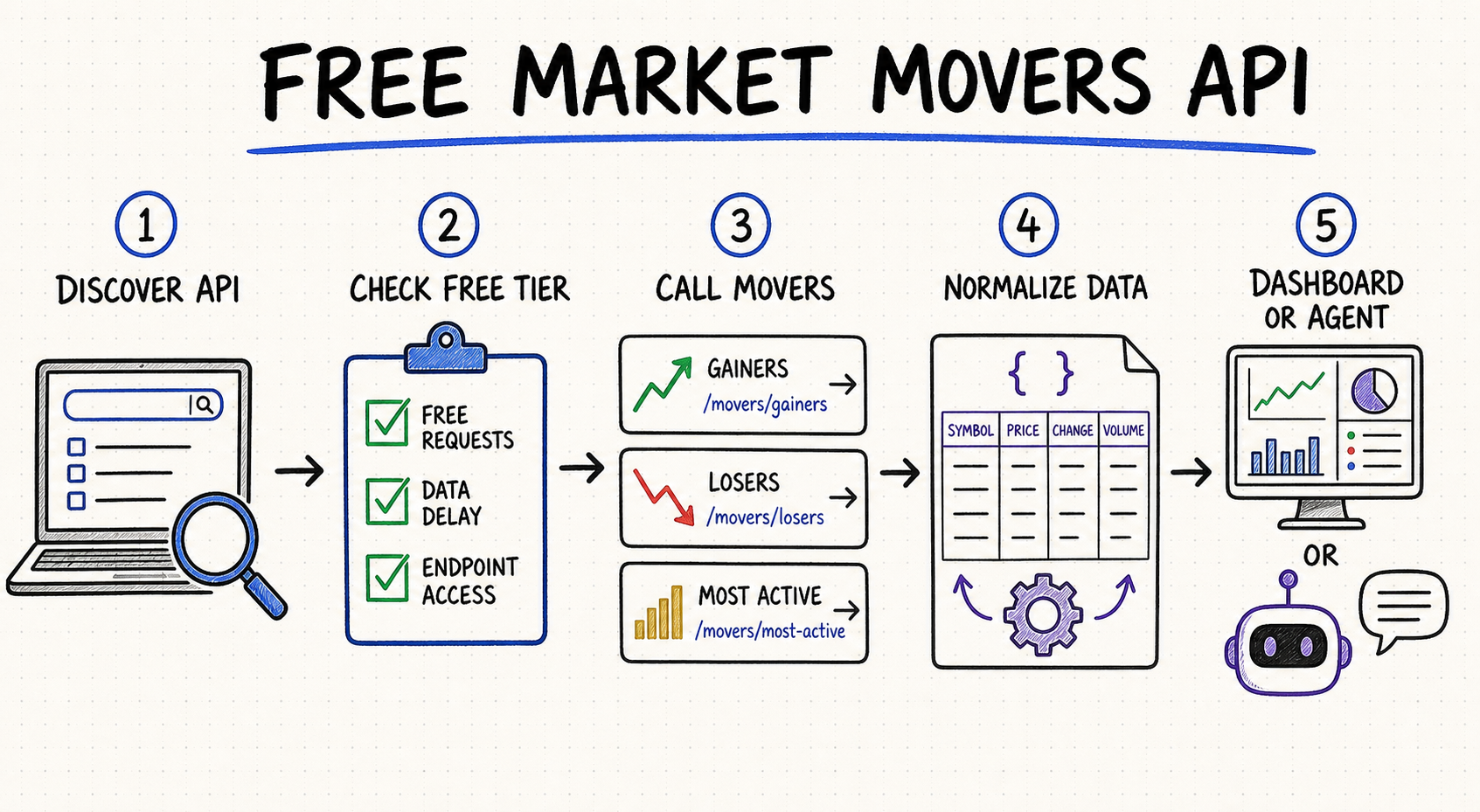
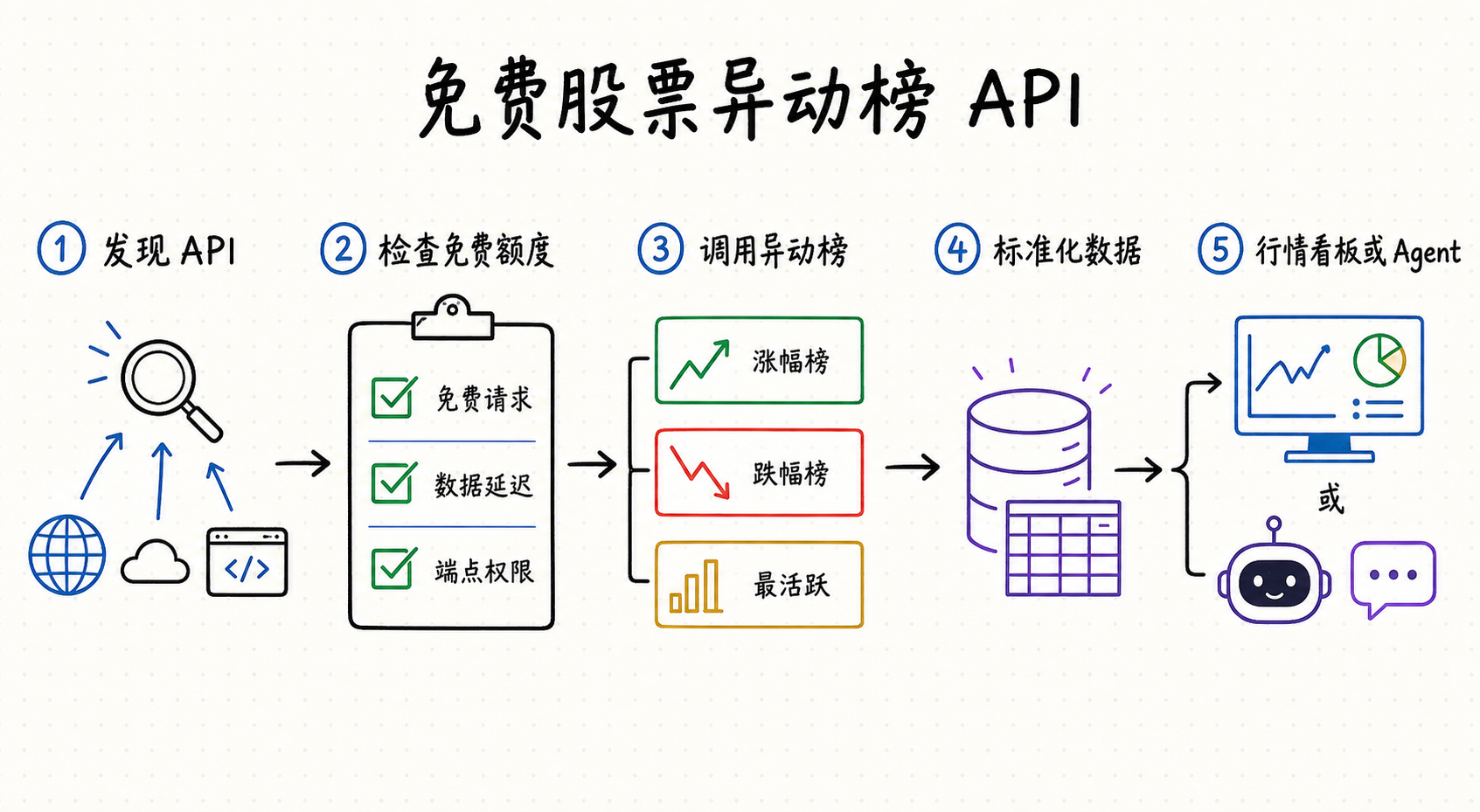
TL;DR摘要
Gainers may rank percent or absolute change; “active” may mean shares, dollar volume, trade count, or unusual volume. Store the exact sort field.
Premarket, regular hours, after-hours, and completed-day lists use different liquidity and reference prices. Label the session and timezone.
Price floors, volume or dollar-volume minimums, security type, exchange, halted status, and corporate actions materially change the leaderboard.
A free key may expose delayed, historical, or end-of-day values. Return provider timestamp and freshness state with every result.
涨幅榜可能按百分比或绝对涨跌额排序,“活跃”也可能指成交股数、成交金额、交易笔数或异常放量,必须保存真实排序字段。
盘前、常规交易、盘后和完整交易日使用的流动性与基准价不同,应明确标注时段和时区。
价格下限、成交量或成交金额门槛、证券类型、交易所、停牌状态和公司行动都会显著改变排名。
免费 key 可能只能获得延迟、历史或收盘数据;每条结果都应返回服务商时间戳与时效状态。
What to check in a free market movers API选择免费股票行情 API 时要检查什么
A useful market-movers API should answer operational questions clearly: which leaderboards exist, what the free plan returns, how delayed the observations are, and whether the result is suitable for a scanner, dashboard, alert, or AI agent.
可用的市场异动榜 API 应清楚回答实际问题:提供哪些涨跌或成交活跃榜单、免费套餐返回什么、行情延迟多久,以及结果能否直接用于扫描器、看板、提醒或 AI Agent。
A leaderboard is a derived dataset. Its rank depends on the eligible universe, snapshot time, reference close, corporate-action adjustment, stale-quote rules, and tie handling. Two APIs can use the same quotes and still return different movers without either response being mechanically wrong. A production contract must expose enough metadata to explain the difference.
异动榜本质上是派生数据。排名取决于可选证券范围、快照时间、比较前收盘价、公司行动复权、陈旧报价处理和并列规则。即使使用相同原始行情,两家 API 也可能返回不同榜单;生产级数据契约必须提供足够元数据解释差异。
Top gainers and losers API coverage
Confirm whether the endpoint returns both directions and how it ranks change: percentage, absolute price move, or another field.
Most active stocks API fields
Check whether activity means share volume, dollar volume, trade count, or provider-specific logic.
Real-time market movers API entitlement
Read the documentation carefully. A free key can coexist with delayed or end-of-day market data because exchange entitlements are separate.
Market and session coverage
Verify US exchanges, premarket and after-hours support, minimum-volume filters, pagination, timestamps, and reset times.
Reference price and corporate actions
Confirm whether percent change uses previous regular-session close, adjusted close, session open, or another baseline. Splits and special distributions can create false movers if the baseline is not adjusted consistently.
Universe and quality filters
Check common shares versus ETFs, ADRs, warrants, units, OTC securities, halted symbols, stale quotes, price floors, and minimum dollar volume. A broad unfiltered universe often promotes illiquid noise.
涨幅榜与跌幅榜覆盖
确认接口是否同时返回两个方向,以及按涨跌幅、价格变动还是其他字段排序。
成交活跃榜的定义
核对“活跃”代表成交股数、成交金额、成交笔数,还是供应商自定义逻辑。
实时行情权限
免费 API Key 不代表免费实时行情;交易所授权、15 分钟延迟和收盘数据可能分别处理。
市场与交易时段
检查美股交易所、盘前盘后、最低成交量过滤、分页、时间戳与每日重置时间。
基准价与公司行动
确认涨跌幅使用的是上一常规交易时段收盘价、复权收盘价、当前时段开盘价还是其他基准。拆股和特别分派若未一致复权,会制造虚假的异动股票。
证券范围与质量过滤
核对普通股、ETF、ADR、认股权证、单位、OTC、停牌证券和陈旧报价的处理方式,以及价格下限与最低成交金额。未经筛选的宽泛范围往往会把低流动性噪声推到榜首。
Worked example: one snapshot, four valid leaderboards实算示例:同一快照可以产生四份合理榜单
Assume the following regular-session snapshot uses adjusted prior closes and contains only eligible common stocks. Percent change is (current ÷ prior close − 1) × 100; dollar volume is current × shares traded.
假设下面是常规交易时段快照,前收盘均已完成复权,且只包含符合条件的普通股。涨跌幅按 (当前价 ÷ 前收盘 − 1) × 100 计算,成交金额按 当前价 × 成交股数 计算。
| Symbol股票 | Prior / current前收盘 / 当前价 | Change涨跌幅 | Share volume成交股数 | Dollar volume成交金额 |
|---|---|---|---|---|
| A | $10 / $12 | +20% | 100,000 | $1.2M |
| B | $50 / $51 | +2% | 2,000,000 | $102M |
| C | $5 / $4 | −20% | 5,000,000 | $20M |
The result depends on the named metric. A leads the gainers list; C leads the losers list and the share-volume list; B leads by dollar volume. Calling all four outputs “most active” or sorting a mixed list by an undocumented field makes the ranking impossible to reproduce. Store the formula, filters, snapshot timestamp, and tie rule with every list.
榜首取决于明确写出的指标。A 是涨幅榜第一,C 同时是跌幅榜和成交股数榜第一,B 则按成交金额排名第一。若把四种结果都叫作“最活跃”,或使用未说明的字段对混合榜单排序,结果就无法复现。每份榜单都应保存公式、筛选条件、快照时间和并列处理规则。
Free stock market movers API comparison免费美股涨跌榜 API 对比
| Provider供应商 | Mover coverage榜单覆盖 | Free-access caveat免费层注意点 | Useful for适合场景 |
|---|---|---|---|
| Alpha Vantage | Top 20 gainers, losers, and most active US tickers.美股涨幅、跌幅与最活跃股票各 20 个。 | Documentation says default output is historical; delayed and real-time access depend on entitlement.文档说明默认返回历史数据;延迟或实时数据取决于 entitlement。 | Simple three-list prototypes.快速制作三榜原型。 |
| Massive | Top 20 US stock gainers or losers with snapshot fields.美股涨幅或跌幅前 20 名及快照字段。 | Plan access and data entitlement must be checked on the current pricing/docs page.需在当前套餐与文档中核对端点权限和行情授权。 | Snapshot-driven scanners.基于快照的扫描器。 |
| Webull | Gainers/losers with premarket, after-hours, intraday, and longer ranking periods.支持盘前、盘后、日内及更长周期的涨跌榜。 | OpenAPI onboarding and market-data permissions apply; do not assume every tier is anonymous or free.需要 OpenAPI 接入和行情权限,不能假设所有层级都免费或免鉴权。 | Session-aware ranking.按交易时段排名。 |
| QVeris | Discovers and calls suitable financial-data capabilities rather than inventing a separate exchange feed.发现并调用合适的金融数据能力,不虚构独立交易所行情源。 | The selected provider's limits, licensing, and freshness still govern the returned data.返回数据仍受所选供应商额度、许可与时效约束。 | Agents that need inspectable tool access.需要可检查工具调用的 Agent。 |
How to integrate a market movers API如何接入股票异动榜 API
Choose gainers, losers, most active, or premarket movers first. Record the market, timezone, session, sort field, and minimum-liquidity rule.
Check request quotas, endpoint access, authentication, attribution, commercial-use terms, and whether the free response is delayed.
Map provider fields to symbol, price, change, percentChange, volume, timestamp, and marketSession. Preserve the provider timestamp.
Market-mover snapshots may repopulate after daily clearing. Treat empty lists, holidays, pre-open periods, rate limits, and stale timestamps as explicit states.
When price, reference price, and volume are present, recalculate change and percent change, then verify ordering after applying your liquidity filters. Flag stale quotes, zero or invalid reference prices, split discontinuities, and ranks inconsistent with the documented field.
Key cached results by market, session, universe, filters, sort field, entitlement, and snapshot time. Do not serve a premarket list as a regular-session list or retain a “live” label after the provider timestamp becomes stale.
明确需要涨幅榜、跌幅榜、活跃榜还是盘前异动,并记录市场、时区、排序字段和最低流动性规则。
核对请求配额、端点权限、鉴权方式、署名、商业使用条款,以及免费响应是否延迟。
映射为股票代码、价格、涨跌额、涨跌幅、成交量、时间戳和交易时段,并保留供应商原始时间。
榜单快照可能每日清空后重建;应显式处理休市、开盘前、限流、空列表和过期时间戳。
当最新价、基准价和成交量齐全时,应重新计算涨跌额与涨跌幅,再应用自身流动性过滤并检查排序。陈旧报价、无效基准价、拆股跳变和与文档排序字段不一致的名次都应标记。
缓存键应包含市场、交易时段、证券范围、过滤条件、排序字段、行情权限与快照时间。不能把盘前榜当作常规交易榜,也不能在服务商时间戳过期后继续标注“实时”。
Use QVeris to find and call market movers data用 QVeris 发现并调用股票异动数据
QVeris can help an agent discover and inspect gainers, losers, volume leaders, dollar-volume leaders, or session-specific mover capabilities. Before calling one, the agent should state the market, eligible security types, session, sort formula, liquidity floor, result count, data entitlement, and freshness tolerance. It should cite the provider timestamp and must not compare ranks built from incompatible universes or sessions.
QVeris 可以帮助 Agent 发现并检查涨幅榜、跌幅榜、成交股数榜、成交金额榜或特定时段异动榜能力。调用前,应明确市场、证券类型、交易时段、排序公式、流动性门槛、返回数量、行情权限与可接受时效;结果必须注明服务商时间戳,也不能比较基于不同证券范围或时段生成的排名。
- Open the QVeris tool details for financial-data capabilities that match the required list and session.
- Inspect parameters and returned fields before calling a provider-backed capability.
- Keep provider licensing, free-tier limits, and timestamps visible in the application.
- 打开 涨幅榜、跌幅榜与活跃股票工具详情,核对榜单范围和交易时段。
- 调用供应商能力前,先检查参数与返回字段。
- 在应用中保留供应商许可、免费额度与时间戳信息。
FAQ常见问题
Some providers offer a free key or limited plan. Verify which lists are included, whether results are current or historical, exchange entitlement, request quota, eligible securities, attribution, and commercial-use terms.
Sometimes, but never assume it from a free API key. Check exchange entitlement, provider timestamp, refresh schedule, session, and any delay label. A frequently refreshed endpoint can still contain delayed underlying quotes.
Usually by percent change from a documented reference price, with absolute change as a separate field. Define the session, adjusted baseline, eligible universe, price and liquidity floors, stale-quote rule, and tie handling.
It can mean share volume, dollar volume, trade count, turnover, or unusual volume relative to history. The API should name the metric and window; these rankings are not interchangeable.
Use an endpoint with explicit extended-hours support, select the premarket session, verify the comparison baseline and snapshot timestamp, and enforce stronger liquidity filters because extended-hours trading can be thin.
They may differ in universe, entitlement, snapshot time, session, reference price, corporate-action adjustment, filters, or sort field. Compare those contracts before treating either list as incorrect.
部分服务商提供免费 key 或有限套餐。应核对包含哪些榜单、结果是当前还是历史数据、交易所行情权限、请求额度、证券范围、署名与商业使用条款。
有可能,但不能根据免费 key 推断。应检查交易所权限、服务商时间戳、刷新频率、交易时段和延迟标签;端点频繁刷新,也可能只是反复返回延迟行情。
通常按相对明确基准价的涨跌幅排序,绝对涨跌额作为另一字段。还要定义交易时段、复权基准、证券范围、价格和流动性门槛、陈旧报价规则与并列处理。
它可能按成交股数、成交金额、交易笔数、换手率或相对历史的异常放量排序。接口必须说明指标和窗口,这些榜单不能互相替代。
选择明确支持延长交易时段的端点,指定盘前 session,核对比较基准与快照时间,并采用更严格的流动性过滤,因为盘前交易通常更稀疏。
差异可能来自证券范围、行情权限、快照时间、交易时段、基准价、公司行动复权、过滤条件或排序字段。比较这些数据契约后,才能判断榜单是否有误。