
Find a Free Market Sentiment API查找免费市场情绪 API
Compare market-wide, news-derived, and market-implied sentiment signals, then validate coverage, history, limits, and JSON fields before integration.
比较全市场、新闻驱动与市场隐含情绪信号,在接入前验证资产覆盖、历史范围、调用限额和 JSON 字段。
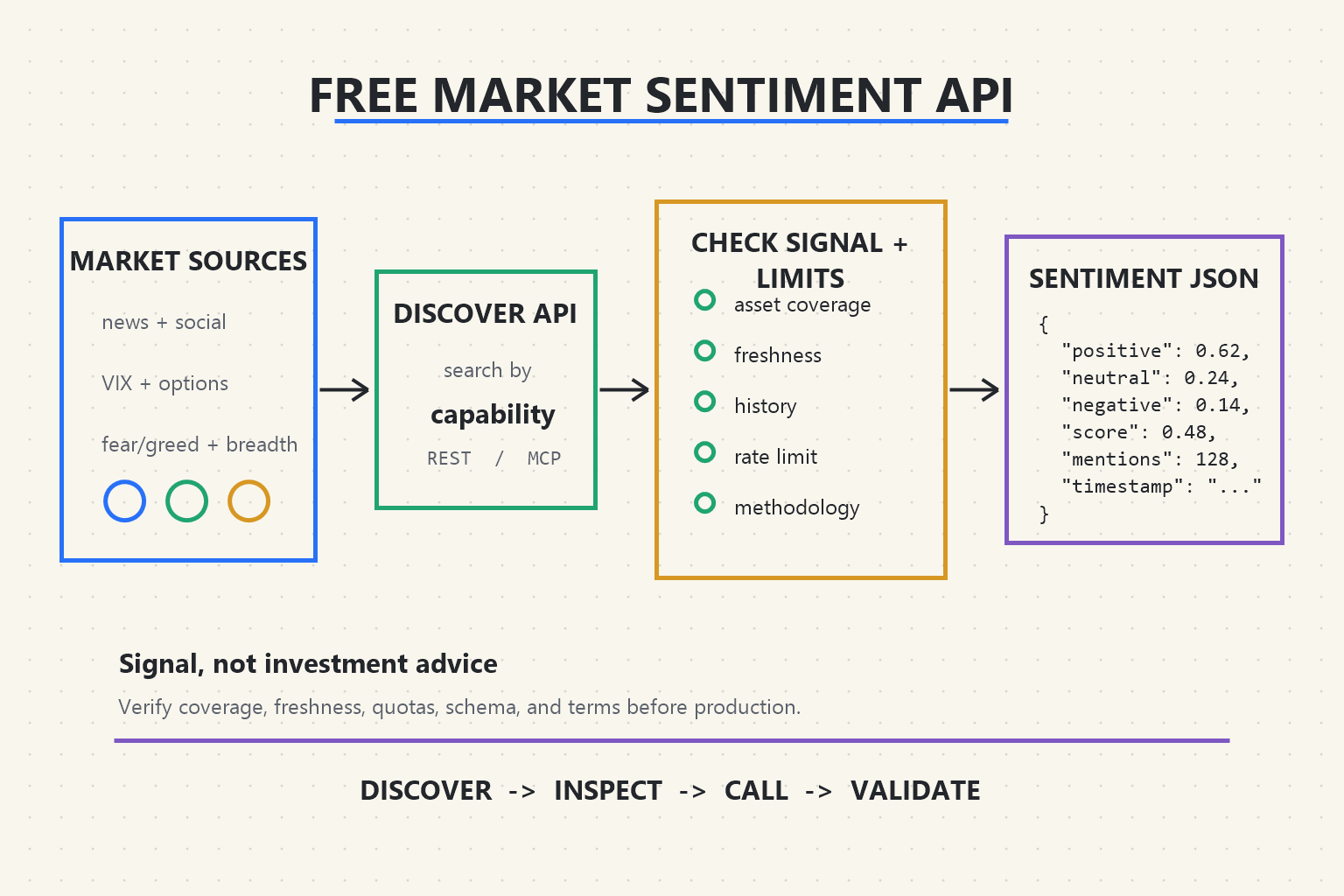
Signals a free market sentiment API should explain免费市场情绪 API 应说明哪些信号
Market sentiment is not one universal number. An endpoint may summarize investor mood across an index, score news about one symbol, or infer risk appetite from options and price behavior. The first selection task is to identify what the score measures and which assets it covers.
市场情绪不是一个通用数字。接口可能汇总指数层面的投资者情绪、计算单只股票的新闻情绪,或根据期权与价格行为推断风险偏好。选型时首先要确认分数衡量什么,以及覆盖哪些资产。
Composite fear and greed scores
A composite score combines several inputs into a bounded scale such as 0–100. Record every component, weighting rule, update time, and interpretation band. Two providers can use the same label while measuring different markets.
Financial news sentiment by symbol
News endpoints usually attach bullish, neutral, or bearish scores to articles, tickers, sectors, or topics. Check entity resolution, language coverage, duplicate handling, source timestamps, and whether the response includes the underlying article identifiers.
Market-implied risk appetite
VIX, put/call ratios, volatility term structure, price momentum, safe-haven demand, and advance-decline breadth can describe different parts of risk appetite. They are inputs to interpretation, not interchangeable sentiment labels.
综合恐惧贪婪分数
综合分数把多个输入合成为 0–100 等有限区间。应记录组成指标、权重规则、更新时间和区间含义。即使名称相同,不同服务商衡量的市场也可能完全不同。
按股票代码返回的金融新闻情绪
新闻接口通常为文章、股票代码、行业或主题返回看涨、中性或看跌分数。应检查实体识别、语言覆盖、去重、来源时间戳,以及是否返回原始文章标识。
市场隐含风险偏好
VIX、看跌看涨比率、波动率期限结构、价格动量、避险需求和涨跌家数分别描述风险偏好的不同侧面,不能被当作可互换的情绪标签。
Important: market sentiment describes a measured state or model output. It is not a guaranteed forecast, buy signal, or substitute for price, liquidity, and risk data.
重要:市场情绪描述的是观测状态或模型输出,不是确定性预测、买卖信号,也不能替代价格、流动性和风险数据。
Practical free starting points for market sentiment data市场情绪数据有哪些实用的免费起点?
There is no single free endpoint that represents sentiment for every market. The most useful starting points fall into three groups: a published composite for one asset class, news-derived sentiment for named assets, or public component series used to build an internal index. Choose by the decision you need to support, not by which response happens to contain a field called score.
不存在一个能够代表所有市场情绪的通用免费接口。实际可用的起点通常分为三类:针对某一资产类别发布的综合指数、按具体资产返回的新闻情绪,以及可用于自行构建内部指标的公开时间序列。选择时应围绕应用要支持的决策,而不是看哪个响应刚好有一个名为 score 的字段。
| Starting point方案 | What it measures衡量内容 | Useful when适用场景 | Main boundary主要边界 |
|---|---|---|---|
| Alternative.me Fear & Greed API | A published crypto-market composite with value, classification, timestamp, and optional historical results.公开的加密市场综合指数,返回数值、区间分类、时间戳,并可请求历史结果。 | A prototype needs a simple crypto regime indicator through a public GET endpoint.原型需要通过公开 GET 接口获取简单的加密市场状态指标。 | It represents crypto sentiment, not stocks or a named token. Attribution is required, and the published index methodology must remain part of the interpretation.它描述的是加密市场整体情绪,不能替代股票或单个代币的情绪。展示数据时需要署名,解释结果时还必须结合该指数的公开计算方法。 |
| Alpha Vantage News & Sentiment | Live and historical news with sentiment for ticker and topic filters across stocks, crypto, forex, and market themes.按股票代码或主题筛选的实时与历史新闻情绪,覆盖股票、加密资产、外汇和市场主题。 | The application needs asset-linked narrative sentiment and the underlying article metadata in one response.应用需要在同一响应中获得与具体资产关联的叙事情绪和新闻元数据。 | An API key is required and the current free service is limited to 25 requests per day. Article-level or ticker-level news sentiment is not a market-wide fear-and-greed index.需要 API 密钥,目前免费服务每天最多 25 次请求。文章级或股票代码级的新闻情绪不能直接当作全市场恐惧贪婪指数。 |
| FRED and ALFRED component series | Public economic and financial time series, including observations, release metadata, updates, and vintage dates that can support an internal regime model.公开的经济与金融时间序列,包括观测值、发布信息、更新记录和历史版本日期,可作为内部市场状态模型的输入。 | A research team wants transparent components such as volatility or macro conditions and is prepared to define normalization and weights.研究团队希望使用波动率或宏观环境等透明组成指标,并愿意自行定义标准化与权重。 | FRED supplies component data, not a ready-made sentiment conclusion. Series frequency, release lag, revisions, licenses, and real-time vintages must be handled explicitly.FRED 提供的是组成数据,不会直接给出市场情绪结论。序列频率、发布延迟、修订、许可和实时历史版本都需要显式处理。 |
Do not merge these scores directly: a crypto composite, a ticker-news score, and a volatility observation describe different populations and timescales. Preserve each source signal first; create a combined index only under a documented methodology.
不要直接合并这些分数:加密市场综合指数、单只资产新闻评分和波动率观测描述的是不同对象与时间尺度。应先分别保留来源信号,只有在计算方法明确时才能构建组合指标。
How to compare free market sentiment API endpoints如何比较免费市场情绪 API 接口
A useful comparison separates signal quality from commercial access. “Free” may mean a no-key public endpoint, a monthly credit allowance, a trial, delayed observations, or a restricted historical window.
有效的比较应把信号质量与商业访问条件分开。“免费”可能代表无需密钥的公开接口、每月免费额度、限时试用、延迟数据或受限的历史窗口。
| Check检查项 | What to verify需要验证 | Why it changes the result为何影响结果 |
|---|---|---|
| Asset scope资产范围 | Whole market, index, sector, stock, ETF, crypto, or multi-asset全市场、指数、行业、股票、ETF、加密资产或跨资产 | A broad market score cannot replace symbol-level sentiment.全市场分数不能替代单只资产情绪。 |
| Methodology计算方法 | Components, weights, model version, score range, and null rules组成指标、权重、模型版本、分数范围与空值规则 | The same numeric value can have different meanings across APIs.相同数值在不同接口中可能含义不同。 |
| Freshness数据时效 | Observation time, publication time, ingestion time, cache, and delay观测、发布、采集时间,缓存与延迟 | A current response can still contain stale source data.最新响应仍可能包含过期源数据。 |
| History历史范围 | Start date, interval, timezone, revisions, and retention起始日期、时间粒度、时区、修订与保留周期 | Backtests require consistent historical definitions.回测需要一致的历史口径。 |
| Free access免费访问 | API key, requests per minute, monthly credits, fields, and commercial useAPI Key、每分钟请求、月度额度、可用字段与商用权限 | A prototype allowance may not support production traffic.原型额度可能无法支持生产流量。 |
| Response contract响应契约 | Symbol, market, score, label, components, timestamp, confidence, and source代码、市场、分数、标签、组成、时间戳、置信度与来源 | Stable fields make validation and provider changes safer.稳定字段能降低验证和更换服务商的风险。 |
Free market sentiment API Python integration pattern免费市场情绪 API 的 Python 接入方法
Request one market and time window
Begin with one documented symbol or market aggregate such as a broad index proxy. Request only the fields needed for validation and use a finite network timeout.
Validate the sentiment JSON contract
Require the asset identifier, score, label, observation timestamp, update timestamp, and component metadata. Reject unknown score ranges instead of guessing how to normalize them.
Preserve raw values before normalization
Store the provider response and methodology version. Convert scores into an internal scale only after documenting the original range and handling missing components explicitly.
先请求一个市场和时间窗口
从文档明确支持的股票代码或市场汇总指标开始,只请求验证所需字段,并设置有限的网络超时时间。
验证市场情绪 JSON 契约
至少检查资产标识、分数、标签、观测时间、更新时间和组成指标。遇到未知分数范围时应拒绝处理,而不是猜测如何归一化。
归一化前保存原始值
保存服务商原始响应和方法版本。只有记录原始范围并明确处理缺失组成后,才能转换为内部统一分数。
import os
import requests

response = requests.get(
    "https://provider.example/v1/market/sentiment",
    headers={"Authorization": f"Bearer {os.environ['API_KEY']}"},
    params={"symbol": "SPY", "window": "1d"},
    timeout=20,
)
response.raise_for_status()
payload = response.json()

required = {"symbol", "score", "label", "observed_at", "updated_at"}
if not required.issubset(payload):
    raise ValueError("Unexpected market sentiment response schema")

score = float(payload["score"])
if not 0 <= score <= 100:
    raise ValueError("Unsupported sentiment score range")
The hostname and field names are illustrative. Replace them with the selected provider’s documented endpoint and schema; never send an example hostname to production.
以上域名和字段仅用于说明请求结构。请替换为所选服务商文档中的真实端点与 Schema,不要在生产环境调用示例域名。
Turn market sentiment data into a testable workflow把市场情绪数据转化为可验证工作流
Build a market regime dashboard
Display the composite score beside its components, timestamps, and historical range. A chart without methodology or freshness can make unlike observations look comparable.
Use sentiment as a risk filter
A bot can pause, reduce, or flag an action when sentiment conflicts with another rule, but the decision should also inspect price, volatility, liquidity, and position limits.
Backtest without look-ahead leakage
Use the timestamp when the sentiment value became available, not merely the date of the underlying article or market observation. Preserve revisions and missing periods.
Validate regime meaning, not just score direction
Build a dated sample across calm, selloff, rebound, earnings-heavy, and low-liquidity periods. For every observation, retain components, methodology version, availability time, and subsequent market context. Test stability when one component is missing and compare the score with volatility, breadth, and returns without treating correlation as causation.
制作市场状态仪表盘
同时展示综合分数、组成指标、时间戳和历史范围。没有计算方法与时效说明的图表,容易把不可比较的数据放在一起。
把情绪作为风险过滤器
当情绪与其他规则冲突时,交易机器人可以暂停、缩减或标记动作,但决策仍应检查价格、波动率、流动性和仓位限制。
避免回测中的未来数据泄漏
使用情绪值真正可获得的时间,而不是只使用新闻或市场观测的日期,并保留修订记录和缺失区间。
验证市场状态含义,而不只看分数方向
建立带日期的样本,覆盖平静期、快速下跌、反弹、财报密集期和低流动性阶段。每条观测都要保留组成指标、方法版本、真正可得时间及后续市场背景,并测试某个组成缺失时分数是否稳定。可以把结果与波动率、市场宽度和收益比较,但不能把相关性直接解释成因果关系。
Design a market sentiment composite without hiding the inputs构建市场情绪综合指标时,不要隐藏组成数据
If no published score matches the target market, an internal composite can combine volatility, breadth, momentum, options, funding, safe-haven demand, or news measures. The hard part is not averaging numbers; it is making observations with different units, frequencies, publication lags, and missing-value behavior comparable without introducing future information.
如果现成指数无法覆盖目标市场,可以用波动率、市场宽度、价格动量、期权、资金流、避险需求或新闻信号构建内部综合指标。真正困难的不是求平均值,而是在不引入未来信息的前提下,让单位、频率、发布时间和缺失规则都不同的观测能够进行比较。
Define the population and decision horizon
State whether the index describes US equities, a global portfolio, large-cap crypto, or another universe. Match input windows to the intended decision—intraday risk control, daily market regime, or weekly allocation—and do not combine horizons merely because the latest values are available.
Normalize with information available at the time
Transform each component using fixed thresholds or rolling statistics calculated only from earlier observations. Record the lookback, clipping rule, direction, and whether a high value means fear or risk appetite. A full-history z-score computed after the test period leaks future distribution information.
Version weights and component membership
Publish the formula, component weights, effective date, and change reason. If a series becomes unavailable, do not silently redistribute its weight. Either hold the last valid observation for a documented period, calculate a partial score with a quality flag, or suspend the composite.
Keep observation time separate from availability time
A value may describe Friday but become available on Monday. Store both timestamps and use availability time in backtests and alerts. For revised macro series, retain the vintage originally available rather than substituting the newest history.
Return quality context beside the score
Include the composite value, interpretation band, component values, missing-component count, methodology version, observed-through time, calculated time, and next expected update. A single 0–100 number without those fields is difficult to monitor or reproduce.
明确市场范围与决策周期
先说明指数描述的是美国股票、全球组合、大市值加密资产还是其他范围;再根据盘中风控、每日市场状态或每周资产配置等用途选择输入窗口,不能因为多个指标都有最新值就混合不同时间尺度。
只能使用当时已经可获得的信息进行标准化
每个组成指标应采用固定阈值,或仅基于此前观测计算的滚动统计量进行转换,并记录回看窗口、截尾规则、方向,以及高值代表恐惧还是风险偏好。使用测试期结束后的完整历史计算 z-score,会泄漏未来分布信息。
为权重和组成变化建立版本
公开公式、组成权重、生效日期和调整原因。如果某个序列暂时不可用,不能静默地把它的权重分配给其他指标;应根据明确规则选择短期沿用旧值、生成带质量标记的部分分数,或暂停发布综合指标。
区分观测时间与真正可用时间
一个数值可能描述周五,却直到周一才发布。应同时保存两个时间戳,并在回测和提醒中使用真正可用时间。对于会修订的宏观序列,应保留当时能够看到的历史版本,不能用最新修订结果替换。
综合分数必须附带质量上下文
除综合数值和区间解释外,还应返回各组成值、缺失指标数量、方法版本、数据截止时间、计算时间和下一次预计更新时间。只有一个 0–100 分数,很难进行监控、排错和复现。
Acceptance test: reconstruct ten historical dates using only the source vintages available on each date. The calculated value and quality flags should match the stored output exactly. Then remove one component at a time to test whether a single input dominates the classification.
验收测试:选择十个历史日期,只使用当日能够获得的来源版本重建综合指标,计算值和质量标记都应与已保存结果完全一致;随后逐个移除组成指标,检查某个单一输入是否过度主导区间分类。
How QVeris helps find market sentiment data capabilitiesQVeris 如何帮助发现市场情绪数据能力
QVeris is a capability routing network. It helps agents discover relevant financial data capabilities, inspect accepted inputs and returned fields, and call a selected capability through a consistent workflow. It does not guarantee that a provider is free, real time, suitable for trading, or licensed for every use.
QVeris 是能力路由网络,帮助 Agent 发现相关金融数据能力、检查输入参数与返回字段,并通过一致工作流调用所选能力。它不保证服务商永久免费、完全实时、适合交易或许可所有使用方式。
- Open the QVeris tool details for market sentiment, fear and greed, news sentiment, volatility, or breadth capabilities.
- Inspect the current provider documentation for authentication, quota, history, timestamps, and licensing.
- Use the QVeris documentation to connect the chosen capability to an auditable agent workflow.
- 在 QVeris 工具详情中搜索市场情绪、恐惧贪婪、新闻情绪、波动率或市场广度能力。
- 根据服务商当前文档检查鉴权、配额、历史范围、时间戳和许可要求。
- 参考 QVeris 文档,把所选能力接入可审计的 Agent 工作流。
Free market sentiment API questions免费市场情绪 API 常见问题
Yes. Some providers expose a free tier, trial, or no-key endpoint for fear and greed, news sentiment, volatility, breadth, or composite market mood. Coverage and limits vary.
Typical responses include an asset or market identifier, bullish or bearish label, normalized score, component values, observation time, update time, and sometimes confidence.
Not reliably by itself. Sentiment can support a dashboard, regime model, or risk filter, but it should be tested with price, volatility, liquidity, and explicit risk rules.
Request one documented symbol or market, verify status and timestamps, validate the JSON schema and score range, then preserve the raw response before normalization.
Not always. A free endpoint may be delayed, cached, sampled, or updated hourly or daily. Check both the response timestamp and the source observation timestamp.
Compare asset scope, methodology, components, freshness, history, score range, rate limits, authentication, null behavior, licensing, and commercial-use terms.
有。部分服务提供免费额度、试用或无需密钥的端点,覆盖恐惧贪婪、新闻情绪、波动率、市场广度或综合市场情绪,但资产范围和限额不同。
常见响应包括资产或市场标识、看涨或看跌标签、标准化分数、组成指标、观测时间、更新时间,有时还会提供置信度。
单独使用时不能可靠预测。情绪可以用于仪表盘、市场状态模型或风险过滤,但应结合价格、波动率、流动性和明确的风险规则测试。
请求文档支持的股票代码或市场,检查状态与时间戳,验证 JSON 结构和分数范围,再在归一化前保存原始响应。
不一定。免费端点可能延迟、缓存、抽样,或按小时、每日更新。应同时检查响应时间和源数据的观测时间。
比较资产范围、计算方法、组成指标、时效、历史范围、分数区间、限额、鉴权、空值规则、许可和商业使用条款。