
Free Most Active Stocks API
for Live Market Data免费最活跃股票 API
实时市场数据指南
Build a most-active stocks feed with an explicit activity metric, eligible universe, session, snapshot time, liquidity controls, and market-data entitlement. Compare share volume, dollar volume, trade count, turnover, and unusual-volume rankings without treating them as interchangeable.
构建最活跃股票数据流时,应明确活跃度指标、证券范围、交易时段、快照时间、流动性过滤与行情权限,并区分成交股数、成交金额、成交笔数、换手率和异常放量榜。
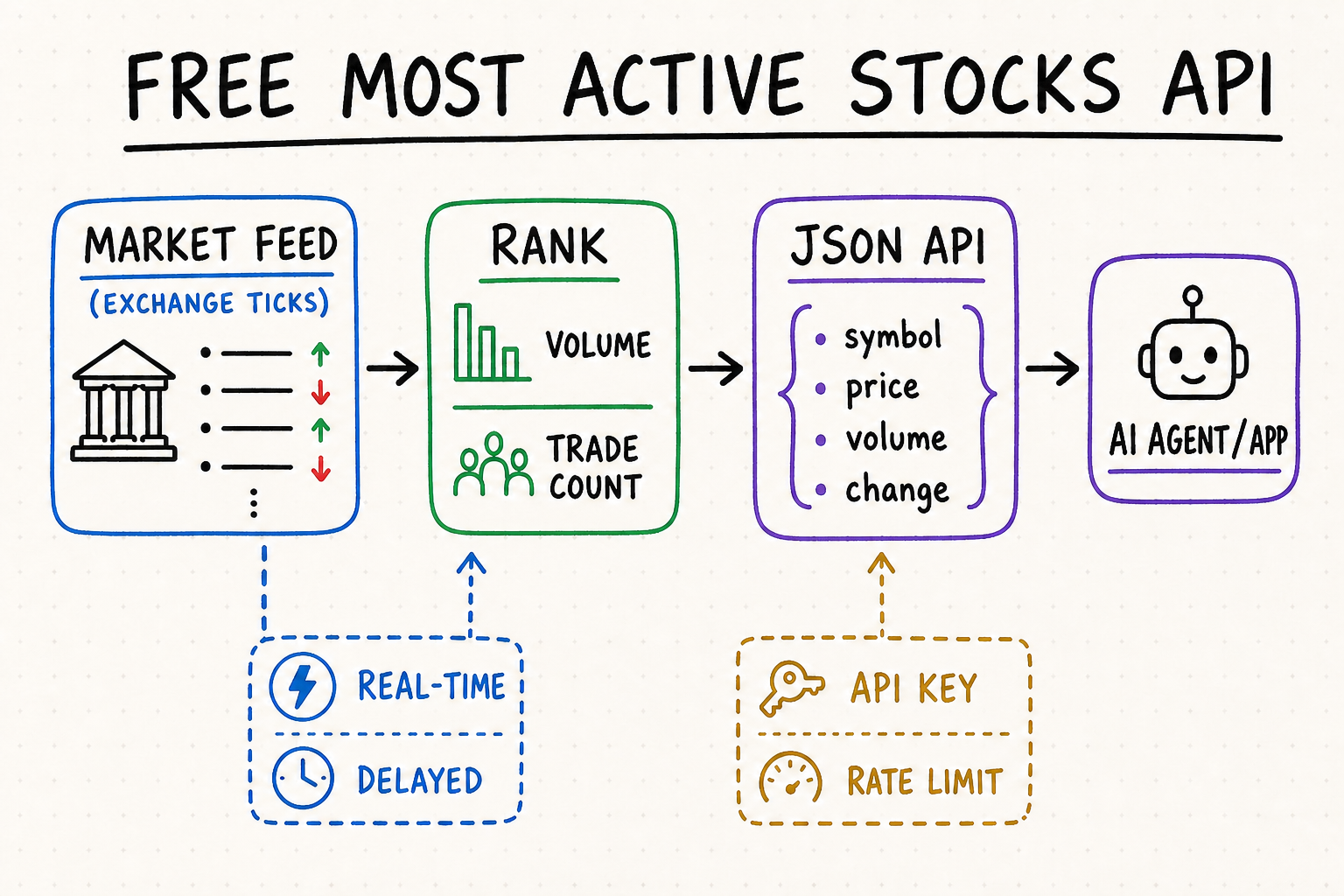
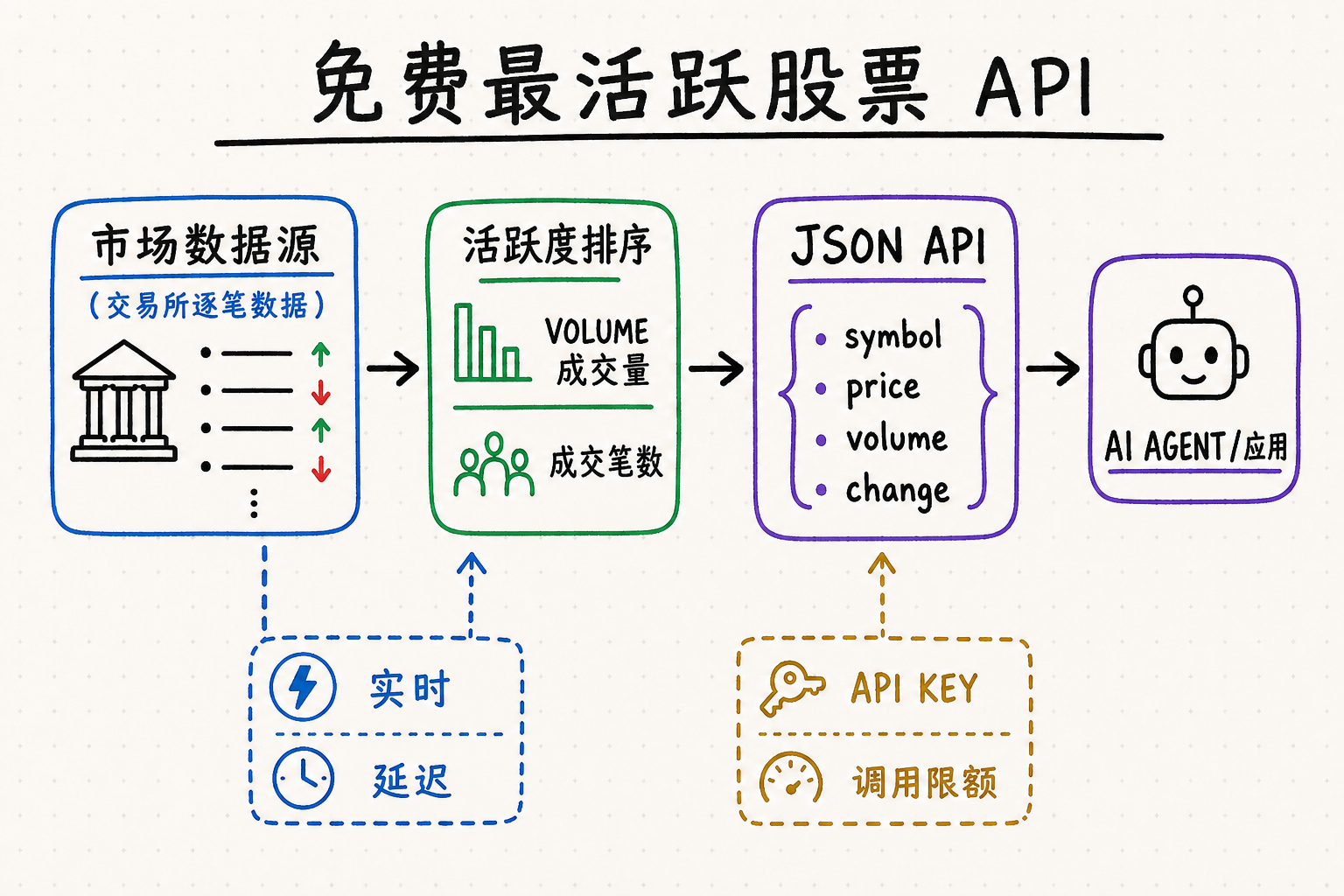
TL;DR快速结论
Name the ranking metric
Share volume favors low-priced securities; dollar volume favors traded value; trade count favors message activity. The response should state which metric produced the rank.
Define the accumulation window
Session-to-date, rolling window, premarket, after-hours, and completed-day volume are different quantities. Return start, end, timezone, and snapshot time.
Control the security universe
Common shares, ETFs, ADRs, warrants, units, OTC securities, halted names, and low-priced stocks can produce very different leaderboards.
Disclose freshness and rights
A free endpoint may use delayed or partial feeds. Preserve exchange coverage, entitlement, provider timestamp, quota, and display or redistribution terms.
先说清排序指标
成交股数更偏向低价股,成交金额强调交易价值,成交笔数反映交易活跃程度;响应必须说明名次由哪个指标生成。
定义累计时间窗口
时段累计、滚动窗口、盘前、盘后和完整交易日成交量含义不同,应返回起止时间、时区与快照时间。
控制证券范围
普通股、ETF、ADR、认股权证、单位、OTC、停牌证券和低价股会形成完全不同的活跃榜。
披露时效与数据权利
免费端点可能使用延迟或局部行情,应保留交易所覆盖、权限、服务商时间戳、额度,以及展示或再分发条款。
How a free most active stocks API ranks market activity免费最活跃股票 API 如何衡量市场活跃度
“Most active” normally means the highest share volume or the largest number of trades during a defined session. It is not the same as top gainers, top losers, unusual volume, or trending tickers. A useful API states the ranking field, market universe, session, timestamp, and whether its feed is real-time or delayed.
“最活跃”通常指在指定交易时段内成交股数最高,或成交笔数最多。它不等于涨幅榜、跌幅榜、异常成交量或热门股票。可靠接口应说明排序字段、股票范围、交易时段、时间戳,以及数据是实时还是延迟。
The ranking also needs a denominator or baseline when it claims relative activity. Relative volume may compare current volume with a time-of-day profile, an average full-day volume, or a trailing period; turnover divides volume by shares outstanding or float. Without the exact baseline date, window, adjustment policy, and share denominator, these values cannot be reproduced.
如果榜单声称衡量“相对活跃度”,还必须说明分母或基准。relative volume 可能把当前成交量与同一时刻的历史曲线、平均全天成交量或某个滚动期间比较;换手率则可能使用总股本或流通股。缺少基准日期、窗口、复权方式与股份分母时,这些指标无法复算。
Most active stocks by volume API
Ranks symbols by shares traded. This is the most common interpretation and is useful for liquidity screens and market dashboards.
Most active stocks by trade count API
Ranks symbols by completed transactions. It can produce a different list because many small trades and fewer large trades are not equivalent.
Real-time vs delayed market movers API
Real-time data is important for intraday workflows. Delayed or end-of-day data can still work for demos, research, and scheduled summaries.
Most active by dollar volume
Price multiplied by traded shares reduces the low-price bias of share-volume rankings and is useful for measuring deployed trading value. Confirm whether the provider sums actual trade notionals or approximates with a snapshot price.
Unusual or relative volume
Compares current activity with a historical baseline. It finds deviations rather than absolute leaders, so the lookback, time-of-day adjustment, minimum history, and corporate-action handling are part of the metric.
按成交量获取活跃股票
按成交股数排序,是最常见的活跃度定义,适合流动性筛选、行情看板和每日市场摘要。
按成交笔数获取活跃股票
按实际成交次数排序。大量小额成交与少量大额成交会形成不同榜单,因此要确认排序口径。
实时与延迟行情接口
盘中自动化通常需要实时数据;演示、研究和定时摘要则可能接受延迟或日终数据。
按成交金额排序
用价格乘成交股数,可以降低成交股数榜对低价股的偏向,更适合衡量实际交易价值。需要确认服务商是累计真实成交金额,还是用快照价格近似计算。
异常成交量或相对成交量
它比较当前活跃度与历史基准,寻找的是“偏离常态”而不是绝对榜首,因此回看窗口、日内时点调整、最低历史长度和公司行动处理都属于指标定义。
Free stock market API comparison checklist免费股票行情 API 对比检查表
| Check检查项 | What to verify需要确认 | Why it matters为什么重要 | Reject when排除条件 |
|---|---|---|---|
| Free access免费权限 | Permanent tier, sandbox, trial, credit card, daily and per-minute quotas.长期免费层、沙盒、试用、信用卡要求、每日与每分钟额度。 | “Free” plans have different production limits.不同“免费”方案的生产可用性差异很大。 | Pricing or limits are undisclosed.价格或限制不透明。 |
| Freshness数据时效 | Real-time SIP/exchange feed, delayed minutes, or end-of-day only.实时综合行情、交易所行情、延迟分钟数或仅日终。 | Determines whether intraday decisions are safe.决定能否用于盘中任务。 | Timestamps or delay are missing.没有时间戳或延迟说明。 |
| Ranking排序口径 | Volume, trade count, relative volume, turnover, and top parameter.成交量、成交笔数、相对成交量、成交额与返回数量。 | Prevents mixing different definitions of activity.避免混用不同活跃度定义。 | The metric is ambiguous.排序指标含糊。 |
| Response返回结构 | Symbol, price, volume, trades, change, timestamp, errors, and pagination.代码、价格、成交量、笔数、涨跌、时间戳、错误与分页。 | Stable JSON reduces integration work.稳定 JSON 可降低接入成本。 | Fields are undocumented or unstable.字段未记录或不稳定。 |
| Universe证券范围 | Exchanges, common stock, ETFs, ADRs, warrants, units, OTC, halted and delisted symbols.交易所、普通股、ETF、ADR、认股权证、单位、OTC、停牌与退市证券。 | Explains why low-priced or non-common instruments dominate a list.解释为何低价或非普通股工具占据榜单。 | Security types and filters cannot be inspected.无法查看证券类型与过滤条件。 |
| Window统计窗口 | Session start/end, timezone, rolling or cumulative method, and reset behavior.时段起止、时区、滚动或累计方式与重置规则。 | Makes rankings reproducible across premarket, regular, and after-hours sessions.使盘前、常规盘和盘后排名可以复现。 | Only a vague “today” label is returned.只返回含糊的“今日”标签。 |
| Quality controls质量控制 | Minimum price, share or dollar volume, stale-quote rule, corporate-action adjustment, and tie handling.最低价格、成交股数或金额、陈旧报价规则、公司行动复权与并列处理。 | Prevents noisy or mechanically distorted leaders.避免噪声或机械失真证券进入榜首。 | Ranks change without documented filters.排名变化却没有过滤规则说明。 |
Most active stocks API options: ready-made list or custom ranking?最活跃股票接口:直接用榜单还是自行排名?
A ready-made endpoint is the fastest route to a market widget, but it gives the provider control over the eligible universe, session window, ranking metric, and exclusions. Building the list from market snapshots takes more data and quota, yet lets the application define common shares only, minimum price, regular hours, dollar volume, or another reproducible rule.
现成榜单端点最适合快速制作行情组件,但证券范围、统计时段、排序指标和排除规则由服务商决定。使用全市场快照自行排名会消耗更多数据和额度,却可以明确限定普通股、最低价格、常规交易时段、成交金额或其他可复现规则。
| Candidate候选方案 | Documented behavior官方文档能力 | Best fit适用场景 | Boundary to verify必须核验的边界 |
|---|---|---|---|
| Alpha Vantage | TOP_GAINERS_LOSERS returns top 20 gainers, losers, and most actively traded U.S. tickers. The default result is updated at the end of the trading day.TOP_GAINERS_LOSERS 返回美国市场涨幅、跌幅和成交最活跃的前 20 个证券;默认结果在每个交易日结束后更新。 | Free-key evaluation, daily market recaps, research notebooks, and products that do not need an intraday leaderboard.免费 Key 评估、每日市场总结、研究笔记,以及不需要盘中榜单的产品。 | Real-time and 15-minute delayed access are documented as premium. Confirm whether the returned universe, metric, security types, and commercial rights match the product.官方文档把实时和 15 分钟延迟访问列为付费能力;还应确认证券范围、排序指标、证券类型和商用许可。 |
| Alpaca | The Market Data API publishes a dedicated /v1beta1/screener/stocks/most-actives endpoint with a ranking-metric parameter.Alpaca Market Data API 提供专用的 /v1beta1/screener/stocks/most-actives 端点,并允许指定排名指标。 | Broker-linked dashboards or trading workflows that already use Alpaca symbols, authentication, and market-data feeds.已经使用 Alpaca 代码、鉴权和行情源的券商账户看板或交易流程。 | Check which feed and subscription serve the endpoint, whether results are indicative or OPRA/SIP-derived where relevant, update cadence, exchange coverage, and display rights.确认端点对应的数据源与套餐、相关行情是 indicative 还是综合行情、更新频率、交易所覆盖和展示权。 |
| Financial Modeling Prep | FMP documents a Market Most Active endpoint that ranks stocks with the highest trading volume; its cycle-time page lists a 15-minute refresh cadence.FMP 文档提供 Market Most Active 端点,按成交量返回最活跃股票;其更新周期页面列出的刷新频率为 15 分钟。 | Applications already using FMP quotes or market-performance endpoints and wanting a provider-built intraday list.已使用 FMP 行情或市场表现端点,并希望直接获取服务商盘中榜单的应用。 | Public documentation does not prove free-plan access. Verify current subscription, region and exchange scope, row limit, ranking definition, latency, and redistribution terms.公开文档不等于免费套餐可调用;需要确认当前订阅、地区与交易所范围、返回数量、排序定义、延迟和再分发条款。 |
| Custom ranking from snapshots基于快照自行排名 | Retrieve a synchronized market snapshot or full-universe aggregate dataset, apply the eligible universe, then sort by shares, notional value, trades, or relative volume.获取同步的全市场快照或聚合数据,应用证券范围规则后,再按成交股数、成交金额、成交笔数或相对成交量排序。 | Products that need common-stock-only results, dollar-volume ranking, custom sessions, explainable filters, or a stable historical definition.需要仅普通股、成交金额排名、自定义交易时段、可解释过滤或稳定历史定义的产品。 | Confirm that the data source can cover the entire universe at one comparable snapshot time within quota. Per-symbol polling produces biased rankings when the market moves during collection.必须确认数据源能在同一可比快照时点、额度允许的情况下覆盖完整证券池;逐个标的轮询会在采集期间行情变化时造成排名偏差。 |
A fair side-by-side leaderboard test如何公平横向验证活跃榜
At three fixed times—shortly after the regular open, midday, and after the closing auction—save the provider response and the underlying snapshot used for a local rank. Normalize symbols, remove the same excluded security types, and compare the top 20 by the provider's stated metric. Record overlap, rank correlation, missing symbols, stale timestamps, ties, and whether late volume revisions change the completed-day list. A disagreement is not automatically an error; it becomes actionable when the universe, time window, or metric cannot explain it.
在常规盘开盘后不久、午间和收盘竞价结束后三个固定时点,分别保存服务商榜单和本地排名使用的底层快照。统一证券代码,排除相同证券类型,再按服务商声明的指标比较前 20 名。记录榜单重合度、名次相关性、缺失证券、陈旧时间戳、并列处理,以及迟报成交量是否改变完整交易日榜单。结果不同并不一定代表错误;只有当证券范围、时间窗口和排序指标都无法解释差异时,才说明需要处理。
How to get most active stocks data with an API如何用 API 获取最活跃股票数据
1. Define the activity metric
Choose volume or trade count, the eligible exchange universe, regular or extended hours, and how many symbols your app needs.
2. Inspect the free tier
Confirm the endpoint is included, obtain an API key if required, and record per-minute and daily limits before writing production code.
3. Validate the JSON response
Check types and timestamps for symbol, price, volume, trades, and change. Handle 401, 403, 429, and 5xx responses explicitly.
4. Cache and disclose freshness
Cache within the provider’s rules, display the source timestamp, and label delayed data so users and agents do not treat it as real-time.
5. Recompute ranks from returned metrics
Apply the same eligible-universe and liquidity rules, then sort by the stated metric. Check monotonic ordering, duplicates, missing symbols, negative volume, stale snapshots, and whether dollar volume or relative volume can be reproduced.
6. Test session transitions and recovery
Observe pre-open emptiness, the regular-session reset, closing-auction volume, after-hours updates, holidays, halts, and late corrections. Resume after a simulated 429 or outage without merging snapshots from incompatible sessions.
1. 定义活跃度指标
选择成交量或成交笔数,明确交易所范围、常规或盘前盘后时段,以及需要返回的股票数量。
2. 检查免费额度
确认免费套餐包含目标端点,按需申请 API Key,并在编写生产代码前记录每分钟和每日调用上限。
3. 验证 JSON 返回
检查股票代码、价格、成交量、成交笔数、涨跌与时间戳的类型,并处理鉴权、限流和服务错误。
4. 缓存并标明时效
按供应商规则缓存,展示来源时间戳,并明确标记延迟数据,避免用户或 Agent 将其误认为实时行情。
5. 根据返回指标复算排名
应用相同证券范围与流动性规则,再按声明指标排序,检查顺序是否单调、是否重复或漏掉证券、成交量是否异常为负、快照是否陈旧,以及成交金额或相对成交量能否复算。
6. 测试交易时段切换与恢复
观察开盘前空榜、常规交易时段重置、收盘竞价成交、盘后更新、节假日、停牌与延迟更正;模拟 429 或服务中断后恢复时,不能把不同交易时段的快照混在一起。
Use QVeris to connect a stock movers API to agents用 QVeris 将股票活跃榜 API 接入 Agent
QVeris can help an agent discover a capability for share-volume leaders, dollar-volume leaders, trade-count leaders, or unusual-volume screens. Before calling it, the agent should declare the market, security types, session, metric, lookback or accumulation window, filters, result count, entitlement, and freshness tolerance. Provider terms still apply, and a delayed feed must remain labeled delayed throughout the workflow.
QVeris 可以帮助 Agent 发现成交股数榜、成交金额榜、成交笔数榜或异常放量筛选能力。调用前,应声明市场、证券类型、交易时段、指标、回看或累计窗口、过滤条件、返回数量、行情权限与时效容忍度。服务商条款仍然适用,延迟行情在整个工作流中都必须保持明确标注。
- Open the QVeris tool details to review market movers, stock screeners, or most-active capabilities.
- Inspect required parameters, provider identity, freshness, and output fields before an agent calls the capability.
- Add validation, rate-limit handling, source timestamps, and a fallback path to the surrounding workflow.
- 使用 QVeris 工具详情搜索市场异动、股票筛选或最活跃股票能力。
- Agent 调用前检查必填参数、供应商身份、数据时效和输出字段。
- 在工作流中加入校验、限流处理、来源时间戳和失败回退。
FAQ
Is there a free API for most active stocks?
Some providers offer a free tier, sandbox, or trial. Availability, quotas, real-time access, exchange coverage, and licensing vary, so verify current provider terms.
How are the most active stocks calculated?
They may be ranked by share volume, dollar volume, trade count, turnover, or activity relative to history for a specified session. The metric, universe, window, filters, and snapshot time are all part of the calculation.
Can I get real-time most active stocks data for free?
Sometimes, but free real-time coverage may be limited by exchange, feed, symbol set, usage rights, or request quota. Never infer real-time status from the word “free.”
What fields should a most active stocks API return?
At minimum: stable security identity, symbol, rank, metric name and value, price, volume, timestamp, timezone, session, exchange, entitlement, and freshness. Relative metrics also need baseline window and denominator.
Is most active the same as top gainers?
No. Most active measures trading activity; top gainers ranks price increases. A highly active stock can rise, fall, or remain nearly unchanged.
How do I handle free API rate limits?
Cache results, poll no faster than the data refresh interval, honor 429 responses, use exponential backoff, and avoid per-user duplicate requests.
Why does share volume favor low-priced stocks?
The same dollar amount purchases more shares at a lower price, so share-count rankings can elevate inexpensive securities. Dollar volume, price floors, or security-type filters can reduce this bias when that matches the use case.
What is unusual volume?
It compares current volume with a historical or time-of-day baseline rather than ranking absolute activity. Require the lookback, intraday adjustment, minimum history, and corporate-action policy before using it.
有没有免费的最活跃股票 API?
部分供应商提供免费套餐、沙盒或试用,但调用额度、实时权限、交易所覆盖和数据许可各不相同,使用前应核对供应商的最新条款。
最活跃股票如何计算?
可以按指定时段的成交股数、成交金额、成交笔数、换手率或相对历史活跃度排序。指标、证券范围、窗口、过滤条件和快照时间都属于计算定义。
能免费获取实时活跃股票数据吗?
有时可以,但可能受交易所、数据源、标的范围、使用权或调用额度限制,不能仅凭“免费”判断数据是否实时。
接口应该返回哪些字段?
至少应包含稳定证券标识、股票代码、名次、指标名称与数值、价格、成交量、时间戳、时区、交易时段、交易所、行情权限和时效。相对指标还需提供基准窗口与分母。
最活跃股票等于涨幅榜吗?
不等于。最活跃衡量交易活动,涨幅榜按价格涨幅排序;高活跃股票可能上涨、下跌或基本持平。
如何处理免费 API 限流?
缓存结果,不要以高于数据刷新频率的速度轮询;正确处理 429 响应,采用指数退避,并合并重复请求。
为什么成交股数榜容易偏向低价股?
相同成交金额在低价证券上对应更多股份,因此按股数排名容易抬高低价股。若符合业务用途,可以使用成交金额、价格下限或证券类型过滤来降低偏差。
什么是异常成交量?
它把当前成交量与历史或同一日内时点基准比较,而不是按绝对活跃度排名。使用前应明确回看窗口、日内调整、最低历史长度和公司行动处理。