
Evaluate a Free News Sentiment API核验免费新闻情感分析 API
Determine what the free plan actually returns, whose sentiment is scored, and whether every result can be traced back to a dated news article.
确认免费套餐实际返回哪些字段、情感评分针对哪个主体,以及每条结果能否追溯到带发布时间的新闻原文。
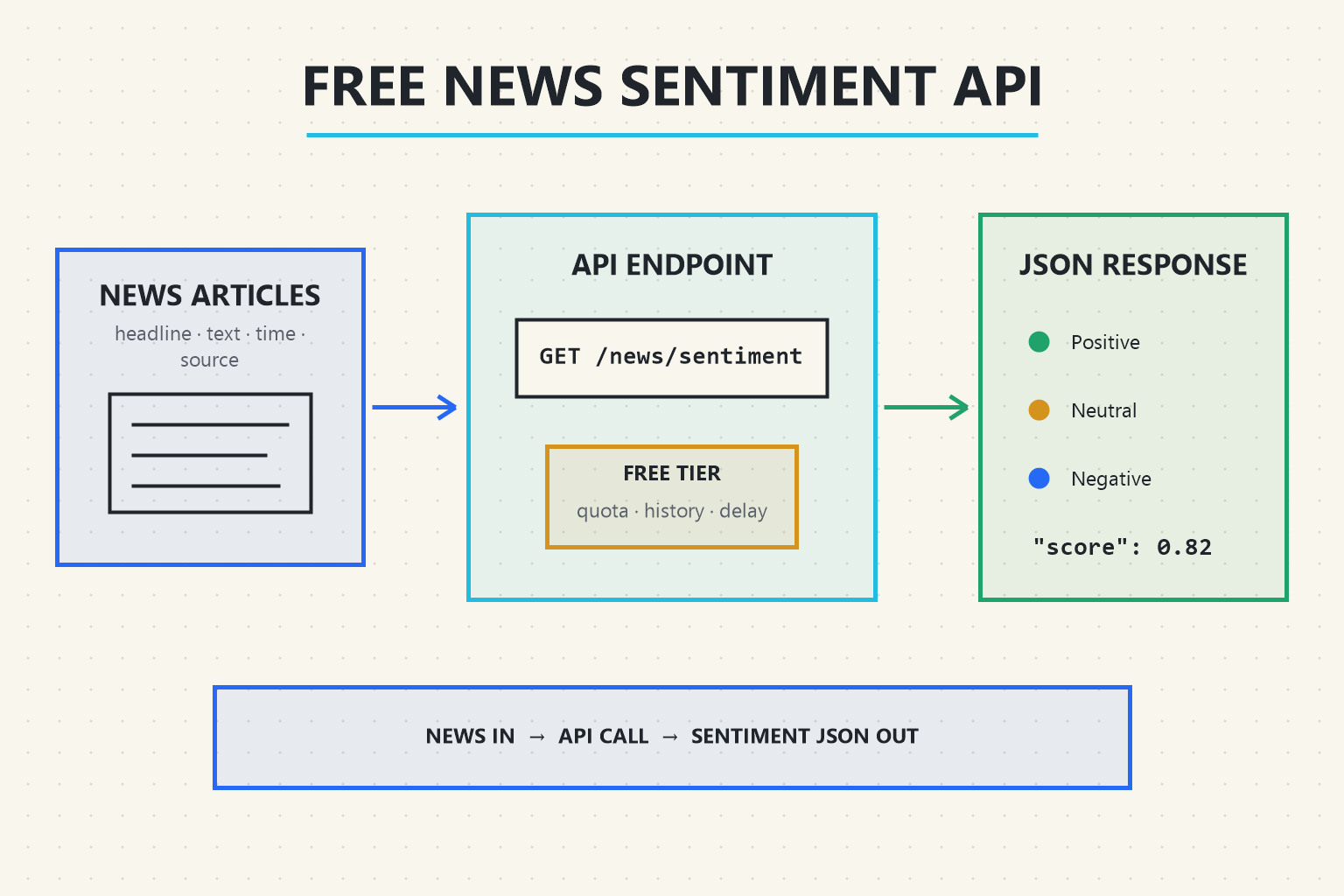
What “free” must include for a news sentiment API免费新闻情感分析 API 必须说明哪些边界
A zero-dollar signup is only the first filter. The useful question is whether the free response contains both a traceable news record and an interpretable sentiment result. Some plans expose headlines but reserve sentiment for paid access; others score text you submit without supplying any news.
零成本注册只是第一道筛选。真正需要核对的是:免费响应是否同时包含可追溯的新闻记录和可解释的情感结果。有些套餐免费提供标题,却把情感字段放在付费层;另一些接口只分析你提交的文本,并不提供新闻。
Choose the sentiment grain before comparing APIs比较接口前先确定新闻情感评分粒度
“Positive” is incomplete unless the response says what the label describes. One article can be optimistic about an industry, negative for one company, and neutral toward another. Match the scoring unit to the decision your application makes.
仅返回“正面”并不完整,响应还必须说明它在描述什么。一篇报道可能看好整个行业、利空某家公司,同时对另一家公司保持中性。评分单位应与应用实际决策一致。
Article-level sentiment for document triage
Use one score per story when the product sorts reading queues, highlights tone, or summarizes a collection. Record the article ID so later corrections remain traceable.
Entity-level sentiment for company or ticker impact
Require an entity identifier and a separate score for every matched company, security, person, or organization. This prevents a document-wide label from being applied to the wrong subject.
Topic-level sentiment for narrative monitoring
Topic scores can track themes such as regulation or supply chains, but the provider should disclose how articles are grouped and how duplicate coverage affects the aggregate.
用文章级情感筛选报道
当产品用于排列阅读队列、突出报道语气或汇总新闻集合时,可使用每篇文章一个评分;同时保留文章 ID,方便追踪后续修订。
用实体级情感判断企业或股票代码的影响
要求每个命中的企业、证券、人物或组织拥有独立实体标识和评分,避免把整篇报道的标签错误套用到其他主体。
用主题级情感监测叙事变化
主题评分适合追踪监管、供应链等叙事,但服务商应说明文章如何分组,以及重复转载会怎样影响聚合值。
Choose between bundled sentiment and a two-stage pipeline选择一体化情感接口还是两阶段处理链路
A free news sentiment API can mean three different products: an endpoint that returns licensed news with scores, a classifier that scores text supplied by your application, or a workflow that combines a news feed with a separate model. Choose the architecture before comparing quotas. Otherwise, a generous text-classification allowance may look attractive even though it provides no articles, entity mapping, or publication metadata.
“免费新闻情感分析 API”可能指三种完全不同的产品:直接返回新闻与评分的一体化接口、只分析应用提交文本的分类器,或由新闻数据源与独立模型组成的两阶段链路。比较配额前应先确定架构,否则,一个额度看似充足的文本分类接口,可能既不提供新闻,也不负责实体映射和发布时间管理。
Best for prototypes and monitoring dashboards that need one response with headlines, timestamps, entities, labels, and scores. Integration is faster, but the provider controls publisher coverage, model behavior, score scale, corrections, and historical depth. Confirm that the free response—not only the product page—contains both the article evidence and sentiment fields.
适合希望一次获得标题、时间、实体、标签和评分的原型或监控面板。接入速度快,但媒体覆盖、模型表现、评分量表、修订方式和历史跨度均由服务商决定。必须确认免费响应本身同时包含新闻证据和情感字段,而不能只看产品介绍。
Best when the application already has suitable news rights or needs to compare models. You control prompts, labels, confidence thresholds, and versioning, but must clean article text, detect entities, remove duplicates, respect language coverage, and maintain two separate failure paths.
适合已经拥有合适新闻使用权,或需要比较不同模型的应用。你可以控制提示词、标签、置信度阈值和版本,但也要自行清洗正文、识别实体、去除重复报道、处理语言覆盖,并维护新闻获取与模型推理两条故障链路。
Best for controlled workloads, private text, repeatable backtests, or custom taxonomies such as guidance cuts and regulatory risk. Model weights may be free, but inference, monitoring, retraining, data rights, and operations are not. A model trained on English filings should not be assumed to score multilingual news correctly.
适合受控工作负载、私有文本、可复现回测,或“下调指引”“监管风险”等自定义分类。模型权重可能免费,但推理资源、监控、再训练、数据权利和运维并不免费;针对英文申报文件训练的模型,也不能直接假定能够准确处理多语言新闻。
Decision rule: use a bundled endpoint when speed and a single contract matter most; separate retrieval from scoring when evidence control, model choice, or domain-specific labels matter more.
选择原则:如果最看重接入速度和单一接口契约,可优先选择一体化方案;如果更重视新闻证据控制、模型选择或行业专用标签,应将新闻获取与情感评分拆开。
Trace every score back to news evidence让每个情感评分都能追溯到新闻证据
A sentiment number without provenance cannot be audited. For each record, retain the canonical article URL, publisher, publication time, provider ingestion time, language, matched entity or topic, and sentiment output. The three timestamps—publication, ingestion, and request—answer different freshness questions.
没有数据出处的情感数字无法审计。每条记录应保留新闻规范 URL、媒体、发布时间、服务商采集时间、语言、命中的实体或主题以及情感输出。发布时间、采集时间和请求时间分别回答不同的及时性问题。
Wire stories may appear under many URLs. Compare canonical URLs, source IDs, normalized titles, and timestamps before counting them as separate evidence.
通讯社报道可能以多个 URL 出现。计入独立证据前,应比较规范 URL、来源 ID、标准化标题和时间戳。
A null score can mean unsupported language, no matched entity, insufficient text, or a processing failure. Do not silently convert it to neutral.
空评分可能表示语言不支持、未命中实体、文本不足或处理失败,不能静默转换成中性。
Store the documented scale and threshold. A value of 0.7 is meaningless if one provider uses −1…1 and another reports class probability.
保存服务商定义的量表和阈值。同样是 0.7,在 −1…1 量表和类别概率中含义完全不同。
Validate sentiment quality before trusting the score信任评分前,先验证情感分析质量
A sentiment endpoint can return valid JSON and still produce a poor financial signal. Evaluate it on articles that resemble the application’s real workload, not on a handful of obvious positive and negative headlines. Build a labeled test set with publication timestamps frozen at collection time, and keep the raw text or permitted evidence needed to reproduce each judgment.
情感接口即使返回格式正确的 JSON,也可能形成质量很差的金融信号。验证时应使用与应用真实场景相似的报道,而不是只挑几条明显的利好或利空标题。建议建立人工标注测试集,在采集时固定发布时间,并在许可范围内保留能够复现判断的原文或证据。
A positive story about an industry is not automatically positive for every company mentioned. Score whether the article is relevant to the target first, then evaluate direction and strength for that entity. Report entity-linking errors separately from classification errors.
Test negation, cautious guidance, beat-but-guide-down results, litigation, restructuring, analyst quotes, rumors, and articles that compare several companies. Headlines such as “loss narrows” or “revenue beats while margins fall” expose weaknesses hidden by simple polarity examples.
Review precision and recall by class, confusion between neutral and weakly directional stories, confidence calibration, unsupported-language rates, and failure rates by publisher. When positive stories dominate the sample, a high accuracy number can conceal weak detection of adverse events.
Use the first observed publication or ingestion time, not a later corrected timestamp. Freeze the model version, thresholds, entity dictionary, and deduplication rules used for each historical run. Reprocessing old stories with a newer model creates a different dataset and must be versioned.
Route low-confidence, high-impact, contradictory, or multi-entity stories for review. The objective is not to force a label onto every article; it is to know which outputs are safe for automated filtering and which need evidence-aware judgment.
一篇看好行业的报道,不一定对文中出现的每家公司都是利好。应先判断报道是否真正影响目标实体,再评估方向和强度;实体链接错误与情感分类错误也要分别统计。
测试否定表达、谨慎指引、业绩超预期但下调指引、诉讼、重组、分析师引述、市场传闻和多公司比较报道。“亏损收窄”或“收入超预期但利润率下降”等标题,往往更能暴露简单正负分类的缺陷。
应分别检查各类别的精确率和召回率、中性与弱方向报道的混淆、置信度校准、语言不支持比例,以及不同媒体的失败率。如果测试集中正面报道占比过高,一个漂亮的准确率可能掩盖模型无法识别风险事件的问题。
使用首次观察到的发布时间或采集时间,不能采用事后修正的时间戳;每次历史运行所用的模型版本、阈值、实体词典和去重规则都应冻结。用新模型重新处理旧报道,会生成一套不同的数据,必须另建版本。
低置信度、影响重大、信号矛盾或涉及多个实体的报道应进入人工复核。目标不是强迫每篇文章都得到一个标签,而是明确哪些结果可以自动用于筛选,哪些必须结合证据进一步判断。
Build an evidence matrix for the free tier为免费套餐建立可核验的证据矩阵
Do not compare providers using plan names alone. Capture one documented statement and one observed response for every requirement. If the two disagree, treat the observed schema as a test result—not permission to ignore the contract.
不要只按套餐名称比较服务商。每项要求都应同时记录一条文档说明和一次实际响应。如果二者不一致,应把响应视为测试结果,而不是忽略合同条款的理由。
| Decision决策项 | Evidence to capture需要保存的证据 | Reject when淘汰条件 |
|---|---|---|
| Coverage媒体覆盖 | Named publishers, regions, languages, categories, and exclusions明确的媒体、地区、语言、分类与排除项 | Required sources cannot be identified无法确认所需来源 |
| Scoring unit评分单位 | Article, entity, ticker, topic, plus label and numeric scale文章、实体、ticker 或主题,以及标签与数值量表 | The scored subject is ambiguous评分对象不明确 |
| Freshness及时性 | Publication time, ingestion time, update interval, and delay policy发布时间、采集时间、更新间隔与延迟规则 | Only request time is available只提供请求时间 |
| Historical access历史范围 | Earliest date, rolling window, archive endpoint, and pagination cap最早日期、滚动窗口、历史端点和分页上限 | Backtests would contain undocumented gaps回测会出现无法说明的缺口 |
| Free allowance免费额度 | Requests, articles per response, reset schedule, and disabled fields请求数、每次文章数、重置周期和禁用字段 | A representative sample cannot be retrieved无法取得具有代表性的样本 |
| Rights数据权利 | Development, production, storage, display, attribution, and redistribution terms开发、生产、存储、展示、署名和再分发条款 | The intended use is not expressly allowed目标用途未被明确允许 |
Normalize a news sentiment response without losing evidence规范化新闻情感响应时不要丢失证据
Keep a provider-neutral record for application logic and retain the provider payload separately where the terms permit. The normalized object below makes article identity, scoring target, timestamps, and scale explicit.
应用逻辑可以使用统一记录;在条款允许时,另行保留服务商原始响应。下面的规范化对象明确区分文章身份、评分对象、时间戳和量表。
from datetime import datetime, timezone

def normalize_news_sentiment(article, provider_name):
    target = article.get("entity") or article.get("topic")
    score = article.get("sentiment_score")

    return {
        "article": {
            "id": article["id"],
            "canonical_url": article["url"],
            "publisher": article["publisher"],
            "published_at": article["published_at"],
            "language": article.get("language"),
        },
        "sentiment": {
            "target": target,
            "label": article.get("sentiment_label"),
            "score": score,
            "scale": article.get("score_scale"),
            "is_missing": score is None,
        },
        "provenance": {
            "provider": provider_name,
            "ingested_at": article.get("ingested_at"),
            "requested_at": datetime.now(timezone.utc).isoformat(),
        },
    }
This is a normalization pattern, not a provider endpoint. Map only documented fields, preserve null values, and keep the provider’s original identifiers so records can be reconciled later.
这是规范化模式,不是真实服务商端点。只映射文档明确说明的字段,保留空值和原始标识,方便后续核对记录。
Turn article sentiment into a defensible time-series signal把文章情感转换成可解释的时间序列信号
Do not average every score returned for a ticker. News volume changes by company and event, syndicated stories can multiply one fact into dozens of rows, and old articles should not influence a current signal forever. Define the aggregation contract before using sentiment in alerts, rankings, or backtests.
不能把某个股票代码下返回的所有评分直接取平均值。不同公司和事件的报道数量差异很大,同一篇通讯社稿件可能被转载成数十条记录,旧报道也不应永久影响当前信号。在将情感用于提醒、排序或回测前,应先明确聚合规则。
Backtest rule: compare the signal with a timestamp-aligned baseline and transaction-aware outcome, then run ablation tests without confidence weighting, source weighting, or duplicate removal. This shows which design choice creates value and which merely makes the chart look smoother.
回测原则:应使用时间严格对齐的基准和考虑交易成本的结果进行比较,并分别移除置信度权重、媒体权重或去重步骤做消融测试。这样才能看出哪些设计真正增加信息价值,哪些只是让曲线看起来更平滑。
Use QVeris to discover the capability, then verify the evidence用 QVeris 发现能力,再核验新闻证据
QVeris helps agents search for capabilities rather than hard-coding a provider name. For this use case, describe the required input and output precisely: topic or entity query, publication-time filters, traceable article metadata, and article- or entity-level sentiment.
QVeris 帮助 Agent 按能力搜索,而不是把服务商名称写死。针对本场景,应准确描述输入输出:主题或实体查询、发布时间筛选、可追溯的新闻元数据,以及文章级或实体级情感。
Discovery does not replace due diligence. Inspect the selected tool’s current authentication, schema, quotas, publisher coverage, and rights before sending production traffic.
能力发现不能替代尽职核验。发送生产流量前,应检查所选工具当前的鉴权、字段结构、配额、媒体覆盖和数据权利。
- Start with the QVeris tool details and search for news retrieval plus sentiment scoring.
- Use the Capability Map to separate news collection from text classification when one tool does not provide both.
- Follow the QVeris documentation to connect the verified capability to an agent workflow.
- 从 QVeris 工具详情开始,搜索新闻检索与情感评分能力。
- 使用 能力地图区分新闻采集和文本分类,处理单一工具无法同时提供两项能力的情况。
- 参考 QVeris 文档,把已核验能力接入 Agent 工作流。
FAQ
Sometimes. A provider may bundle articles and sentiment in one response, exclude sentiment from its free plan, or require a separate classifier. Confirm the live response schema and plan restrictions.
Use article-level scores for document filtering and entity-level scores when one story discusses several companies differently. A single document label can hide opposing effects.
Compare the publisher timestamp, provider ingestion timestamp, and request time. Also check update frequency, cache behavior, timezone handling, and whether the free plan is delayed.
Useful records identify the article, publisher, publication time, language, matched entity or topic, sentiment label, numeric score, and the model or endpoint version when available.
Not automatically. Free access may be limited to evaluation, development, attribution, or non-commercial use. Review both news-content rights and API plan terms.
QVeris helps agents discover capabilities and inspect tool inputs and outputs. Provider availability, price, data rights, and sentiment methodology still require verification in current provider documentation.
有些接口会在同一响应中返回文章和情感字段,有些免费套餐不开放情感分析,还有些需要另外调用分类器。应以当前套餐和真实响应结构为准。
文章级评分适合筛选文档;当一篇报道对多家企业产生不同影响时,应优先检查实体级评分,避免一个总标签掩盖相反信号。
同时比较媒体发布时间、服务商采集时间和请求时间,并核对更新频率、缓存规则、时区以及免费套餐是否延迟。
实用响应应标识文章、媒体、发布时间、语言、命中的实体或主题、情感标签、数值评分,以及可用时的模型或端点版本。
不能默认可以。免费访问可能仅限评估、开发、署名或非商业用途,需要同时检查新闻内容权利和 API 套餐条款。
QVeris 帮助 Agent 发现能力并检查工具输入输出;服务商可用性、价格、数据权利和情感评分方法仍应通过其当前文档核验。