
WTI spot
Use for U.S. physical-market reference work; record the publication date and unit.
Define the benchmark, clock, unit, and evidence contract before choosing an oil-price endpoint.
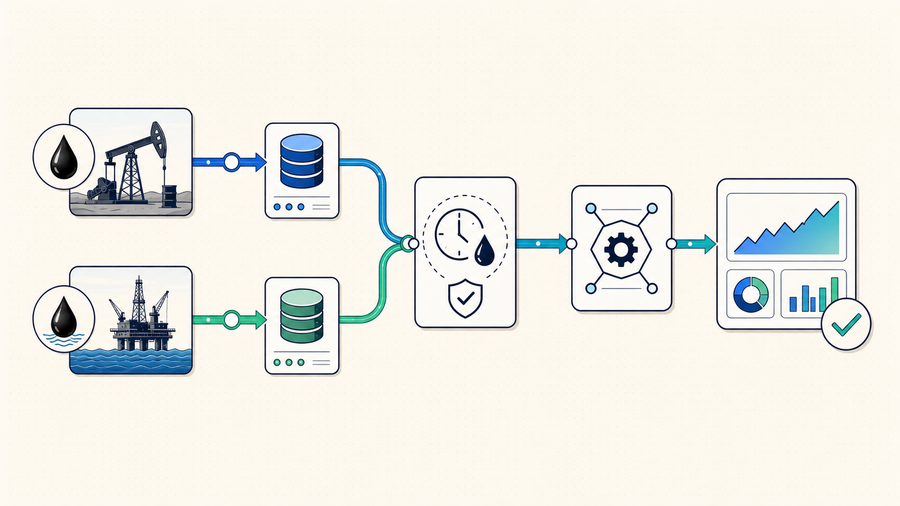
Before comparing providers, settle the job, the meaning of free access, the benchmark, and the evidence each value must carry.
Developers want a usable free oil price API and sample request, not only a commodity chart or market commentary.
A free tier can mean a permanent monthly quota, a time-limited trial, delayed prices, or restricted history.
WTI and Brent spot prices, futures, daily settlements, and intraday quotes are different datasets.
Confirm benchmark, timestamp, currency, unit, update interval, API limits, and redistribution rights.
WTI spot, Brent spot, and futures answer different questions. Pick the price contract first, then evaluate the endpoint.
Use for U.S. physical-market reference work; record the publication date and unit.
Use for global crude comparisons; keep the source series and observation date.
Use when contract month, roll rule, settlement type, and exchange license are explicit.
There is no single universal oil price. Crude grade, delivery location, contract month and price field all change the meaning. A provider that labels one number “crude oil” without benchmark and methodology is not sufficient for reliable analysis.
| Series or price | What it represents | Required context | Typical use |
|---|---|---|---|
| WTI | A US light sweet crude benchmark with delivery context centered on Cushing, Oklahoma. | Spot or futures, contract month, source, unit and timestamp. | US market and inventory analysis. |
| Brent | A North Sea-linked benchmark widely used for international crude pricing. | Assessment or futures methodology, contract or delivery period, and publisher. | Global crude comparisons and differentials. |
| Physical spot | A price or assessment for crude delivered under specified grade, timing and location terms. | Grade, location, delivery window, currency, unit and methodology. | Physical trade, refining and procurement. |
| Futures quote or settlement | A value for one exchange contract; settlement is an exchange-defined end-of-day field. | Exchange, symbol, contract month, quote field, session and status. | Hedging, valuation and curve analysis. |
| Front-month or continuous series | A derived history that switches contracts according to a roll rule. | Roll trigger, adjustment method, source contracts and roll dates. | Charts and return research, not direct execution. |
Do not remove the curve. Replacing every contract with a generic WTI label loses delivery month and can hide contango, backwardation and roll effects. Keep contract-level data even if the interface later displays a continuous chart.
benchmarkWTI, Brent, Dubai/Oman, or a named futures contract.
price_typeSpot, close, settlement, bid, ask, or last trade.
unitUsually USD per barrel; never infer it silently.
observed_atThe market observation time, not merely your request time.
published_atWhen the source released or revised the value.
sourceSeries, exchange, or provider identity and license context.
| Source | Best for | What to verify |
|---|---|---|
| EIA Open Data | Official U.S. energy series | Series code, release cadence, revisions |
| FRED WTI | Research and historical analysis | Underlying source and observation date |
| FRED Brent | Cross-benchmark research | Calendar gaps and update lag |
| FMP in QVeris | Application-oriented market capability | Plan, symbol convention, timestamps, license |
The right API identifies the benchmark and price type instead of returning an unexplained “oil price.” Verify whether a value is WTI or Brent, spot or futures, live, delayed, or a daily settlement. A free account does not override market-data licenses or public-display restrictions.
Check the source timestamp, stated delay, trading-session rules, and update interval. “Latest” can mean the latest available settlement rather than an intraday quote.
Check the first available date, daily or intraday granularity, missing periods, revisions, and whether the series represents spot prices, front-month futures, or settlements.
A useful response identifies benchmark, price, currency, unit, timestamp, and source. Stable field names, documented errors, authentication, and rate-limit headers reduce integration risk.
Oil data has additional failure modes beyond ordinary JSON handling: benchmark substitution, contract expiry, unit mismatches, holiday schedules, settlement corrections and continuously rolled history. Validate these explicitly.
Require benchmark, grade, location and publisher. Do not fill a missing Brent value with WTI or another crude merely because all are quoted per barrel.
Store contract month and distinguish last trade, bid, ask, close and settlement. A front-month alias must resolve to the actual contract on every date.
Persist currency and unit exactly as published. If converting barrels, tonnes or currencies, record the factor, assumptions and FX timestamp.
Compare event time with ingestion time and respect market sessions, weekends and holidays. Label delayed and end-of-day series clearly.
Save source contracts and roll decisions. Back-adjustment can help return analysis, but adjusted historical price levels are synthetic.
Sample against EIA Open Data, FRED's WTI series, or the licensed exchange source appropriate to the series, and retain attribution, display and redistribution terms.
Backtest warning: today's cleaned continuous series can contain revised settlements and a roll convention chosen with hindsight. Reconstruct the series using information available at each decision time when results depend on exact historical availability.
| Check | Questions to ask | Good for | Common limit |
|---|---|---|---|
| Coverage | WTI, Brent, spot, futures, gasoline, or diesel? | Matching the required benchmark. | One benchmark or price type only. |
| Freshness | Real time, delayed, end of day, or cached? | Matching research or live workflows. | Exchange entitlement. |
| Fields | Benchmark, price, currency, barrel unit, timestamp, source? | Charts, research, monitoring. | Free tier may omit history. |
| Access | REST, JSON, SDK, API key, quota, and documented errors? | Reliable application integration. | Trials expire; quotas change. |
Turn “oil price” into a benchmark, price type, unit, and required freshness.
Test a known date and symbol; retain the raw response.
Compare observation, publication, and receipt times.
Persist source URL, series code, unit, and transformation rule with the value.
Choose WTI or Brent, spot or futures, currency, barrel unit, update frequency, and history range before comparing providers.
Start with the provider’s official cURL or Python example and a free API key. Keep credentials outside source code, set a timeout, and record quota headers.
Reject missing timestamps, normalize timezones, preserve the raw symbol, detect stale responses, and compare a small sample with an official exchange or licensed vendor reference.
Retry transient failures with exponential backoff and jitter. Respect 429 responses and provider guidance; do not turn a small free quota into a polling loop.
QVeris separates capability discovery from provider selection, so an agent can inspect inputs and evidence before a call. Continue with Financial Modeling Prep provider details, then confirm the calling contract in the QVeris REST API reference.
Yes. Some providers offer a permanent low-volume tier or a trial for WTI and Brent. Check current quotas, delays, history, and license terms.
Yes, but daily and intraday coverage varies. Confirm the benchmark, spot or futures methodology, earliest date, timestamp, and revision policy.
At minimum: benchmark code, price type, value, currency, unit, timestamp, and source. Add OHLC data only when the series supports it.
Only after verifying quota, license, freshness, reliability, corrections, and public-display rights. Free access alone does not prove production suitability.