
Free Options Data
with Python用 Python 获取
免费期权数据
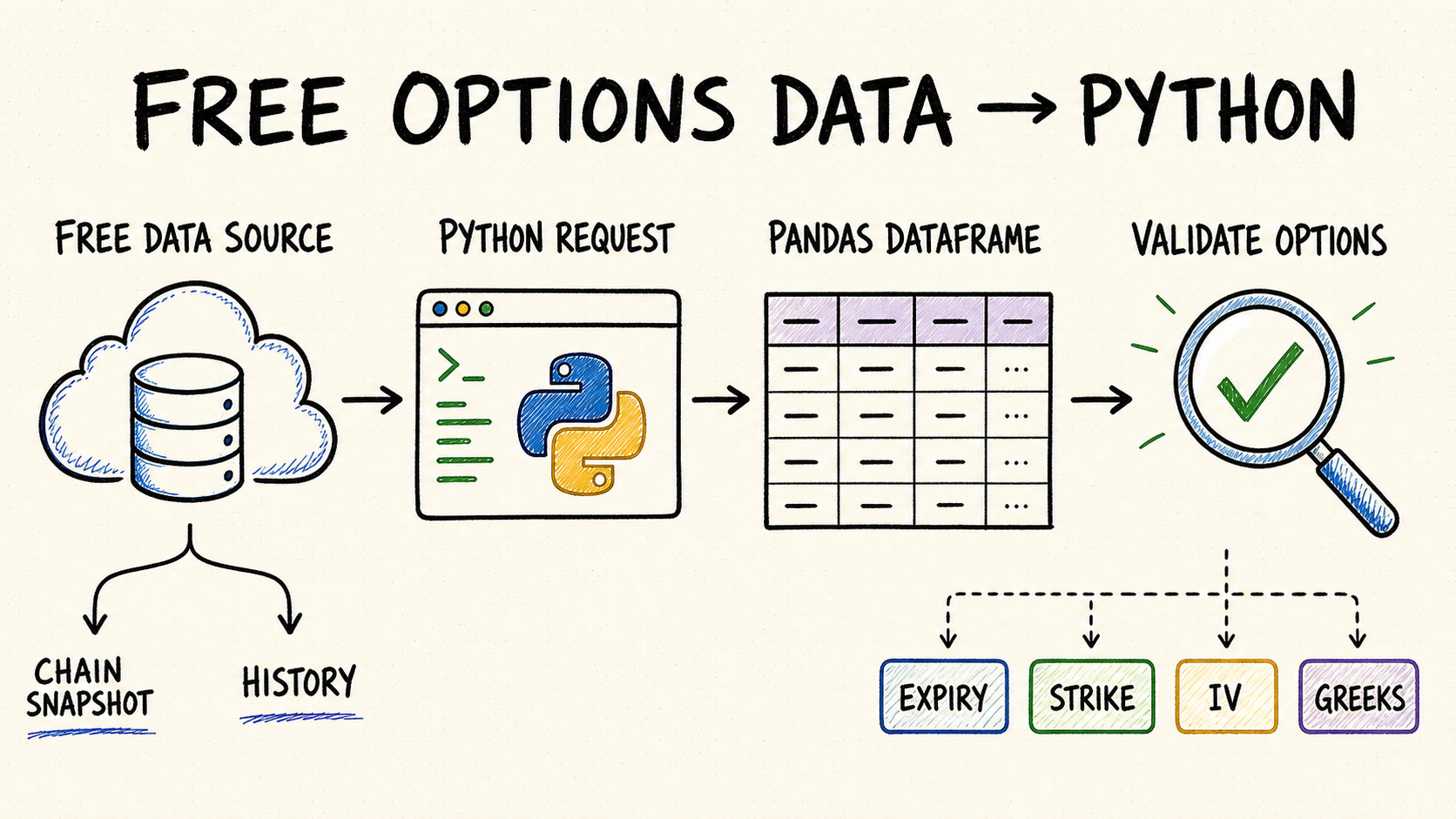
Fetch option chains into pandas, compare free sources, and validate expiries, strikes, Greeks, timestamps, limits, and licenses.
把期权链读入 pandas,比较免费数据源,并核对到期日、行权价、希腊值、时间戳、限额与许可。
TL;DR核心摘要
Use a documented API or provider SDK, load JSON into pandas, and save a raw copy before transforming it.
Expect delayed chains, snapshot-only access, request caps, limited expiries, or non-commercial terms.
Start with one underlying and one expiry. Confirm contract fields, timestamps, missing values, and quote quality before requesting a wider chain.
A current free chain can support learning and screening, but it is not automatically a point-in-time historical dataset suitable for backtesting.
选择文档清晰的 API 或 SDK,把 JSON 读入 pandas,并在转换前保存原始响应。
免费套餐通常只能获取延迟的期权链数据或当前快照,并可能受到 API 请求次数上限、可用到期日或非商业用途条款的限制。
先处理一个标的和一个到期日。在扩大请求范围前,确认合约字段、时间戳、缺失值和报价质量符合预期。
免费的当前期权链适合学习和筛选,但它并不等同于能够直接用于回测的严格时点历史数据集。
The practical answer is to begin with one narrow, repeatable request: one underlying, one expiry, and a documented set of fields. Save the response before transforming it, normalize the contract identity and quote timestamp, then reject rows that fail basic market-data checks. Only after that workflow is stable should you add more expiries, symbols, or scheduled collection.
更实用的做法是从一个范围明确、可以重复执行的请求开始:一个标的、一个到期日,以及一组有文档说明的字段。先保存响应,再规范化合约身份与报价时间戳,并排除未通过基本行情检查的记录。只有这套流程稳定后,才适合增加更多到期日、标的或定时采集任务。
This guide is for developers building research notebooks, option screeners, teaching examples, or data-ingestion prototypes. It is not a recommendation to trade an option, and it does not treat a free quote as complete evidence for execution or historical performance.
本指南面向构建研究 Notebook、期权筛选器、教学示例或数据采集原型的开发者,不构成期权交易建议,也不会把一条免费报价视为成交或历史绩效的完整证据。
Choose a free options data source for Python选择适用于 Python 的免费期权数据源
Start with the dataset—not the library. A current chain screener needs bid, ask, volume, open interest, IV, strike, expiry, and contract side. Backtesting also needs historical chain snapshots, which are much harder to find on a free plan.
先确定所需的数据集,而不是先选择库。筛选当前期权链需要买价、卖价、成交量、持仓量、隐含波动率、行权价、到期日以及看涨或看跌类型;回测还需要历史期权链快照,而这类数据通过免费套餐更难获得。
Define the job before comparing sources. A notebook that ranks contracts by spread needs current bid and ask sizes; an implied-volatility study needs the option price, synchronized underlying price, valuation time, rate, dividend assumption, and calculation method. If you only need to learn DataFrame operations, a documented sample file may be more stable than an undocumented public endpoint.
比较数据源之前,先明确任务。按价差筛选合约的 Notebook 需要当前买卖价和挂单量;研究隐含波动率则需要期权价格、同步的标的价格、估值时间、利率、股息假设和计算方法。如果目的只是学习 DataFrame 操作,一份有说明的样例文件往往比未经说明的公开接口更稳定。
Best for screeners and notebooks. Confirm whether quotes are live or delayed and whether IV and Greeks are supplied or must be calculated.
Useful for prototypes, but wrapped endpoints can change. Pin versions, test returned columns, and never assume every expiry is available.
Useful when the same application may later place orders. Check whether market-data permissions depend on the account, exchange agreements, region, or session.
Useful for repeatable tutorials and schema exploration. Verify the observation date, adjustment status, license, and whether the file contains quotes, trades, or derived analytics.
最适合用于筛选工具和分析笔记本。应确认报价是实时还是延迟,以及隐含波动率和希腊值是直接提供还是需要自行计算。
适合快速构建原型,但其封装的底层接口可能发生变化。应锁定版本、测试返回的列,并且不要假定所有到期日的数据都可用。
适合同一应用后续可能提交订单的场景。需要确认行情权限是否取决于账户状态、交易所协议、所在地区或交易时段。
适合制作可复现教程和探索数据结构。使用前应确认观测日期、合约调整状态、许可条件,以及文件包含的是报价、成交还是衍生指标。
Treat “free” as an access condition, not a quality grade. Record the source, retrieval time, advertised delay, request parameters, terms of use, and the fields actually returned. That small provenance record lets you explain why two runs produced different chains.
“免费”描述的是访问条件,并不代表数据质量等级。应记录数据来源、获取时间、标称延迟、请求参数、使用条款以及实际返回字段。保留这些基本来源信息,才能解释两次运行为什么得到不同的期权链。
| Source type数据源类型 | Best use适用场景 | Check before using使用前检查 |
|---|---|---|
| Documented REST API有文档的 REST API | Repeatable scripts, scheduled snapshots, and explicit request parameters.可复现脚本、定时快照和明确请求参数。 | Authentication, pagination, rate limits, quote delay, fields, and redistribution terms.认证、分页、限流、报价延迟、字段与再分发条款。 |
| Provider SDK供应商 SDK | Faster integration when the SDK exposes the full API contract.SDK 能完整呈现 API 合同时,可更快完成接入。 | Supported Python versions, release cadence, error behavior, and access to raw responses.支持的 Python 版本、发布节奏、错误处理与原始响应访问能力。 |
| Convenience library第三方封装库 | Exploration and short-lived prototypes where convenience matters most.更重视便利性的探索和短期原型。 | Upstream source, maintenance status, schema drift, licensing, and caching behavior.上游来源、维护状态、字段变化、许可和缓存行为。 |
| Downloadable sample可下载样例 | Tutorials, unit tests, schema design, and offline demonstrations.教程、单元测试、数据结构设计和离线演示。 | Observation date, completeness, survivorship, contract adjustments, and reuse rights.观测日期、完整性、存续偏差、合约调整与复用权利。 |
Keep adjacent search intents separate. If the main decision is which endpoint or provider model to use, continue with the free options data API selection guide. For a file-first workflow, use the free options data CSV guide to define columns, encoding, and import checks before writing Python transformations.
相邻搜索意图应保持区分。如果核心问题是选择哪种端点或供应商模式,可继续阅读免费期权数据 API 选型指南;如果采用文件优先的工作流,则可参考免费期权数据 CSV 指南,先确定字段、编码与导入检查,再编写 Python 转换逻辑。
Quote fields also need market context. Option chains present buying and selling interest through bid and ask values, and the spread matters alongside either price. That is why a source returning only a last price is inadequate for many screening and execution studies.
报价字段还需要结合市场背景理解。期权链通过买价和卖价展示市场两侧的交易意愿,价差与两侧价格本身同样重要。因此,只返回最新成交价的数据源并不足以支持许多筛选和成交研究。
Python example: fetch an option chain into pandasPython 示例:获取期权链数据并读入 pandas
A provider-neutral pattern uses requests for transport and pandas for normalization. Replace the endpoint, authentication method, response path, pagination rules, and field names with those in your provider’s documentation. The example intentionally stops at ingestion and validation; it does not generate a trading recommendation.
一种与数据供应商无关的通用做法是使用 requests 发起 HTTP 请求,再通过 pandas 规范数据结构。请根据所选供应商的文档替换 API 端点、认证方式、响应路径、分页规则和字段名。这个示例只演示获取与验证数据,并不生成交易建议。
import os
import requests
import pandas as pd

url = "https://api.example.com/v1/options/chain"
params = {
    "underlying": "AAPL",
    "expiry": "2026-09-18",
    "apikey": os.environ["OPTIONS_API_KEY"],
}
response = requests.get(url, params=params, timeout=20)
response.raise_for_status()

rows = response.json()["contracts"]
df = pd.DataFrame(rows)
df["quote_time"] = pd.to_datetime(df["quote_time"], utc=True)
df["expiry"] = pd.to_datetime(df["expiry"])
key = ["expiry", "strike", "side"]
df = df.sort_values("quote_time").drop_duplicates(key, keep="last")
print(df[key + ["bid", "ask", "iv", "delta", "open_interest"]].head())| Step步骤 | Why it matters作用 | Minimum check最低检查项 |
|---|---|---|
| Request请求 | Timeouts and HTTP errors prevent silent failures.设置请求超时并检查 HTTP 错误,可避免请求失败却未被发现。 | Status code and provider error body.HTTP 状态码和供应商返回的错误响应内容。 |
| Normalize标准化 | Stable columns isolate analysis from provider schemas.稳定的列结构可使分析逻辑不受供应商响应结构差异的影响。 | Types, UTC dates, numeric columns.字段类型、UTC 时间字段和数值列。 |
| Validate验证 | Bad contracts can produce believable but wrong signals.错误的合约记录可能产生看似可信、实则错误的交易信号。 | Expiry, strike, side, quote time, bid/ask, IV.到期日、行权价、看涨或看跌类型、报价时间、买卖报价和隐含波动率。 |
Real APIs often return nested JSON rather than a flat contracts array. Inspect one raw response before writing transformation code, then use a documented record path or pandas.json_normalize when contracts are nested under expiries or option sides. Keep the raw payload unchanged so you can revisit fields that were not included in the first DataFrame.
真实 API 经常返回嵌套 JSON,而不是平铺的 contracts 数组。编写转换逻辑前,应先检查一份原始响应;如果合约嵌套在不同到期日或期权类型之下,可使用明确的记录路径或 pandas.json_normalize 展开。原始响应应保持不变,以便以后重新提取首次 DataFrame 未保留的字段。
For repeated collection, separate immutable raw files from normalized tables. Partition by retrieval date and underlying, save the provider request ID when available, and write a small manifest containing schema version, row count, minimum and maximum quote time, and validation status. This makes failed or incomplete downloads visible before they enter analysis.
如果需要持续采集,应把不可变的原始文件与规范化表分开。可按获取日期和标的分区,在供应商提供请求 ID 时一并保存,并生成包含数据结构版本、行数、最早和最晚报价时间及验证状态的小型清单。这样可以在数据进入分析前发现失败或不完整的下载。
Read the API key from an environment variable, set an explicit timeout, and keep the underlying, expiry, and optional filters in a parameter dictionary. Production calls should never wait indefinitely.
Record the status code, response headers, request ID, pagination cursor, and raw JSON before selecting the contract rows. Error payloads can be valid JSON, so successful decoding does not prove that the API call succeeded.
Map vendor fields into stable names for contract ID, underlying, expiry, strike, side, bid, ask, sizes, volume, open interest, quote time, IV, and Greeks. Use pandas.json_normalize when the response contains nested contract records.
Check types, compound-key uniqueness, quote order, timestamps, missingness, and expected expiry coverage. Write failures to a report and keep the last verified dataset rather than replacing it with an incomplete refresh.
从环境变量读取 API 密钥,设置明确的超时时间,并把标的、到期日和可选筛选条件放入参数字典。生产请求不应无限等待。
在提取合约记录前,保存状态码、响应头、请求 ID、分页游标和原始 JSON。错误响应也可能是合法 JSON,因此成功解码并不代表 API 调用成功。
把供应商字段映射为稳定名称,包括合约 ID、标的、到期日、行权价、方向、买卖价、挂单量、成交量、持仓量、报价时间、隐含波动率与希腊值。响应包含嵌套合约记录时,可使用 pandas.json_normalize 展开。
检查字段类型、复合键唯一性、报价关系、时间戳、缺失比例和预期到期日覆盖。把失败写入报告,并保留上一版已验证数据,不要用不完整刷新结果覆盖它。
For a scheduled collector, make each run idempotent: the same request window should produce the same partition key, while a changed payload creates a new version rather than silently overwriting history. Add bounded retries for timeouts and temporary server errors, but do not retry invalid credentials, malformed parameters, or permission failures as if they were transient.
定时采集任务应具备幂等性:相同请求区间应生成相同分区键;响应内容变化时应创建新版本,而不是静默覆盖历史。遇到超时或临时服务器错误时可以有限重试,但无效凭证、错误参数或权限失败不应被当作临时问题反复请求。
Validate free options data before analysis使用免费期权数据分析前,先做好验证
Compare every contract timestamp with the exchange session, expected delay, and underlying-price timestamp.
Treat underlying, expiry, strike, and call/put side as a compound key; parse provider contract symbols only after testing edge cases.
Flag missing, locked, or crossed markets. Keep bid and ask sizes when available, and do not treat the midpoint or last trade as a guaranteed executable price.
Confirm whether implied volatility and Greeks use decimal or percentage units. Preserve nulls separately from numeric zero and record provider status fields.
Record whether IV and Greeks came from the provider or your own model. Calculated values need the price input, underlying value, rate, dividends, valuation time, and model version.
逐份合约核对报价时间,确认其符合交易时段和预期延迟,并与标的资产价格的时间戳一致。
以标的资产、到期日、行权价和期权类型(看涨或看跌)的组合作为复合键;先测试各种边界情况,再解析数据提供方的期权合约代码。
标记缺失、锁定或倒挂的市场。供应商提供挂单量时应一并保留,也不要把中间价或最新成交价当作保证可以成交的价格。
确认隐含波动率和希腊值采用小数还是百分比单位。空值必须与数值零分开处理,并保留供应商返回的状态字段。
记录隐含波动率和希腊值由供应商提供还是自行计算。自行计算时应保存价格输入、标的价值、利率、股息、估值时间与模型版本。
Turn these checks into assertions or a machine-readable validation report. At minimum, report duplicate contract keys, stale timestamps, negative prices, bid-above-ask rows, missing expiries, unexpected currencies, and the percentage of contracts without volume, open interest, IV, or Greeks. Fail the pipeline on broken identity or timestamps; warn separately about optional analytics that the source never promised.
应把这些检查写成断言或机器可读的验证报告。最低限度需要报告重复合约键、陈旧时间戳、负价格、买价高于卖价、缺失到期日、异常币种,以及缺少成交量、持仓量、隐含波动率或希腊值的合约比例。合约身份或时间戳错误应使管道直接失败;供应商未承诺提供的可选指标则可以单独警告。
| Validation rule验证规则 | What it can reveal可能发现的问题 | Recommended action建议处理方式 |
|---|---|---|
| Unique contract-time key合约—时间键唯一 | Duplicate pages, corrections, or mixed snapshots.重复分页、修订记录或混合快照。 | Keep provenance; deduplicate only with a documented rule.保留来源信息,仅按明确规则去重。 |
| Bid ≤ ask买价不高于卖价 | Crossed markets, timing mismatch, or field reversal.市场倒挂、时间不一致或字段颠倒。 | Flag the row; do not silently swap values.标记该行,不要静默交换数值。 |
| Timestamp freshness时间戳新鲜度 | Delayed or stale quotes mixed into a current screen.延迟或陈旧报价混入当前筛选。 | Calculate age against retrieval time and the declared delay.根据获取时间和标称延迟计算数据年龄。 |
| Expected expiry coverage预期到期日覆盖 | Pagination failure, source limits, or an invalid expiry.分页失败、数据源限制或无效到期日。 | Stop the refresh or label the dataset incomplete.停止刷新或明确标记数据集不完整。 |
| Multiplier and adjustment status乘数与调整状态 | Non-standard contracts after a corporate action.公司行动后产生的非标准合约。 | Preserve the deliverable and provider contract ID.保留交割物信息与供应商合约 ID。 |
| IV and Greeks lineageIV 与希腊值来源 | Mixed models, units, inputs, or valuation times.模型、单位、输入或估值时间混用。 | Store method and inputs or exclude the field from comparison.保存方法和输入,否则从比较中排除。 |
Contract identity deserves special treatment. Corporate actions can create adjusted contracts whose deliverables differ from a standard 100-share contract. Preserve the provider contract ID, multiplier, deliverable, and adjustment indicator instead of reconstructing identity from strike and expiry alone.
合约身份需要单独重视。公司行动可能产生交割物不同于标准 100 股合约的调整期权。因此,应保留供应商合约 ID、乘数、交割物和调整标记,而不是只根据行权价与到期日重建合约身份。
If the goal is strategy simulation rather than current-chain analysis, move to the free options data for backtesting guide. That workflow needs historical point-in-time snapshots, contract lifecycle handling, realistic fill assumptions, and a stricter evidence standard than a current Python chain fetch.
如果目标是策略模拟,而不是分析当前期权链,应继续阅读免费期权回测数据指南。回测需要历史时点快照、合约生命周期处理、现实的成交假设,以及比当前 Python 期权链请求更严格的证据标准。
Use QVeris for provider-flexible options data access借助 QVeris 灵活接入多家期权数据服务商
QVeris helps developers and agents discover, inspect, and call financial-data capabilities without coupling every workflow to one provider-specific API.
QVeris 帮助开发者和智能体查找、评估并调用金融数据能力,无需让每套工作流依赖某一家数据服务商的专用 API。
Use the documented discover → inspect → call sequence. For this workflow, start by inspecting the Realtime Options tool in QVeris, including its symbol, contract, data-format, and optional Greeks parameters. Then review the Alpha Vantage provider profile before deciding whether it fits the required market coverage and workflow.
可以采用文档说明的“发现 → 检查 → 调用”流程。对于当前工作流,可先检查 QVeris 中的 Realtime Options 工具,核对股票代码、合约、数据格式以及可选希腊值参数;随后查看 Alpha Vantage Provider 详情,再判断其市场覆盖与工作流是否符合需求。
Python applications can implement that workflow with the QVeris Python SDK. Begin with a narrow discovery query such as “US equity option chain with bid, ask, open interest, and quote timestamp,” inspect the returned schema, and test one underlying and expiry. If you want to evaluate the interaction before adding code, run the same narrow task in the QVeris Playground.
Python 应用可以通过 QVeris Python SDK 实现这套流程。可以先使用“包含买价、卖价、持仓量和报价时间戳的美股期权链”这类范围明确的发现请求,检查返回的数据结构,再测试一个标的与到期日。如果希望在编写代码前评估交互流程,也可以在 QVeris Playground 中运行同样的窄范围任务。
- Discover options-data capabilities and inspect their inputs before calling them.
- Keep application code focused on underlyings, expiries, strikes, and normalized outputs.
- Use a direct provider integration instead when you need an exchange-specific feed, contract, or operational control that the inspected capability does not expose.
- 查找可用的期权数据能力,并在调用前核对输入参数。
- 让应用代码只需处理标的资产、到期日、行权价以及标准化后的输出。
- 如果需要检查后发现能力未提供某项交易所专用行情、合同条款或运营控制,应继续采用供应商直接集成。
FAQ常见问题
Yes. Free APIs and Python libraries can provide current or delayed option chains. Complete historical chains are less commonly free.
Use pandas for cleaning and analysis, requests for direct APIs, or a provider SDK for convenience. Normalize results into a DataFrame.
Not by itself. A current chain is one observation. A defensible backtest needs historical point-in-time chains, contract adjustments, timestamps, delisted contracts, and realistic fill assumptions.
Neither is universally correct. The last trade may be stale, while the midpoint is calculated and may not be executable. Keep bid, ask, sizes, timestamps, and quality flags.
Greeks depend on the model and inputs, including option price, underlying price, time, rates, and dividends. Store the assumptions and avoid mixing values without reconciliation.
Keep an unchanged raw response plus a normalized table. Add retrieval time, source, schema version, request parameters, row count, and validation results.
No. Sample files and some public endpoints may work without one, while documented APIs often require credentials. Never embed a key in source code, notebooks, URLs committed to Git, or exported data.
Keep the raw response and schema tests, pin library versions, and fail visibly when required fields disappear. Do not silently fill a missing market field with zero or reuse an old value.
可以。免费 API 和 Python 库通常能提供实时或延时的期权链数据,但完整的历史期权链通常需要付费获取。
可用 pandas 清洗和分析数据,用 requests 直接调用 API;如果更看重接入便利性,也可使用数据服务商提供的 SDK。无论采用哪种方式,建议最终将数据统一整理为 DataFrame。
不能只靠当前期权链。它只是一个观测时点;可信的回测还需要历史时点期权链、合约调整、时间戳、已退市合约以及现实的成交假设。
两者都不是通用答案。最新成交价可能已经陈旧,中间价则是计算值且未必能够成交。应保留买卖价、挂单量、时间戳和质量标记。
希腊值取决于模型及其输入,包括期权价格、标的价格、时间、利率和股息。应保存相关假设,不要在未经核对时混用不同来源的结果。
同时保存未经修改的原始响应和规范化表,并记录获取时间、来源、数据结构版本、请求参数、行数及验证结果。
不一定。样例文件和部分公开端点可能无需密钥,而有文档的 API 通常需要凭证。不要把密钥写入源代码、Notebook、提交到 Git 的 URL 或导出数据。
保留原始响应与数据结构测试,锁定库版本,并在必需字段消失时明确失败。不要用零静默填充缺失的行情字段,也不要沿用旧值。