
Free Price Target API
Data, Limits & Use Cases免费目标价 API
数据、限制与使用场景
Find analyst targets without paying first, then verify coverage, timestamps, source records, and usage rights before building on the data.
先免费获取分析师目标价格,再核验覆盖范围、时间戳、来源记录与使用权限,确认无误后再接入产品。
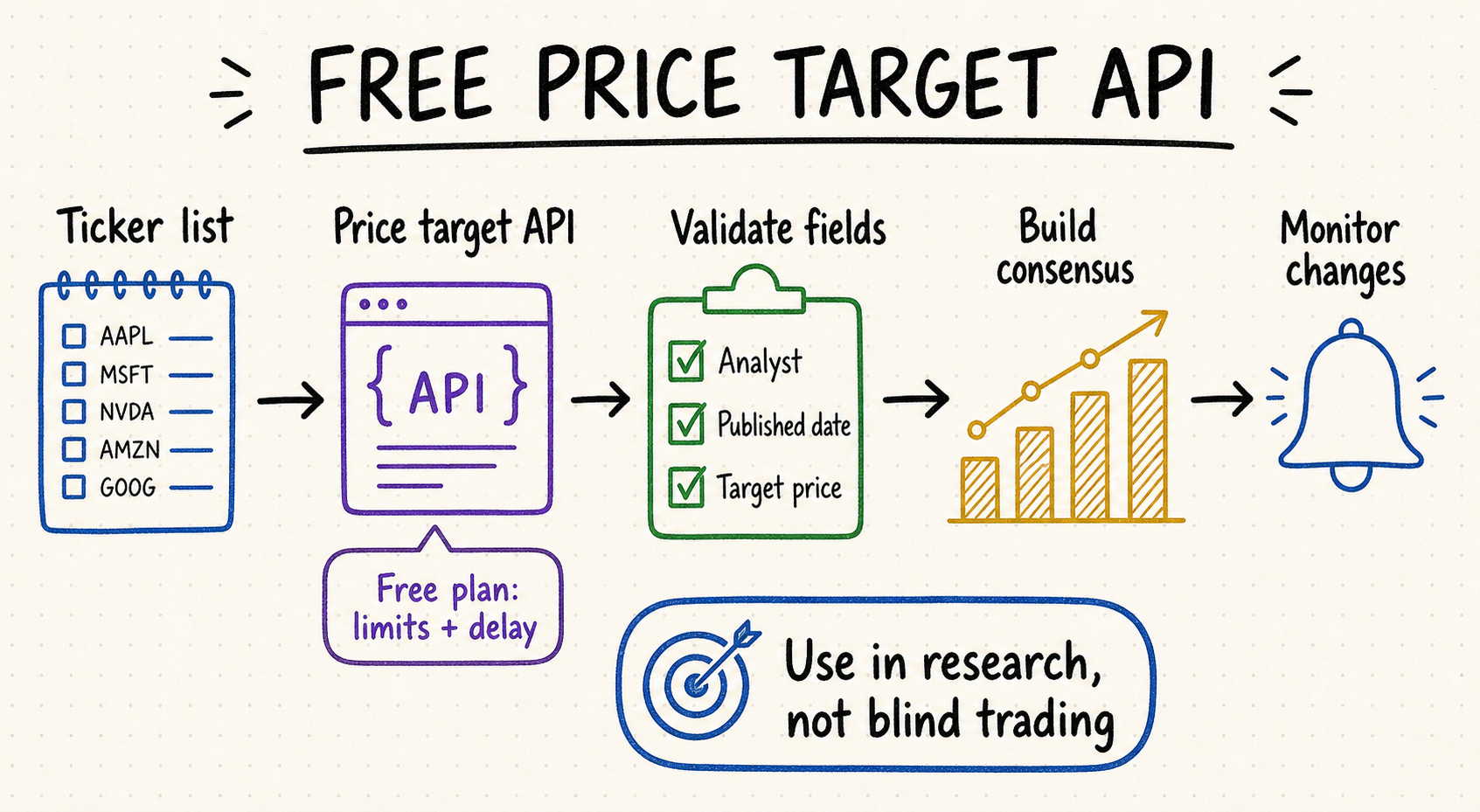
TL;DR核心摘要
Expect request caps, delayed updates, limited history, reduced exchange coverage, or personal-use restrictions.
Check the analyst record behind every aggregate, plus timestamp meaning, currency, symbol mapping, and adjustment policy.
Mean, median, high, and low are meaningless without the contributing analysts, lookback window, duplicate policy, and observation count.
A price target is a dated analyst estimate with assumptions and a horizon, not a market quote or guaranteed future price.
免费套餐通常设有请求次数上限,并可能存在数据更新延迟、历史数据区间较短、交易所覆盖有限或仅限个人使用等限制。
核对每项汇总数据背后的分析师记录,并确认时间戳的具体含义、计价货币、证券代码映射方式以及公司行为调整规则。
如果不知道参与统计的分析师、回溯窗口、重复记录规则和样本数量,均值、中位数、最高值与最低值都缺乏可解释性。
目标价是带发布日期、假设和预测期限的分析师估计,不是市场报价,也不代表未来价格一定会实现。
Fields a useful price target API should expose实用的目标价 API 应提供哪些字段
A consensus number is easy to display but hard to audit. Prefer endpoints with individual observations so you can reconstruct the aggregate and remove stale or duplicate entries. Each record should identify the symbol, target, rating action, analyst or firm, publication date, and currency.
展示一个共识目标价并不难,但要审计其计算依据却很困难。应优先选择可返回逐条分析师记录的接口,以便重新计算汇总值并剔除过期或重复数据。每条记录应包含证券代码、目标价、评级调整动作、分析师或研究机构、发布日期和计价货币。
A new target means something different when it was raised from $90, cut from $150, initiated for the first time, or merely reiterated.
Distinguish when the analyst published the note from when the provider collected it. The gap determines practical data freshness.
Keep a stable analyst or firm identifier, display name, brokerage, and source-record ID. Names alone create duplicates after spelling or employer changes.
Preserve the stated horizon where available, quote currency, exchange, share class, listing, and provider symbol. Never compare targets across currencies or ADR ratios without conversion.
Return observation count, mean, median, high, low, dispersion, calculation time, lookback start, and inclusion rule—not only one average.
同一个新目标价,如果是从 90 美元上调、从 150 美元下调、首次覆盖时给出,或只是重申原目标价,所传达的含义截然不同。
应区分分析师发布研报的时间与数据服务商收录该记录的时间;两者之间的时间差决定了用户拿到数据时,它距离研报发布已有多久。
保留稳定的分析师或机构 ID、显示名称、所属券商和来源记录 ID。只按姓名去重,会在拼写变化或任职机构变化后产生重复。
在可用时保存目标价期限、报价币种、交易所、股票类别、上市地点和供应商代码。不同币种或 ADR 换算比例未统一时,不能直接比较目标价。
除平均值外,还应返回样本数量、中位数、最高值、最低值、离散程度、计算时间、回溯起点和纳入规则。
How to evaluate a free price target API如何评估免费目标价 API
| Test测试项 | Question需要确认的问题 | Failure signal风险信号 |
|---|---|---|
| Coverage覆盖范围 | Which exchanges, security types, and analysts are included?涵盖哪些交易所、证券品种和分析师? | Only popular US large caps return records.仅热门美国大盘股能返回数据记录。 |
| Freshness数据时效 | How soon does a published revision appear?分析师发布目标价调整后,多久能在接口中查到相关数据? | No published timestamp or delay disclosure.既不提供发布时间,也未说明数据延迟情况。 |
| Consistency一致性 | Can you recompute consensus from raw records?能否根据原始明细重新计算共识目标价? | Aggregate changes without underlying records.汇总值发生变化,却没有对应的明细记录。 |
| Terms使用条款 | Are caching, redistribution, and commercial use allowed?是否允许缓存、再分发和商业使用? | “Free” pricing with unclear usage rights.标称“免费”,但数据使用权限并不明确。 |
Query the same watchlist daily for two weeks. Log status codes, latency, missing fields, duplicate IDs, and revision times. This acceptance test reveals more than a feature checklist.
连续两周每天查询同一组股票,并记录状态码、响应延迟、缺失字段、重复 ID 和目标价调整时间。这项验收测试比单看功能清单能发现更多问题。
Build a defensible price target workflow构建可追溯验证的目标价工作流程
Keep the original response, provider timestamp, query parameters, and a normalized copy. Raw evidence lets you investigate later changes.
Map symbols, currencies, analyst identities, and action labels. Flag splits and corporate actions before comparing old and new targets.
Document the lookback window, whether each analyst contributes one latest target, and whether you use mean, median, or trimmed mean.
Do not overwrite a prior target. Link each raise, cut, reiteration, initiation, suspension, or withdrawal to the previous observation and source record.
Store both reported and adjusted values. Splits, reverse splits, spinoffs, currency changes, ADR ratio changes, and symbol migrations require an explicit transformation record.
A changed average may come from one revision, a stale target aging out, a new analyst entering, or a withdrawn record. Attribute the change before treating it as a signal.
保留原始响应、数据服务商提供的时间戳和查询参数,并另存一份标准化副本。借助这些原始记录,可以追查数据后续发生的变化。
统一证券代码、币种、分析师身份信息和评级操作标签;比较新旧目标价前,先标记拆股及其他公司行动。
明确记录回溯期、每位分析师是否只计入其最新目标价,以及汇总时采用均值、中位数还是截尾均值。
不能覆盖上一版目标价。每次上调、下调、重申、首次覆盖、暂停或撤回,都应关联前一条观测与来源记录。
同时保存原始报告值和调整后数值。拆股、并股、分拆、币种变化、ADR 比例变化和代码迁移都需要明确的转换记录。
平均值变化可能来自一位分析师修订、旧目标价超出窗口、新分析师加入或记录撤回。将其视为信号前,应先解释变化来源。
Use QVeris to find and compare data capabilities使用 QVeris 查找并比较数据能力
No exact QVeris price-target tool and matching provider profile were verified for this page, so the safe next steps are the QVeris Docs and QVeris Playground. Describe the capability narrowly—individual analyst targets with firm, publication date, prior target, action, currency, and source ID—then inspect the returned schema before integration.
本页未核实到精确匹配的 QVeris 目标价工具及对应 Provider 页面,因此更稳妥的入口是 QVeris 文档与 QVeris Playground。应把需求描述得足够具体:逐条分析师目标价、机构、发布日期、前次目标价、调整动作、币种和来源 ID,再检查返回结构。
- Reject generic market-data results that return only a consensus number without source observations.
- Save the discovery query, inspected capability, parameters, response, retrieval time, and validation decision.
- Keep provider selection separate from consensus calculation and corporate-action adjustment logic.
- 如果通用市场数据结果只返回共识值而没有来源明细,应直接排除。
- 保存发现请求、已检查能力、参数、响应、抓取时间和校验结论。
- 将供应商选择与共识计算及公司行动调整逻辑分开。
FAQ常见问题
Some providers offer a free plan, but coverage, history, request volume, freshness, or usage rights are usually limited.
Use one recent observation per analyst, disclose the lookback window, and compare the median with the mean and dispersion.
It can support research, but delayed or incomplete records should not be treated as execution-grade signals.
Use the analyst's stated horizon when available. Otherwise apply a disclosed freshness window and remove withdrawn or superseded observations.
Preserve the reported value and add a separate adjusted value with the action, factor, effective date, and transformation source.
部分服务商提供免费套餐,但通常会限制覆盖范围、历史数据、请求次数、数据时效或使用权限。
在回溯期内,每位分析师仅保留一条最新目标价记录;同时明确披露回溯期,并比较中位数、均值和数据离散程度。
免费数据可以辅助研究,但延迟或不完整的记录不应被视为可直接用于交易执行的信号。
优先使用分析师明确给出的预测期限;没有期限时,应采用公开说明的新鲜度窗口,并移除已撤回或已被新记录替代的观测。
应保留原始报告值,再增加独立的调整后数值,并记录公司行动、调整因子、生效日期和转换来源。
References and next steps参考资料与下一步
FMP price targets API
FMP plans
Benzinga analyst ratings API