
Free Quantitative
Stock Screener免费量化
选股器
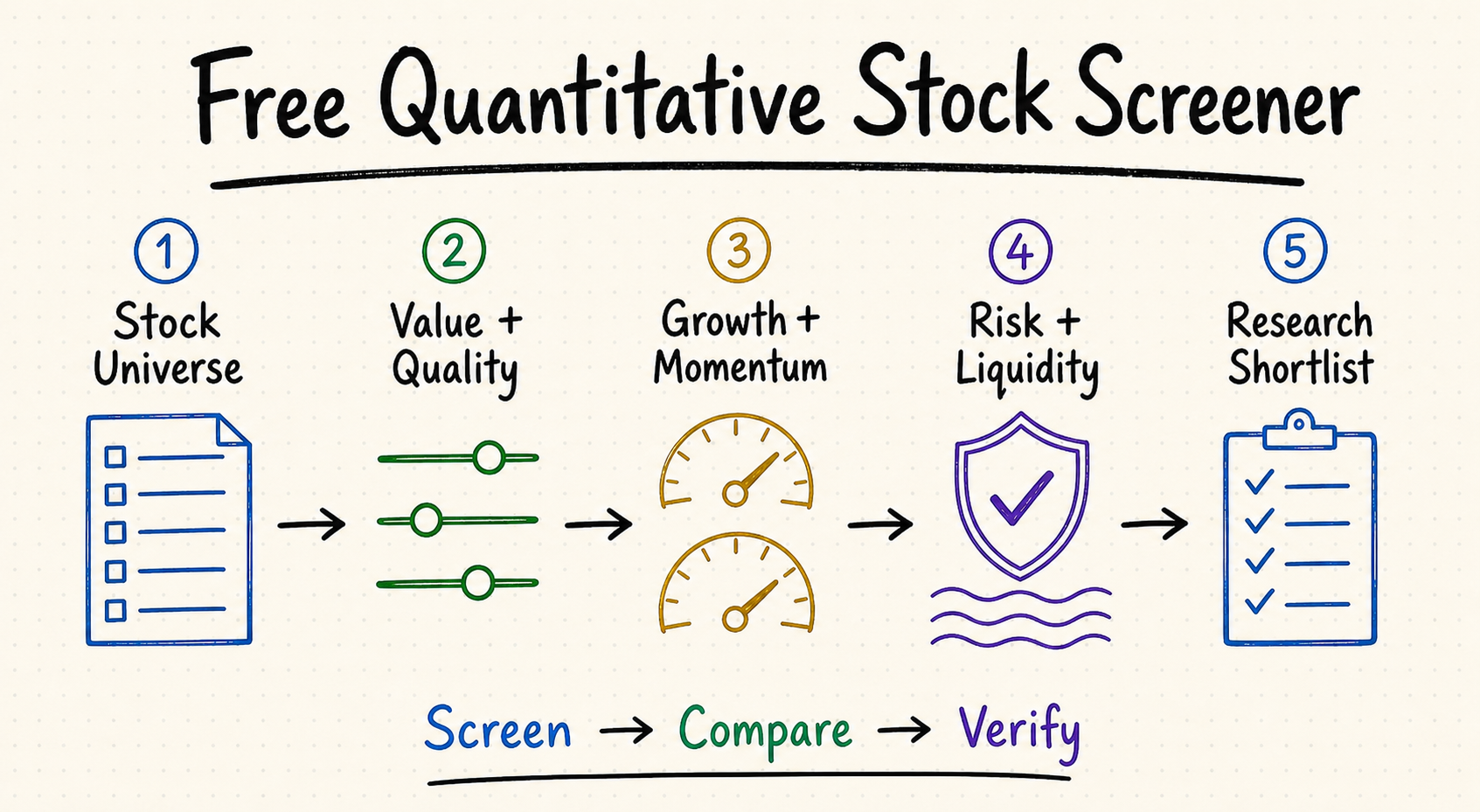
Build a rules-based stock shortlist with measurable value, quality, growth, momentum, risk, and liquidity filters—then verify every result.
用估值、质量、成长、动量、风险与流动性因子建立候选股票池,
再核验数据与公司披露。
TL;DR摘要
Convert a defined, investable universe into a smaller research list using rules that can be rerun with the same data and date.
Combine economically distinct value, quality, growth, momentum, risk, and liquidity signals instead of stacking several versions of one idea.
Show raw values, normalized scores, exclusions, sector exposure, and the reason each candidate passed—not only a mysterious composite rank.
Check point-in-time definitions, filing availability, outliers, missing values, rebalancing turnover, and transaction-cost sensitivity.
用能够在相同日期和数据上重复运行的规则,把明确且可投资的证券池缩小为研究候选名单。
组合经济含义彼此不同的估值、质量、成长、动量、风险和流动性信号,避免叠加同一种观点的多个变体。
展示原始值、标准化分数、排除原因、行业敞口和每只股票入选理由,而不是只给一个无法解释的综合排名。
检查时点口径、申报可用日、异常值、缺失值、调仓换手和交易成本敏感性。
Free quantitative stock screener factors that matter免费量化选股器应覆盖的核心因子
A multi-factor stock screener is useful when each rule has a clear purpose. Value asks what you pay, quality examines business strength, growth measures change, momentum captures price behavior, while risk and liquidity test whether a candidate is practical to research. MSCI’s factor investing overview identifies value, quality, momentum, size, yield, and low volatility as established factor categories.
多因子选股工具的每条规则都应有明确目的:估值衡量价格与基本面的关系,质量观察企业经营稳健性,成长衡量收入和利润的变化,动量反映价格行为,风险与流动性则帮助排除不适合继续研究的标的。MSCI 的因子投资概览列出了估值、质量、动量、规模、收益率与低波动等常见因子类别。
Raw factor values are rarely comparable across the whole market. Banks, software companies, utilities, and early-stage firms have different accounting structures and distributions. A credible screen states whether it ranks within sector or industry, how it winsorizes extreme values, whether it converts values to percentiles or z-scores, and how it combines scores when one input is missing.
原始因子值通常不能直接横跨全市场比较。银行、软件公司、公用事业和早期企业的会计结构与数值分布并不相同。可靠的筛选器应说明是否在行业内排名、如何缩尾处理极端值、使用百分位还是标准分,以及某个输入缺失时如何合成总分。
Compare P/E, price-to-book, free-cash-flow yield, profitability, leverage, and cash-flow consistency. Definitions and sector norms matter.
Use revenue or earnings growth with price momentum over a stated lookback. Avoid treating recent performance as a forecast.
Market capitalization, trading volume, volatility, drawdown, and leverage can prevent an attractive score from hiding practical constraints.
Hard filters exclude stocks at a threshold; percentile ranks preserve more candidates and make cross-factor trade-offs easier to inspect.
Winsorize or cap extreme observations before ranking, then compare percentile or z-score behavior. Sector-relative ranks can reduce structural industry bets, but the chosen grouping and minimum group size must be explicit.
Measure correlation between signals and how often candidates change. A slightly stronger paper score may be less useful if it creates high turnover, wide-spread trades, or repeated exposure to the same underlying factor.
可比较市盈率、市净率、自由现金流收益率、盈利能力、杠杆和现金流稳定性,同时注意口径与行业差异。
把收入或利润增速与明确周期的价格动量结合使用,不把近期表现当作未来收益预测。
市值、成交量、波动率、回撤与杠杆可避免高分掩盖实际交易和研究限制。
硬性条件按阈值排除股票;百分位排名保留更多候选,便于观察不同因子之间的取舍。
排名前应缩尾或限制极端观测,再比较百分位或标准分表现。行业内排名可以减少结构性行业押注,但必须明确分组方式和最小样本数。
衡量信号之间的相关性以及候选更换频率。纸面分数稍高的组合,如果带来高换手、大点差交易,或反复暴露于同一底层因子,实际价值可能更低。
How to compare free factor stock screeners如何比较免费的多因子选股工具
| Check检查项 | What to verify核验内容 | Why it matters为什么重要 | Warning sign风险信号 |
|---|---|---|---|
| Market coverage市场覆盖 | Exchanges, security types, active and delisted stocks.交易所、证券类型、在市与退市股票范围。 | The starting universe changes every result.初始股票池会改变全部结果。 | Coverage is not disclosed.未说明覆盖范围。 |
| Factor definitions因子定义 | Formula, reporting period, units, and missing-value handling.公式、报告期、单位和缺失值处理。 | Similar labels may use different calculations.相似名称可能采用不同算法。 | Opaque scores without methodology.只有分数,没有方法。 |
| Data freshness数据时效 | Price delay, filing update time, and refresh schedule.价格延迟、财报更新时间和刷新频率。 | Stale inputs can alter a shortlist.过期输入会改变候选名单。 | No timestamp or source.没有时间戳或来源。 |
| Free-tier limits免费版限制 | Filters, exports, saved screens, alerts, and result caps.筛选项、导出、保存条件、提醒和结果上限。 | “Free” may describe only a trial or partial workflow.“免费”可能只是试用或部分功能。 | Paywall appears after rules are entered.输入规则后才出现付费墙。 |
| Normalization标准化 | Outlier cap, percentile or z-score, sector grouping.极值限制、百分位或标准分、行业分组。 | Raw units and sector structures are not comparable.原始单位与行业结构不可直接比较。 | A single outlier dominates the score.单个极端值主导总分。 |
| Point-in-time data时点数据 | Filing availability, restatements, old universes, delistings.申报可用日、重述、历史证券池和退市标的。 | Controls look-ahead and survivorship bias.控制前视偏差与存续偏差。 | Only today's values are available.只能获得今天的数值。 |
| Portfolio realism组合现实性 | Turnover, capacity, spread, rebalance frequency, concentration.换手、容量、点差、调仓频率与集中度。 | A screen must survive implementation costs.筛选结果需要经受实际执行成本。 | Only backtested return is shown.只展示回测收益。 |
How to use a free quantitative stock screener如何使用免费量化选股器建立候选股票池
Choose market, exchange, security type, minimum size, and minimum liquidity before selecting factors. This prevents accidental comparisons across unlike securities.
Start with one or two rules from value, quality, growth, and momentum. Highly correlated filters can create false confidence without adding information.
Compare factor values, sector concentration, missing data, outliers, and the reason each stock passed. Save the exact rules and date.
Read current company filings and confirm recent figures before making any decision. Check the issuer, reporting period, units, restatements, and source timestamp.
Apply documented outlier handling, rank within the intended peer group, and combine factors with explicit weights. Preserve every raw value, transformed score, missing-value decision, and exclusion reason.
Shift thresholds, lookbacks, and rebalance dates slightly. Compare candidate overlap, sector weights, turnover, spreads, and performance after conservative costs; a robust research screen should not collapse after a tiny parameter change.
Store the eligible universe, source dates, filing availability, factor formulas, code version, ranking, and rejected rows. Rebuilding the screen later should reproduce the same list without consulting data published afterward.
先选择市场、交易所、证券类型、最低市值与最低流动性,再添加因子,避免比较性质不同的证券。
从估值、质量、成长和动量中各选一至两个规则。高度相关的条件可能增加确定感,却没有增加有效信息。
比较各因子数值、行业集中度、缺失数据、异常值以及每只股票入选的原因,并保存筛选规则和日期。
决策前阅读最新公司披露并确认数值,检查发行人、报告期、单位、重述情况与来源时间戳。
按文档处理异常值,在目标同类组内排名,再用明确权重合成因子;同时保留原始值、转换后分数、缺失值决策和排除原因。
小幅移动阈值、回看周期和调仓日期,比较候选重合度、行业权重、换手、点差,以及扣除保守成本后的结果。可靠的研究筛选不应因参数轻微变化就完全失效。
保存合格证券池、来源日期、申报可用时间、因子公式、代码版本、排名和被排除记录。之后重建时,不应依赖当时尚未发布的数据。
Worked example: turn raw factors into an auditable score实算示例:把原始因子转成可核验分数
Suppose Stock A is ranked only against eligible companies in its industry. After clipping each factor at documented cross-sectional limits and orienting every score so “higher is better,” it has value z = 1.2, quality z = 0.6, low-volatility z = 0.4, and no valid momentum observation. With target weights of 30% value, 30% quality, 25% momentum, and 15% low volatility, do not turn missing momentum into zero. Reweight the three available factors: (0.30×1.2 + 0.30×0.6 + 0.15×0.4) ÷ 0.75 = 0.80. Return the 0.80 composite together with the missing-factor flag, original 75% weight coverage, peer group, raw values, clipping limits, and as-of time.
假设股票 A 只与同一行业内符合条件的公司比较。各因子先按已记录的截面边界缩尾,再统一方向,使“分数越高越好”。处理后,股票 A 的估值因子为 z = 1.2、质量因子为 z = 0.6、低波动因子为 z = 0.4,动量数据无效。目标权重分别为估值 30%、质量 30%、动量 25%、低波动 15%。此时不能把缺失的动量直接记为 0,而应对其余三个有效因子重新归一化:(0.30×1.2 + 0.30×0.6 + 0.15×0.4) ÷ 0.75 = 0.80。返回综合分 0.80 时,还应同时给出因子缺失标记、原始权重覆盖率 75%、同类组、原始值、缩尾边界和数据截至时间。
Translate rank quality into implementable results. If a rebalance replaces 35% of portfolio notional and the conservative one-way cost is 20 basis points per traded dollar, the immediate cost estimate is 0.35 × 20 bp = 7 bp per rebalance, before taxes or market impact. Report gross and net results, turnover, spread assumptions, and capacity together. Historical tests must also retain securities that later delisted, use fundamentals only after their real publication time, and apply splits, dividends, symbol changes, and other corporate actions without rewriting the past universe.
排名有效不等于策略可以低成本执行。 如果一次调仓替换了组合名义金额的 35%,每一元成交金额采用保守的单边成本 20 个基点,那么该次调仓的直接成本约为 0.35 × 20 bp = 7 bp,尚未包含税费和市场冲击。结果应同时披露毛收益、净收益、换手率、点差假设和容量。历史测试还必须保留后来退市的证券,只在基本面数据真实发布后使用,并正确处理拆股、分红、代码变更及其他公司行动,不能用今天仍存续的股票池改写过去。
Use QVeris to connect screening with verifiable data用 QVeris 连接筛选流程与可核验数据
QVeris helps an agent discover and inspect relevant market-data and financial-data capabilities before calling them. It does not turn a screening rule into investment advice or guarantee that third-party data is complete.
QVeris 可帮助 Agent 在调用前发现并检查相关市场数据与金融数据能力。它不会把筛选规则变成投资建议,也不保证第三方数据完整无误。
- Open the QVeris provider details to review capabilities relevant to quotes, fundamentals, filings, or company data.
- Inspect a capability’s inputs, metric definitions, source periods, timestamps, identifiers, and output shape before using it in a repeatable stock-screening workflow.
- Pass universe rules, as-of date, factor formulas, normalization, weights, null policy, and output evidence explicitly so the agent cannot silently redefine the model.
- Keep source timestamps, identifiers, raw inputs, and rule version with results so a human can reproduce and verify the shortlist.
- 打开 QVeris 服务商详情,查看行情、基本面、公司披露或企业数据能力。
- 在重复执行量化筛选流程前,先检查能力的输入、指标定义、来源期间、时间戳、标识符与输出结构。
- 明确传入证券池规则、截至日期、因子公式、标准化、权重、空值处理和证据输出,避免 Agent 暗中改变模型。
- 在结果中保留来源时间戳、标识符、原始输入与规则版本,方便人工复现和核验候选名单。
FAQ常见问题
It applies measurable rules to a defined stock universe and returns a smaller list for further research.
Some tools offer free multi-factor filters, but market coverage, delayed data, exports, saved screens, and advanced factors may be limited.
Start with a small, explainable mix such as valuation, profitability, growth, momentum, leverage, and liquidity. Learn each definition before combining rules.
No. It narrows a universe. Verify filings, data freshness, risks, valuation context, and personal suitability independently.
Not automatically. Accounting and valuation distributions differ by industry. Compare whole-market and sector-relative ranks, disclose the grouping method, and inspect whether neutrality removes information you intended to keep.
Use a documented rule: cap or winsorize plausible extremes, quarantine calculation errors, and distinguish not applicable from unavailable. Never convert every missing value to zero without testing the economic meaning.
Look-ahead bias, survivorship bias, crowded exposures, unstable thresholds, high turnover, poor liquidity, and ignored costs can turn an attractive historical shortlist into an unusable workflow.
它对明确的股票池应用可计算规则,返回更小的候选名单,供用户继续研究。
部分工具提供免费多因子筛选,但可能限制市场覆盖、数据时效、导出、条件保存或高级因子。
从少量可解释指标开始,例如估值、盈利能力、成长、动量、杠杆和流动性,组合前先理解口径。
不会。它只负责缩小范围,仍需独立核验公司披露、数据时效、风险、估值背景与个人适用性。
不一定。各行业的会计与估值分布不同,应比较全市场与行业内排名,说明分组方法,并检查中性化是否删除了原本希望保留的信息。
应采用明确规则:限制合理极值、隔离计算错误,并区分不适用与暂无数据。不能不考虑经济含义就把所有缺失值补成零。
前视偏差、存续偏差、拥挤暴露、阈值不稳定、高换手、流动性不足和忽略成本,都可能让漂亮的历史候选名单在真实执行中失效。