
Trades and quotes
Event prices, sizes, conditions, venues, and sequence.
Separate reference, delayed, snapshot, streaming, and direct-feed data before choosing a provider.
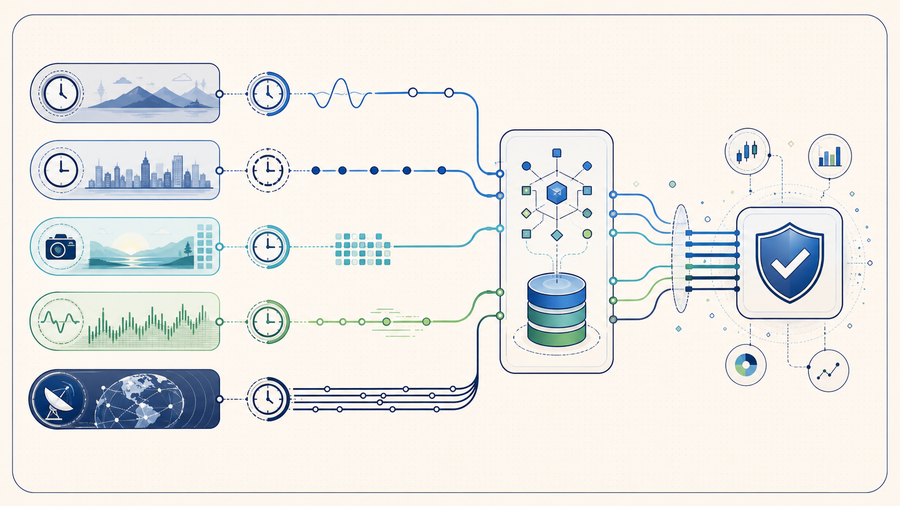
End-of-day or periodic values for valuation and reporting.
Exchange-controlled delay, often suitable for display and research.
Current-looking response at request time, not necessarily event-by-event.
Incremental events with ordering, reconnect, and gap handling.
Venue-native data with explicit entitlement and infrastructure requirements.
Event prices, sizes, conditions, venues, and sequence.
Windowed OHLCV with timezone and session rules.
Symbols, listings, corporate actions, and calendars.
Contracts, expiries, strikes, curves, and settlement.
Timestamped context with source and entity mapping.
Indicators and signals whose formulas must be disclosed.
Alpaca is practical for US stock prototypes, but its free live feed is IEX rather than the consolidated SIP.
Twelve Data exposes stocks, forex, crypto, ETFs, and more, while free credits and market entitlements still define usable coverage.
Databento offers credits and direct-feed depth, but free credit is not the same as a permanent free live plan.
Choose by venue coverage, timestamp quality, streaming limits, and legal use—not by the word free alone.
Searches for a free real-time market data API usually hide several different jobs: a watchlist that refreshes every minute, a streaming trading dashboard, a backtest downloader, or an AI agent that must cite fresh prices. One provider rarely wins all four.
The first filter is the feed, not the SDK. US equities may come from one venue such as IEX, a consolidated SIP, or a delayed feed. Options can require OPRA rights. Forex may be an indicative broker stream or a daily central-bank reference rate. Crypto is often easier to stream, but exchange fragmentation creates a different coverage problem.
For that reason, this comparison treats free as a testable commercial boundary: what is available at zero monthly cost, which fields and symbols are included, how fresh the timestamps are, and what happens when the prototype becomes a public product.
| Provider | Typical strength | Delivery | Verify |
|---|---|---|---|
| Alpaca | US equities and brokerage context | REST and streaming | Feed tier and exchange coverage |
| Finnhub | Multi-asset application data | REST and WebSocket | Plan, symbol mapping, delay |
| Twelve Data | Multi-asset bars and indicators | REST and WebSocket | Credits and streaming limits |
| Databento | Normalized institutional datasets | Historical and live | Dataset license, schema, venue |
| FMP in QVeris | Application-oriented financial data | Inspectable capability | Provider contract and timestamps |
| Provider | Zero-cost access | Real-time scope | Best use |
|---|---|---|---|
| Alpaca | Permanent free market-data plan | Live IEX stocks; limited symbols over WebSocket; indicative options | US equity prototypes and paper trading |
| Finnhub | Free personal-use plan | Stocks, forex, crypto; plan and exchange details vary | Multi-asset prototypes |
| Twelve Data | Basic free plan with credits | Broad assets; full WebSocket and international access depend on plan | Broad symbol discovery and REST testing |
| Databento | Signup credits | Direct feeds and granular schemas; live use is subscription/licensing sensitive | Market microstructure evaluation |
Measure source timestamp, provider receive time, and application receive time separately. A fast API can still return delayed market events.
A live single-venue feed is real-time but not a consolidated view. That distinction affects quotes, volume, highs, lows, and alerts.
Check concurrent connections, subscribed symbols, reconnect rules, heartbeats, and whether snapshots must be loaded before deltas.
Personal research, internal non-display use, public display, redistribution, and derived analytics can require different terms.
Start with Alpaca or another clearly documented limited live feed. Prioritize simple authentication, snapshots plus WebSocket updates, and reproducible reconnect behavior.
Favor a unified provider such as Finnhub or Twelve Data, then verify every exchange and asset class separately. A single API surface does not guarantee equal freshness everywhere.
Begin with licensing and display rights before latency. Estimate users, symbol fan-out, derived-data rules, attribution, exchange fees, and redistribution terms.
Use timestamped snapshots unless the task truly needs streaming. Require the agent to return provider, feed, event time, retrieval time, market session, and units with every answer.
Keep the provider payload and request identifiers.
Store event, provider, receipt, and normalization times.
Resolve venue, symbol, asset class, currency, and corporate actions.
Create a stable internal record without discarding source fields.
Measure freshness, gaps, duplicates, corrections, and entitlement errors.
Mix liquid and illiquid securities across open, pre-market, after-hours, and halted conditions. Compare source timestamps against an independent reference.
Use REST for the initial snapshot and WebSocket for updates. Confirm sequence handling, duplicates, late messages, and reconnect recovery.
Model symbol count, users, calls, egress, exchange fees, display rights, and historical downloads. Free-plan limits often fail on a different dimension than request count.
Normalize timestamps, symbols, corporate actions, conditions, and error states behind your own interface so changing feeds does not rewrite the product.
Alpaca is one of the clearest free starting points for US equities because its documentation states the feed boundary: the free plan streams live IEX data, while consolidated SIP coverage belongs to the paid tier. That makes it useful for paper trading, alert prototypes, and learning event-driven architecture, but a poor benchmark for total-market volume or best quotes across every venue.
Finnhub combines stocks, forex, crypto, company news, and fundamentals behind one key. The convenience is valuable for a multi-asset proof of concept, but teams should test the exact exchanges, symbols, history, and personal-use terms they need. A provider can advertise real-time access while individual venues or redistribution scenarios remain restricted.
Twelve Data is attractive when developers want a common REST schema across global symbols and asset classes. Its credit model makes endpoint experimentation easy, but production capacity depends on how one request consumes credits, which markets are included, and whether the workload needs full WebSocket access. Price a representative watchlist rather than extrapolating from a one-symbol demo.
Databento is strongest when the question is data fidelity: direct feeds, granular schemas, market-by-order depth, precise timestamps, and licensing visibility. Signup credit helps evaluate historical data and offset a subscription, but it should be modeled as an evaluation budget rather than a permanent zero-cost production feed.
A 50 ms response does not prove the quote itself is current.
Pre-market, after-hours, holidays, halts, and half days must be represented explicitly.
A plan permitted for personal testing may not allow customer-facing display or redistribution.
Quotes, trades, midpoints, indicative values, and official closes answer different questions.
Use QVeris to inspect candidate schemas and calling requirements while preserving the underlying provider's license and provenance. Continue with FMP market-data provider details, then confirm the calling contract in the QVeris REST API reference.
Yes for limited scopes, such as a single venue, restricted symbols, personal use, or selected asset classes. Full consolidated and redistributable feeds usually introduce fees or agreements.
Yes, it is live data from IEX. It is not the same as the consolidated US equity SIP covering all exchanges.
Only when the task needs event-driven freshness. Many research questions are better served by a timestamped snapshot with provenance.
Use the same symbols, sessions, request pattern, and output checks, then compare legal use and upgrade cost separately from technical performance.