
Free Real-Time Stock API: Data, Feeds & Limits
Define quote fields, feed identity, event clocks, and recovery behavior before shipping a stock-data workflow.
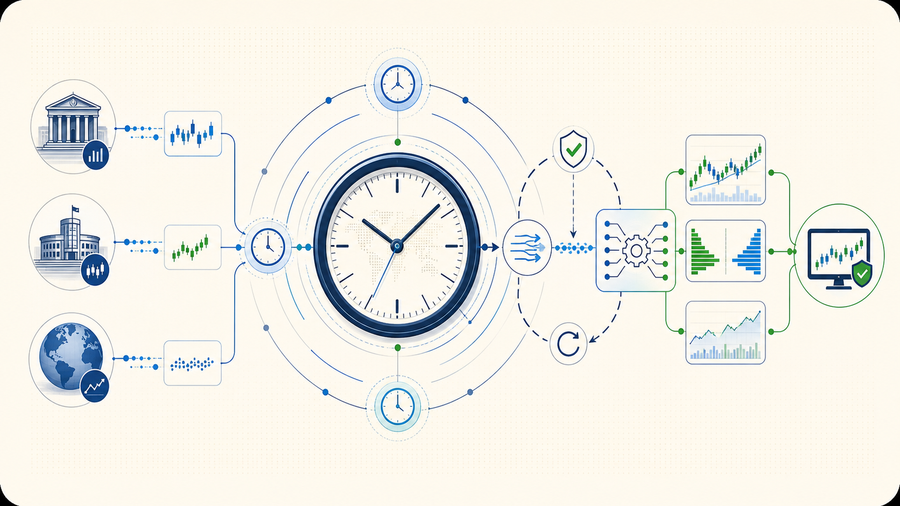
TL;DR
A free real-time stock data API can support demos, watchlists, paper trading, and low-traffic research tools when its feed and license match your use case.
“Real time” is not universal. Verify exchange, quote timestamp, session, and whether the response is delayed.
“Real-time” is not a measurable promise without an exchange timestamp, retrieval time, timezone, and documented session policy.
Cache repeated requests, batch symbols when allowed, and keep a provider adapter so you can switch later.
Four clocks behind a stock quote
event_timeWhen the trade or quote occurred at the venue.
provider_timeWhen the provider processed or published it.
received_timeWhen your system received the payload.
normalized_timeWhen your pipeline produced the internal record.
Quote and trade field contract
| Record | Required fields | Common mistake |
|---|---|---|
| Quote | Bid, ask, sizes, venues, event time | Calling midpoint a tradable price |
| Trade | Price, size, venue, condition, sequence | Ignoring sale-condition filters |
| Bar | Open, high, low, close, volume, window | Mixing session and timezone rules |
| Snapshot | Last trade, quote, day bar, status | Assuming every component has one timestamp |
| Corporate action | Type, effective date, factor, source | Comparing unadjusted history across a split |
How to verify real-time stock data
A “real-time” label is not enough. Measure freshness from the exchange timestamp, identify the underlying feed, and confirm what the license permits.
| Data | Fields to expect | Use | Common trap |
|---|---|---|---|
| Latest quote | Price, timestamp, currency, exchange, session | Watchlists and snapshots | Treating delayed data as live |
| Freshness | Exchange time, received time, timezone, delay | Measure end-to-end latency | Comparing server time to local time |
| Market feed | Exchange, venue, feed type, session | Understand quote scope | Assuming one feed represents the full market |
| Delivery | REST cadence, WebSocket events, reconnect rules | Snapshots or streaming | Polling faster than the source updates |
Real-time stock price is one field, not the whole feed
A real-time stock price API may return only the most recent eligible trade. A broader stock-data feed can also deliver bid and ask quotes, trade size and conditions, OHLCV aggregates, market status, halts, symbol metadata, and corrections. These records answer different questions. A watchlist may need a last price and session state; a spread monitor needs bid and ask; an execution model needs event-level trades and quotes; a chart usually needs interval bars. Define the record type before comparing providers or you may pay for speed while receiving the wrong data.
Executed price, size, venue, event time, sequence, sale condition, and correction state. “Last” is normally derived from eligible trades, not every received event.
Bid and ask prices and sizes, venue or consolidated indicator, event time, and quote condition. A midpoint is calculated, not an executed trade.
Open, high, low, close, volume, and sometimes transaction count for a defined interval, session, timezone, and set of eligible events.
Convenient packages of latest fields plus session status, but each field can have a different source time. Validate field-level freshness where available.
Feed choices
| Source | Strength | Trade-off |
|---|---|---|
| Alpha Vantage | Easy application access | Quota and real-time semantics need testing |
| Financial Modeling Prep | Broad financial endpoints | Plan and exchange coverage vary |
| Massive / Polygon | Detailed U.S. equity market data | Entitlement and plan determine depth |
| FMP in QVeris | Inspectable provider capability | Underlying provider rules still apply |
Feed coverage and the clocks behind “real time”
Low latency does not guarantee complete market coverage. For U.S. equities, a provider may distribute consolidated information derived from securities information processors, data from selected exchanges, FINRA facilities, OTC sources, or a broker-specific view. A single-venue feed can arrive quickly and still differ from the national market because trading occurs across venues. Record the feed or venue and do not describe one source as “the market” unless its documented coverage supports that statement.
| Clock | Definition | Why retain it | Failure it exposes |
|---|---|---|---|
| Event time | When the trade or quote occurred at the source. | Orders events correctly and measures true data age. | Late reports, out-of-order messages, and stale events. |
| Provider receipt | When the provider received or processed the source event. | Separates upstream delay from delivery delay. | Feed congestion or provider processing lag. |
| Client receipt | When your service received the response or message. | Measures network and application ingestion latency. | Connection stalls, backpressure, and overloaded consumers. |
| Display time | When the normalized value reached the user interface. | Measures the end-to-end experience promised to users. | Slow caches, queues, rendering, or client synchronization. |
Normalize timestamps to a common internal representation, but retain original values and precision. Timezone conversion alone cannot repair a provider timestamp that represents bar close rather than trade time. During onboarding, measure event age for several liquid and thinly traded symbols in regular, pre-market, after-hours, halted, and closed states. Unchanged prices are not automatically stale when no eligible event has occurred.
What “free” means for real-time stock data
Convert the advertised quota into your own workload: symbols × refreshes × users. A generous daily allowance can still fail if the provider enforces a tight per-minute burst limit.
Free feeds may be delayed, end-of-day only, or limited outside regular sessions. Label the timestamp and delay in the UI instead of implying live execution quality.
Confirm the exact exchanges, instruments, delisted symbols, intraday depth, and historical start date. “Global” rarely means identical coverage everywhere.
Free access does not automatically permit public display, redistribution, commercial resale, or training. Read both the API terms and underlying exchange rules.
Compare verified provider boundaries, not marketing labels
Alpha Vantage currently says most free datasets allow up to 25 requests per day and that U.S. real-time and 15-minute delayed market data are premium-only. Financial Modeling Prep requires an API key for documented requests and lists quote, historical, company, calendar, and market-data endpoints; actual endpoint access and delay depend on the current plan. Massive (formerly Polygon.io) documents U.S. stock trades, quotes, aggregates, snapshots, and reference records sourced through exchanges, securities information processors, FINRA facilities, and OTC markets, with feed access controlled by plan and entitlement. Recheck these boundaries when implementing because plans can change.
Streaming reliability blueprint
- 01
Subscribe
Record the exact symbols, channels, and feed.
- 02
Order
Use sequence numbers or documented ordering guarantees.
- 03
Detect gaps
Measure heartbeats and missing sequence ranges.
- 04
Recover
Reconnect with backoff and refill gaps from snapshots or history.
- 05
Prove
Store sample payloads, lag metrics, and failure outcomes.
Build WebSocket streaming that survives production
A WebSocket connection is only the transport. A reliable consumer must authenticate, subscribe, confirm subscription state, process heartbeats, retain sequence or event identifiers, detect gaps, reconnect with bounded backoff, and resubscribe without creating duplicate handlers. It must also protect itself when messages arrive faster than downstream storage or user interfaces can process them.
Model disconnected, connecting, authenticated, subscribed, degraded, and closing states explicitly. Do not let every error callback start another connection.
Use provider sequence numbers where available. Detect missing or repeated events, backfill through a documented REST endpoint when possible, and mark incomplete intervals.
Bound queues, batch writes, prioritize required event types, and shed optional work before memory grows without limit. Record dropped or coalesced messages.
Track connection age, last heartbeat, last event by symbol, event lag, reconnect count, authentication errors, subscription count, and downstream queue depth.
Do not turn aggressive REST polling into fake streaming
Polling a quote endpoint every second can exhaust a free quota, synchronize traffic spikes across users, and still miss every intermediate trade. Use request coalescing so many users share one upstream refresh, add jitter to scheduled polls, and choose cadence from the provider update frequency and product promise. If continuous event coverage is a true requirement, select an entitled streaming feed rather than trying to reconstruct one from snapshots.
A resilient real-time stock data integration
Map provider-specific responses into your own Quote, Bar, and Instrument models. Keep raw payloads for debugging, but do not spread vendor field names through product code.
Cache end-of-day history much longer than an active quote. Use explicit freshness rules and coalesce identical requests to protect the free quota.
Reject impossible timestamps, negative prices, inconsistent currencies, duplicate bars, and unexpected timezone shifts. Record the provider and retrieval time.
Respect Retry-After, use exponential backoff with jitter, and serve a clearly marked cached value when freshness requirements allow it.
Measure data age before accepting a normalized event
This provider-neutral Python function makes freshness measurable. It accepts an already parsed event timestamp, compares it with client receipt time in UTC, rejects future events beyond a small clock-skew allowance, and labels values that exceed the product’s maximum permitted age. The threshold must come from the product requirement and market state—not from the word “real-time” in a plan name.
from datetime import datetime, timezone

def validate_freshness(event_time, max_age_seconds, clock_skew_seconds=2):
    received_at = datetime.now(timezone.utc)
    event_time = event_time.astimezone(timezone.utc)
    age = (received_at - event_time).total_seconds()

    if age < -clock_skew_seconds:
        raise ValueError("Event timestamp is unexpectedly in the future")

    return {
        "event_time": event_time.isoformat(),
        "received_at": received_at.isoformat(),
        "age_seconds": max(age, 0),
        "is_stale": age > max_age_seconds,
    }
Run this after schema and identity validation, then retain the result with the raw payload. The function cannot prove that a provider timestamp is semantically correct or that the feed is complete; those require documentation review and cross-source tests. During closed or halted markets, use market state to choose an appropriate threshold and message instead of generating continuous false stale-data alerts.
Inspect a stock-data capability
Describe the exact market, event type, freshness, and fields before an agent chooses a stock-data capability. Continue with FMP provider details, then confirm the calling contract in the QVeris REST API reference.
FAQ
Sometimes, but coverage, exchanges, entitlements, and delays vary. Verify the timestamp and license instead of relying on a “real-time” label.
Use time-series OHLCV bars with a documented interval, timezone, session policy, and adjusted-price option.
Yes for long-term performance and most backtests. Raw close can create false jumps after splits and can omit dividend effects.
Cache responses, deduplicate requests, batch symbols when supported, slow background refreshes, and back off correctly after 429 responses.
No. A price often means the latest eligible trade, while a quote normally contains bid and ask prices and sizes. Confirm which record the endpoint returns.
The market may be closed, the symbol halted, no eligible trade may have occurred, or the connection may be stale. Check market state, event time, heartbeat, and feed status together.