
Free S-1 API
for SEC Filing Data免费 S-1 API
获取 SEC 申报数据
Build a free S-1 research workflow that follows an offering from the first public registration statement through every amendment, prospectus update, pricing change, and outcome—without mistaking filing activity for a completed IPO.
建立免费的 S-1 研究流程,从首次公开注册声明开始,持续跟踪每次修订、招股书更新、定价变化与最终结果,同时避免把“提交文件”误判为“IPO 已完成”。
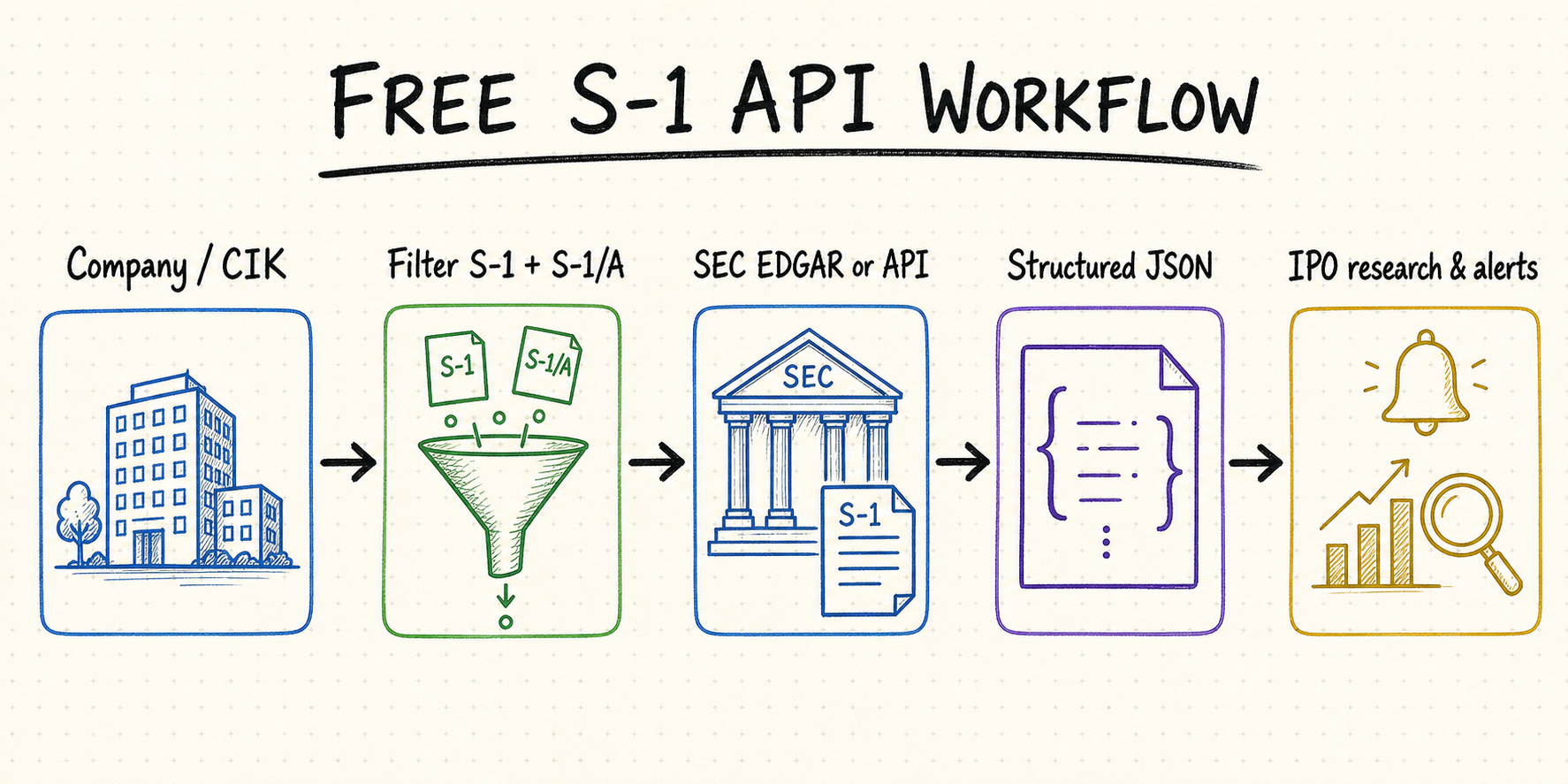
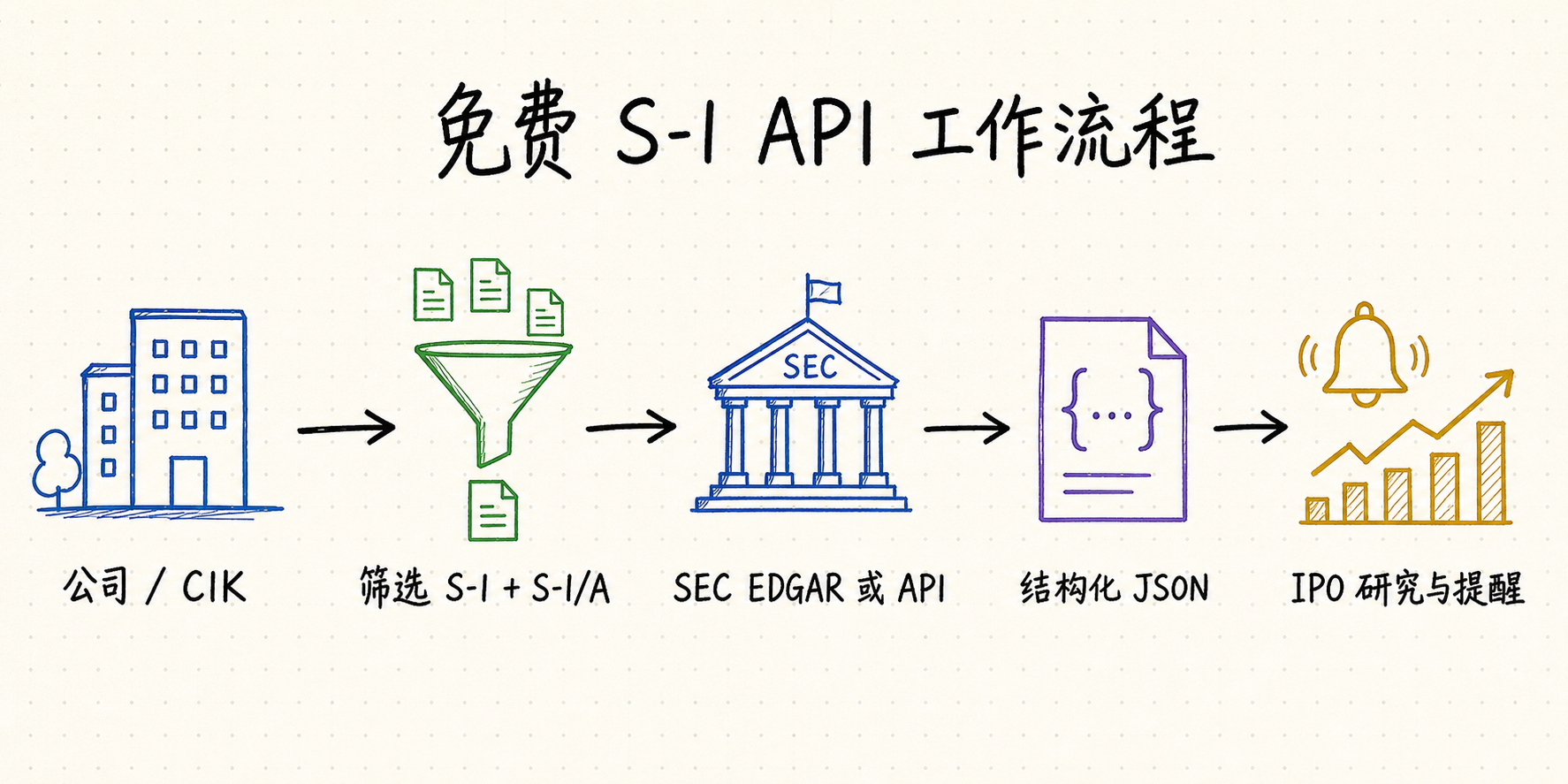
TL;DR摘要
Assemble the original registration statement and amendments into one evolving offering record before an issuer has a stable ticker.
Track price range, offered shares, selling shareholders, proceeds, dilution, underwriters, risk factors, and each value’s filing version.
An S-1 shows registration intent; it does not prove that the deal will launch, price inside the range, list, or avoid withdrawal.
QVeris helps agents discover and call relevant financial-data capabilities; provider terms and quotas still govern each API.
在发行人拥有稳定股票代码前,把原始注册声明与全部修订整理成一条持续变化的发行记录。
跟踪价格区间、发行股份、售股股东、募集用途、稀释、承销商、风险因素及各数值对应的申报版本。
S-1 表示注册意图,并不能证明交易一定启动、在区间内定价、成功上市或不会撤回。
QVeris 帮助 Agent 发现并调用金融数据能力;实际免费额度和使用条款仍由各 API 提供方决定。
How to use a free S-1 API for SEC filings如何使用免费 S-1 API 获取 SEC 申报
An S-1 API supports IPO and registration-statement due diligence. Start with CIK because a first-time filer may not have a ticker, assemble the original S-1 and every S-1/A in filing order, then extract how the offering changes: proposed price range, share counts, dilution, use of proceeds, selling shareholders, underwriters, risk factors, capitalization, and financial statements. Filing an S-1 does not prove that an IPO will price or complete.
S-1 API 主要服务于 IPO 与注册声明尽调。首次申报公司可能尚无股票代码,因此应从 CIK 开始,按申报顺序整理原始 S-1 与所有 S-1/A,再提取发行方案如何变化,包括拟议价格区间、股份数量、稀释、募集资金用途、售股股东、承销商、风险因素、资本结构和财务报表。提交 S-1 并不意味着 IPO 一定会定价或完成。
Treat the registration as a versioned dossier, not a row in an IPO calendar. Early filings may omit a price range or final share count; later amendments can add financial periods, change underwriters, revise risk language, update selling shareholders, or alter the primary-versus-secondary mix. The economically important answer is often the difference between versions and the evidence behind it.
注册声明应被视为持续演进的版本档案,而不是 IPO 日历中的一行。早期文件可能没有价格区间或最终发行数量;后续修订可能补充财务期间、更换承销商、改写风险披露、更新售股股东,或改变新股发行与老股出售的比例。真正具有研究价值的,往往是版本之间发生了什么变化,以及这些变化对应的原文证据。
Order S-1 and S-1/A filings by acceptance time and accession. Compare versions rather than treating every amendment as a separate IPO candidate.
Track primary versus secondary shares, proposed price range, total proceeds, selling shareholders, option allocations, underwriters, and exchange plans when disclosed.
Preserve pre- and post-offering shares, equity classes, conversion assumptions, option pools, and pro forma capitalization. Headline proceeds alone do not explain ownership impact.
Compare risk factors, use of proceeds, business description, related-party transactions, and financial statements across amendments. A newly added or expanded passage can matter more than a changed cover-page number.
Track the same offering through prospectus filings and effectiveness or withdrawal events when available. Keep form type and accession for each stage; do not infer pricing, first trade, or completion from an S-1/A alone.
The filing package can include underwriting forms, charter documents, material contracts, legal opinions, consents, and financial exhibits. Save exhibit type, sequence, filename, description, URL, and version relationship rather than indexing only the main prospectus.
按 SEC 接收时间和 accession 排列 S-1 与 S-1/A,通过版本比较追踪变化,不要把每次修订都当作一个新的 IPO 候选。
跟踪新发行与老股出售、拟议价格区间、募集总额、售股股东、超额配售、承销商及计划上市交易所。
保存发行前后股份、不同股权类别、转换假设、期权池和备考资本结构。仅看募集金额无法解释所有权影响。
跨修订比较风险因素、募集资金用途、业务描述、关联交易和财务报表。新增或扩展的一段披露,可能比封面数字变化更重要。
在数据可得时,继续跟踪同一发行对应的招股书文件、生效或撤回事件,并为每个阶段保留表格与 accession。不能仅凭一份 S-1/A 推断最终定价、首日交易或发行完成。
完整申报材料可能包含承销协议样本、公司章程、重大合同、法律意见、同意函与财务附件。除主要招股书外,还应保存附件类型、顺序、文件名、说明、URL 与版本关系。
From S-1 filing to pricing: follow the document chain从 S-1 申报到定价:按文件链确认发行状态
No single document proves every stage of an IPO. Build an offering-level timeline keyed by issuer CIK and registration identity, then attach each filing and market event with its own accepted time and evidence. A public API also cannot reveal a confidential draft while it remains nonpublic; absence from EDGAR before public filing is not proof that an issuer has done no preparation.
没有任何一份文件能够单独证明 IPO 的全部阶段。应以发行人 CIK 和注册事项身份构建发行级时间线,再把每份申报和市场事件连同各自的受理时间与证据挂接进去。公开 API 也无法读取仍处于非公开状态的保密草案;公司在 EDGAR 尚无公开文件,并不代表它没有进行上市准备。
| Evidence证据 | What it establishes能够确认什么 | Important fields重点字段 | Do not infer不能据此推断 |
|---|---|---|---|
| S-1 | A public registration statement was filed.公开注册声明已经提交。 | CIK, accession, securities, initial disclosures, accepted time.CIK、申报编号、证券类型、初始披露与受理时间。 | Final price, completion, listing date, or first trade.最终价格、发行完成、上市日或首笔交易。 |
| S-1/A | A specific version amended the registration.注册声明出现了一个新的修订版本。 | Changed range, shares, financial periods, risks, exhibits.变化后的价格区间、股份、财务期间、风险与附件。 | That the newest disclosed range became the final price.最新披露的区间一定成为最终发行价。 |
| EFFECT | The registration statement became effective.注册声明已经生效。 | Effective date and time, related registration identity.生效日期与时间、关联注册事项。 | That securities priced, were sold, or began trading.证券已经定价、售出或开始交易。 |
| 424B4 | A final prospectus commonly provides final offering terms.最终招股书通常提供更接近最终的发行条款。 | Offering price, final shares, underwriting terms, proceeds, dilution.发行价、最终股份、承销条款、募集金额与稀释。 | That every allocated share traded or that the deal met forecasts.所有配售股份都已交易,或发行结果符合预测。 |
| RW | A request was made to withdraw the registration statement.发行人请求撤回注册声明。 | Filing time, related registration, stated reason when provided.提交时间、关联注册事项及文件中说明的原因。 | That the issuer can never return with another registration.发行人以后不会再次提交注册。 |
| Market evidence市场证据 | Listing and first trade can be observed separately.上市和首笔交易可通过独立市场记录确认。 | Exchange, ticker, listing date, first-trade timestamp and price.交易所、股票代码、上市日、首笔交易时间与价格。 | That filing acceptance time equals market launch time.申报受理时间等于市场启动时间。 |
An initial S-1 may omit price and final share count. An S-1/A can later disclose 12 million shares at $18–$20, another amendment can change that to 10 million shares at $20–$22, EFFECT can mark registration effectiveness, and a 424B4 can state 10 million shares priced at $21. A “latest value” table loses how expected gross proceeds moved from an implied $216–$240 million range to $200–$220 million and finally $210 million. Store each value with its accession, accepted time, units, scenario and source location.
最初的 S-1 可能没有价格和最终股份数量;之后的 S-1/A 可能披露发行 1,200 万股、区间为 18–20 美元;再下一版又可能改成 1,000 万股、区间为 20–22 美元;EFFECT 证明注册声明生效;424B4 最终写明以 21 美元发行 1,000 万股。如果只保存“最新值”,就会丢失预计募集总额从 2.16–2.40 亿美元、变为 2.00–2.20 亿美元并最终落在 2.10 亿美元的过程。每个数值都应绑定申报编号、受理时间、单位、计算情景和来源位置。
Free SEC filing API fields and capabilities免费 SEC 申报接口的字段与能力
| Layer层级 | Main job主要作用 | Best for适合场景 | Boundary边界 |
|---|---|---|---|
| Form type | S-1 or S-1/A.S-1 或 S-1/A。 | Separating originals from amendments.区分原始声明与修订文件。 | Do not infer IPO completion.不能据此推断 IPO 已完成。 |
| CIK / ticker | Issuer lookup key.发行人查询键。 | Company-specific S-1 search.查询特定公司的 S-1。 | Ticker may be absent or change.股票代码可能缺失或变化。 |
| Accession / URL | Unique filing reference and source document.唯一申报标识与原始文档。 | Deduplication and audit trails.去重与审计追踪。 | Document parsing may be separate.文档解析可能需要另一接口。 |
| Extracted IPO fields | Offering, underwriter, proceeds, shareholders, or risk data.发行、承销商、募集用途、股东或风险字段。 | Structured IPO research.结构化 IPO 研究。 | Coverage varies by provider and plan.覆盖范围取决于提供方和套餐。 |
| Offering version发行方案版本 | Price range, primary and secondary shares, options, proceeds, and valuation assumptions per accession.按 accession 保存价格区间、新股与老股数量、超额配售、募集金额和估值假设。 | Explaining how deal terms evolve.解释发行条款如何变化。 | Blank early-stage fields are not zero and must not be forward-filled silently.早期空白字段不等于零,也不能静默用后续值回填。 |
| Capitalization / dilution资本结构 / 稀释 | Share classes, conversions, options, warrants, pro forma equity, and dilution assumptions.股份类别、转换、期权、认股权证、备考权益与稀释假设。 | Ownership and per-share impact analysis.所有权与每股影响分析。 | Calculations depend on the stated scenario and offering version.计算结果取决于披露的情景与发行版本。 |
| Narrative diff叙述披露差异 | Added, removed, or changed risks, use of proceeds, business claims, and related-party disclosures.新增、删除或修改的风险、募集用途、业务表述与关联交易披露。 | Reviewing substantive changes across S-1/A versions.审查 S-1/A 之间的实质变化。 | Layout and pagination changes create noisy text diffs; section-aware comparison is required.版式和分页变化会制造大量噪声,需要按章节进行比较。 |
S-1 filings API example and validation checklistS-1 申报 API 示例与验证清单
Store one registration dossier with a version list rather than emitting every amendment as a new IPO. The placeholders below show how filing evidence and extracted offering terms remain connected.
应把同一注册事项保存为一份带版本列表的档案,而不是把每次修订都发布成新的 IPO。下面的占位示例展示申报证据与提取后的发行条款如何保持关联。
{
  "registration_id": "ISSUER_CIK:REGISTRATION_FILE_NUMBER",
  "issuer": {"cik": "ISSUER_CIK", "name": "ISSUER_NAME", "ticker": null},
  "state": "amended",
  "versions": [
    {
      "accession_number": "INITIAL_S1_ACCESSION",
      "form": "S-1",
      "accepted_at": "YYYY-MM-DDThh:mm:ss-04:00",
      "source_url": "SEC_S1_URL",
      "offering": {"shares": null, "price_low": null, "price_high": null}
    },
    {
      "accession_number": "AMENDMENT_ACCESSION",
      "form": "S-1/A",
      "accepted_at": "YYYY-MM-DDThh:mm:ss-04:00",
      "source_url": "SEC_S1A_URL",
      "offering": {
        "shares": "12000000",
        "price_low": "18.00",
        "price_high": "20.00",
        "currency": "USD",
        "source_location": "prospectus-cover"
      }
    }
  ],
  "outcome_evidence": {"effect_accession": null, "final_prospectus_accession": null}
}
State must follow evidence. An S-1/A can justify amended, but not effective, priced, or completed. Update those later states only from the appropriate EFFECT, final prospectus, withdrawal, exchange, or market evidence, and retain the accession that caused each transition.
发行状态必须由证据驱动。S-1/A 可以支持 amended,却不能证明 effective、priced 或 completed。后续状态只能依据相应的 EFFECT、最终招股书、撤回文件、交易所或市场证据更新,并保留触发每次状态变化的 accession。
Use CIK because a pre-IPO issuer may have no ticker. Retrieve S-1 and S-1/A, sort by accepted timestamp, follow older-submission references where needed, and preserve every accession as a distinct version in one registration timeline.
Store the filing index, primary registration statement, exhibits, accepted time, filing date, and official URLs. Hash immutable source files before parsing. A valid source package is the prerequisite for reliable field extraction and later replay.
For price range, shares, proceeds, underwriters, shareholders, dilution, and financial periods, store value, unit, accession, source section, extraction method, and confidence. Preserve blanks and ranges; never convert missing early terms to zero.
Normalize headings and trivial formatting while retaining tables and substantive text. Compare Risk Factors, Use of Proceeds, Dilution, Capitalization, Business, MD&A, related parties, and financial statements. Surface additions, removals, and changed numbers with source anchors.
Keep registration filed, amended, effective, priced, completed, postponed, and withdrawn as separate states backed by appropriate filings or market evidence. An S-1 record alone proves only that a registration statement was filed publicly.
IPO 前发行人可能没有 ticker,因此应使用 CIK,获取 S-1 与 S-1/A,按 accepted timestamp 排序,必要时读取更早 submissions 引用,并把每个 accession 作为同一注册时间线中的独立版本保存。
保存文件索引、主要注册声明、附件、受理时间、申报日和官方 URL,并在解析前为不可变源文件计算哈希。只有来源材料完整,字段提取和后续重放才可靠。
价格区间、股份数量、募集金额、承销商、售股股东、稀释与财务期间等字段,都应保存数值、单位、accession、来源章节、提取方式和置信度。空白与区间必须原样保留,不能把早期尚未披露的条款写成零。
可以消除标题格式与无意义版式差异,但要保留表格和实质正文。重点比较风险因素、募集用途、稀释、资本结构、业务、MD&A、关联交易与财务报表,并用来源锚点展示新增、删除及数字变化。
注册提交、修订、生效、定价、完成、延期与撤回应作为不同状态,并由相应文件或市场证据支持。单独一份 S-1 只能证明注册声明已经公开提交。
How QVeris helps discover an S-1 filing APIQVeris 如何帮助发现 S-1 申报接口
QVeris can help an agent discover and inspect capabilities for registration-statement search, document retrieval, prospectus extraction, or amendment comparison. Before calling one, define the CIK, form family, cutoff time, sections and fields required, version policy, and evidence contract. An agent must not fill an undisclosed price range from a later amendment or label a filed registration as a completed IPO. Provider rights, quota, freshness, and usage terms still apply.
QVeris 可以帮助 Agent 发现并检查注册声明检索、正文下载、招股书字段提取或修订比较等能力。调用前,应明确 CIK、表格范围、截止时间、所需章节与字段、版本策略和证据要求。Agent 不能用后续修订的价格区间回填早期未披露版本,也不能把已经提交注册声明表述成 IPO 已完成。服务商的数据权利、额度、更新频率和使用条款仍然适用。
- Open QVeris tool details for issuer lookup, SEC filing search, or structured filing extraction.
- Inspect required parameters and returned fields before connecting the capability to an agent workflow.
- Keep the SEC source URL and provider attribution in every research output.
- 打开 QVeris 工具详情,查看符合发行人查询、SEC 申报检索或结构化解析需求的能力。
- 接入 Agent 工作流前,先检查必填参数、返回字段与提供方条款。
- 在研究输出中保留 SEC 原始链接与提供方归属。
FAQ常见问题
SEC EDGAR exposes public submission metadata and archived registration statements without an API key. Query the issuer by CIK, filter S-1 and S-1/A, follow current access guidance, and retrieve the filing package for prospectus analysis.
Yes. CIK is the durable SEC issuer identifier and is more reliable than ticker for pre-IPO research. Preserve issuer names and observed ticker mappings separately because names and proposed symbols can change.
S-1 is an initial public registration statement; each S-1/A is a separate amendment version. Amendments may add or change offering terms, financial periods, risk language, shareholders, underwriters, exhibits, or other disclosures.
No. It establishes a public registration record, not a guaranteed launch, price, listing, or completion. Track later amendments and appropriate effectiveness, prospectus, withdrawal, and market events before assigning an outcome.
Store lower and upper price, primary and secondary shares, option assumptions, units, currency, accession, and source location for each version. Keep missing values null; do not overwrite history with the latest terms.
Align sections first, normalize only superficial formatting, then diff text, tables, and extracted fields. Prioritize Risk Factors, Use of Proceeds, Dilution, Capitalization, shareholders, underwriting, and financial statements, with links to both source versions.
SEC EDGAR 无需 API key 即可提供公开 submissions 元数据和归档注册声明。可按 CIK 查询发行人,筛选 S-1 与 S-1/A,并在遵守当前访问指引的前提下获取完整申报材料。
可以。CIK 是 SEC 体系中更稳定的发行人标识,尤其适合 IPO 前研究。公司名称和拟议股票代码可能变化,应与 CIK 分开保存,并记录映射的观察时间。
S-1 是首次公开注册声明,每份 S-1/A 则是独立修订版本。修订可能补充或修改发行条款、财务期间、风险措辞、股东、承销商、附件或其他披露。
不是。它只能证明已经形成公开注册记录,不能保证交易启动、定价、上市或完成。判断结果还需继续跟踪修订文件,以及相应的生效、招股书、撤回和市场事件。
每个版本都应保存价格上下限、新股与老股数量、超额配售假设、单位、币种、accession 和来源位置。未披露值保持为空,不能用最新条款覆盖历史。
先对齐章节,只消除表面格式噪声,再比较正文、表格与提取字段。重点关注风险因素、募集用途、稀释、资本结构、股东、承销和财务报表,并同时链接两个来源版本。