
Choose a Free Sector Data API
for Stock Market Research选择可靠的
免费股票板块数据 API
Compare stock sector data APIs for classifications, ticker mapping, constituents, performance, and history—then test a reliable Python workflow.
比较股票行业分类、成分股、板块表现与历史数据接口,
再构建可靠的 Python 或 AI Agent 工作流。
Free sector data API: quick answer免费股票板块数据 API:快速结论
Separate company classification, sector constituents, index levels, and calculated aggregates. A label lookup cannot safely replace a point-in-time sector performance or breadth dataset.
Confirm the taxonomy owner and version, hierarchy, market coverage, effective dates, unclassified securities, and how reclassifications are represented.
应区分公司分类、板块成分、指数点位和计算后的聚合指标。只查到一个板块标签,并不能替代可用于历史时点的板块表现或市场宽度数据。
确认分类体系的制定方与版本、层级、市场覆盖、生效日期、未分类证券,以及公司被重新分类时数据如何记录。
What users need from a stock sector data API用户希望股票板块数据 API 完成什么任务
Sector data supports screeners, research notebooks, dashboards, portfolio views, and AI agents. The required output may be a valid sector label, ticker classification, constituent list, or performance series for a chosen period. Historical work also needs membership dates so a backtest does not apply today’s constituents to the past.
用户通常要为选股器、研究笔记、行情看板、投资组合视图或 AI Agent 获取数据,核心需求是有效的板块名称、股票分类、成分股或指定周期的板块表现。历史分析还必须保留成员生效日期,避免把今天的成分股套用到过去。
“Sector” is not one universal field. GICS, ICB, exchange classifications, and provider-owned taxonomies can assign different labels or hierarchy levels to the same issuer. Keep the original taxonomy code and parent-child path rather than normalizing everything into a loose text label.
“板块”并不是一个全球统一的字段。GICS、ICB、交易所分类以及供应商自建体系,可能把同一家公司放在不同类别或不同层级。接入时应保留原始分类代码和完整层级路径,不要只留下一个经过模糊归一化的文字标签。
Fields and capabilities that matter真正需要核对的字段与能力
Capture sector, industry, ticker, exchange, country, company ID, and the provider’s taxonomy name.
Prefer endpoints with additions, removals, weights, and effective dates; current members alone are unsafe for historical analysis.
Check weighting, price versus total return, corporate-action adjustments, aggregation method, and observation date.
Authentication, pagination, time zones, nulls, response limits, caching, and licensing determine production suitability.
Record the classification source, version, effective-from and effective-to dates. A company can move sectors after a business transformation, merger, or methodology review.
For valuation, growth, breadth, or margin metrics, document weighting, negative-value treatment, missing observations, currency conversion, and the eligible universe.
Test spin-offs, mergers, ticker changes, dual listings, and diversified companies. Decide whether the workflow follows the legal issuer, the listed security, or the provider's primary classification.
保存板块、行业、股票代码、交易所、国家、公司标识符及提供方采用的分类体系。
优先选择提供纳入、移除、权重和生效日期的接口;仅有当前成员不适合历史分析。
核对加权方式、价格收益或总收益、公司行动调整、汇总方法和观察日期。
鉴权、分页、时区、空值、响应上限、缓存和许可共同决定接口能否用于生产环境。
记录分类来源、版本以及生效和失效日期。公司在业务转型、并购或分类方法调整后,所属板块可能发生变化。
计算估值、增长、市场宽度或利润率时,要写清加权方式、负值处理、缺失值、币种换算和实际纳入的证券范围。
重点测试分拆、并购、代码变更、双重上市和多元化经营公司,并明确流程跟踪的是法律主体、上市证券,还是供应商给出的主要分类。
Preserve the source taxonomy when creating a cross-provider map建立跨供应商映射时保留原始分类体系
A canonical label is useful for navigation, but it must not erase the provider's meaning. One source may classify a software issuer as Information Technology → Software → Application Software, another as Technology → Software & Computer Services, and a third as a broad Technology category. Mapping all three to “Technology” is acceptable for a coarse dashboard only if the original code, hierarchy, taxonomy version, mapping rule, and validity dates remain available.
统一标签便于导航,但不能抹去供应商原始含义。同一家软件公司在一个来源中可能属于 信息技术 → 软件 → 应用软件,在另一个来源中属于 科技 → 软件与计算机服务,第三个来源则只给出宽泛的 科技。面向粗粒度看板时可以统一映射为“科技”,前提是仍保存原始代码、层级、分类版本、映射规则和有效日期。
| Field字段 | Example示例 | Why retain it保留原因 |
|---|---|---|
source_taxonomy | GICS 2025 | Identifies the owner and version of the classification标识分类体系的所有者与版本 |
source_path | 45 → 4510 → 451030 | Preserves the exact hierarchy instead of a loose label保留精确层级,而不是模糊文字标签 |
canonical_sector | Technology | Supports a product-owned broad grouping支持产品自定义的宽口径分组 |
valid_from / valid_to | 2025-03-24 / null | Prevents a later reclassification from rewriting history避免后续重分类覆盖历史归属 |
mapping_confidence | manual-reviewed | Distinguishes reviewed mappings from text matching区分人工复核映射与简单文字匹配 |
Compare free sector data API sources比较免费股票板块数据 API 来源
Providers solve different tasks. Financial Modeling Prep documents classification, screening, performance history, and valuation endpoints; Webull returns stocks and statistics for a selected sector; Barchart focuses on multi-period sector returns; Roic AI supplies classification reference lists. Verify current free-plan access and terms.
不同提供方解决不同任务。Financial Modeling Prep 提供分类、筛选、历史表现和估值接口;Webull 查询指定板块的股票及统计数据;Barchart 侧重多周期板块收益;Roic AI 提供分类参考列表。使用前应核对当前免费计划与条款。
Benchmark candidates with the same small portfolio and date range. Compare unresolved symbols, taxonomy depth, effective-date support, constituent count, aggregate formulas, response latency, and whether a historical request reproduces the provider's own published sector result. Do not compare labels alone: two feeds can both say “Technology” while using different universes and methodology.
可用同一组小型持仓和相同日期范围做基准测试,比较无法识别的证券、分类深度、生效日期支持、成分数量、聚合公式、响应延迟,以及历史请求能否复现供应商自己发布的板块结果。不要只比较名称:两个数据源都写“科技”,其证券范围和计算方法仍可能完全不同。
| Source来源 | Best fit适合场景 | Key / format鉴权 / 格式 | Important caveat重要限制 |
|---|---|---|---|
| Financial Modeling Prep | Mapping, screening, history, valuation.分类映射、筛选、历史表现、估值。 | Key; JSON.Key;JSON。 | Confirm free endpoints and limits.确认免费接口与限额。 |
| Webull | Stocks and statistics by sector.按板块查询股票与统计数据。 | Credentials; JSON.凭据;JSON。 | Specific market and access rules.市场及接入规则有限制。 |
| Barchart | Multi-period sector returns.多周期板块收益。 | Key; JSON/CSV.Key;JSON/CSV。 | Check delay and redistribution terms.核对延迟与再分发条款。 |
| Roic AI | Classification reference lists.分类参考列表。 | Auth; JSON.鉴权;JSON。 | Not a full performance feed.并非完整表现数据源。 |
How to use a free sector data API in Python如何用 Python 调用免费股票板块数据 API
A reliable workflow for classification and performance data适用于分类与板块表现数据的可靠流程
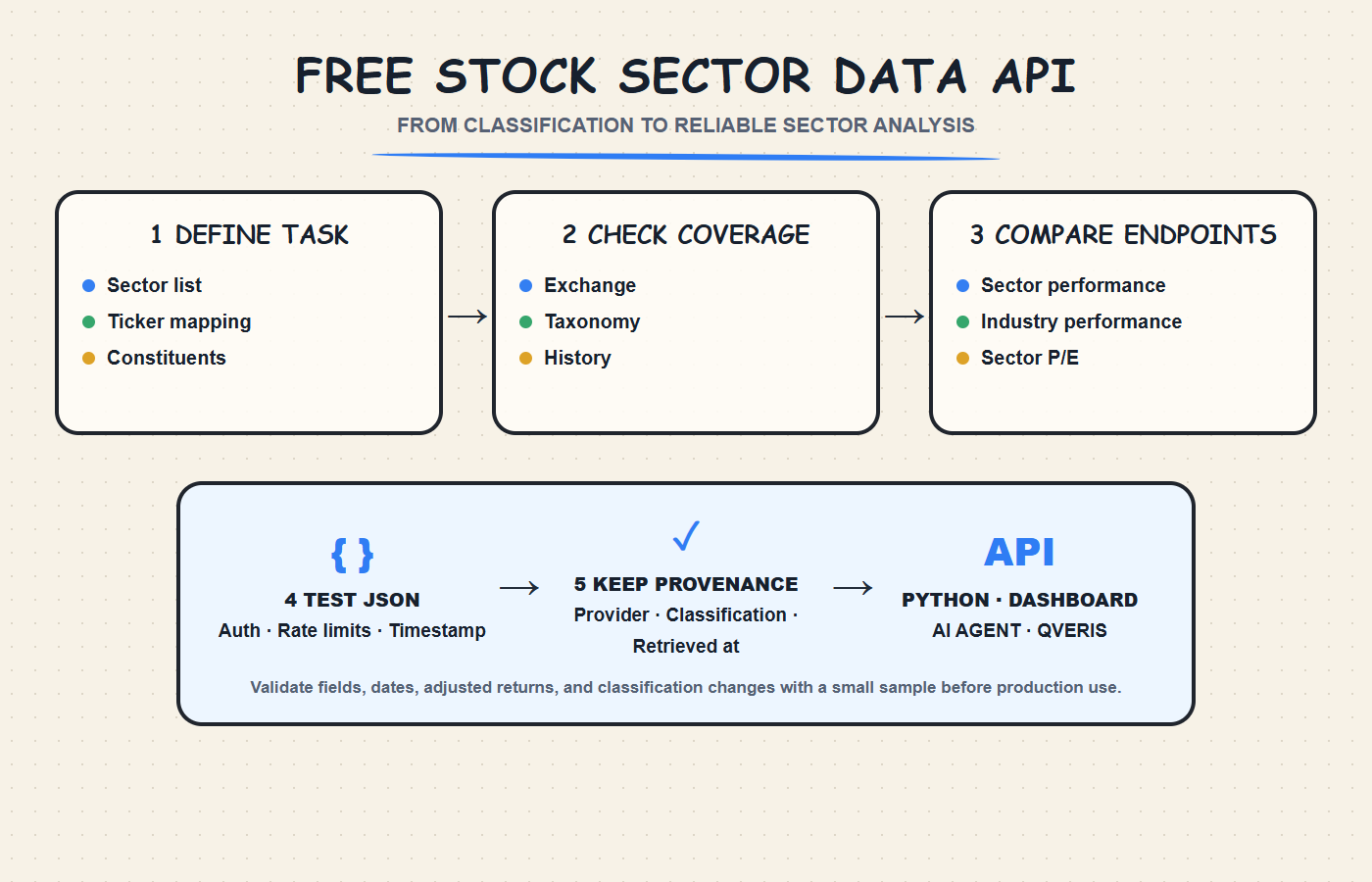
Specify exchange, taxonomy level, symbols, constituent fields, performance window, valuation date, and history.
Fetch supported exchanges, sectors, industries, and provider IDs. Preserve original labels and codes.
Check JSON types, pagination, nulls, currency, timezone, timestamp meaning, ordering, and one documented example.
Add timeouts, bounded retries, caching, and validation. Store endpoint, parameters, taxonomy, effective date, retrieval time, and formulas.
Store every mapping with valid-from and valid-to dates. Never overwrite yesterday's sector with today's label if the output supports research or backtesting.
For a sample date, rebuild return, breadth, or valuation from constituents and compare it with the API result. Investigate universe, weight, currency, and null-handling differences.
Use known mergers, spin-offs, ticker changes, and methodology review dates. Confirm that the old and new states are available at the correct effective time.
写清交易所、分类层级、股票范围、成分股字段、表现周期、估值日期和历史深度。
先获取支持的交易所、板块、行业和提供方标识符,并保留原始标签与代码。
检查 JSON 类型、分页、空值、币种、时区、时间戳含义、排序及一条官方示例。
加入超时、有限重试、缓存和校验,记录接口、参数、分类体系、生效日期、抓取时间与公式。
每条映射都保存有效起止日期。只要结果用于研究或回测,就不能用今天的新标签覆盖昨天的板块归属。
选取一个样本日期,利用成分股重算收益、市场宽度或估值,并与接口结果对照;差异通常来自证券范围、权重、币种或空值处理。
使用已知的并购、分拆、代码变更和分类方法评审日期,确认新旧状态都在正确的生效时点可查询。
Recalculate one sector result from constituents从成分股复算一次板块结果
Suppose a sector contains three eligible stocks at the start of the day. A has a $600 million float-adjusted market value and returns +2%; B has $300 million and returns −1%; C has $100 million and returns +4%. A market-value-weighted return is (600×2% + 300×−1% + 100×4%) ÷ 1,000 = 1.3%. The equal-weighted return is (2% − 1% + 4%) ÷ 3 = 1.67%, while breadth is two advancers out of three, or 66.7%. All three figures are correct, but they answer different questions.
假设某板块在当日开始时有三只符合条件的股票:A 的自由流通市值为 6 亿美元、收益率 +2%;B 为 3 亿美元、收益率 −1%;C 为 1 亿美元、收益率 +4%。市值加权收益为 (600×2% + 300×−1% + 100×4%) ÷ 1,000 = 1.3%;等权收益为 (2% − 1% + 4%) ÷ 3 = 1.67%;上涨家数占比则是三只中两只上涨,即 66.7%。三个数字都可能正确,但回答的是不同问题。
Now remove B because its price is missing. Renormalizing A and C produces a 2.29% weighted return; keeping B in the denominator with an assumed zero return produces 1.6%; marking the sector result incomplete produces no number. The API contract must specify which rule it uses. Store expected constituents, included constituents, excluded weights, return type, weight date, currency treatment, and corporate-action policy next to every aggregate.
如果 B 因价格缺失而被移除,只对 A 和 C 重新归一化权重会得到 2.29%;保留 B 的权重并假设其收益为零会得到 1.6%;将板块结果标为不完整则不应输出数值。接口必须明确采用哪种规则。每个聚合结果都应同时保存预期成分、实际纳入成分、被排除权重、收益口径、权重日期、币种处理和公司行为政策。
Reclassification acceptance case: choose a company with a known sector move. Query the day before and the effective day. The old mapping must remain valid through the prior date, the new mapping must begin on the documented effective date, and sector membership and weights must change under the same timing rule. A current-only label pasted across both dates fails the test.
重分类验收场景:选择一家已知发生板块变更的公司,分别查询生效日前一日和生效当日。旧分类应持续有效至前一日,新分类应从正式生效日开始,板块成分和权重也应按照同一时间规则变化。若两个日期都返回今天的分类标签,则验收失败。
How QVeris helps discover sector data APIsQVeris 如何帮助发现股票板块数据 API
QVeris does not create classifications or alter market data. It helps developers and agents find relevant capabilities and inspect documented inputs and outputs. Use the QVeris provider details, then verify the provider’s coverage, entitlement, taxonomy, timestamps, and limits.
QVeris 不创建行业分类,也不改写市场数据。它帮助开发者与 Agent 寻找相关能力并检查文档中的输入输出。可先打开 QVeris 服务商详情,核对提供方的覆盖、授权、分类体系、时间戳与限制。
- Search separately for company classification, sector constituents, sector index history, and sector aggregate capabilities.
- Inspect whether the contract exposes taxonomy name, version, hierarchy, effective date, formula, history, and revision state.
- Preserve provider codes, entity IDs, timestamps, formulas, and license constraints in the downstream evidence record.
- 分别搜索公司分类、板块成分、板块指数历史和板块聚合指标能力,不要假设一个接口可以覆盖全部任务。
- 检查能力契约是否明确分类名称、版本、层级、生效日期、计算公式、历史范围和修订状态。
- 在下游证据记录中保留供应商代码、实体标识、时间戳、计算公式和许可限制。
FAQ常见问题
There is no universal winner. Choose by required exchange, taxonomy, ticker mapping, constituents, performance history, valuation fields, free-tier limits, and licensing.
Yes. Company profile, screener, or classification endpoints commonly return sector and industry fields. Preserve the provider’s taxonomy because labels can differ between sources.
Use a documented historical sector endpoint, request one sector and short date range first, verify weighting and timestamps, then add pagination, caching, retries, and provenance.
Some reference datasets may be public, but many sector endpoints require credentials even when a free tier exists. Recheck current access rules and request limits before deployment.
They may use different taxonomies, versions, hierarchy levels, effective dates, or judgment for diversified companies. Keep the source code and methodology instead of treating the label as universal truth.
Not safely. Doing so introduces classification and membership look-ahead. Use point-in-time mappings with effective dates and retain prior classifications after a company moves sectors.
Document whether the metric is weighted by market value or equally weighted, how negative and missing values are treated, which securities are eligible, and which date and currency the inputs use.
没有适合所有场景的唯一选择。应按交易所、分类体系、股票映射、成分股、历史表现、估值字段、免费额度和许可综合判断。
可以。公司资料、股票筛选或分类接口通常会返回板块和行业字段。不同来源的标签可能不同,因此必须保留提供方使用的分类体系。
使用有文档说明的历史板块接口,先请求一个板块和较短日期范围,核对加权方式与时间戳,再加入分页、缓存、重试和出处记录。
部分参考数据可能公开访问,但很多板块接口即使提供免费额度也需要凭据。部署前应重新核对当前接入规则和调用限制。
它们可能采用不同分类体系、版本、层级、生效日期,对多元化公司的判断也可能不同。应保留来源代码和方法说明,不能把一个文字标签当成绝对统一的事实。
不可以。这样会引入分类和成员信息的前视偏差。应使用带生效日期的历史映射,并在公司转入新板块后继续保留旧分类记录。
需要写清采用市值加权还是等权、如何处理负值和缺失值、哪些证券有资格纳入,以及输入数据对应的日期与币种。