
Choose a Free Shareholder Data API选择合适的免费股东数据 API
Compare legal ownership concepts, markets, source filings or registries, identity resolution, refresh cycles, confidence, and free limits before integrating shareholder data.
接入股东数据前,应比较法律上的所有权概念、市场与登记来源、实体识别、更新周期、可信度和免费限额。
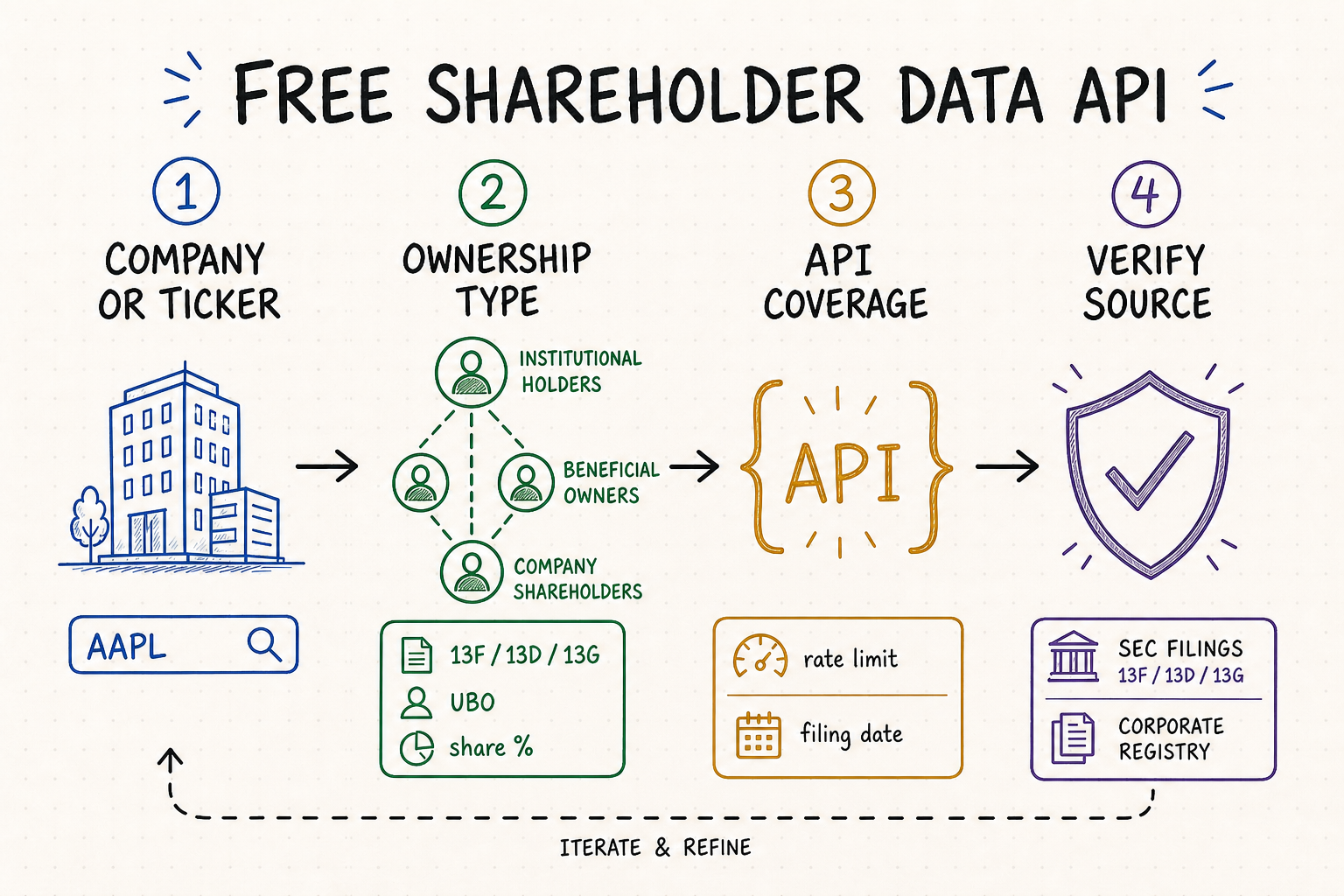
Define the ownership question before choosing a shareholder API选择股东数据 API 前先明确所有权问题
Developers usually want a usable endpoint rather than a definition: query a company or security, identify disclosed owners, retrieve ownership amounts or percentages, and trace each result to a filing or registry record. The first decision is the dataset, not the vendor. A public-company investor page, an institutional-holdings screen, a KYB ownership graph, and a private-company cap table require different sources and legal definitions.
开发者通常需要的是可直接调用的接口,而不只是概念解释:按企业或证券查询公开披露的所有者,获取持股数量或比例,并把每条结果追溯到申报或登记记录。第一步应先确定数据集,而不是先选供应商。上市公司股东页面、机构持仓筛选、KYB 股权穿透图和非上市公司股权表分别依赖不同来源与法律定义。
No public API should be assumed to provide a complete, live list of every ultimate human owner. Securities may be held through nominees, custodians, funds, trusts, or layered companies; disclosures can be threshold-based, periodic, jurisdiction-specific, private, or legally restricted. A high-quality API exposes source scope, effective dates, ownership path, confidence or unresolved links, and the reason a person or entity appears in the result.
不能默认任何公共 API 都能提供完整、实时的最终自然人所有者名单。证券可能通过名义持有人、托管机构、基金、信托或多层公司持有;披露又可能受持股门槛、申报周期、司法辖区、隐私与法律限制影响。高质量接口应说明来源范围、生效日期、股权路径、置信或未解析环节,以及某个人或实体为何出现在结果中。
Start with the ownership question先确定要回答哪类股权问题
“Who owns this company?” can mean a registered shareholder, an institutional holder, an insider, a 5% beneficial owner, or a UBO. These are not interchangeable.
“谁拥有这家公司”可能指登记股东、机构持有人、内部人、5% 受益持有人或最终受益所有人,不能混用。
Free is a plan condition免费是套餐条件,不是数据属性
Record the request quota, reset period, market restrictions, history depth, attribution, redistribution, and production-use rules.
应记录请求额度、重置周期、市场限制、历史深度、署名、再分发和生产用途规则。
Source dates matter必须保留来源日期
Ownership data is point-in-time. Keep the reporting period, filing date, retrieval time, and source document so users can understand staleness.
股东数据具有时点性,应保留报告期、申报日期、抓取时间和来源文件,以便判断数据是否过期。
Free shareholder data API coverage and ownership types免费股东数据 API 的覆盖范围与股东类型
A shareholder endpoint may offer ticker or company lookup, institutional holders, beneficial owners, registered members, ownership percentages, historical filings, or corporate ownership chains. These labels do not establish equivalence. Record the governing source, disclosure threshold, included owner types, security or share class, geographic coverage, observation date, and whether the dataset represents reported, registered, inferred, or calculated ownership.
股东接口可能支持按证券或企业查询机构持有人、受益所有人、登记股东、持股比例、历史申报或企业股权链,但名称相似不代表口径相同。应记录主管来源、披露门槛、纳入的股东类型、证券或股份类别、地域覆盖、观察日期,以及数据属于申报、登记、推断还是计算结果。
Institutional ownership API for 13F holdings
Use this for U.S. investment-manager positions. Check filer and issuer identifiers, shares, value, reporting quarter, filing date, amendments, historical quarters, and accession numbers.
Beneficial ownership API for 13D and 13G filings
Use this to research disclosed holders crossing reporting thresholds. Keep filing type, reporting person, ownership percentage, event date, and amendments.
Company shareholder and UBO API coverage
Corporate registries and KYB providers may return registered shareholders, ownership percentages, control statements, and ownership chains. Jurisdiction, legal definitions, privacy rules, and update cycles vary.
Registered shareholder lists and public-company disclosures
A transfer-agent or issuer register can differ from public “top holders” disclosures. Nominee and omnibus accounts may appear instead of underlying investors, and full registers may not be public or API-accessible.
Insider and control data are separate evidence
Officer, director, or significant-owner filings can describe transactions, roles, or threshold ownership, but they do not automatically produce a complete current ownership graph. Preserve filing type and legal capacity.
基于 13F 的机构持仓 API
适合研究美国投资管理机构的申报持仓。应检查申报人与发行人标识、股数、市值、报告季度、提交日、修订、历史季度和原始申报编号。
基于 13D/13G 的受益所有权 API
适合研究达到披露门槛的受益持有人。应保留表单类型、申报人、持股比例、事件日期、申报目的和修订记录。
企业登记股东与 UBO 数据
工商登记或 KYB 服务可能返回登记股东、持股比例、控制声明和股权链。司法辖区、法律定义、隐私规则和更新周期均有差异。
登记股东名册与上市公司公开披露
过户登记机构或发行人名册与公开的“主要股东”披露并不相同。名义或汇总账户可能代替底层投资者出现,完整名册也未必公开或可通过 API 获取。
内部人与控制权数据属于另一类证据
高管、董事或重要持有人申报可以说明交易、身份或门槛持股,却不能自动形成完整的当前股权图。必须保留表单类型和申报人的法律身份。
How to compare free shareholder data API options如何比较免费的股东信息接口
| Check检查项 | Questions to ask需要确认的问题 | Evidence to keep应保留的证据 |
|---|---|---|
| Ownership type股东类型 | 13F, 13D/13G, insider, registered shareholder, or UBO?机构持仓、受益持有人、内部人、登记股东还是 UBO? | Dataset definition数据集定义 |
| Coverage覆盖范围 | Which exchanges, registries, countries, entities, and history?覆盖哪些市场、登记机关、国家、企业和历史区间? | Coverage list and test IDs覆盖清单与测试标识 |
| Free limits免费限额 | Calls, credits, sandbox-only data, delay, and commercial-use rules?请求数、积分、沙盒数据、延迟和商用规则是什么? | Pricing page and terms date价格页与条款日期 |
| Freshness时效性 | Does the response expose period, filed date, updated date, and amendments?是否提供报告期、申报日、更新日和修订记录? | Source and retrieval timestamps来源与抓取时间 |
| Identity实体标识 | Can names be resolved to CIK, LEI, company number, ISIN, or ticker?名称能否关联 CIK、LEI、注册号、ISIN 或股票代码? | Stable IDs and mapping rules稳定 ID 与映射规则 |
| Verification来源验证 | Can each row link back to a filing or registry record?每条记录能否追溯到申报或登记来源? | Accession or registry URL申报编号或登记链接 |
| Percentage semantics比例口径 | Voting or economic ownership? Direct or indirect? Which share class, denominator, and date?投票权还是经济权益?直接还是间接?对应哪个股份类别、分母和日期? | Numerator, denominator and calculation version分子、分母与计算版本 |
| Ownership path股权路径 | Are intermediate entities, control basis, path percentages, loops, and unresolved links exposed?是否展示中间实体、控制依据、路径比例、循环持股和未解析环节? | Path-level source and confidence路径级来源与可信度 |
| Privacy and permitted use隐私与许可用途 | May personal data be stored, displayed, enriched, or redistributed for this purpose?当前用途是否允许保存、展示、补充或再分发自然人信息? | Terms, lawful basis and retention policy条款、合法依据与保留策略 |
Reconcile ownership percentages, sources, and unknown states勾稽持股比例、来源与未知状态
Worked indirect-ownership example间接持股计算示例
Assume Company A owns 60% of Company B, and Company B owns 40% of Company C. Along that path, A's derived economic interest in C is 60% × 40% = 24%. If A also directly owns 5% of the same share class in C, a simple model may report 29%—but only when both records use compatible effective dates, denominators, ownership definitions, and share classes.
假设 A 公司持有 B 公司 60%,B 公司持有 C 公司 40%,那么沿这条路径计算,A 对 C 的间接经济权益为 60% × 40% = 24%。如果 A 还直接持有 C 同一股份类别的 5%,简单模型可以得到 29%;但前提是两条记录的生效日期、分母、所有权定义和股份类别彼此兼容。
Do not automatically add parallel paths. They may represent voting rights versus economic rights, joint control, nominee holdings, duplicate registry records, or the same interest disclosed by several sources. Preserve each edge, path formula, source, effective period, and confidence before publishing a consolidated percentage. Circular ownership also requires a declared calculation method rather than repeated multiplication until an arbitrary cutoff.
平行路径不能自动相加,因为它们可能分别代表投票权与经济权益、共同控制、名义持有、重复登记,或同一权益被多个来源披露。发布合并比例前,应保留每条关系、路径公式、来源、生效期间和可信状态。遇到循环持股时,也必须采用明确的计算方法,而不是持续相乘到某个任意截止点。
Different disclosures can describe different owner populations不同披露可能描述不同的股东范围
| Source来源 | Population represented代表的股东范围 | Why the list may differ名单不同的原因 |
|---|---|---|
| 13F | Reportable positions of qualifying institutional investment managers符合条件的机构投资管理人申报持仓 | Quarterly timing, reportable-security scope, manager aggregation, and no complete look-through to beneficial humans季度时点、申报证券范围、机构合并口径,且无法完整穿透至最终自然人 |
| 13D / 13G | Beneficial owners meeting applicable disclosure conditions达到适用披露条件的受益所有人 | Threshold and event-driven disclosure, group reporting, amendments, and beneficial-ownership rules披露门槛、事件驱动申报、集团申报、修订和受益所有权规则 |
| Proxy or issuer disclosure代理声明或发行人披露 | Selected major holders, directors, officers, and ownership known for the stated disclosure特定披露中列出的主要股东、董事、高管及已知持股 | Different measurement date, inclusion rules, share classes, and reported persons计量日期、纳入规则、股份类别和申报主体不同 |
| Register or transfer-agent record股东名册或过户登记记录 | Registered names for the covered legal register对应法律名册中的登记名称 | Nominees and omnibus accounts can hide underlying beneficial owners; access may be restricted名义持有人和汇总账户可能遮蔽底层受益人,且访问可能受限 |
A mismatch among these sources is therefore a reconciliation task, not immediate proof that one provider is wrong. Compare issuer, security class, denominator, effective date, filing date, legal ownership concept, and amendment status before choosing a preferred record.
因此,不同来源的名单不一致首先属于口径勾稽问题,不能立即认定某个供应商出错。选择优先记录前,应比较发行人、证券类别、分母、生效日期、申报日期、法律所有权概念和修订状态。
Represent unknown ownership states explicitly明确表示未知的所有权状态
The source explicitly reports zero or confirms that a prior position ended. Keep the source, date, and scope.
No qualifying disclosure is present. This does not prove zero ownership.
The query, identifier mapping, name match, pagination, or parser did not produce a reliable record.
The register or personal data exists but cannot be returned under current access, privacy, or license conditions.
来源明确报告为零,或确认此前仓位已经结束;仍应保存来源、日期和适用范围。
没有符合条件的公开披露,但这不能证明持股为零。
查询、标识映射、名称匹配、分页或解析过程未能产生可靠记录。
相关名册或个人数据可能存在,但当前访问权限、隐私规则或许可不允许返回。
Free shareholder data API integration steps免费股东数据 API 的接入步骤
1. Query one known company or ticker
Start with a stable company, security, or filing identifier and one reporting period. Avoid broad name searches until identifier matching is tested.
2. Validate the shareholder JSON response
Require stable owner and issuer identifiers, position or percentage, units, reporting period, filed date, source type, and a source record reference. Treat derived labels as provider-specific.
3. Handle pagination, amendments and rate limits
Follow cursors or pages, respect 429 and Retry-After, retain amendments, and avoid overwriting a historical record with a later filing.
4. Preserve evidence and uncertainty
Store the raw response, source record, retrieval time, provider mapping version, and any confidence or unresolved status. Do not convert “not disclosed” or “not found” into zero ownership.
5. Version the ownership graph
Key relationships by owner, owned entity or security, ownership type, effective period, and source version. Recalculate indirect percentages only when every path component uses compatible dates and definitions.
6. Publish limitations with the answer
Return source jurisdiction, as-of date, disclosure scope, possible nominee coverage, and whether the percentage is reported or derived. A concise limitation label prevents a partial disclosure from being read as a complete cap table.
1. 用已知企业或证券标识发起查询
先用稳定的公司、证券或申报标识查询一个报告期,在验证名称匹配规则前不要依赖宽泛的模糊搜索。
2. 验证股东信息 JSON 字段
至少检查股东与发行人标识、持股数量或比例、单位、报告期、申报日期、来源类型和原始记录引用。
3. 处理分页、修订与限流
遍历游标或页码,遵守 429 与 Retry-After,保留修订记录,不要让较新的申报覆盖历史时点数据。
4. 保留证据与不确定性
保存原始响应、来源记录、抓取时间、供应商映射版本,以及置信或未解析状态。不能把“未披露”或“未找到”转换为持股为零。
5. 对股权关系图进行版本化
应按股东、被持有实体或证券、所有权类型、有效期间和来源版本记录关系。只有路径上的各环节使用兼容日期与定义时,才能计算间接持股比例。
6. 与结果一起展示局限
返回来源司法辖区、截至日期、披露范围、可能存在的名义持有,以及比例属于申报值还是推导值。简短而明确的局限说明,可以避免用户把部分披露误读为完整股权表。
import os, requests

response = requests.get(
    "https://provider.example/v1/shareholders",
    headers={"Authorization": f"Bearer {os.environ['API_KEY']}"},
    params={"company_id": "KNOWN_ID", "period": "2026-Q1"},
    timeout=20,
)
response.raise_for_status()
for row in response.json().get("results", []):
    required = {"owner_id", "company_id", "reported_at", "source_id"}
    if not required.issubset(row):
        raise ValueError("Unexpected shareholder schema")
The hostname and identifiers are illustrative. Replace them with the provider’s documented endpoint and identifier scheme.
以上域名与标识仅用于说明请求结构,请替换为服务商文档中的真实端点和标识体系。
How QVeris helps discover shareholder data capabilitiesQVeris 如何帮助发现股东数据能力
QVeris is a capability routing network, not a claim that every discoverable shareholder dataset is free, complete, current, or licensed for every use. Search by the ownership question—13F holdings, beneficial ownership, company registry, UBO, or insider evidence—then inspect entity inputs, jurisdiction, source type, effective dates, relationship fields, confidence, pagination, and provider terms. Keep source verification and privacy controls around every result.
QVeris 是能力路由网络,并不承诺每个可发现的股东数据集都免费、完整、最新或适用于所有用途。应按照具体问题搜索,例如 13F 机构持仓、受益所有权、企业登记、UBO 或内部人证据,再检查实体参数、司法辖区、来源类型、生效日期、关系字段、可信度、分页和供应商条款。每条结果仍需保留来源验证与隐私控制。
- Open the QVeris tool details by ownership type, market, or company-data capability.
- Inspect authentication, identifiers, response fields, limits, and provider terms before use.
- Use the QVeris documentation to connect a verified capability to an app or agent.
- 在 QVeris 工具详情中按股东类型、市场或企业数据能力搜索。
- 调用前检查鉴权、标识、返回字段、限额和服务商条款。
- 参考 QVeris 文档,把已验证的能力接入应用或智能体。
Frequently asked questions常见问题
Is there a free shareholder data API?
Some providers, filings, and registries offer free access, trials, sandboxes, or limited tiers. Coverage, calls, history, personal-data handling, redistribution, and production use may be restricted.
Can an API return a complete list of a company’s shareholders?
Usually not from public disclosure alone. Thresholds, nominees, custodians, private registers, reporting delays, and jurisdiction rules can hide or aggregate underlying owners. Check exactly what the source claims to represent.
What data does a shareholder API return?
Depending on the source, it may return owner and company IDs, ownership type, shares or percentage, direct or indirect path, filing or registry dates, source record, and confidence or status.
Is shareholder data the same as beneficial ownership data?
No. Institutional holdings, registered members, insiders, significant beneficial owners, and UBOs are different legal or reporting concepts. Choose the dataset for the task and jurisdiction.
How should an ownership percentage be verified?
Confirm voting versus economic ownership, direct versus indirect interest, share class, numerator, dated denominator, path calculation, and whether the value was reported or derived.
How do I verify shareholder API data?
Keep the filing or registry ID, effective and filing dates, entity and security IDs, retrieval time, mapping version, and source link. Compare material records with the authoritative source.
How can QVeris help?
QVeris can help agents discover capabilities and inspect inputs and outputs. Provider coverage, identity mapping, pricing, licensing, privacy, and accuracy still require source-level review.
有免费的股东信息 API 吗?
部分服务商、监管申报和登记系统提供免费访问、试用、沙盒或受限套餐,但可能限制覆盖、调用、历史、个人信息处理、再分发或生产用途。
API 能返回一家公司的完整股东名单吗?
仅凭公开披露通常不能。披露门槛、名义持有人、托管机构、非公开名册、申报时滞和司法辖区规则都可能隐藏或汇总底层所有者,必须核对来源声称代表的范围。
股东信息 API 通常返回哪些字段?
根据来源不同,可能返回股东与企业 ID、所有权类型、股数或比例、直接或间接路径、申报或登记日期、来源记录,以及可信或事件状态。
股东数据与受益所有权数据相同吗?
不同。机构持仓、登记股东、内部人、重要受益持有人和最终受益所有人分别属于不同法律或披露概念,必须依据任务与司法辖区选择。
如何验证持股比例?
应确认投票权还是经济权益、直接还是间接持有、股份类别、分子、有明确日期的分母、路径计算,以及数值属于申报值还是推导值。
如何验证股东 API 数据?
保存申报或登记 ID、生效与提交日期、实体与证券 ID、抓取时间、映射版本和来源链接,并把重要记录与权威来源核对。
QVeris 可以怎样提供帮助?
QVeris 可帮助智能体发现能力并检查输入输出;供应商覆盖、身份映射、定价、许可、隐私和准确性仍需在来源层面审核。