
Free Short Volume API
for US Stock Data免费美股卖空成交量 API
数据获取指南
Use a free short-volume API without confusing reported short-sale activity with market-wide volume or open short positions. Validate facilities, trade date, denominator, short-exempt volume, publication timing, and revisions before building a signal.
使用免费的美股卖空成交量 API 时,不能把报告范围内的卖空交易误当成全市场成交或未平仓空头。构建指标前,应核对报告设施、交易日、分母、豁免卖空量、发布时间与修订。
TL;DR摘要
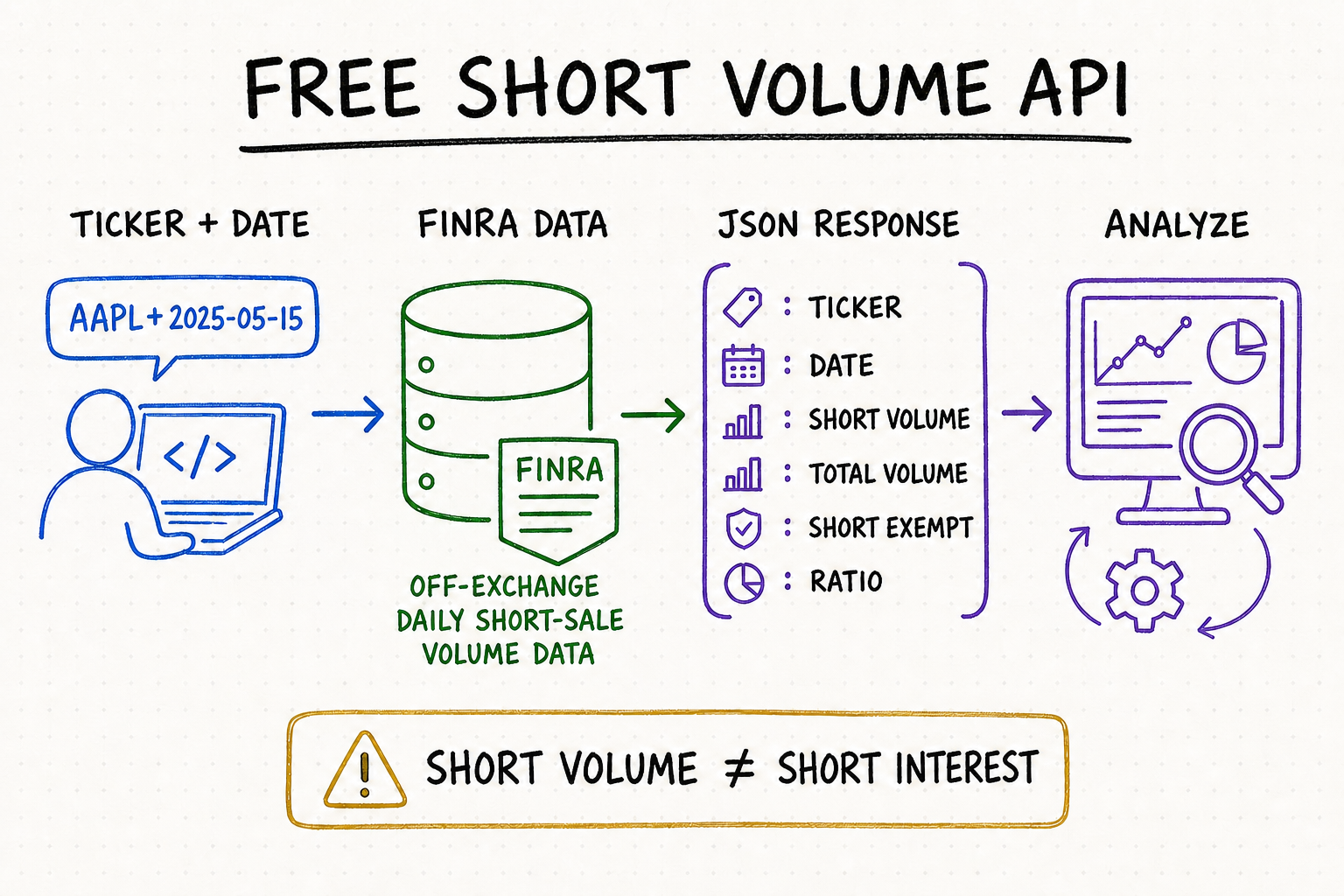
A daily short volume API typically returns ticker, trade date, short volume, short-exempt volume, total reported volume, and a ratio.
Free may mean a sample, trial, or rate-limited tier. Confirm history, symbol coverage, redistribution rights, and request quotas.
FINRA short-sale volume is reported activity from specified facilities; it is not the same as total exchange volume or outstanding short interest.
Use it for research, monitoring, and feature engineering with price, liquidity, and event context—not as a standalone trading signal.
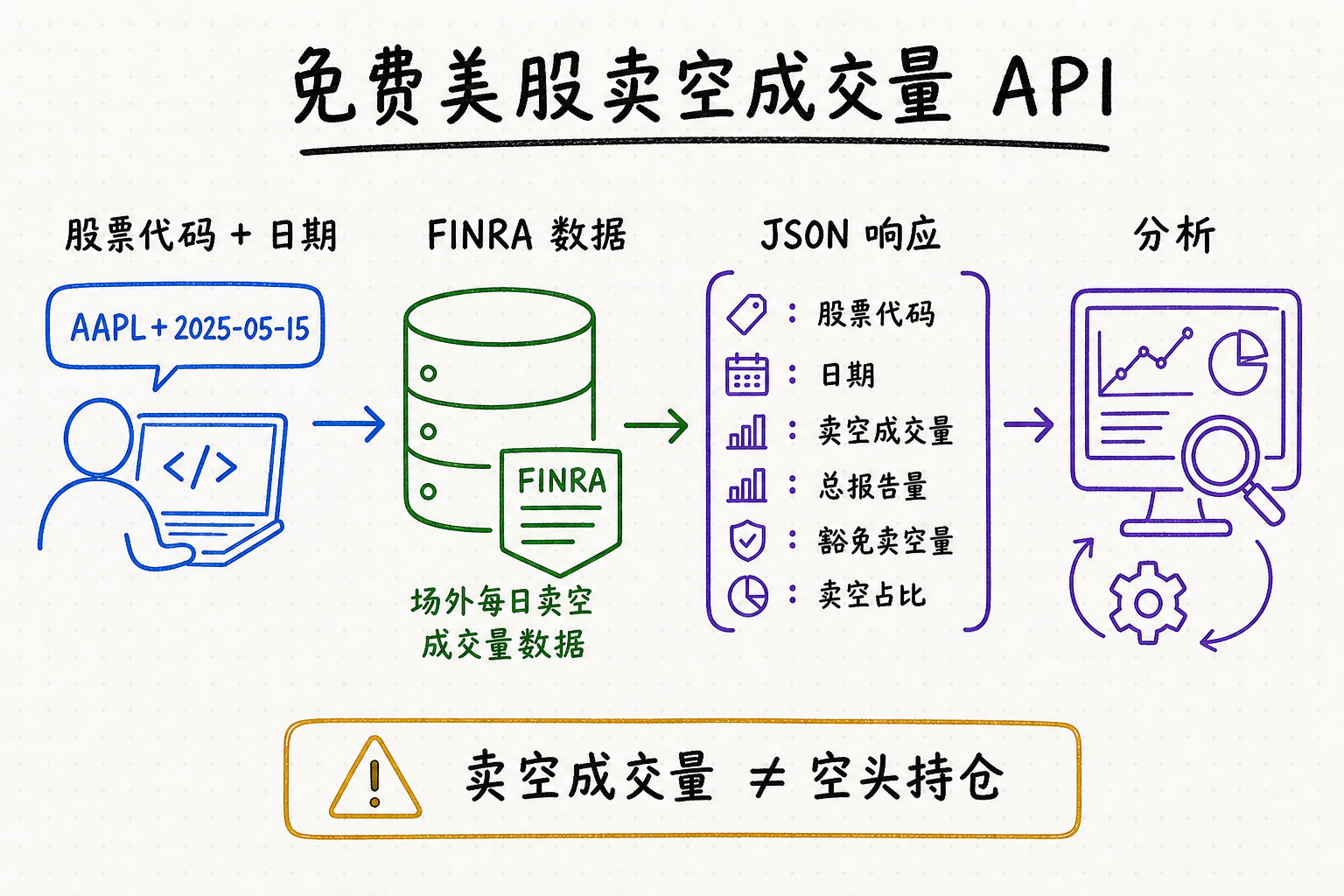
常见字段包括股票代码、交易日期、卖空成交量、豁免卖空量、报告总量和卖空成交量占比。
可能是样例、试用或限额套餐。应核对历史跨度、股票范围、再分发权限和请求频率。
FINRA 卖空成交量是指定报告设施的活动数据,不等于全市场总成交量,也不等于未平仓空头数量。
适合研究、监控和量化特征构建,但应结合价格、流动性和事件背景,不能单独当作交易信号。
What a free short volume API actually covers免费美股卖空成交量 API 实际覆盖什么
Daily short-sale volume reported to FINRA comes from defined reporting facilities and often includes off-exchange venues and alternative trading systems. A provider may consolidate facilities or expose venue-level rows, so compare its methodology before combining dates or symbols.
FINRA 每日卖空成交量来自定义明确的报告设施,常见范围包括场外交易场所与替代交易系统。供应商可能汇总多个设施,也可能返回设施级记录,因此在跨日期或跨证券合并前,必须先核对其处理方法。
FINRA explains that its daily files cover qualifying publicly disseminated short-sale activity reported through specified facilities. They are not automatically consolidated with each exchange, and some offsetting buy activity is outside the file. Therefore a high ratio can describe the composition of the covered reportable flow without proving that most market participants are building bearish positions.
FINRA 说明,每日文件记录的是通过指定设施报告、且符合条件的公开传播卖空交易,并不会自动合并各交易所数据;部分用于对冲或回补的买入活动也不在该文件中。因此,较高占比只能说明“被覆盖报告流量”的构成,不能据此证明大多数市场参与者正在持续建立看空头寸。
FINRA short-volume files are generally used as daily data. Do not label an endpoint real time unless the provider documents update timing.
Total volume in the response may mean total reported volume within the dataset, not consolidated market-wide share volume.
Short volume measures trading activity during a period. Short interest measures shares remaining short at a reporting date.
A free endpoint can restrict commercial use or redistribution. Check current terms before placing data in a public product.
If the API returns TRF, ADF, or other venue-level records, aggregate only after checking whether symbols, dates, corrections, and total-volume definitions align. Preserve facility-level inputs beside any derived combined value.
Short marking can occur in liquidity provision and other workflows, and a trade can be offset the same day. Interpret the ratio with price, spread, total liquidity, events, and later short-interest snapshots.
FINRA 卖空成交量通常按交易日使用;除非服务商明确说明更新时间,否则不要把接口描述为实时数据。
返回的 total volume 可能只是该数据集中的报告总量,并不一定代表全市场综合成交量。
前者衡量某段时间发生的卖空交易活动,后者衡量报告日尚未平仓的空头股份。
免费接口仍可能限制商业使用和再分发。公开产品接入前应检查最新条款。
如果接口返回 TRF、ADF 或其他场所级记录,只有在证券代码、交易日、更正方式和 total volume 定义一致后才能汇总;派生合并值还应保留全部设施级输入。
做市和其他流动性流程也可能产生 short 标记,交易还可能在当天对冲。解读占比时应结合价格、价差、总体流动性、事件和之后公布的 short interest 快照。
Where to get free daily short-sale volume data免费每日卖空成交量数据可以从哪里获取
Use the FINRA source when you need the published files and their documented scope. Use a normalized provider when your application needs ticker queries, JSON, or easier historical retrieval. A capability layer can help an Agent discover either route, but it must keep the underlying dataset and facility coverage visible.
需要公开文件及其正式口径时,应优先使用 FINRA 来源;应用需要按代码查询、JSON 返回或更方便的历史检索时,可以使用标准化供应商。能力调用层可以帮助 Agent 发现两类路线,但必须保留底层数据集名称与设施覆盖信息。
| Route路线 | Best fit适用场景 | Verify需要核对 |
|---|---|---|
| FINRA daily filesFINRA 每日文件 | Direct source ingestion, independent validation, bulk daily research, and a benchmark for provider rows.直接接入来源、独立验证、批量日频研究以及核对供应商记录。 | File type and facility, trade date, symbol rules, corrections, publication schedule, and whether every expected file arrived.文件类型与报告设施、交易日、代码规则、更正、发布时间,以及预期文件是否全部到达。 |
| FINRA Data / developer accessFINRA Data 与开发者入口 | Discovering documented datasets and building workflows around FINRA's available data interfaces.查找正式数据集,并围绕 FINRA 提供的数据接口建立工作流。 | Dataset identity, authentication where applicable, filters, async behavior, limits, and current terms rather than assuming the file and API contracts are identical.数据集身份、适用时的鉴权、筛选、异步行为、限制和当前条款,不能默认文件与 API 契约完全相同。 |
| Normalized market-data API标准化市场数据 API | Applications that need REST or JSON, symbol and date filters, pagination, and integration with price or reference data.需要 REST 或 JSON、代码与日期筛选、分页,并希望结合价格或证券主数据的应用。 | Whether data is FINRA-sourced, facility-level or consolidated, the denominator used, history, revisions, free limits, and redistribution rights.数据是否来自 FINRA、设施级或合并口径、所用分母、历史范围、修订、免费限制与再分发权限。 |
Worked ratio example: 62% is not a market-wide bearish vote占比实例:62% 不等于全市场有 62% 看空
Suppose a covered FINRA dataset reports 620,000 short shares and 1,000,000 total reported shares for a symbol. The ratio is 62% within that dataset. If consolidated market volume for the day is 2,500,000 shares, the API denominator covers only part of total activity. Dividing by the market-wide number instead would produce 24.8%, but that new ratio mixes scopes and is not automatically a valid FINRA metric. The correct output states the numerator, denominator, facilities, and trade date together.
假设某 FINRA 数据范围内,一只股票的卖空成交量为 620,000 股,报告总量为 1,000,000 股,则该数据集内的占比为 62%。如果当天全市场综合成交量为 2,500,000 股,说明接口分母只覆盖了部分活动。改用全市场成交量计算会得到 24.8%,但这个新比例混合了不同口径,不能自动当作有效的 FINRA 指标。正确输出应同时说明分子、分母、报告设施和交易日。
Two failure cases that can reverse the interpretation两类可能改变结论的失败情形
Missing facility: if one expected facility file is absent, a consolidated ratio may move even when underlying behavior did not. Mark the date incomplete and recompute only after the missing component arrives. Same-day offset: a liquidity provider can execute a short-marked sale and purchase shares later that day; the short-volume file records the sale activity, not the end-of-day open position. Short interest, borrow data, price action, and event context answer different questions.
设施文件缺失:如果某个预期设施的文件没有到达,即使实际交易行为未变,合并占比也可能波动。应把该日期标记为不完整,待缺失部分补齐后再计算。同日对冲:流动性提供者可能先执行标记为 short 的卖出,随后在同日买回股份;卖空成交量文件记录卖出活动,却不表示收盘时仍有空头头寸。空头持仓、借券数据、价格表现和事件背景回答的是不同问题。
Choose the output by use case按使用场景设计输出
Show short, exempt, and total reported volume, ratio, facility set, trade date, publication state, and completeness warning together.
Freeze source versions, reject changing coverage, preserve missing days, and join price or events only after calendar and identifier checks.
Require the Agent to describe the dataset scope and avoid causal or bearish claims unless supported by additional evidence.
Verify redistribution rights, cite the source, expose methodology, and distinguish provider-derived ratios from original reported fields.
同时展示卖空量、豁免卖空量、报告总量、占比、设施集合、交易日、发布状态与完整性警告。
冻结来源版本,拒绝覆盖变化的日期,保留缺失日,并在日历和标识核对后再关联价格或事件。
要求 Agent 说明数据集范围;没有其他证据时,不能直接给出因果判断或看空结论。
核对再分发权利,标注来源并公开方法,同时区分供应商派生占比与原始报告字段。
Free short volume API fields to validate美股每日卖空成交量 API 必查字段
| Field字段 | Meaning含义 | Validation验证方式 | Common risk常见风险 |
|---|---|---|---|
| ticker / symbol | The US security identifier requested.查询的美股证券代码。 | Check exchange and identifier normalization.核对交易所与代码标准化规则。 | OTC, class shares, or renamed symbols.OTC、不同股类或代码变更。 |
| trade_date | The reporting trade date.数据对应的交易日期。 | Use documented timezone and calendar.使用文档指定的时区与交易日历。 | Treating publish time as trade time.把发布时间误作交易时间。 |
| short_volume | Reported shares sold short.报告的卖空成交股数。 | Confirm consolidated or facility-level scope.确认是设施级还是合并口径。 | Assuming it equals open short positions.误认为尚未平仓空头。 |
| total_volume / ratio | Dataset total and derived short share.数据集报告总量及计算占比。 | Recalculate ratio and inspect denominator.重新计算占比并核对分母。 | Comparing against market-wide volume.错误对比全市场成交量。 |
| short_exempt_volume | Reported short-sale volume marked exempt under applicable rules.按适用规则标记为豁免的报告卖空成交量。 | Whether it is included in short volume and ratio calculations.它是否已包含在 short volume 与占比计算中。 | Adding it twice or dropping it without documenting the formula.重复相加,或未说明公式就直接删除。 |
| facility / venue | Reporting source such as a TRF or ADF.TRF、ADF 等报告来源。 | Whether the row is facility-level or already consolidated.记录是设施级还是已经合并。 | Summing a consolidated row with its components.把合并记录与组成记录再次相加。 |
| publish / revision metadata | When the file was available and whether it was corrected.文件何时可用,以及之后是否更正。 | Retrieval time, source version, and overwrite policy.抓取时间、来源版本与覆盖策略。 | Using revised history in a point-in-time backtest.在时点回测中使用事后修订数据。 |
How to use a FINRA short volume API safely如何安全调用 FINRA 卖空数据接口
1. Confirm data origin and update timing
Read the provider methodology: reporting facilities, consolidation rules, publication schedule, historical start date, and corrections policy.
2. Query historical short volume by ticker and date
Use a documented example, inspect HTTP status and pagination, then save the raw response before transforming fields.
3. Recalculate the short volume ratio
Where the denominator is documented, verify short_volume ÷ total_volume. Keep nulls distinct from zeros.
4. Add context and monitoring
Join by a verified trading date, log provider and timestamp, detect late revisions, and combine with price or liquidity data only after aligning coverage.
5. Build a coverage matrix
For every date, record which facilities and exchanges are represented, whether the provider supplies components or a consolidated row, and which denominator supports the ratio. Reject cross-date comparisons when the coverage set changes silently.
6. Validate with event-day controls
Test high-volume earnings days, halts, symbol changes, splits, OTC securities, missing facility files, and late corrections. Measure duplicate rate, missing-date rate, ratio-recalculation error, and the delay between trade date and usable publication.
1. 确认来源与更新时间
查看报告设施、汇总规则、发布时间、历史起点和数据修正规则。
2. 按股票代码和日期查询历史卖空成交量
先调用文档示例,检查 HTTP 状态、分页和原始 JSON,再做字段转换。
3. 重新计算卖空成交量占比
在分母定义明确时,用 short_volume ÷ total_volume 复核;不要把空值当成零。
4. 增加上下文与监控
按确认过的交易日关联数据,记录来源和时间戳,监控修订,并在覆盖范围一致后再连接价格或流动性数据。
5. 建立覆盖矩阵
为每个交易日记录包含哪些设施和交易所、服务商提供的是组成记录还是合并记录,以及占比采用哪个分母。如果覆盖集合发生了未说明的变化,应拒绝直接做跨日比较。
6. 使用事件日样本验证
测试财报高成交日、停牌、代码变更、拆股、OTC 证券、设施文件缺失和延迟更正,并衡量重复率、缺失交易日比例、占比复算误差,以及从交易日到数据可用的延迟。
How QVeris helps find and call short-volume dataQVeris 如何帮助发现并调用卖空成交量数据
QVeris helps agents discover and inspect capabilities for daily short volume, venue-level files, ratios, or short-interest snapshots. Before calling one, the agent should state the exact dataset, ticker or stable security ID, trade-date range, facility scope, denominator, and point-in-time cutoff. It must not answer a short-interest question with daily volume or describe a facility-specific ratio as market-wide. Provider access, quotas, and data rights still apply.
QVeris 帮助 Agent 发现并检查每日卖空成交量、设施级文件、占比或空头持仓快照等能力。调用前,应明确数据集、ticker 或稳定证券标识、交易日范围、设施覆盖、分母与时点截止时间;不能用每日成交回答 short interest 问题,也不能把设施级占比描述成全市场占比。服务商访问权限、限额和数据授权仍然适用。
- Open the QVeris tool details for financial-data capabilities matching ticker and date inputs.
- Inspect schemas before calling, especially units, venue coverage, pagination, and missing-value behavior.
- Keep the provider response and metadata available for review instead of treating one ratio as a conclusion.
- 打开 QVeris 工具详情,查看支持股票代码和日期输入的金融数据能力。
- 调用前检查单位、报告场所范围、分页和缺失值处理。
- 保留服务商原始响应与元数据,避免把单一占比直接当成结论。
FAQ常见问题
Some providers offer sample access, trials, or free tiers, and FINRA publishes daily files. Verify history, quota, symbol mapping, facility coverage, corrections, licensing, and whether the response is raw or already consolidated.
Short volume measures reportable short-sale transactions during a trade date. Short interest is an open-position snapshot on designated settlement dates. A same-day short and cover can appear in volume but not remain in short interest.
It is commonly short volume divided by total reported volume within the same dataset and facility scope. Confirm whether short-exempt volume is included, avoid mixing venue components with consolidated rows, and store the denominator.
Not by itself. FINRA notes that its files are not automatically consolidated with exchange data. A complete market view requires compatible data from the relevant reporting facilities and exchanges, with duplicate and denominator rules defined.
The file does not show every offsetting buy and covers a defined reporting universe. Short marking can also occur in liquidity workflows. A high ratio is not proof that the same percentage of shares became persistent bearish positions.
Not reliably on its own. Use it as a documented feature alongside price response, liquidity, spreads, events, venue coverage, and later position data, then validate out of sample without revised-history leakage.
部分服务商提供样例、试用或免费限额,FINRA 也发布每日文件。接入前要核对历史、额度、证券映射、设施覆盖、更正方式、授权,以及响应是原始记录还是已合并结果。
卖空成交量表示某个交易日内的报告卖空交易;空头持仓则是指定结算日的未平仓头寸快照。同日卖空并回补的交易会进入成交量,却可能不会留在 short interest 中。
通常是同一数据集和设施范围内的 short volume 除以 total reported volume。应确认 short-exempt 是否包含在内,避免把设施组成记录与合并记录重复相加,并保存实际分母。
单独使用时并不覆盖。FINRA 明确说明其文件不会自动合并交易所数据。要形成全市场视图,需要兼容的报告设施和交易所数据,并明确去重与分母规则。
文件不会显示所有对冲买入,覆盖范围也有明确边界;做市等流动性活动同样可能产生 short 标记。高占比并不证明同等比例的股份变成了持续看空头寸。
单独使用并不可靠。它只能作为一个口径清楚的特征,与价格反应、流动性、价差、事件、场所覆盖和之后的持仓数据结合,并在避免历史修订泄漏的前提下做样本外验证。