
Find a Free Social Sentiment API查找免费社交舆情 API
Compare source coverage, sentiment fields, free limits, freshness, history, and integration paths before you commit to a provider.
比较数据源覆盖、情感字段、免费限额、实时性、历史范围和接入方式,再决定使用哪一个服务商。
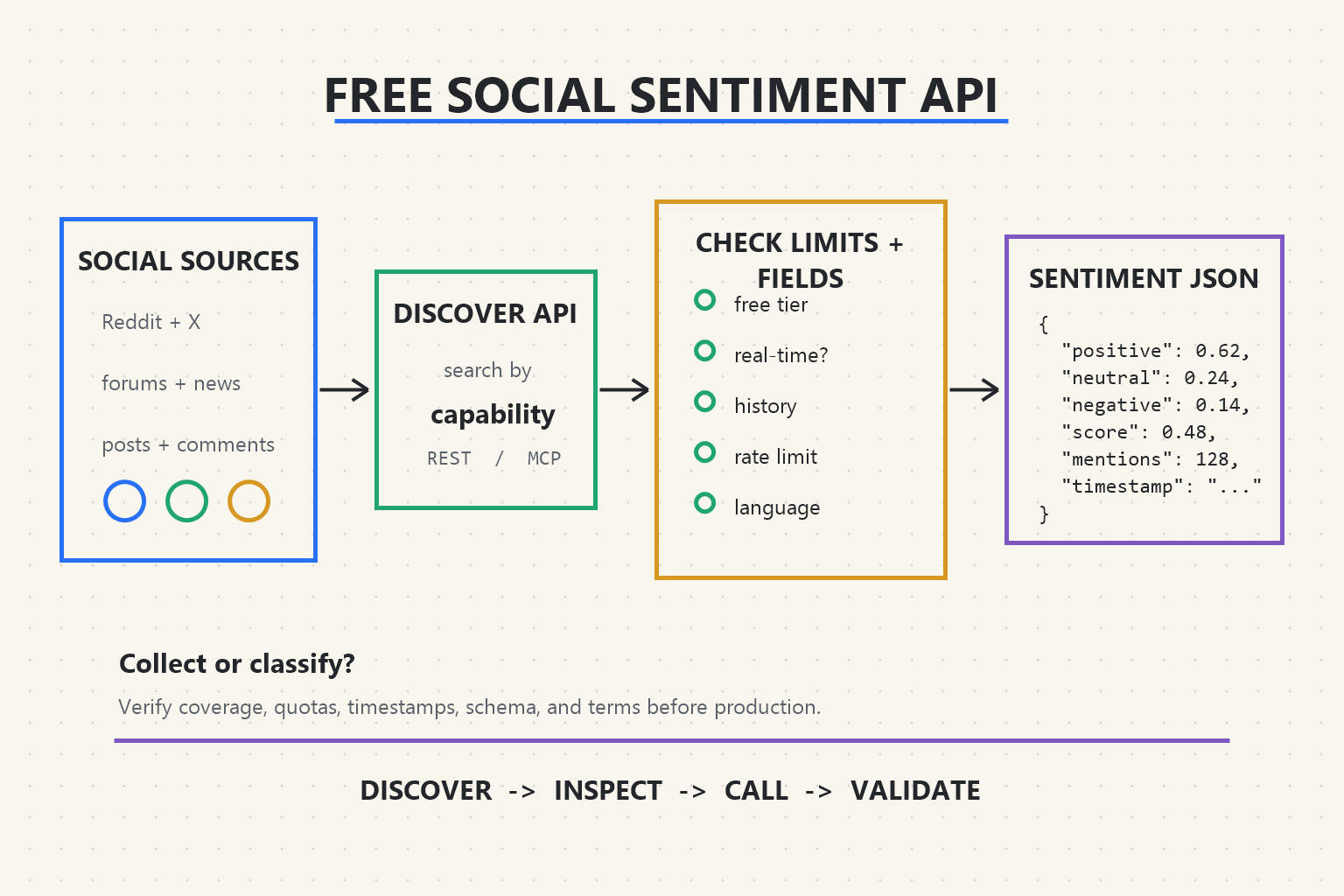
What users expect from a free social sentiment API用户对免费社交舆情 API 的真实需求
Start by separating three different products: an API that collects permitted social posts, a classifier that scores text you already hold, and an aggregate feed that returns topic- or ticker-level indicators. They require different inputs, permissions, evidence, and validation. An endpoint that performs one job should not be assumed to perform the other two.
首先要区分三类产品:采集获准使用的社交内容、为已有文本判断情绪,以及直接返回主题或股票代码级聚合指标。三者需要的输入、许可、证据和验证方法并不相同;一个接口能完成其中一项,不能据此推断它也能完成另外两项。
A free tier, trial, demo, or sample dataset is not the same as unlimited production use. Record quotas and commercial terms.
免费套餐、试用、演示和样例数据不等于可无限用于生产。应记录配额和商用条款。
A social data API may return posts without sentiment. A sentiment API may classify text but collect nothing from social networks.
社交数据接口可能只返回帖子;情感分析接口可能只分类输入文本,不负责采集平台内容。
Check timestamps, cache policy, polling interval, sampling, and history. Never infer real-time coverage from marketing language.
检查时间戳、缓存、采集频率、抽样和历史范围,不要仅凭宣传语推断实时性。
Two ways to build social media sentiment analysis构建社交媒体情感分析的两条数据路径
Use a social listening API with sentiment included
Send a keyword, topic, account, ticker, or URL and receive mentions plus sentiment fields. This is the shortest path, but source coverage, history, and classification details may be provider-specific.
Combine a social media data API with a text sentiment API
Collect permitted public content first, then classify each text item. This gives more control over language models and storage, but you must handle deduplication, rate limits, privacy, and platform terms.
Choose a finance-specific social sentiment API only when needed
Stock and crypto endpoints often return ticker-level mention volume and sentiment trends. They fit trading prototypes but should not replace a general brand or topic monitoring API.
Choose item-level evidence or aggregates
Item-level posts support audit, reclassification, entity correction, and custom weighting, but may carry stricter storage and deletion obligations. Pre-aggregated scores reduce privacy exposure and data volume but can hide sample composition, bot filtering, and model errors. Require counts and methodology even when raw content is unavailable.
Plan deletion and retention before collection
Document permitted fields, retention period, user deletion propagation, hashing, access controls, and whether text can be embedded or sent to another model. A public post can later be deleted or made private; the collection pipeline needs a policy for removing evidence and recomputing affected aggregates.
Evaluate each language and domain separately
Do not infer Chinese, Spanish, finance, gaming, or product-review accuracy from a generic English benchmark. Build labeled samples with slang, sarcasm, negation, emojis, code switching, ticker aliases, and mixed sentiment, then report results by language, source, and topic.
直接使用包含情感字段的社交监听 API
提交关键词、话题、账号、股票代码或 URL,直接获得提及内容和情感字段。接入最短,但数据源、历史和分类方法通常由服务商决定。
组合社交媒体数据 API 与文本情感分析 API
先采集合规的公开内容,再逐条分类。这样可控制模型与存储,但需要自行处理去重、限流、隐私和平台条款。
仅在需要时选择金融专用社交情绪接口
金融专用接口常返回股票代码级别的提及量和情绪趋势,适合交易原型,不适合作为通用品牌或话题监测接口。
选择单条证据还是聚合结果
单条帖子便于审计、重新分类、纠正实体和自定义权重,但通常承担更严格的保存与删除义务;预聚合分值能减少隐私暴露和数据量,却可能隐藏样本构成、机器人过滤与模型错误。即使拿不到原文,也应要求返回样本量和方法说明。
采集前制定删除与保存策略
明确允许保存的字段、保存期限、用户删除如何传递、是否哈希、访问控制,以及文本能否生成向量或发送给其他模型。公开帖子后来可能被删除或设为私密,采集流程必须能够删除证据并重新计算受影响的聚合值。
按语言与领域分别评测
不能用通用英文基准推断中文、西班牙语、金融、游戏或产品评论中的准确率。应建立包含俚语、反讽、否定、表情、语言混用、股票别名和混合情绪的标注样本,再按语言、来源和主题分别报告结果。
How to compare social sentiment API free tiers如何比较社交舆情 API 的免费额度
| Check检查项 | Why it matters为什么重要 | Evidence to record应记录的证据 |
|---|---|---|
| Sources数据源 | Reddit, X, forums, news, and review sites expose different audiences.Reddit、X、论坛、新闻和评论网站代表不同人群。 | Supported platforms and endpoint docs支持平台与接口文档 |
| Sentiment output情感输出 | A label alone is less useful than a score, confidence, and model version.只有标签不如同时提供分数、置信度和模型版本。 | Schema, sample JSON, null behavior字段结构、样例 JSON、空值规则 |
| Free limits免费限额 | Requests, records, credits, and trial days are not interchangeable.请求数、记录数、积分和试用天数不能直接等同。 | Quota, reset period, overage behavior配额、重置周期、超额处理 |
| Freshness and history实时性与历史 | Delayed, sampled, or cached results can change alerts and analysis.延迟、抽样或缓存会影响告警和分析结果。 | Timestamp, latency, retention window时间戳、延迟、保留周期 |
| Language and context语言与语境 | Sarcasm, slang, emojis, and domain jargon can change classifications.反讽、俚语、表情和行业术语会改变分类结果。 | Supported languages and evaluation notes支持语言与评测说明 |
| Terms and privacy条款与隐私 | Public availability does not automatically grant every reuse right.公开可见并不自动等于可以任意再利用。 | License, attribution, deletion, storage rules许可、署名、删除与存储规则 |
Separate opinion from amplification. Mention volume and engagement can be dominated by bots, coordinated campaigns, reposts, giveaways, or a few high-reach accounts. Record whether the provider deduplicates reposts, scores unique authors, exposes bot or spam filters, and weights posts by engagement or influence. For finance queries, resolve a ticker to the intended company or token contract before aggregation; a shared symbol or ordinary word can create a persuasive but false sentiment signal.
把真实观点与传播放大区分开。提及量和互动量可能被机器人、协同行动、重复转发、抽奖活动或少数高影响力账号主导。应确认供应商是否对转发去重、统计独立作者、提供机器人或垃圾内容过滤,并说明是否按互动或影响力加权。金融场景还要先把股票代码或币种简称解析到正确公司或代币合约;同名代码或普通词汇很容易生成看似可信、实际错误的情绪信号。
Worked example: aggregate authors, not repeated amplification实算示例:聚合独立作者,而不是重复传播
Assume a 15-minute window contains four matched posts: Author A scores +0.8 with confidence 0.9, Author B scores −0.4 with confidence 0.8, Author A reposts the first message, and Author C scores +0.2 with confidence 0.5. Keep raw mention volume at four, but remove the repost from the opinion aggregate. A confidence-weighted mean over the three independent items is (0.8×0.9 − 0.4×0.8 + 0.2×0.5) ÷ (0.9+0.8+0.5) = 0.23. Return that score with raw mentions 4, eligible items 3, unique authors 3, source mix, exclusion counts, and the exact window boundary.
假设一个 15 分钟窗口内有四条匹配内容:作者 A 的情绪分为 +0.8、置信度为 0.9;作者 B 的情绪分为 −0.4、置信度为 0.8;作者 A 又转发了第一条内容;作者 C 的情绪分为 +0.2、置信度为 0.5。原始提及量仍记录为 4,但观点聚合时应去掉这条重复转发。对三条独立内容按置信度加权,结果为 (0.8×0.9 − 0.4×0.8 + 0.2×0.5) ÷ (0.9+0.8+0.5) = 0.23。返回该分值时,还应附带原始提及数 4、有效内容数 3、独立作者数 3、来源构成、排除数量和准确的窗口边界。
Use availability time in alerts and backtests. Preserve published_at, ingested_at, edited_at, and scored_at separately. A post published at 10:02 but first ingested at 10:08 was not available to a 10:05 decision, even though its publication timestamp falls inside the earlier window. If text is edited or deleted, keep the permitted version history or mark the affected aggregate; never silently replace the evidence that an earlier decision actually saw.
告警与回测应以数据真正可用的时间为准。应分别保存 published_at、ingested_at、edited_at 和 scored_at。一条内容虽然发布于 10:02,但直到 10:08 才被系统抓取,那么 10:05 的决策就不可能使用它,不能因为发布时间落在较早窗口内就把它提前纳入。文本被编辑或删除后,应在许可范围内保留版本记录,或标记受影响的聚合结果,不能静默替换早期决策当时实际看到的证据。
Free social sentiment API Python request pattern免费社交舆情 API 的 Python 请求模式
Send a narrow query first
Start with one topic, language, source, and time window. Put the API key in an environment variable and set a finite timeout.
Validate sentiment JSON fields
Require source, timestamp, text or content ID, label, score, and confidence where available. Preserve the raw response for debugging within the permitted retention period.
Handle quotas and partial coverage
Respect 429 and Retry-After, paginate deliberately, and mark gaps instead of silently treating missing posts as neutral sentiment.
Keep item and aggregate contracts separate
Normalize content ID, author or anonymized author key, source, timestamps, language, entity match, label, score, confidence, model version, and deletion status before aggregation. Store window boundaries, weighting, unique-author count, source mix, and missing-data state with every aggregate.
Run a manipulation-aware benchmark
Include organic discussion, coordinated reposts, bots, spam, giveaways, sarcasm, ambiguous entities, deleted posts, and sudden volume spikes. Measure entity precision, label agreement, duplicate suppression, bot-filter behavior, source concentration, and aggregate stability—not only average sentiment accuracy.
Monitor drift and evidence loss
Track source coverage, language mix, sample count, unique authors, score distribution, neutral share, bot-filter rate, freshness, deleted-content volume, quota use, and model changes. Recompute or mark affected windows when evidence is removed.
先发送范围明确的查询
从一个话题、一种语言、一个来源和一个时间窗口开始。API Key 放入环境变量,并设置有限超时时间。
验证情感 JSON 字段
至少检查来源、时间戳、文本或内容 ID、标签、分数,以及可用时的置信度。在许可的保留期内保存原始响应用于排错。
处理配额与不完整覆盖
遵守 429 与 Retry-After,明确处理分页,并标注数据缺口,不要把缺失帖子静默视为中性情绪。
分开定义单条数据与聚合契约
聚合前先规范化内容 ID、作者或匿名作者键、来源、时间、语言、实体匹配、标签、分值、置信度、模型版本和删除状态。每个聚合值还应保存窗口边界、权重、独立作者数、来源构成和缺失数据状态。
运行考虑操纵行为的基准测试
样本应包含自然讨论、协同转发、机器人、垃圾内容、抽奖、反讽、歧义实体、已删除帖子和提及量骤增。除平均分类准确率外,还要测量实体精度、标签一致性、重复抑制、机器人过滤、来源集中度和聚合稳定性。
监控漂移与证据丢失
跟踪来源覆盖、语言构成、样本量、独立作者、分值分布、中性占比、机器人过滤率、新鲜度、删除内容量、额度消耗和模型变化。证据被删除时,应重新计算或标记受影响窗口。
import os, requests

response = requests.get(
    "https://provider.example/v1/social/sentiment",
    headers={"Authorization": f"Bearer {os.environ['API_KEY']}"},
    params={"query": "product launch", "language": "en", "limit": 25},
    timeout=20,
)
response.raise_for_status()
items = response.json().get("results", [])

for item in items:
    required = {"source", "timestamp", "sentiment", "score"}
    if not required.issubset(item):
        raise ValueError("Unexpected sentiment response schema")
The hostname is intentionally illustrative. Replace it with the endpoint and field names from the provider you select.
以上域名仅用于说明请求结构,请替换为所选服务商的真实端点和字段名。
How QVeris helps discover social sentiment capabilitiesQVeris 如何帮助发现社交舆情能力
QVeris is a capability routing network. It does not promise that every social data provider is free, real-time, or permitted for every use. It helps agents discover relevant capabilities, inspect inputs and outputs, and route calls through a consistent workflow.
QVeris 是能力路由网络,不承诺每个社交数据服务商都免费、实时或适用于所有用途。它帮助 Agent 发现相关能力、检查输入输出,并通过一致工作流进行调用。
- Open the QVeris tool details to inspect by capability instead of guessing a provider name.
- Review authentication, parameters, response fields, and provider terms before production use.
- Follow the QVeris documentation to connect discoverable tools to an agent workflow.
- 使用 QVeris 工具详情按能力搜索,而不是先猜服务商名称。
- 用于生产前,检查鉴权、参数、返回字段和服务商条款。
- 参考 QVeris 文档,把可发现工具接入 Agent 工作流。
FAQ
Yes. Some providers offer a free tier or trial for social listening or text sentiment endpoints. Limits, platforms, retention, and commercial-use terms vary and should be checked in current provider documentation.
Common responses include positive, neutral, or negative labels; a score or confidence; mention counts; timestamps; source identifiers; and sometimes topics, language, or engagement fields.
Some unified providers cover multiple public sources, while others require separate collection APIs plus a sentiment classifier. Confirm supported platforms and lawful data access before implementation.
Send an authenticated HTTP request with a query or text payload, check the status code, validate the response schema, and store timestamps, source, label, score, and model or endpoint version.
Not always. Free access may be delayed, sampled, cached, limited to a short history, or restricted to a small quota. Verify freshness and timestamps rather than assuming real-time coverage.
Compare source coverage, whether sentiment is included, languages, history, latency, limits, authentication, pagination, licensing, privacy, error handling, and export fields.
有些服务商提供社交监听或文本情感分析的免费额度或试用。平台覆盖、历史范围、商用许可和调用限额各不相同,应以服务商当前文档为准。
常见字段包括正面、中性、负面标签,情感评分或置信度,提及量、时间戳、来源,有时还包含主题、语言和互动指标。
部分统一服务商覆盖多个公开数据源,另一些方案需要分别采集数据再调用情感分类接口。接入前应确认平台覆盖与合规要求。
携带鉴权信息发送 HTTP 请求,提交关键词或文本,检查状态码并验证返回结构,同时保存来源、时间戳、标签、分数和接口版本。
不一定。免费额度可能是延迟、抽样或缓存数据,也可能只开放很短的历史范围。应检查数据时间戳和实时性说明。
比较数据源、是否直接包含情感字段、语言、历史、延迟、限额、鉴权、分页、许可、隐私、错误处理和导出字段。