
Choose a Free Stablecoin Data API
for Price, Supply, and History选择免费稳定币数据 API
获取价格、供应量与历史数据
Compare stablecoin coverage, price and supply methodology, historical access, authentication, and free-tier limits before you integrate.
比较稳定币覆盖、价格与供应量口径、历史数据、鉴权和免费层限制,
再决定如何接入。
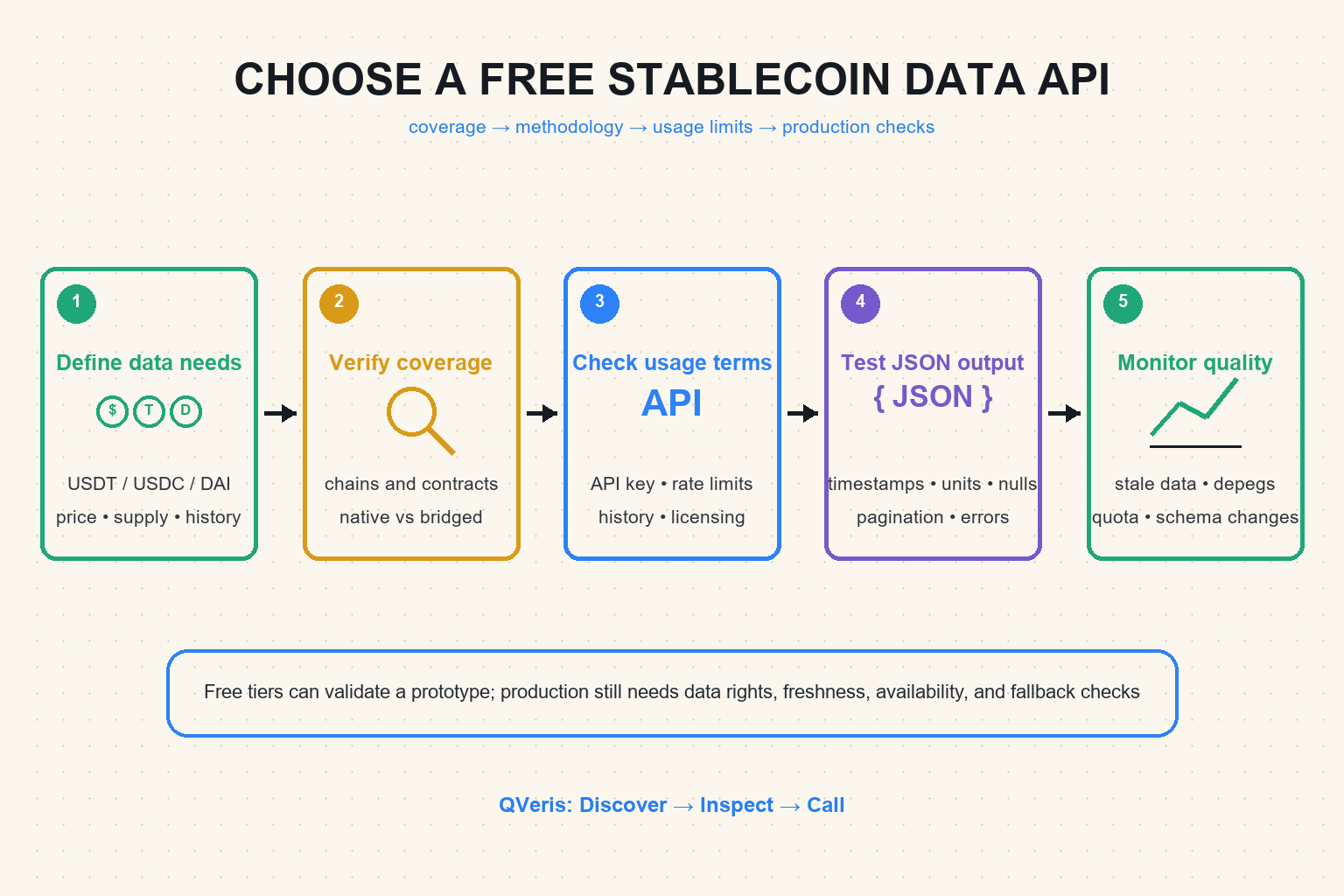
TL;DR: what “free stablecoin data API” should mean核心结论:怎样判断免费稳定币数据 API
Separate a public endpoint, an ongoing free tier, and a time-limited trial. Record the quota, authentication, license, and upgrade trigger.
Total supply, circulating supply, bridged supply, and per-chain balances are not interchangeable. Confirm how each field is calculated.
A stablecoin price may be an exchange quote, an aggregate, an oracle value, or a cached snapshot. Keep its source and timestamp.
Track stale data, missing chains, quota exhaustion, schema changes, and fallback behavior—not only HTTP success.
区分公共端点、长期免费层和限时试用,并记录配额、鉴权、许可和升级触发条件。
总供应量、流通供应量、跨链供应量和分链余额不能直接等同,必须确认字段如何计算。
稳定币价格可能来自交易所、聚合源、预言机或缓存快照,应保留来源和时间戳。
除了 HTTP 成功,还要监控陈旧数据、缺失链、配额耗尽、结构变化和回退行为。
Stablecoin API data model: price, supply, chains, and history稳定币 API 数据模型:价格、供应量、链上分布与历史
A useful stablecoin data API should tell you what the value represents, where it came from, and when it was observed. A numeric response without provenance is difficult to validate or audit.
可用的稳定币数据接口不仅要返回数值,还要说明数值代表什么、来自哪里、何时观测。缺少来源信息的数字很难验证和审计。
Price, peg, and depeg signals价格、锚定状态与脱锚信号
- Price: quote currency, venue set, aggregation method, timestamp, and cache age.
- Peg reference: USD, EUR, gold, or another asset; do not assume every stablecoin targets one US dollar.
- Depeg signal: threshold, observation window, liquidity filter, and whether the signal is calculated by the provider or your application.
- 价格:计价货币、来源场所、聚合方式、时间戳和缓存时长。
- 锚定基准:可能是美元、欧元、黄金或其他资产,不能假设所有稳定币都锚定 1 美元。
- 脱锚信号:需要明确阈值、观察窗口、流动性过滤,以及由服务商还是应用自行计算。
Circulating supply and per-chain distribution流通供应量与分链分布
For multichain assets, verify whether the API identifies native contracts, canonical bridges, third-party wrapped tokens, locked bridge inventory, and excluded addresses. Summing every contract balance can double count the same economic supply.
对于多链资产,应确认接口是否区分原生合约、官方跨链桥、第三方封装代币、桥内锁仓和排除地址。简单汇总所有合约余额可能重复计算同一份经济供应量。
Historical coverage and revisions历史覆盖、粒度与修订
Check the earliest date, interval, timezone, missing-value policy, pagination, and whether historical records can be revised after contract mappings or methodology change. Price history and supply history may have different retention limits.
应核对最早日期、时间粒度、时区、缺失值策略、分页方式,以及合约映射或统计方法变化后历史记录是否会修订。价格历史和供应量历史可能采用不同保留期限。
How to compare a free stablecoin data API如何比较免费稳定币数据 API
Use the same six checks for every candidate so a generous-looking free plan does not hide missing assets, stale data, restricted rights, or a weak production path.
用同一组六项标准检查每个候选接口,避免表面宽松的免费套餐掩盖资产缺失、数据陈旧、使用权受限或生产保障不足。
| Criterion比较项 | Questions to ask需要确认的问题 | Failure if ignored忽略后的风险 |
|---|---|---|
| Asset coverage资产覆盖 | Are USDT, USDC, DAI, USDe, FDUSD, and required regional stablecoins included?是否覆盖 USDT、USDC、DAI、USDe、FDUSD 及所需地区稳定币? | Missing symbols or inconsistent identifiers.币种缺失或标识不一致。 |
| Network coverage网络覆盖 | Which chains and contract versions are mapped? Are bridged forms separated?映射哪些链与合约版本?是否区分跨链资产? | Incomplete or double-counted supply.供应量缺失或重复计算。 |
| Freshness更新频率 | What do source timestamp, cache interval, and update schedule mean?源时间戳、缓存周期和更新计划分别代表什么? | A fast response containing stale data.响应很快但数据已经陈旧。 |
| Free limits免费限制 | Requests per minute, monthly credits, endpoint exclusions, and history limits?每分钟请求、月度额度、排除端点和历史范围是多少? | Unexpected 429 errors or blocked features.出现 429 或关键功能不可用。 |
| Usage rights使用权利 | Can data be cached, displayed, redistributed, or used commercially?能否缓存、展示、再分发或商用? | A technically working but noncompliant integration.技术可用但不符合许可。 |
| Reliability可靠性 | Status page, version policy, changelog, support, and fallback options?是否有状态页、版本策略、更新日志、支持和回退方案? | Silent breakage after upstream changes.上游变化后静默失败。 |
Choose the right stablecoin data source type选择适合的稳定币数据源类型
Stablecoin-specific analytics API稳定币专项分析 API
Best when your product needs stablecoin lists, per-chain supply, peg history, issuer metadata, or stablecoin-specific risk fields. Verify how the provider handles bridged supply and methodology revisions.
适合需要稳定币列表、分链供应量、锚定历史、发行方元数据或专项风险字段的产品。重点检查跨链供应量处理和方法修订规则。
General crypto market data API通用加密货币市场数据 API
Useful when stablecoins are one part of a broader asset universe and you need a consistent price, market-cap, volume, and metadata schema. It may offer less stablecoin-specific supply detail.
当稳定币只是更大资产范围的一部分,并需要统一的价格、市值、成交量和元数据结构时更合适,但稳定币专项供应量细节可能较少。
Blockchain explorer or direct on-chain API区块链浏览器或链上数据 API
Useful for contract events, token balances, mint and burn activity, and chain-specific verification. Your application must maintain contract mappings and define how raw events become circulating supply.
适合查询合约事件、代币余额、铸造销毁和单链验证,但应用需要维护合约映射,并定义如何把原始事件转换为流通供应量。
Oracle or exchange price feed预言机或交易所价格源
Useful for a specific market or on-chain decision. It should not automatically be treated as a complete stablecoin market dataset because supply, issuer, and cross-chain context may be absent.
适合特定市场或链上决策,但不能自动视为完整稳定币数据集,因为可能缺少供应量、发行方和跨链语境。
Reconcile stablecoin supply and depeg signals before using them使用前先勾稽稳定币供应量与脱锚信号
Worked supply example: do not count bridged tokens twice供应量示例:不要重复计算跨链代币
Assume 1.0 billion native tokens exist on Chain A. A canonical bridge locks 200 million of them and mints 200 million representations on Chain B. Adding every visible contract balance produces 1.2 billion, but the economic supply is still 1.0 billion: 800 million freely circulating on Chain A, 200 million locked in the bridge, and 200 million corresponding representations on Chain B.
假设某稳定币在 A 链原生发行 10 亿枚,其中 2 亿枚锁入官方跨链桥,并在 B 链铸造 2 亿枚映射资产。如果把所有合约余额直接相加,会得到 12 亿枚;但经济供应量仍是 10 亿枚,即 A 链自由流通 8 亿枚、桥内锁定 2 亿枚,以及 B 链与这 2 亿枚一一对应的映射资产。
A normalized record therefore needs a relationship such as native, canonical_bridge, or third_party_wrapped, plus the backing contract and mapping version. Third-party wrappers require another decision: report them as distribution of the original asset, as a separate derivative asset, or both in separate fields. Never bury that policy inside an undocumented total.
因此,标准化记录应标明 native、canonical_bridge 或 third_party_wrapped 等关系,并保留对应的储备合约和映射版本。第三方封装资产还需要明确口径:把它视为原资产的链上分布、独立衍生资产,还是分别在两个字段中报告。不能把这项决策藏进一个没有说明的总量里。
Worked depeg example: combine price, liquidity, and time脱锚示例:同时考虑价格、流动性与持续时间
Suppose three liquid venues show 0.997, 0.999, and 1.000 USD while one thin venue briefly prints 0.970. A minimum-price rule would trigger a severe alert, but a volume-aware median remains 0.999. A defensible monitor records every venue, excludes only by a documented liquidity rule, and requires the consolidated deviation to persist for a defined window such as five minutes before escalating.
假设三个流动性较好的交易场所报价分别为 0.997、0.999 和 1.000 美元,而一个成交稀疏的场所短暂出现 0.970。若只取最低价,会触发严重警报;考虑成交量后的中位价格仍约为 0.999。可靠的监控应保存所有场所数据,只按有文档的流动性规则排除异常源,并要求综合偏差持续达到设定时间,例如五分钟后再升级告警。
Define both entry and recovery conditions. For example, enter a warning when the consolidated price stays below 0.995 for five minutes, but clear it only after price remains above 0.998 for ten minutes. Separate thresholds reduce alert flapping. These numbers are design examples, not universal risk limits; the peg asset, venue liquidity, product purpose, and loss tolerance determine the real policy.
告警进入条件与恢复条件都要定义。例如,综合价格连续五分钟低于 0.995 时进入警告,但只有连续十分钟高于 0.998 才解除,以减少告警反复跳变。这些数字只是设计示例,并非通用风险阈值;实际策略取决于锚定资产、市场流动性、产品用途和损失容忍度。
Use three source layers for different claims用三层来源验证不同结论
| Source layer来源层 | What it can support能够支持的判断 | What it cannot prove alone单独无法证明的内容 |
|---|---|---|
| Issuer disclosure发行方披露 | Authorized contracts, issuance totals, reserve reports, redemption terms, and policy changes授权合约、发行总量、储备报告、赎回条款与政策变化 | Current secondary-market price or complete cross-chain state当前二级市场价格或完整跨链状态 |
| On-chain data链上数据 | Balances, mint and burn events, bridge locks, contract activity, and block time余额、铸造销毁、跨链锁仓、合约活动与区块时间 | Off-chain reserves, legal redemption rights, or the economic owner of every address链下储备、法律赎回权或每个地址的经济所有者 |
| Market-data API市场数据 API | Venue prices, consolidated quotes, volume, history, identifiers, and operational delivery场所价格、综合行情、成交量、历史、标识和稳定传输 | Reserve quality or guaranteed redemption at the quoted peg储备质量或按锚定价格保证赎回 |
Reserve disclosure is not the same as redemption certainty. Record the reporting date, reporting entity, asset categories, auditor or attestation scope, frequency, and redemption eligibility. A historical reserve report cannot by itself establish current liquidity or a retail holder's ability to redeem directly.
储备披露不等于确定能够赎回。应记录报告日期、报告主体、资产类别、审计或鉴证范围、披露频率和赎回资格。历史储备报告本身不能证明当前流动性,也不能证明普通持有人可以直接向发行方赎回。
Integrate a stablecoin data API step by step分步骤接入稳定币数据 API
List symbols, chains, fields, historical window, refresh schedule, latency tolerance, and commercial use before choosing an API.
Record key location, quota scope, pagination, endpoint-specific pricing, error codes, and rate-limit headers.
Test a large asset, a multichain asset, a less common asset, a missing symbol, an old date, and a quota error.
Keep provider ID, contract address, chain, source timestamp, receive timestamp, units, methodology version, and raw response reference.
Align cache TTL with source updates, detect stale records, watch quota consumption, and define what the product shows during upstream failure.
选择接口前列出币种、链、字段、历史区间、更新计划、延迟容忍和商用要求。
记录 Key 位置、配额口径、分页、端点计费、错误码和限流响应头。
测试大型资产、多链资产、小众资产、缺失币种、较早日期和配额错误。
保存服务商 ID、合约地址、链、源时间戳、接收时间、单位、方法版本和原始响应引用。
缓存周期应匹配源更新频率,同时检测陈旧数据、监控配额,并定义上游失败时的产品表现。
Minimum normalized record最小标准化记录
{
  "asset": "USDC",
  "chain": "ethereum",
  "contract": "provider-verified-address",
  "price": 1.0001,
  "quote": "USD",
  "circulating_supply": "provider-value",
  "source_timestamp": "ISO-8601",
  "received_at": "ISO-8601",
  "provider": "selected-provider",
  "methodology_version": "provider-version"
}
The values above are structural examples, not live market data. Use the provider’s documented identifiers, numeric precision, and timestamps.
以上数值仅用于说明结构,并非实时市场数据。实际接入应采用服务商文档规定的标识、数值精度和时间戳。
Production checklist for stablecoin data稳定币数据生产环境检查清单
Freshness and data-quality controls新鲜度与数据质量控制
- Reject or mark data older than the application’s explicit freshness threshold.
- Validate quote currency, units, decimals, and negative or impossible values.
- Compare supply changes with mint, burn, and bridge events when the use case is sensitive.
- Do not turn a single venue price into a market-wide depeg conclusion without liquidity context.
- 超过应用明确新鲜度阈值的数据应拒绝使用或标记为陈旧。
- 验证计价货币、单位、小数位,以及负数或不可能值。
- 敏感场景中应将供应量变化与铸造、销毁和跨链事件交叉核对。
- 缺少流动性语境时,不要用单一场所价格得出全市场脱锚结论。
Quota and error handling配额与错误处理
Handle 400-series validation errors separately from 429 quota responses and 500-series provider failures. Use bounded retries only for retryable conditions, respect Retry-After when provided, and prevent multiple workers from causing a retry storm.
应区分 400 系列参数错误、429 配额响应和 500 系列服务商故障。只对可重试条件进行有上限重试,遵循 Retry-After,并避免多个工作进程形成重试风暴。
Licensing, attribution, and retention许可、署名与数据保留
Confirm whether the plan permits internal analytics, public display, persistent storage, derived metrics, AI-agent use, and redistribution. Technical access does not by itself grant every downstream data right.
确认套餐是否允许内部分析、公开展示、长期存储、衍生指标、AI Agent 使用和再分发。能够技术访问,并不自动代表拥有所有下游数据权利。
Use QVeris to discover and inspect stablecoin data capabilities用 QVeris 发现并检查稳定币数据能力
Use QVeris provider details to describe the data task—such as stablecoin price, supply by chain, or historical crypto data—then inspect candidate inputs and outputs before calling a capability.
可在 QVeris 服务商详情中描述稳定币价格、分链供应量或历史加密数据等任务,再检查候选能力的输入输出后进行调用。
- Search by the required output, not only by a provider name.
- Inspect parameter schemas and declared response fields before generating code.
- Use a small representative request before connecting the capability to an agent loop.
- Verify current provider licensing, limits, and methodology in official documentation.
- 按所需输出搜索,而不只按服务商名称搜索。
- 生成代码前检查参数结构和声明的响应字段。
- 接入 Agent 循环前,先执行小规模代表性请求。
- 在官方文档中核验当前许可、限制与数据方法。
Free stablecoin data API FAQ免费稳定币数据 API 常见问题
Is there a free API for stablecoin prices?
Yes. Some general crypto-data providers and stablecoin-specific services expose public endpoints or ongoing free tiers. Confirm quotas and usage rights.
Can I get stablecoin supply by blockchain?
Use an endpoint with explicit per-chain supply and contract mappings. Verify how native, bridged, locked, and wrapped supply are treated.
Does a free stablecoin API require a key?
Some public endpoints do not; other free plans require an account and API key. Never expose a private key in public browser code.
Does the free tier include historical data?
Sometimes. Price history, supply history, retention, and interval limits often differ, so inspect each endpoint rather than the plan label alone.
How do I detect a stablecoin depeg?
Define the peg reference, price sources, liquidity filters, deviation threshold, and observation window. One isolated quote is not enough.
Can a free API be used in production?
Possibly, but only after checking availability, limits, data rights, support, change policy, monitoring, and fallback requirements.
有没有免费的稳定币价格 API?
有。部分通用加密数据服务和稳定币专项服务提供公共端点或长期免费层,但应核对配额和使用权利。
如何按区块链获取稳定币供应量?
选择明确返回分链供应量和合约映射的端点,并确认如何处理原生、跨链、锁仓和封装供应量。
免费稳定币 API 是否需要 Key?
部分公共端点不需要;其他免费套餐要求账号和 API Key。不要把私有 Key 暴露在公开浏览器代码中。
免费层是否包含历史数据?
有时包含,但价格历史、供应量历史、保留范围和时间粒度通常不同,应逐个检查端点。
如何检测稳定币脱锚?
需要定义锚定基准、价格来源、流动性过滤、偏离阈值和观察窗口,单一孤立报价不足以下结论。
免费 API 能用于生产环境吗?
可能可以,但必须先检查可用性、限制、数据权利、支持、变更策略、监控和回退要求。