
Free Stock Data
with Python用 Python 获取
免费股票数据
Fetch stock prices into pandas, compare free data sources, and validate timestamps, adjustments, limits, and licenses before you build.
把股票价格读入 pandas,比较免费数据源,并在开发前核对时间戳、复权方式、调用限额和使用许可。
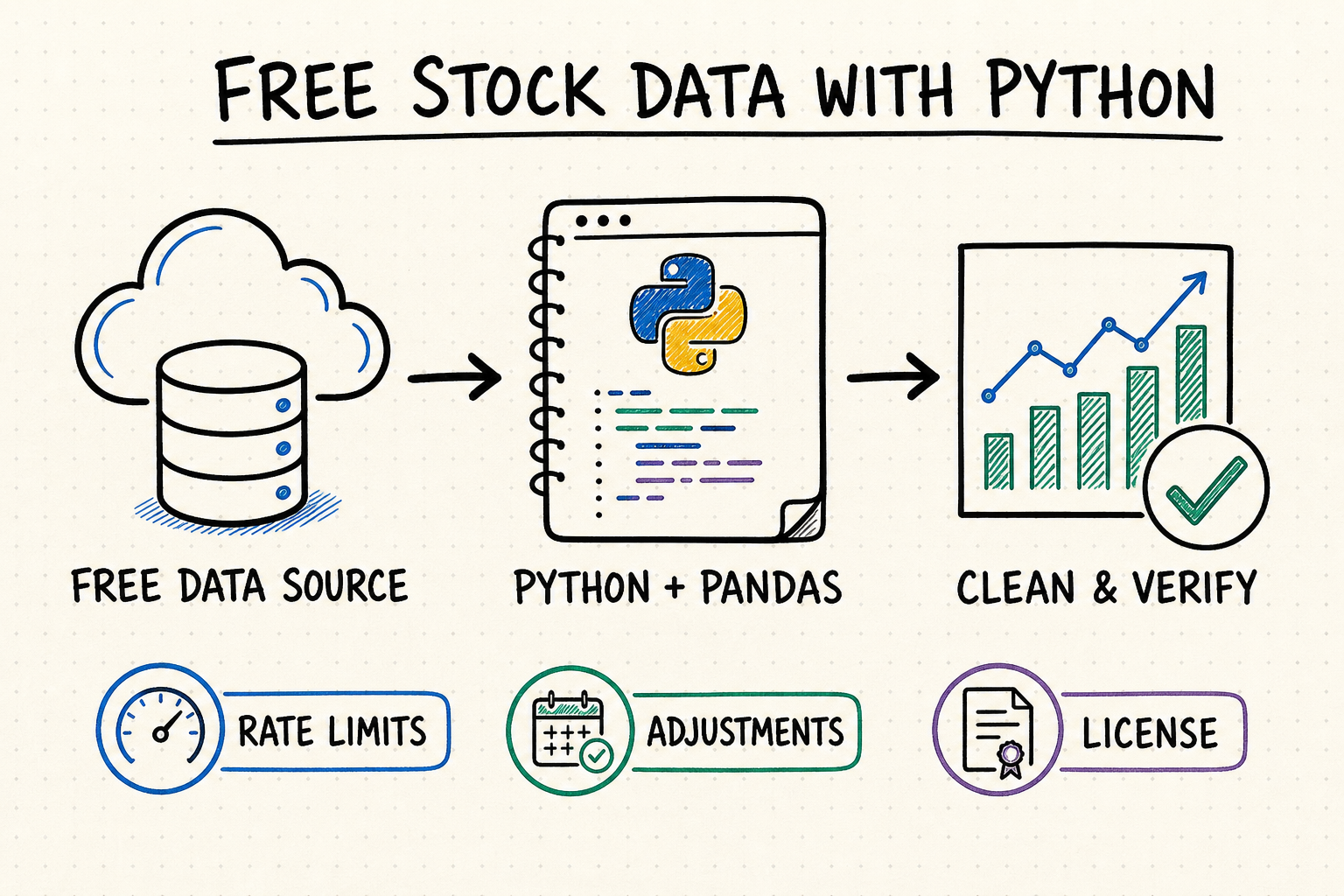
TL;DR核心摘要
Use a documented API or provider SDK, load JSON into pandas, and save a raw copy before transforming it.
Expect delayed quotes, end-of-day history, request caps, narrower exchange coverage, or non-commercial terms.
Check timestamps, time zones, split and dividend adjustments, symbol formats, nulls, and duplicate rows.
选择文档清晰的 API 或 SDK,把 JSON 读入 pandas,并在转换前保存原始响应。
免费套餐通常伴随延迟行情、日线数据、调用上限、较少交易所覆盖或非商业条款。
检查时间戳、时区、拆股分红复权、代码格式、空值和重复记录。
Choose a free stock data source for Python为 Python 选择免费股票数据源
Start with the data shape your project needs—not the library name. Historical research needs stable OHLCV and corporate actions; a dashboard needs current quotes and explicit freshness; screening needs fundamentals and consistent identifiers.
先确定项目需要的数据形态,而不是先选库。历史研究需要稳定的 OHLCV 与公司行动数据;看板需要最新报价和明确时效;选股则需要基本面与一致的标识符。
Best when you need predictable JSON, documented fields, API keys, and explicit request limits. Prefer sources that expose timestamps and adjustment policy.
Useful for notebooks and prototypes. They reduce setup, but may wrap endpoints that change, so pin versions and test returned columns.
CSV works for exchange and one-off analysis; Parquet is more efficient for typed, partitioned history. Preserve the raw source file before cleaning either format.
Use one module to fetch and normalize data and another to calculate indicators or models. This makes provider changes testable and keeps notebooks reproducible.
适合需要稳定 JSON、清晰字段、API Key 和明确限额的项目。优先选择提供时间戳与复权说明的来源。
适合 Notebook 和原型,能减少配置,但其底层端点可能变化,因此要锁定版本并测试返回列。
CSV 适合交换数据和一次性分析,Parquet 更适合带类型、按分区存储的历史数据。无论哪种格式,清洗前都应保留原始来源文件。
用一个模块负责拉取和标准化,另一个模块计算指标或模型。这样供应商变化更容易测试,Notebook 也更容易复现。
Python example: fetch prices into pandasPython 示例:把价格读入 pandas
A provider-neutral pattern uses requests for transport and pandas for normalization. Replace the endpoint and field names with those in your provider’s documentation.
供应商无关的写法是用 requests 请求数据,再用 pandas 标准化。请按所选供应商文档替换端点与字段名。
import os
import requests
import pandas as pd

url = "https://api.example.com/v1/daily"
params = {"symbol": "AAPL", "apikey": os.environ["STOCK_API_KEY"]}
response = requests.get(url, params=params, timeout=20)
response.raise_for_status()

rows = response.json()["data"]
df = pd.DataFrame(rows)
df["date"] = pd.to_datetime(df["date"], utc=True)
df = df.sort_values("date").drop_duplicates("date")
print(df[["date", "open", "high", "low", "close", "volume"]].tail())| Step步骤 | Why it matters为什么重要 | Minimum check最低检查项 |
|---|---|---|
| Request请求 | Timeouts and HTTP errors prevent silent failures.超时和 HTTP 错误处理可避免静默失败。 | Status code and provider error body.状态码与供应商错误信息。 |
| Normalize标准化 | Stable columns isolate analysis from provider schemas.稳定列名可隔离分析逻辑与供应商格式。 | Types, UTC dates, numeric columns.类型、UTC 日期、数值列。 |
| Validate验证 | Bad rows can produce believable but wrong charts.错误记录可能生成看似可信的错误图表。 | Order, duplicates, nulls, price bounds.顺序、重复、空值、价格边界。 |
For repeated jobs, write normalized data into partitions such as market/symbol/year or market/date, depending on the dominant query. Keep a manifest with provider, parameters, retrieval time, schema version, row count, and checksum. Re-fetch a short overlap on every update so late corrections can replace recent records deterministically.
对于重复运行的任务,可按主要查询方式把标准化数据写入 market/symbol/year 或 market/date 等分区。同时维护清单,记录供应商、参数、采集时间、字段版本、行数和校验值。每次更新都重新拉取一段近期重叠区间,以确定性规则替换迟到修订的数据。
Validate free stock data before analysis分析前验证免费股票数据
Compare the newest timestamp with the exchange session and expected delay. Weekends and holidays are not missing data.
Confirm whether close prices are raw or adjusted for splits and dividends. Never mix adjusted and unadjusted series.
Require expected columns, coerce price fields explicitly, preserve wide integer volume, reject duplicate keys, and fail when an HTML error page is parsed as data.
Check high ≥ max(open, close), low ≤ min(open, close), nonnegative volume, monotonic timestamps, and one currency per instrument unless a change is documented.
Pin library versions, save request inputs and raw payload hashes, and avoid silently refreshing historical data inside an analysis notebook.
结合交易时段和预期延迟检查最新时间戳。周末和休市日并不代表数据缺失。
确认收盘价是否针对拆股与分红做过复权,绝不要混用复权与未复权序列。
强制检查必需列,显式转换价格字段,为成交量保留足够宽的整数类型,拦截重复主键,也要防止把 HTML 错误页误当成数据。
检查最高价不低于开盘和收盘、最低价不高于开盘和收盘、成交量非负、时间戳递增;除非有明确变更,同一标的应保持单一币种。
锁定库版本,保存请求参数和原始响应哈希,不要在分析 Notebook 内悄悄刷新历史数据。
Use QVeris for provider-flexible stock data access用 QVeris 灵活接入不同股票数据提供方
There is no single verified QVeris result for every Python stock-data pipeline. Use the QVeris Python SDK documentation for integration and the Playground to inspect candidate capabilities before mapping them into your normalized schema.
目前没有一个经过核实的 QVeris 结果,可以覆盖所有 Python 股票数据管道。接入时可参考 QVeris Python SDK 文档,并先到 Playground 检查候选能力,再映射到自己的标准字段。
- Discover stock-data capabilities and inspect their inputs before calling them.
- Keep application code focused on symbols, dates, and normalized outputs.
- Use auditable capability calls when agents need current financial data.
- 发现股票数据能力,并在调用前检查输入参数。
- 让应用代码只关注股票代码、日期与标准化输出。
- 当 Agent 需要当前金融数据时,使用可审计的能力调用。
FAQ常见问题
Yes. Free APIs, public datasets, and Python libraries can provide historical prices, delayed quotes, fundamentals, or metadata within plan limits.
Use pandas for cleaning and analysis, requests for direct APIs, or a provider SDK for convenience. Normalize results into a DataFrame.
CSV is portable and easy to inspect. Parquet preserves types, compresses well, and supports selective reads, making it better for larger recurring datasets.
Refresh the newest overlap on each run and audit provider corrections periodically. Immutable older partitions reduce cost while keeping revisions traceable.
可以。免费 API、公共数据集和 Python 库可提供历史价格、延迟报价、基本面或元数据,但受套餐限制。
用 pandas 清洗分析,用 requests 直接调用 API,或用供应商 SDK 简化接入,最终统一成 DataFrame。
CSV 通用、便于人工查看;Parquet 能保留类型、压缩效率高并支持按列读取,更适合规模较大的重复数据集。
每次运行都刷新最近一段重叠区间,并定期检查供应商修订。更早的分区保持不可变,既节省额度,也便于追踪变化。
References and next steps参考资料与下一步
Alpha Vantage API documentation
Alpaca market data documentation
Twelve Data API documentation
QVeris Python SDK
QVeris Playground
Alpha Vantage API 文档
Alpaca 市场数据文档
Twelve Data API 文档
QVeris Python SDK 文档
QVeris Playground