
Free Stock Screener API
Selection & Build Guide免费股票筛选 API
选择与接入指南
Compare free stock screener APIs by universe, metric definitions, point-in-time behavior, pagination, freshness, and licensing—then build a reproducible watchlist or agent workflow.
从证券池、指标口径、时点一致性、分页、数据时效和授权范围出发,
选择适合量化脚本、选股工具或智能体的免费股票筛选 API。
TL;DR摘要
Find an endpoint that evaluates a defined security universe and returns every passing symbol—not a quote API that only accepts one ticker at a time.
Match the endpoint to fundamental, technical, classification, liquidity, price, and listing-status rules, with documented operators and null handling.
Check request and row limits, delay, market coverage, authentication, pagination, historical access, and display rights before coding.
Keep the query definition, as-of time, source periods, result count, and rank beside the symbols so the screen remains reproducible.
找到能在明确证券池中执行条件并返回全部合格标的的端点,而不是每次只能接收一个代码的普通行情 API。
核对基本面、技术指标、分类、流动性、价格和上市状态条件,以及操作符与空值处理是否有清晰定义。
接入前确认调用与返回行数限制、延迟、市场覆盖、鉴权、分页、历史查询和公开展示授权。
把查询定义、截至时间、指标报告期、结果数量和排名与股票一起保存,确保筛选结果可以复现。
What users expect from a free stock screener API用户真正需要的免费选股 API 能力
Most developers need to answer four practical questions: does the endpoint screen an entire universe, which financial and market conditions can it combine, what does the free tier permit, and can one query be reproduced in code? They also need to distinguish a screener from a quote endpoint and understand which fields are current, delayed, or tied to the latest published filing.
开发者通常需要解决四个实际问题:接口能否筛选完整证券池、能组合哪些财务与行情条件、免费额度允许怎样使用,以及同一筛选能否在代码中复现。同时还要区分选股接口与普通行情接口,并弄清哪些字段是当前值、延迟值,哪些来自最近一次已披露财报。
A true screener performs server-side filtering over a stated universe. Downloading thousands of symbols and filtering locally can still be a valid architecture, but it has different quota, bandwidth, latency, survivorship, and licensing implications. Before comparing endpoints, decide whether you need current discovery, scheduled watchlist refreshes, or historical point-in-time screening for research.
真正的选股接口会在明确证券池上执行服务端筛选。批量下载全部股票后在本地过滤也可以成立,但它对额度、带宽、延迟、存续偏差和数据授权的要求完全不同。比较端点前,应先判断任务是当前标的发现、定时更新自选股,还是用于研究的历史时点筛选。
Free stock screener API with fundamental filters
Look for valuation, profitability, growth, leverage, dividend, sector, and market-cap fields. Confirm the definitions and reporting periods behind each metric.
Real-time stock screener API limits
“Real time” may apply to quotes while fundamentals refresh after filings. Verify exchange entitlements, timestamp fields, delays, and whether streaming is included.
Stock screener API for Python workflows
Prefer stable JSON, documented operators, pagination, metadata discovery, and examples that can be reproduced with requests, pandas, or an SDK.
Licensing and production use
A zero-cost developer tier does not automatically permit redistribution, public display, or commercial use. Read the provider's current terms.
Point-in-time fundamentals and survivorship
For backtests, ask whether metrics reflect what was known on the screen date, not values restated later. The universe must preserve delisted securities and historical classifications or results will be biased toward survivors.
Null values, units, and fiscal periods
Define whether a missing value fails the filter or is excluded before evaluation. Confirm currency, percentage versus decimal units, trailing versus annual values, fiscal period, and the filing date behind every fundamental metric.
支持基本面条件的免费选股 API
重点检查估值、盈利能力、成长性、杠杆、股息、行业和市值字段,并确认指标口径与报告期。
实时股票筛选 API 的延迟
“实时”可能只适用于行情,基本面仍随财报更新。需要核对交易所授权、时间戳、延迟和流式数据范围。
适合 Python 的股票筛选接口
优先选择 JSON 稳定、操作符清晰、支持分页和字段元数据,并提供 requests、pandas 或 SDK 示例的接口。
数据授权与生产使用
免费开发额度不等于允许再分发、公开展示或商业使用,上线前应阅读供应商当前条款。
历史时点基本面与存续偏差
回测需要确认指标是否代表筛选日当时已经公开的信息,而不是后来重述后的最新值。证券池还应保留退市股票和历史行业分类,否则结果会过度偏向存续公司。
空值、单位与财务期间
先规定缺失值是直接不合格,还是在计算前排除;同时核对币种、百分比或小数单位、滚动或年度口径、财务期间,以及每个基本面指标对应的申报日期。
How to compare free stock screening API options如何比较免费股票筛选 API
| Criterion标准 | What to verify需要核对 | Why it matters影响 | Test测试方式 |
|---|---|---|---|
| Coverage市场覆盖 | Exchanges, symbols, ETFs, delisted securities.A 股、美股、港股、ETF 与退市标的。 | Defines the usable universe.决定可筛选范围。 | Query known symbols from each market.查询各市场已知代码。 |
| Filters筛选字段 | Fundamentals, technicals, sectors, operators.基本面、技术指标、行业与操作符。 | Separates a screener from a quote API.区分选股接口与行情接口。 | Run a multi-condition query.执行多条件查询。 |
| Freshness数据时效 | Quote delay, filing refresh, timestamps.行情延迟、财报更新与时间戳。 | Prevents false “real-time” assumptions.避免误判实时性。 | Compare timestamps with market status.对照开市状态检查时间。 |
| Free tier免费额度 | Calls, rows, rate limit, attribution, license.调用次数、返回行数、限速、署名与授权。 | Determines prototype and production fit.决定原型和生产可用性。 | Test pagination and rate-limit headers.测试分页和限速响应头。 |
| Metric semantics指标口径 | Formula, unit, currency, period, filing date, null policy.公式、单位、币种、期间、申报日与空值规则。 | Prevents silently comparing unlike values.避免把不可比数值混在同一条件中。 | Recalculate several metrics from source statements.用原始财报重算若干样本指标。 |
| Pagination分页与排序 | Stable sort key, cursor behavior, row cap, duplicate policy.稳定排序键、游标行为、单页上限与重复处理。 | Ensures no symbol is skipped between pages.确保翻页时不会漏掉或重复股票。 | Fetch the full universe twice and compare IDs.完整抓取两次并比较证券标识。 |
| Historical integrity历史完整性 | As-of queries, delisted names, restatements, classifications.截至日查询、退市标的、重述与历史分类。 | Controls look-ahead and survivorship bias.控制前视偏差与存续偏差。 | Rebuild a known past screen using only then-known data.只用当时已知数据重建历史筛选。 |
Consider a U.S. common-stock screen with price at least $5, 20-day median dollar volume above $5 million, positive trailing-twelve-month operating cash flow, revenue growth above 10%, and net debt to EBITDA below 3. Exclude securities with missing cash-flow or leverage inputs, sort by dollar volume descending with a stable security ID as the secondary key, and cap the result at 100 names. Save the universe definition, metric formulas, filing dates, quote timestamp, null policy, sort keys, and complete result count. “growth > 10” is not reproducible until the API states whether 10 means 10%, 0.10, year-over-year growth, or another period.
假设要筛选美国普通股:股价不低于 5 美元,20 日成交额中位数高于 500 万美元,过去十二个月经营现金流为正,营收同比增长超过 10%,净债务与 EBITDA 之比低于 3。现金流或杠杆数据缺失的股票直接排除;结果按成交额降序排列,并以稳定证券 ID 作为第二排序键,最多返回 100 只。运行时还要保存证券池定义、指标公式、财报日期、行情时间、空值规则、排序键和完整结果数量。若接口只写 growth > 10,却不说明 10 代表 10%、0.10、同比增长还是其他期间,这个条件就无法复现。
Return the evaluated value, threshold, unit, source period, and pass state for each condition. A symbol list alone cannot explain why a company entered the screen.
Record whether the price moved, a new filing changed a metric, the security left the universe, the value became unavailable, or the provider revised history.
为每个条件返回实际值、阈值、单位、来源期间和通过状态。只有股票代码列表,无法解释公司为何进入结果集。
记录是价格变化、新财报改变指标、证券退出筛选池、数据暂时缺失,还是供应商修订了历史记录。
Build a stock screener with a free API用免费股票 API 构建选股流程
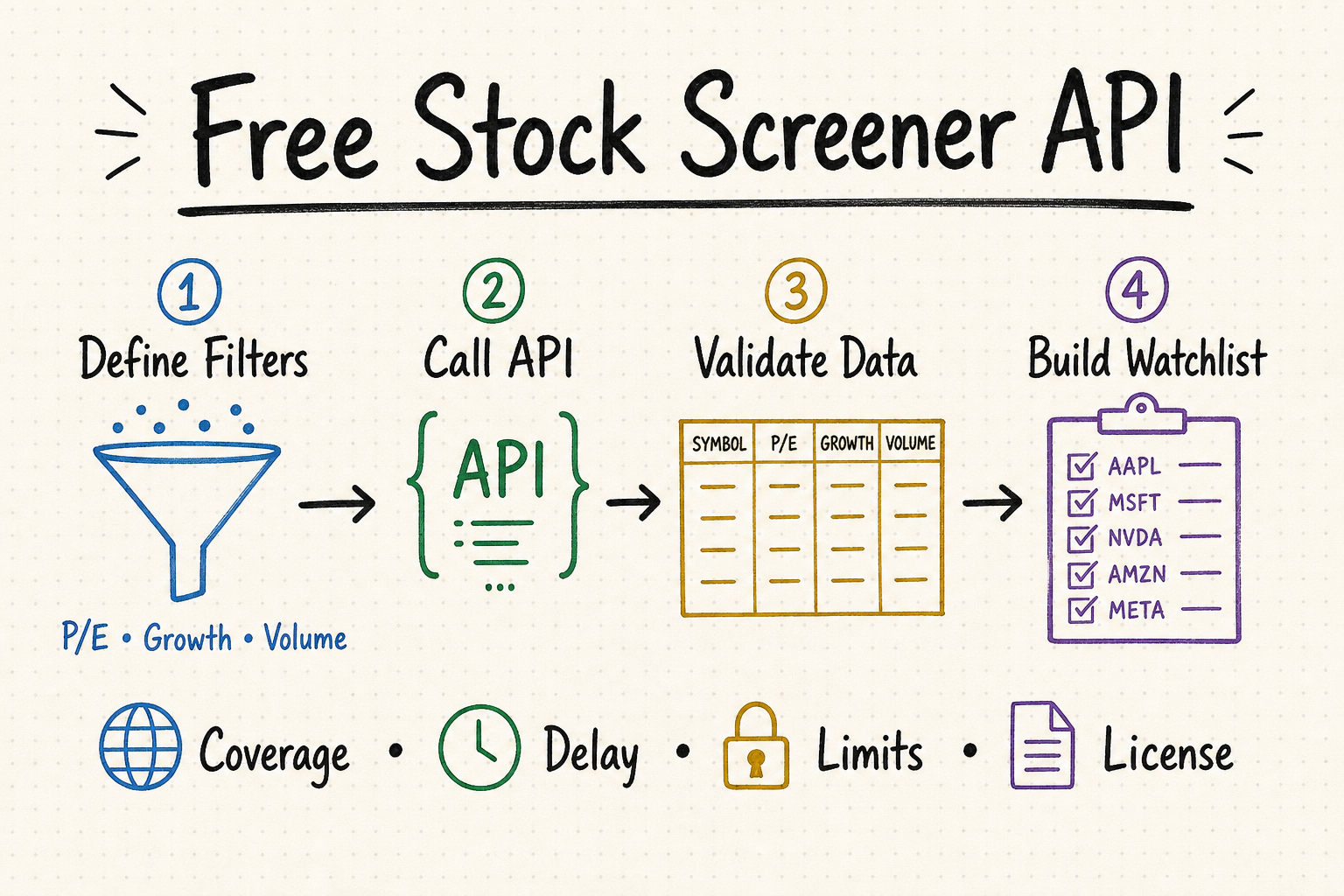
1. Define a reproducible stock screen
Write the market, currency, minimum liquidity, valuation or growth thresholds, null handling, sort order, and maximum result count before choosing a provider.
2. Inspect the API schema and free limits
Map human metric names to API fields. Record authentication, operators, pagination, timestamps, errors, and current free-tier restrictions.
3. Test one stock screener API request
Run a small query, validate several returned symbols manually, store the provider timestamp, and log the exact filters beside the results.
4. Add caching, validation, and fallback
Cache slow-changing fundamentals, reject stale or malformed responses, respect rate limits, and keep provider-specific code behind an adapter.
5. Paginate with a stable ordering
Use a documented cursor or a deterministic secondary key such as a stable security ID. Deduplicate across pages, record the total universe count, and fail the run if pages change underneath a long retrieval.
6. Version the screen and explain every match
Store a canonical filter object, metric definitions, source dates, code version, and a per-symbol explanation of which conditions passed. When a symbol disappears, report the changed input or failed condition rather than silently dropping it.
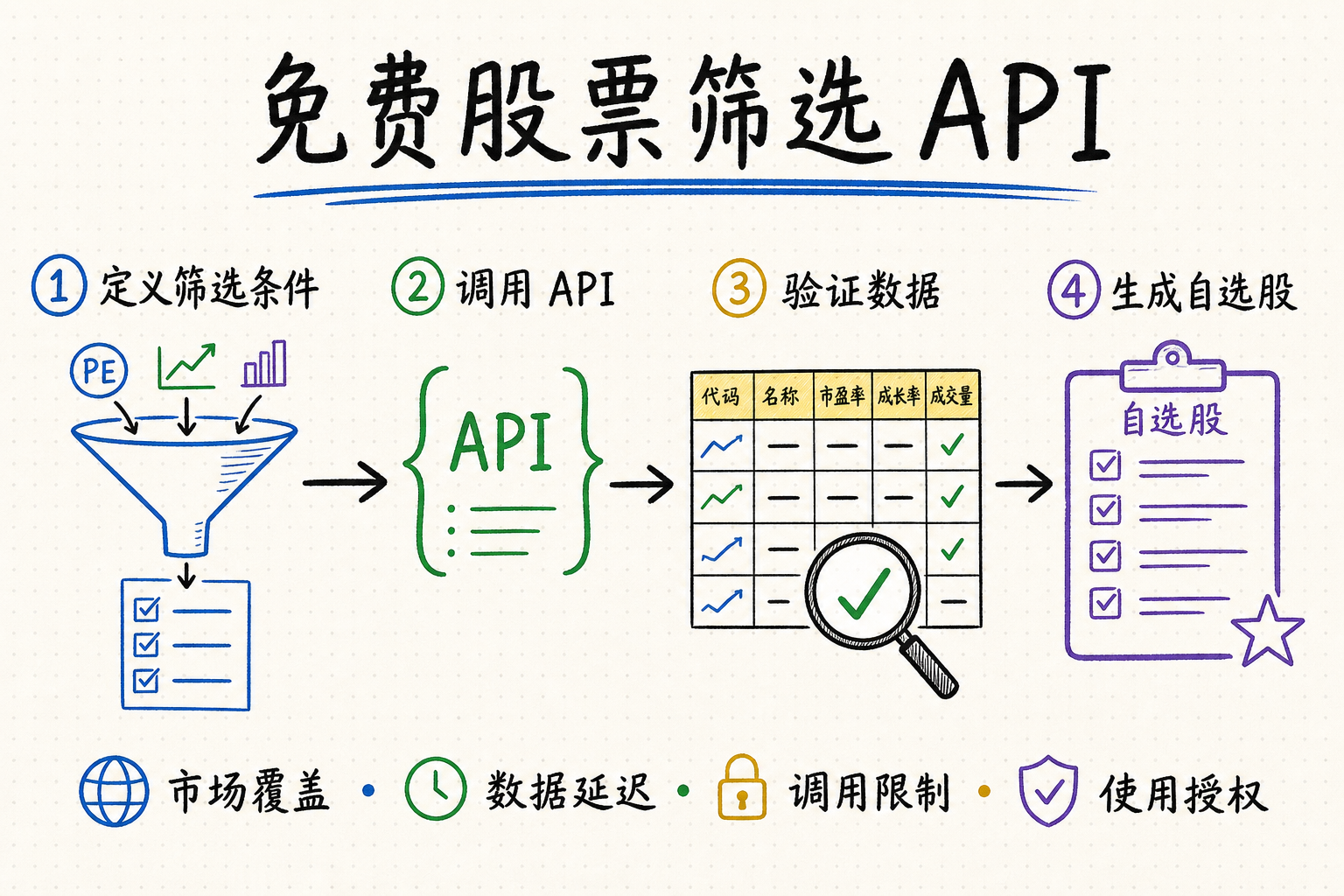
1. 先定义可复现的选股条件
明确市场、币种、最低流动性、估值或成长阈值、空值处理、排序方式和最大返回数量。
2. 检查接口字段和免费限制
把业务指标映射到 API 字段,记录鉴权、操作符、分页、时间戳、错误格式和当前免费额度。
3. 用 Python 测试一次条件选股请求
先发起小规模查询,人工核对部分股票,保存数据时间戳,并把筛选条件与结果一起记录。
4. 增加缓存、校验和降级
缓存低频变化的基本面数据,拒绝过期或异常响应,遵守限速,并用适配层隔离供应商差异。
5. 使用稳定顺序完成分页
采用文档明确的游标,或用稳定证券 ID 作为确定性次级排序键;跨页去重并记录证券池总数,如果长时间抓取期间页面内容发生漂移,应让本次任务失败并重试。
6. 给筛选规则定版并解释每个结果
保存规范化条件对象、指标定义、来源日期和代码版本,并为每只股票记录哪些条件通过。股票退出结果集时,应指出变化的输入或未通过的条件,而不是无声消失。
Use QVeris to find and call financial API capabilities用 QVeris 发现并调用金融 API 能力
QVeris can help an agent discover and inspect relevant financial-data capabilities before making a tool call. It does not guarantee that every provider offers free, real-time, or redistribution rights; those terms still require provider-level verification.
QVeris 可以帮助智能体发现并检查相关金融数据能力,再发起工具调用;但它不会替供应商承诺免费、实时或再分发权限,这些条件仍需逐一核对。
- Open the QVeris provider details to review a financial or market-data capability.
- Inspect inputs, operators, units, outputs, provider identity, pagination, timestamps, and error behavior before adding a capability to an automated stock-screening workflow.
- Pass the target market, security types, as-of requirement, filter object, null policy, sort rule, and maximum result count explicitly; do not let an agent invent missing constraints.
- Keep screening results and their source evidence as research inputs; they are not investment recommendations.
- 需要查找金融或行情数据能力时,可以先使用 QVeris provider details。
- 加入自动化选股流程前,检查输入、操作符、单位、输出、供应商身份、分页、时间戳与错误行为。
- 明确传入目标市场、证券类型、截至日要求、筛选对象、空值规则、排序方式和最大返回数量,不要让 Agent 猜测缺失条件。
- 筛选结果及其来源证据只应作为研究输入,不构成投资建议。
FAQ常见问题
Is there a free stock screener API?
Yes, some providers publish a free endpoint or developer tier. Limits, eligible markets, data delay, fields, and licensing differ and can change.
What is the best free stock screener API?
The best option is the one whose market coverage, screening fields, freshness, limits, documentation, and license match your exact workflow.
Can I build a stock screener with a free API?
Usually for a prototype. Define filters, call the endpoint, paginate results, validate timestamps and symbols, then cache and monitor responses.
Does a free stock API provide real-time data?
Not always. Quotes, fundamentals, technical indicators, and exchange feeds can have different refresh schedules and entitlements.
What is the difference between a screener API and a quote API?
A screener evaluates conditions across a universe and returns matching securities. A quote API usually returns fields for symbols you already know; using it as a screener requires universe data, bulk retrieval, and local filtering.
Can a stock screener API be used for backtesting?
Only if it supports point-in-time data, historical universes, delisted securities, and then-known fundamentals. Running today's database with an old date label does not remove look-ahead or survivorship bias.
How should missing fundamentals be filtered?
Define the policy before execution. A missing ratio is not zero: it may mean not applicable, unavailable, not yet filed, or a failed calculation. Preserve a reason code and test nulls separately from numeric thresholds.
有免费的股票筛选 API 吗?
有些供应商提供免费接口或开发者额度,但市场覆盖、延迟、字段、调用次数与授权范围各不相同。
如何选择免费的选股 API?
根据 A 股、美股或港股覆盖,筛选字段、数据时效、免费限额、文档质量和使用授权来选择。
可以用免费 API 构建股票筛选器吗?
通常可以制作原型:定义条件、调用接口、处理分页、核对股票与时间戳,再加入缓存和监控。
免费股票 API 都是实时行情吗?
不是。行情、基本面和技术指标可能采用不同更新频率,也可能受交易所授权限制。
选股 API 与行情 API 有什么区别?
选股 API 会在证券池中执行条件并返回匹配标的;行情 API 通常只返回用户已经知道的代码。若用行情接口自行选股,还需要证券池、批量抓取和本地过滤。
股票筛选 API 可以用于回测吗?
只有在支持历史时点数据、历史证券池、退市股票和当时已知基本面时才可靠。仅给今天的数据库加一个过去日期,无法消除前视偏差和存续偏差。
筛选时怎样处理缺失基本面?
执行前必须明确规则。缺失比率并不等于零,它可能表示不适用、暂无数据、尚未申报或计算失败;应保留原因码,并把空值判断与数值阈值分开。