
Free Stock Sentiment API
Sources, Limits & Setup免费股票情绪 API
数据源、配额与接入方法
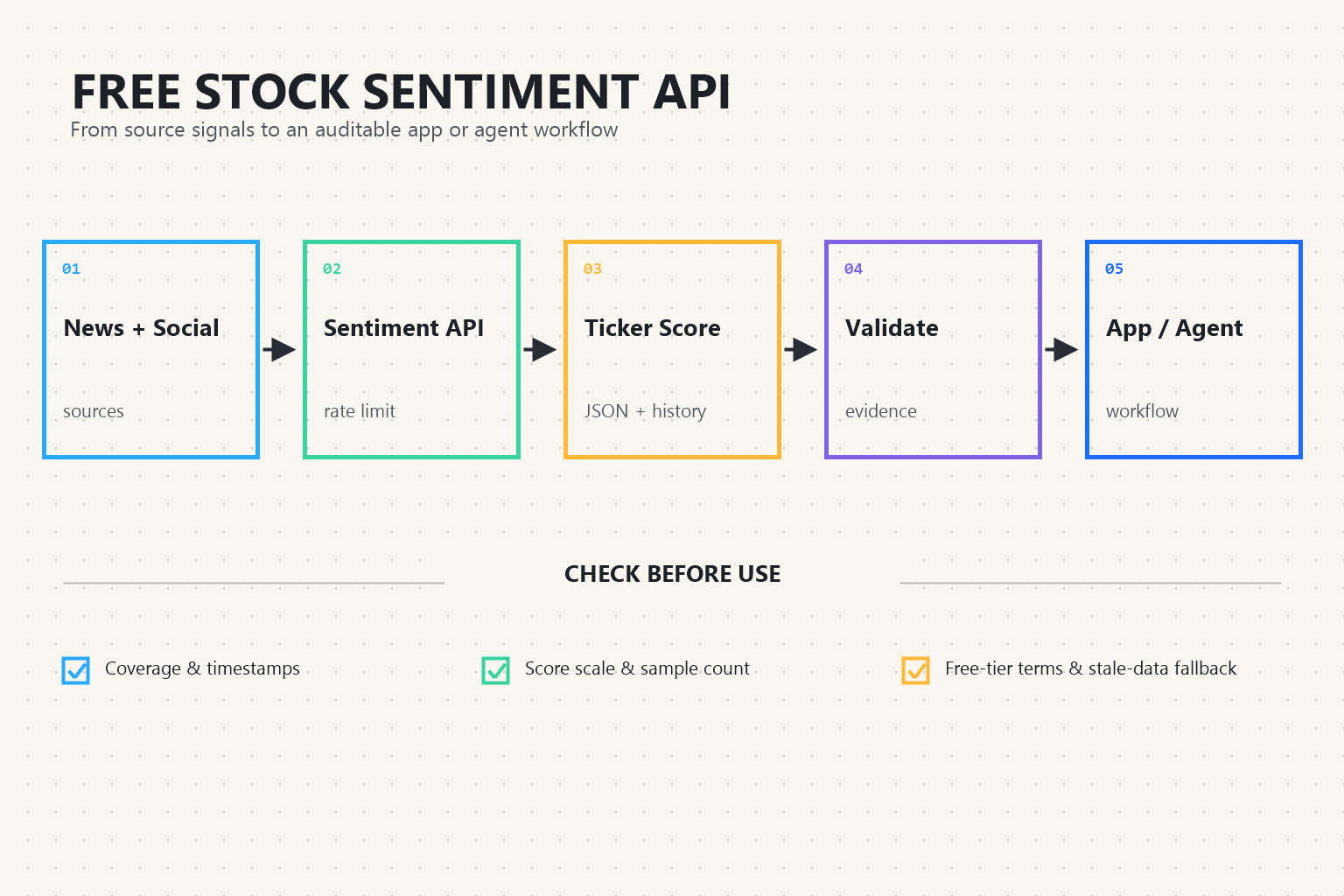
Find a free stock sentiment API for news or social signals, compare the limits that matter, and connect a ticker-level score to your app or agent.
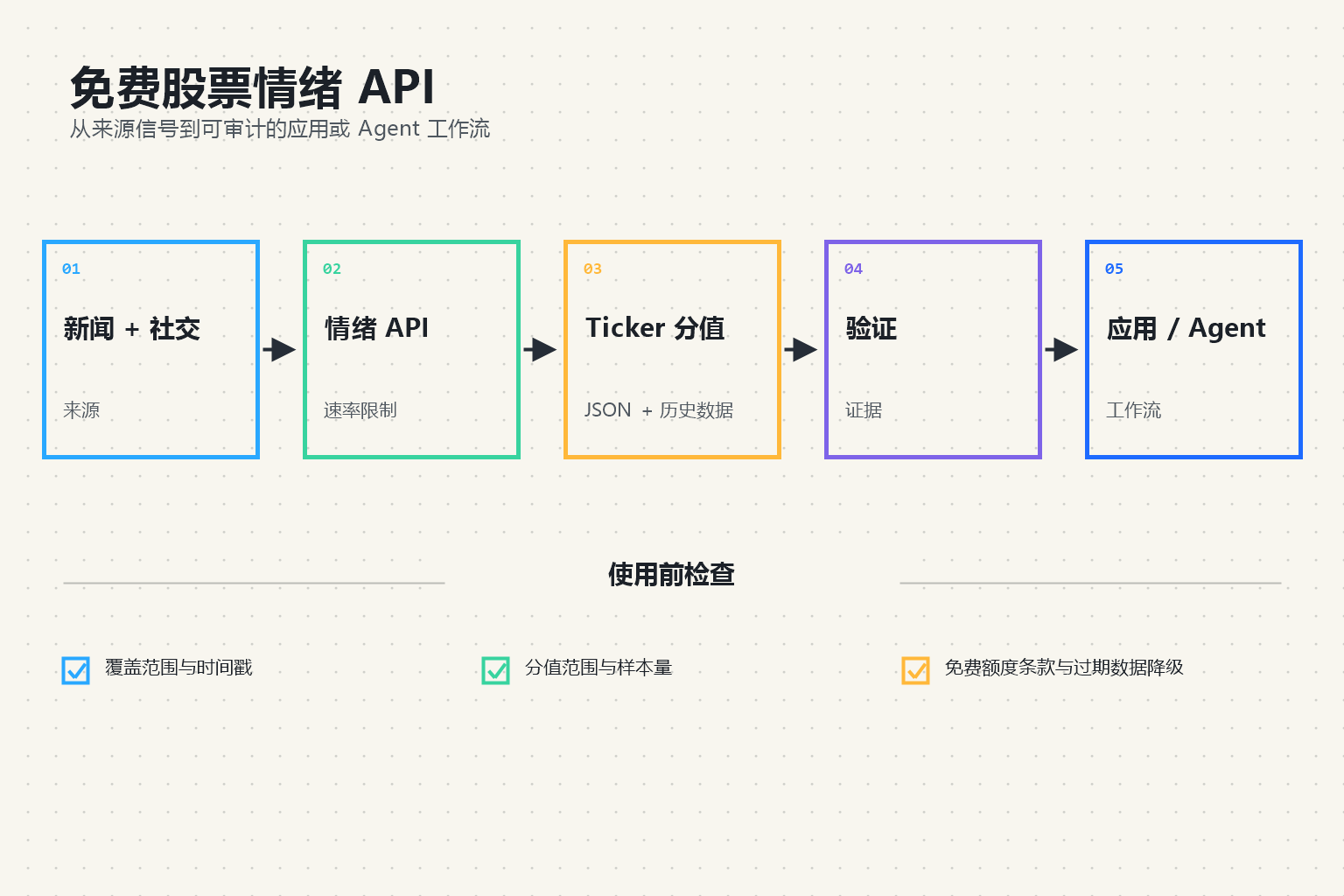
寻找适合新闻、社交或 A 股市场情绪数据的免费接口,比较真实配额与字段,再把股票代码级情绪信号接入应用或 Agent。
TL;DR摘要
Developers want a working REST endpoint, a free key or no-key trial, ticker-level output, documented limits, and enough source context to judge the score.
News sentiment APIs score publisher coverage; social sentiment APIs aggregate Reddit, Stocktwits, X, or other communities. They are not interchangeable.
Check monthly calls, per-minute limits, delayed data, historical depth, commercial-use rights, supported exchanges, and attribution terms.
Treat sentiment as one input. Inspect source counts, timestamps, score scale, missing-data behavior, and revisions before using it in a workflow.
中文用户更常寻找 A 股市场情绪数据接口、情绪周期接口或股票舆情 API;共同目标是拿到可调用、可解释的结构化信号。
新闻情感、社交舆情、涨跌停与连板统计构成的市场情绪并不等价,选择前要先确定数据含义。
核对每日或每月配额、更新延迟、历史跨度、覆盖市场、商用条款和鉴权方式。
情绪只应作为一个输入。先检查时间戳、样本数、分值范围、缺失值和数据修订方式。
How to choose a free stock sentiment API如何选择免费股票情绪数据接口
Choose the data source before comparing prices. A news-sentiment endpoint, a social-discussion feed, and a market-breadth indicator may all use the word “sentiment,” but they observe different behavior and answer different questions. Define the decision first, then evaluate whether the free allowance is sufficient for the required symbols, refresh rate, history, and evidence retention.
比较价格之前,先确定需要哪一种数据源。新闻情感、社交讨论和市场宽度都可能被称为“市场情绪”,但它们观察的行为不同,解决的问题也不同。应先写清要支持的决策,再判断免费额度能否覆盖所需标的、更新频率、历史跨度和证据留存。
Match the source to the question先让数据源匹配问题
Use stock news sentiment data when you need publisher coverage tied to articles and timestamps. Use a Reddit stock sentiment API or broader social feed when you need retail discussion, mention volume, bullish/bearish labels, or buzz. For China-focused workflows, “market sentiment” may instead mean breadth, limit-up counts, consecutive boards, and risk appetite.
如果任务是解释个股新闻影响,应选择能返回文章、发布时间和股票代码的新闻情感接口;如果任务是观察散户讨论,则需要帖子来源、提及量和多空标签;如果任务是判断 A 股盘面,则可能更需要涨跌停、连板、炸板率和市场宽度。
Provider routes to test first可以优先测试的供应商路线
The following services document sentiment-related endpoints, but they should not be treated as equivalent products or permanently free offers. Verify the current endpoint access, quota, market coverage, source licensing, and retention rights on the official documentation and pricing pages.
下面几家均公开了情绪相关端点,但它们不是可以直接互换的同类产品,也不能假设会永久免费。实际接入前,要在官方文档与价格页重新核对端点权限、配额、市场覆盖、来源授权和保存权利。
| Route路线 | What it returns主要返回 | Use it when适用场景 | Verify before choosing选择前核实 |
|---|---|---|---|
| Alpha Vantage | News articles with ticker topics, relevance, and sentiment fields through its News & Sentiment function.通过 News & Sentiment 函数返回新闻、相关股票主题、关联度和情绪字段。 | You want a documented market-data API family and article-level evidence for a prototype or scheduled brief.希望在同一套市场数据 API 中获得文章级证据,用于原型或定时简报。 | Time range, ticker/topic filters, sort order, result limit, source coverage, delay, and current plan access.时间范围、股票与主题过滤、排序、返回数量、来源覆盖、延迟和当前套餐权限。 |
| Marketaux | Financial-news entities and sentiment fields that can be filtered by symbols, industries, countries, languages, and time.金融新闻中的实体与情绪字段,可按证券代码、行业、国家、语言和时间筛选。 | Your workflow needs entity-level news context, multilingual filtering, and links back to the underlying articles.需要实体级新闻语境、多语言筛选,并能追溯到原始文章。 | Entity matching quality, duplicate stories, languages, historical reach, pagination cost, and rights to store article text.实体匹配质量、重复报道、语言、历史深度、翻页成本,以及是否允许保存文章正文。 |
| Finnhub | A documented social-sentiment route for supported symbols, alongside company news and other market-data endpoints.为支持的股票提供社交情绪端点,并可与公司新闻及其他市场数据接口配合。 | You need social activity and sentiment in a broader market-data workflow rather than article scoring alone.需要把社交活跃度与情绪放入更广泛的市场数据工作流,而不只是分析新闻文章。 | Symbol coverage, source composition, update cadence, historical availability, field definitions, and plan entitlement.代码覆盖、来源构成、更新频率、历史数据、字段定义和套餐权限。 |
| Build from licensed raw sources基于合规原始来源自建 | Your own item-level classifier, entity linker, deduplication, and aggregation over licensed news or community data.在获得授权的新闻或社区数据上,自行完成单条分类、实体关联、去重和聚合。 | You need transparent methodology, custom languages or taxonomies, and reproducible historical aggregates.需要透明方法、自定义语言或标签体系,以及可复现的历史聚合结果。 | Source terms, deletion obligations, model evaluation, inference cost, moderation, and ongoing taxonomy maintenance.来源条款、删除义务、模型评估、推理成本、内容治理和标签体系维护。 |
Check the free tier, not just the word “free”检查免费额度,而不是只看“免费”
| Criterion条件 | What to verify需要核对 | Why it matters影响 |
|---|---|---|
| Sources数据源 | News publishers, Reddit, Stocktwits, X, or market breadth新闻、Reddit、Stocktwits、X 或盘面宽度 | Defines what the score actually measures决定分值的真实含义 |
| Coverage覆盖范围 | Tickers, exchanges, ETFs, sectors, and delisted symbols股票代码、交易所、ETF、行业与退市标的 | Prevents silent gaps避免静默缺失 |
| Limits配额 | Calls per minute/month, concurrency, and caching rules每分钟/每月调用、并发与缓存条款 | Determines prototype viability决定原型能否持续运行 |
| History历史数据 | Lookback window and point-in-time availability回溯窗口与时点数据能力 | Required for honest backtests关系到回测是否可信 |
Choose the signal by product workflow按产品工作流选择情绪信号
Use article-level news sentiment with publication time, ticker relevance, source URL, topic, and a short evidence excerpt when licensing permits. Rank by relevance and recency, but show conflicting coverage instead of averaging every article into one apparently certain conclusion.
Track mention velocity, unique authors, engagement, bullish/bearish distribution, source concentration, and spam-filter rate. Separate popularity from direction: a sudden rise in mentions can matter even when positive and negative posts cancel to a neutral average.
Require point-in-time snapshots, stable source coverage, archived methodology versions, and an availability timestamp. Lag the feature to when it was actually observable, rebuild delisted-symbol history, and compare it against a simple price-and-volume baseline before claiming predictive value.
News or social NLP alone may miss the intended concept. Market breadth, limit-up and limit-down counts, failed breakouts, consecutive-board height, turnover, and index dispersion may be the more relevant inputs. Define the formula and trading calendar because “sentiment cycle” is not a standardized API field.
使用文章级新闻情感,并保留发布时间、股票关联度、来源链接、主题,以及授权允许展示的简短证据。可以按关联度和时效排序,但遇到相互矛盾的报道时应如实呈现,不能把所有文章平均后包装成一个看似确定的结论。
同时观察提及增速、独立作者数、互动量、多空分布、来源集中度和垃圾内容过滤率,并把“热度”与“方向”分开。即使正负帖子相互抵消为中性,提及量突然上升本身也可能具有意义。
必须具备时点快照、稳定的来源覆盖、可归档的方法版本和真实可用时间。特征要滞后到当时确实可以获取的时点,还要补齐退市股票历史,并先与简单的价格成交量基线比较,再讨论是否具有预测增量。
单独使用新闻或社交文本模型可能偏离用户真正想看的“情绪周期”。市场宽度、涨跌停数量、炸板率、连板高度、成交额和指数离散度往往更相关。由于“情绪周期”不是标准化 API 字段,必须公开公式并正确处理交易日历。
Stock sentiment API fields worth requiring股票情绪 API 应具备哪些字段
Minimum useful response最低可用响应
A practical response includes a normalized ticker, timestamp, sentiment label or score, score scale, source type, mention or article count, and a stable identifier. Confidence, source URLs, model/version metadata, and aggregation window make the output easier to audit.
实用响应至少应包含标准化股票代码、时间戳、情绪标签或分值、分值范围、来源类型、样本数量和稳定 ID。若还能返回置信度、来源 URL、模型版本和聚合窗口,后续审计会更可靠。
Aggregation window and weighting聚合窗口与权重
A daily score can be an equal average of articles, a mention-weighted social measure, an engagement-weighted index, an exponentially decayed signal, or the latest observation. Require window start and end, update cadence, weighting formula, minimum sample, source counts, and the treatment of missing periods. A score of 0.7 based on two posts is not equivalent to the same value based on 2,000 independent items.
日度情绪可能是文章等权平均、按提及量计算的社交指标、互动加权指数、指数衰减信号,也可能只是最新一条观测。应要求返回窗口起止、更新频率、权重公式、最低样本量、各来源数量和缺失周期处理方式。基于两条帖子得到的 0.7,与来自 2,000 条独立内容的同一分值不具有相同可信度。
Market-time alignment与市场时间对齐
Store the event or post time, provider ingestion time, aggregation cutoff, timezone, and whether the score belongs to premarket, regular trading, after-hours, or a 24-hour crypto window. Late-arriving articles must not be backdated into a decision bucket where they were not yet available. For cross-market studies, align local sessions before comparing sentiment with returns.
保存事件或帖子时间、供应商收录时间、聚合截止时间、时区,以及分值属于盘前、正常交易、盘后还是加密货币的 24 小时窗口。延迟到达的文章不能回填到当时尚不可见的决策区间。跨市场研究还应先对齐各地交易时段,再比较情绪与收益。
Historical stock sentiment data for backtesting用于回测的历史股票情绪数据
Historical data must be point-in-time safe. If an endpoint overwrites earlier values with revised aggregates, a backtest can accidentally see information that was unavailable at the time. Save the raw response, request time, provider timestamp, and version you actually received.
历史接口需要避免未来数据泄漏。如果服务商用修订后的聚合值覆盖旧值,回测可能无意中使用当时并不存在的信息。应保存原始响应、请求时间、服务商时间戳和实际收到的版本。
Validate the signal before using it使用前先验证信号质量
Create a dated benchmark with manually reviewed positive, negative, neutral, mixed, and irrelevant items. Measure ticker-assignment accuracy and score agreement separately from market prediction. Also inspect source concentration, reposts, bot or spam filtering, deleted-content handling, and the share of the score driven by a few high-reach accounts. Run the test again around earnings, quiet periods, and volatile sessions: a signal that looks stable in aggregate can fail when language is sarcastic, an article discusses several companies, or mention volume suddenly changes.
建立一组带时间戳并经人工复核的基准样本,覆盖正面、负面、中性、混合观点以及与目标股票无关的内容。股票代码关联准确率、情绪评分一致性和价格预测能力应分开测量。还要检查来源是否过度集中、转发是否去重、机器人与垃圾内容如何过滤、删除内容如何处理,以及分值是否被少数高影响力账号主导。财报期、消息清淡期和剧烈波动阶段都应单独复测,因为讽刺表达、多公司文章或提及量骤增,都可能让整体看似稳定的指标突然失真。
Normalize and validate stock sentiment scores统一并验证股票情绪分值
Provider scores cannot be merged safely until their meaning is explicit. One service may use −1 to +1, another 0 to 1, and another only bullish, neutral, or bearish labels. Even identical numeric ranges can represent different models, source mixtures, or time windows. Keep the original value and documented scale, then create a separate normalized field for cross-provider use.
在明确分值含义之前,不能直接合并不同供应商的结果。一家可能使用 −1 到 +1,另一家使用 0 到 1,还有的只返回看多、中性或看空标签。即使数值范围相同,模型、来源构成和聚合窗口也可能不同。应保留原始值与官方量表,再单独生成用于跨供应商比较的规范化字段。
Store the provider name, raw score or label, documented minimum and maximum, model or methodology version, item identifier, source URL when permitted, publication time, ingestion time, ticker relevance, and language. Never overwrite this layer when the normalization rule changes.
Choose an internal range such as −1 to +1 and map only documented numeric scales. Convert categorical labels through an explicit lookup table, not an assumed midpoint. Keep unknown, mixed, and missing separate from neutral; “no evidence” is not the same as balanced sentiment.
Wire stories, syndication copies, retweets, quoted posts, and near-identical headlines can make one event look like broad consensus. Deduplicate with stable IDs, canonical URLs, text similarity, source lineage, and a time window. Report both raw item count and effective independent-source count.
A passing mention should not carry the same weight as an article centered on the company. Apply documented ticker relevance, decay older observations, cap the influence of a single account or publisher, and require a minimum sample before publishing an aggregate. Return confidence or coverage separately from direction.
Freeze a dated set of earnings news, product announcements, litigation, analyst commentary, sarcastic social posts, multi-company stories, and irrelevant ticker collisions. Measure entity-link precision, sentiment agreement, duplicate reduction, coverage, latency, and revision rate. Only then test whether the signal adds value beyond price and volume features.
保存供应商、原始分值或标签、官方最小值与最大值、模型或方法版本、内容 ID、条款允许保存的来源链接、发布时间、收录时间、股票关联度和语言。规范化规则变化时,不要覆盖这一层。
可以选择 −1 到 +1 作为内部范围,但只对文档明确的数值量表做映射。类别标签应通过显式对照表转换,不能想当然地取中点。未知、混合和缺失必须与中性分开;“没有证据”不等于“正负观点平衡”。
通讯社稿件、转载、转发、引用帖子和高度相似的标题,可能把同一个事件伪装成广泛共识。应结合稳定 ID、规范 URL、文本相似度、来源链和时间窗口去重,同时报告原始内容数与独立有效来源数。
顺带提及某家公司,不应与整篇围绕该公司展开的报道权重相同。使用文档提供的股票关联度,对旧内容做衰减,限制单一账号或媒体的最大影响,并在样本量不足时停止发布聚合值。置信度或覆盖度应与情绪方向分开返回。
固定一组带日期的财报新闻、产品公告、诉讼、分析师评论、讽刺帖子、多公司文章和代码误匹配样本,分别测量实体关联准确率、情绪一致性、去重效果、覆盖率、延迟和修订率。通过这些检查后,再判断该信号是否能在价格与成交量特征之外提供增量价值。
A production aggregate should explain itself. Return the normalized score together with the raw score range, window start and end, unique source count, total item count, dominant-source share, freshness, model version, and evidence links or IDs. An agent can then say “negative across 18 independent sources in the last six hours” instead of presenting an unexplained −0.63.
生产环境中的聚合值应当能够自证。除规范化分值外,还要返回原始量表、窗口起止、独立来源数、内容总数、最大来源占比、新鲜度、模型版本以及证据链接或 ID。这样 Agent 才能说明“过去 6 小时内 18 个独立来源整体偏负面”,而不是只抛出无法解释的 −0.63。
Free stock sentiment API setup for Python and agents用 Python 或 Agent 接入股票情绪接口
A safe four-step integration四步完成稳健接入
Confirm authentication, symbol format, timezone, and empty-response behavior before batching requests.
Map the provider’s documented range to your internal schema; never assume that 0, 0.5, or “neutral” mean the same thing across APIs.
Store source URLs or identifiers, counts, timestamps, request parameters, and raw JSON alongside the derived value.
Respect rate-limit headers, cache only when terms allow it, and define what your app does when the feed is stale or unavailable.
Store permitted source evidence and normalized item-level scores before producing ticker aggregates. Version the aggregation code, weighting, model, and cutoff so a changed method can be replayed without losing the earlier approved signal.
Track score distribution, neutral share, sample count, source concentration, unmatched tickers, language mix, bot-filter rate, freshness, and revision frequency. Alert when the signal becomes constant, coverage collapses, or one source suddenly dominates.
先验证鉴权、代码格式、时区和空响应,再批量调用。
按文档把服务商分值映射到内部结构,不要假设不同接口的 0、0.5 或“中性”含义相同。
将来源 URL 或 ID、样本数、时间戳、请求参数和原始 JSON 与派生值一并保存。
遵守限流响应头,只在条款允许时缓存,并定义数据过期或接口不可用时的行为。
先保存条款允许的来源证据和规范化后的单条情绪,再生成股票级聚合值。对聚合代码、权重、模型和截止时点进行版本化,这样方法变化后可以重新计算,同时保留此前获批的信号。
跟踪分值分布、中性占比、样本量、来源集中度、未匹配代码、语言构成、机器人过滤率、新鲜度与修订频率。当信号变成常数、覆盖突然下降或单一来源占据主导时,应立即告警。
Use QVeris to find and inspect stock sentiment APIs用 QVeris 查找并检查股票情绪 API
QVeris can help an agent discover and inspect callable financial-data capabilities, then connect the selected tool to an auditable workflow. Provider availability, pricing, limits, and terms still need verification at call time.
QVeris 可帮助 Agent 发现并检查可调用的金融数据能力,再把选定工具接入可审计工作流。具体服务商是否可用、价格、配额和条款仍需在调用时核验。
- Open the QVeris tool details to review relevant capabilities.
- Review the QVeris documentation before connecting a capability to production.
- Keep provider responses and citations so an agent can show the evidence behind a sentiment summary.
- 先用 QVeris 工具详情发现相关能力。
- 接入生产环境前阅读 QVeris 文档。
- 保留服务商响应和来源,让 Agent 能展示情绪摘要背后的证据。
FAQ
Is there a free stock sentiment API?
Yes. Some services provide a limited free allowance or evaluation access, but limits, history, source access, commercial rights, and maintenance vary. Verify the current pricing and documentation before choosing one.
Which API provides stock news sentiment data?
Several market-data and sentiment providers expose news sentiment. Compare whether the response includes article URLs, publication times, ticker relevance, score definitions, and historical access instead of choosing by the label alone.
Can I get Reddit stock sentiment through an API?
Some specialist APIs aggregate Reddit discussions and return ticker mentions or sentiment. Check subreddit coverage, update frequency, deleted-content handling, licensing, and whether raw evidence is available.
Can stock sentiment predict prices?
Sentiment may be a useful feature, but it is not a guaranteed predictor. Results depend on source quality, timing, market regime, methodology, and leakage-free validation.
有没有免费的股票情绪数据接口?
有些服务提供免费额度、试用或无需 Key 的接口,但配额、历史范围、数据授权和维护状态差异很大,应以当前文档和价格页为准。
A 股市场情绪接口通常返回什么?
常见内容包括涨跌停数量、连板高度、炸板率、市场宽度、风险偏好或情绪周期;不同服务的定义并不统一。
股票新闻情感分析 API 如何验证?
检查原文链接、发布时间、股票相关性、分值定义、样本数量和历史接口,并对一组已知新闻进行人工抽样。
情绪数据可以直接用于交易吗?
不应把单一情绪分值视为交易建议。它更适合作为研究或风控输入,并结合价格、流动性、基本面和严格的时点回测。