
Free Stock Split API
for Historical & Upcoming Data免费股票拆分 API
查询历史与即将发生的拆股
Use a free stock split API to retrieve point-in-time dates and unambiguous ratios, monitor revisions, and keep prices, shares, volume, and position history consistent.
通过免费股票拆分 API 获取按历史时点可追溯的日期和无歧义比例、监控事件修订,并保持价格、股数、成交量与持仓历史一致。
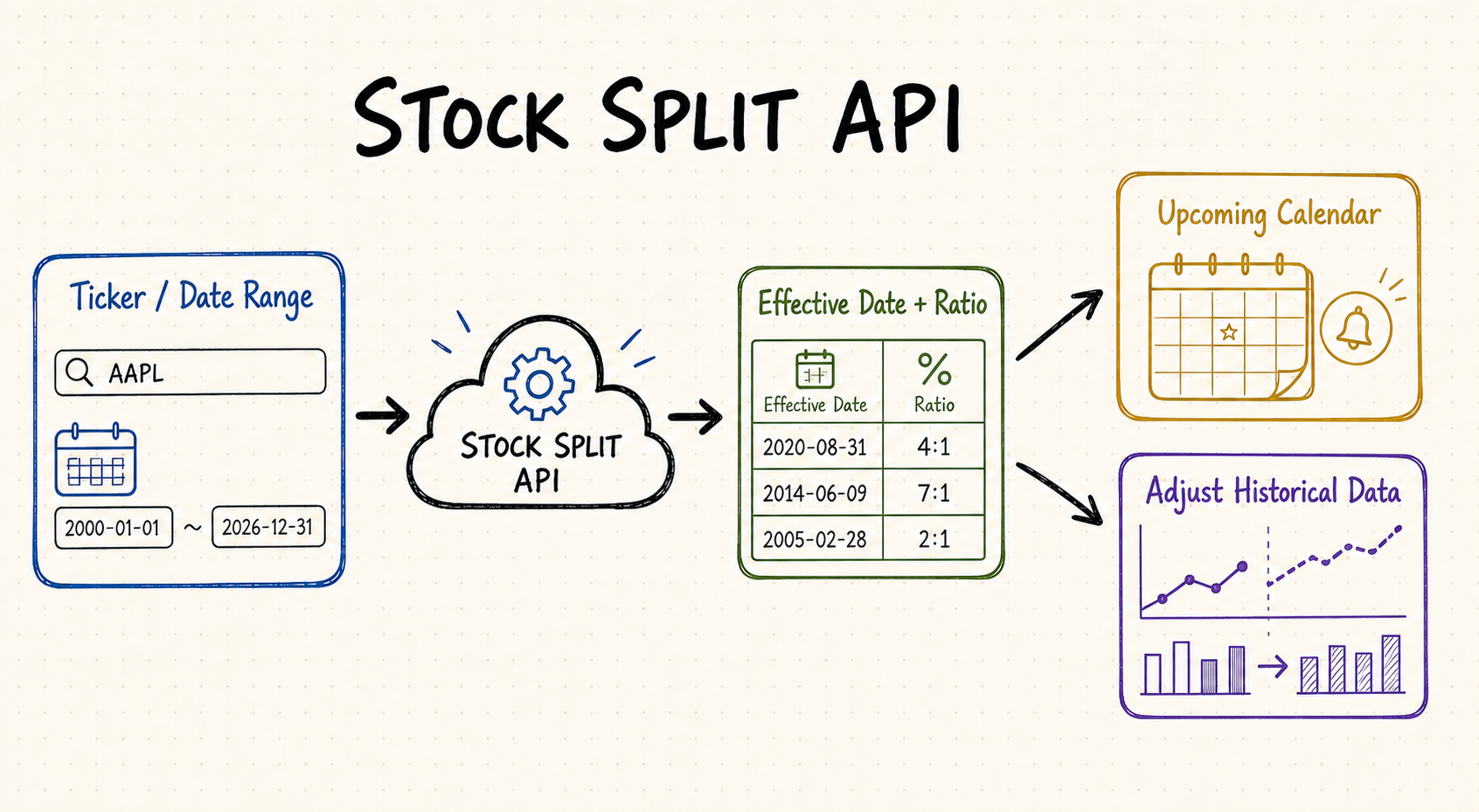
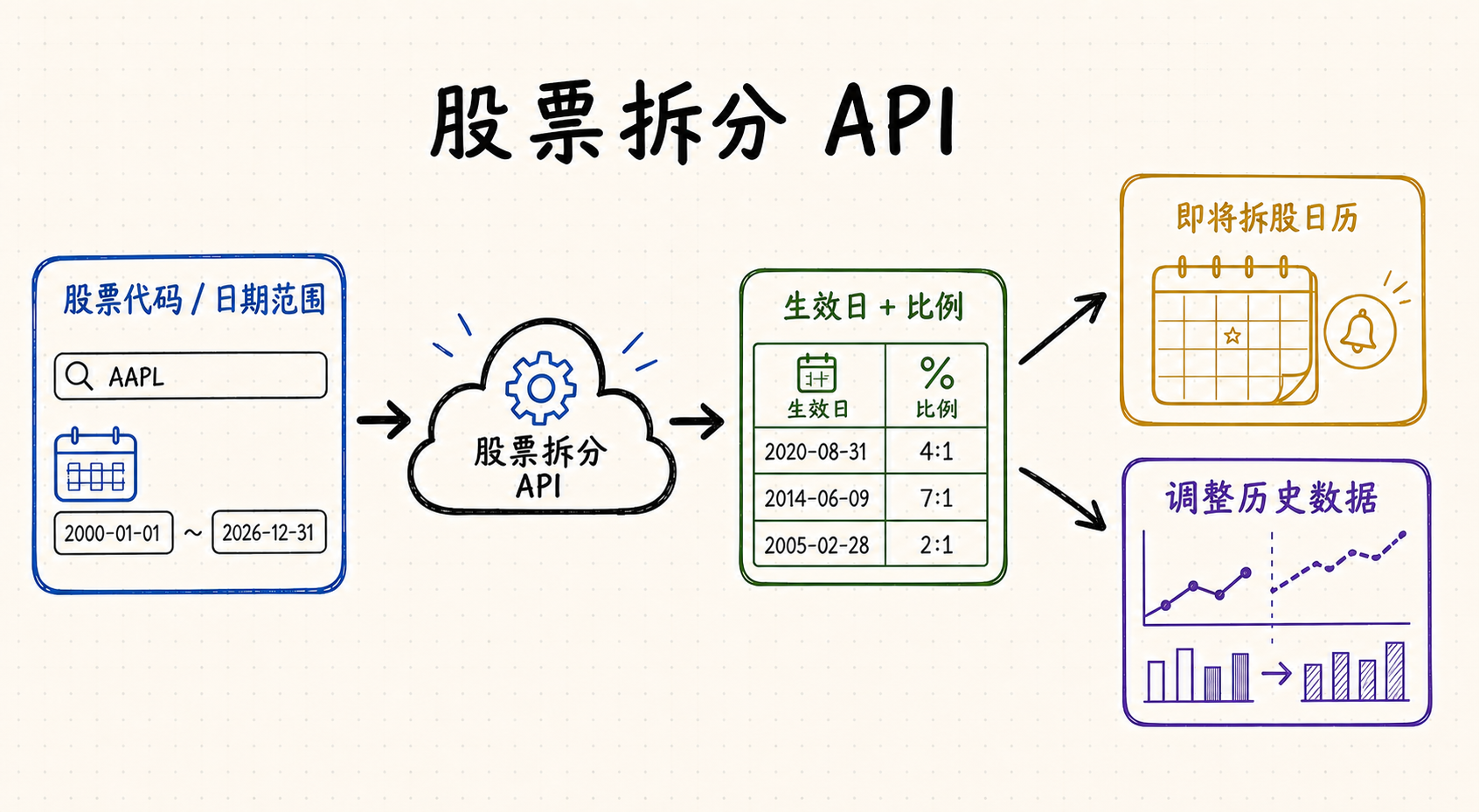
Free stock split API: what developers need免费股票拆分 API:开发者真正需要什么
A stock split API should identify when a listed security changes its shares-per-unit relationship without treating that mechanical change as an investment gain or loss. For each event, require a stable security ID, original and current ticker where relevant, announcement and effective dates, forward or reverse type, numerator and denominator, a documented factor orientation, status, source timestamp, and revision history.
股票拆分 API 应准确描述上市证券的每单位股数关系何时发生变化,同时避免把这种机械调整误判为投资收益或损失。每条事件至少应尽量包含稳定证券 ID、必要时的新旧代码、公告日与生效日、正向拆股或合股类型、分子与分母、方向明确的调整因子、事件状态、来源时间和修订历史。
The ratio must be interpreted before it is applied. A “4-for-1” split can be represented as 4:1, 1:4, or a factor of 4 depending on the provider and target field. Define whether the factor means new shares divided by old shares, new price divided by old price, or the inverse. Store the original terms and derive separate price, share, and volume factors so the same event is never applied in the wrong direction.
在应用比例前,必须先确认它的方向。同一笔“1 股拆为 4 股”事件,供应商可能写成 4:1、1:4 或因子 4,具体取决于字段定义和调整对象。应明确因子表示“新股数÷旧股数”“新价格÷旧价格”还是其倒数,并保留原始条款,再分别推导价格、股数和成交量调整因子,避免把同一事件反向应用。
Query historical or upcoming stock splits by ticker or date range and receive machine-readable dates and ratios.
Stable ID, announcement and effective dates, numerator, denominator, ratio orientation, status, and forward or reverse type.
Maintain a stock split calendar, normalize time series, and prevent a split from looking like a sudden price collapse.
Check request quotas, history depth, exchange coverage, delayed data, attribution, and commercial-use terms.
按股票代码或日期范围查询历史及即将发生的拆股,并获得可编程处理的日期和比例。
稳定证券 ID、公告日与生效日、分子、分母、比例方向、事件状态,以及正向拆股或合股类型。
维护拆股日历、规范化时间序列,避免把拆股造成的价格变化误认为暴跌。
需要核对请求配额、历史深度、交易所覆盖、数据延迟、署名和商业使用条款。
Historical stock split data and upcoming calendars历史拆股数据与即将发生的拆股日历
There are two distinct retrieval jobs: a ticker-level history for rebuilding one security and a market-wide calendar for monitoring a date window. A provider may expose both, but the endpoints, date filters, update cadence, and free-tier limits can differ. Historical data should include completed and corrected events; an upcoming calendar should expose announced, confirmed, amended, postponed, and cancelled states where available.
拆股数据通常有两类不同的获取任务:按证券查询历史,用于重建单只股票的数据;按日期范围查询全市场日历,用于持续监控。供应商可能同时提供两类接口,但端点、日期筛选、更新节奏和免费限额未必相同。历史数据应包含已完成及修订后的事件;未来日历则应尽量区分已公告、已确认、已修订、已延期和已取消等状态。
Stock split history API by ticker按股票代码查询历史拆股 API
Use this pattern when importing a symbol, rebuilding an adjusted series, recalculating shares outstanding, or checking whether a price gap was mechanical. History must survive ticker changes and delistings, so prefer a permanent security identifier with symbol effective dates. Preserve the raw event and the provider’s adjustment convention before deriving research-ready fields.
导入证券、重建复权序列、重算流通股数或判断价格跳空是否属于机械调整时,可使用单股历史查询。历史记录必须能跨越代码变更和退市,因此应优先采用永久证券标识,并保留代码有效期。在生成研究字段前,还要保存原始事件和供应商复权定义。
Upcoming and reverse stock split API即将发生与反向拆股 API
Calendar requests usually filter by start date, end date, exchange, or split type. Include reverse splits in testing: a 1-for-10 consolidation needs a factor below one when represented as new shares divided by old shares.
拆股日历通常按开始日期、结束日期、交易所或拆股类型过滤。测试时应覆盖反向拆股:若调整因子按新股数除以旧股数表示,10 股合并为 1 股时的因子应小于 1。
What a split changes—and what it does not拆股会改变什么,又不会改变什么
A split changes per-share price, share count, per-share fundamentals, and often reported volume units, while leaving the investor’s economic ownership approximately unchanged before market movement and implementation frictions. Historical adjustment should therefore transform linked fields coherently. Adjusting close without open, high, low, volume, shares, options deliverables, or per-share metrics can create internally inconsistent research data.
拆股会改变每股价格、股数、每股基本面指标,通常也会影响成交量的计量单位;在不考虑市场波动和执行摩擦时,投资者的经济权益大致不变。因此,历史调整必须在相关字段之间保持一致。只调整收盘价,却不处理开高低价、成交量、股数、期权交割条款或每股指标,会产生内部自相矛盾的研究数据。
Stock split dates, fractional shares, and adjustment math拆股时间线、零碎股与复权计算
A provider may expose several dates for one event. Preserve each date under its own meaning instead of choosing whichever field is populated. The announcement date is when terms become public; the record date can identify holders for administrative purposes; the effective or ex-date is when the new share relationship and trading basis apply; the distribution or payable date describes delivery. Exact mechanics vary by market and event, so the source notice—not a generic date label—should control the interpretation.
同一笔拆股可能包含多个日期,不能只挑一个有值的字段保存。公告日表示条款何时公开;登记日可能用于确定行政处理对象;生效日或除权日表示新的股数关系与交易基准何时开始适用;分配日或支付日描述新股份何时交付。不同市场和事件的具体机制可能不同,因此应以原始公告为准,不能只依赖通用日期标签。
Store announced terms, source document, first-known time, event ID, and status. A future event may later be amended, postponed, or cancelled.
Use the confirmed effective or ex-date for price-series boundaries. Do not shift the factor to the announcement date merely because that date appeared first.
A reverse split can create fractional entitlements. Preserve whether fractions are rounded, aggregated and sold for cash in lieu, or handled under another issuer rule.
Keep the permanent security ID, old and new ticker, exchange, and effective ranges. A symbol change beside a split must not break or duplicate the history.
保存公告条款、来源文件、首次可知时间、事件 ID 与状态。未来事件可能继续被修订、延期或取消。
价格序列应以确认后的生效日或除权日为边界,不能因为公告日更早出现,就把调整因子提前应用。
合股可能产生不足一股的权益。需要保存零碎股是取整、汇总卖出后支付现金补偿,还是按发行人另行规定处理。
保留永久证券 ID、新旧股票代码、交易所及各自有效期。拆股同时伴随代码变化时,历史数据不能因此断裂或重复。
For a 4-for-1 forward split, each old share becomes four new shares: the share factor is 4 and the price factor is 1/4. A pre-split close of $120 becomes $30 on a comparable adjusted basis, while 1,000 pre-split shares become 4,000; the approximate position value remains $120,000 before market movement. For a 1-for-10 reverse split, the share factor is 0.1 and the price factor is 10. An account with 103 shares may become 10.3 shares before the issuer's fractional-share rule is applied. These assertions catch reversed ratios and silent rounding.
在 1 股拆为 4 股的正向拆股中,每股旧股变为 4 股新股:股数因子为 4,价格因子为 1/4。拆股前收盘价 120 美元在可比复权口径下变为 30 美元,1,000 股变为 4,000 股;不考虑市场波动时,持仓价值仍约为 12 万美元。若是 10 股合为 1 股,股数因子为 0.1,价格因子为 10;原有 103 股在应用发行人的零碎股规则前会对应 10.3 股。这两组断言可以及时发现比例方向反了,或系统在没有说明的情况下进行了取整。
How to use a free stock split API如何调用免费股票拆分 API
Start from the task. A per-ticker endpoint answers company history; a calendar endpoint supports daily monitoring and batch ingestion.
Store the API key outside source code. Use an exact ticker or bounded date range, then implement pagination and retry rules from the provider documentation.
Map provider fields into a stable internal schema. Validate that numerator divided by denominator matches the split factor and type.
Do not adjust an already adjusted price series. Record the source event, factor, ingestion time, and transformation version.
Poll upcoming events by update time, then re-fetch recently effective splits. Keep amended, postponed, and cancelled versions under one event lineage rather than creating silent duplicates.
On the effective boundary, test price continuity, inverse share-factor behavior, volume convention, market-cap continuity, and downstream per-share metrics. Quarantine unexplained jumps instead of guessing a factor.
先确定任务:单股端点用于公司拆股历史,日历端点适合每日监控和批量采集。
把 API Key 存放在源码之外。使用准确股票代码或有限日期范围,并按文档实现分页与重试。
把服务商字段映射到稳定的内部结构,并验证分子除以分母是否与拆股因子及类型一致。
不要重复调整已经复权的价格序列。记录事件来源、因子、采集时间和转换版本。
按更新时间轮询未来事件,并重抓近期已经生效的拆股。已修订、延期或取消的版本应归入同一事件链,而不是生成无法解释的重复记录。
在生效日前后检查价格连续性、股数因子的反向关系、成交量口径、市值连续性和下游每股指标。遇到无法解释的跳变应进入待核队列,不能凭价格变化猜测因子。
GET /splits?ticker=AAPL&start_date=2020-01-01
Authorization: Bearer YOUR_API_KEY

{
  "ticker": "AAPL",
  "effective_date": "2020-08-31",
  "ratio": "4:1",
  "split_factor": 4
}
GET /splits?ticker=AAPL&start_date=2020-01-01
Authorization: Bearer YOUR_API_KEY

{
  "ticker": "AAPL",
  "effective_date": "2020-08-31",
  "ratio": "4:1",
  "split_factor": 4
}
This is a provider-neutral schema example, not a live QVeris endpoint. Match parameter names and authentication to the selected provider's documentation.
以上是与服务商无关的字段示例,并非真实 QVeris 端点。实际参数名和鉴权方式应以所选服务商文档为准。
Compare free stock split data API options比较免费股票拆分数据 API 时看什么
| Criterion标准 | Questions to verify需要验证的问题 | Why it matters重要性 |
|---|---|---|
| Free access免费访问 | Is it a permanent free plan, a trial, or delayed sample data? Is commercial use allowed?是长期免费层、试用,还是延迟样例数据?是否允许商业使用? | “Free” can describe materially different rights and limits.“免费”可能对应完全不同的权限和限制。 |
| Coverage覆盖 | Which exchanges, assets, historical years, upcoming events, and reverse splits are included?覆盖哪些交易所、资产、历史年份、未来事件和反向拆股? | Missing events can corrupt downstream adjustments.事件缺失可能导致下游复权错误。 |
| Fields字段 | Are effective date, ratio, numerator, denominator, factor, type, status, and exchange available?是否提供生效日、比例、分子、分母、因子、类型、状态和交易所? | Explicit fields reduce ambiguous parsing.明确字段可减少模糊解析。 |
| Factor semantics因子语义 | Does the factor apply to shares or prices? Is it new divided by old, or old divided by new?因子用于股数还是价格?表示新值除以旧值,还是旧值除以新值? | A correct event applied backward corrupts the entire history.即使事件本身正确,反向应用也会破坏整段历史。 |
| Identity and lineage身份与事件链 | Are permanent security ID, provider event ID, old and new ticker, source time, and revision time returned?是否返回永久证券 ID、供应商事件 ID、新旧代码、来源时间和修订时间? | Supports deduplication, ticker changes, and point-in-time research.支持去重、代码变更和时点化研究。 |
| Adjustment scope调整范围 | Which price, volume, shares, and per-share fields are already adjusted, and when are factors restated?哪些价格、成交量、股数和每股字段已经调整?因子何时会被重述? | Prevents double adjustment and cross-dataset inconsistency.避免重复复权和跨数据集不一致。 |
| Operations运行能力 | What are the rate limit, pagination, update schedule, error format, and service terms?限流、分页、更新频率、错误格式和服务条款是什么? | A prototype endpoint still needs reliable ingestion behavior.原型端点也需要可靠的采集行为。 |
Find and inspect stock split API capabilities with QVeris用 QVeris 发现并检查拆股 API 能力
QVeris helps developers and agents discover available capabilities, inspect schemas, and connect to real-world tools. Use the QVeris tool details to evaluate stock-split history, calendar, or broader corporate-action capabilities. Before calling one, inspect identifier and date inputs, ratio fields, status and revision metadata, pagination, coverage, pricing, and provider terms. QVeris can route the capability; your pipeline must still validate factor direction and adjustment state.
QVeris 帮助开发者和 Agent 发现可用能力、检查数据结构并连接真实工具。可先通过QVeris 工具详情筛选拆股历史、拆股日历或更广泛的公司行动能力。调用前应检查证券标识和日期参数、比例字段、状态与修订元信息、分页、覆盖、价格及供应商条款。QVeris 可以完成能力路由,但因子方向和数据复权状态仍需由业务管道验证。
- Search by the job: stock split history, corporate actions, or split calendar.
- Inspect input and output fields before writing integration code.
- Keep provider limitations visible in your agent or data-pipeline policy.
- 按任务搜索:历史拆股、公司行动或拆股日历。
- 编写接入代码前先检查输入与输出字段。
- 在 Agent 或数据管道策略中明确服务商限制。
Free stock split API FAQ免费股票拆分 API 常见问题
Is there a free stock split API?
Yes, some providers offer free plans or trials. Compare history depth, request limits, exchange coverage, data delay, attribution, and commercial-use rights.
How do I get historical stock split data by ticker?
Call a ticker-history endpoint with an API key, then store the effective date, ratio, numerator, denominator, and split factor returned for each event.
Can an API return upcoming and reverse stock splits?
Many calendar endpoints do, usually with date-range and split-type filters. Confirm announcement status and update timing with the provider.
How do I adjust historical prices after a stock split?
Apply the documented factor to pre-event prices and share counts, preserve raw values, and make sure the source series was not already adjusted.
What is the difference between a forward and reverse split?
A forward split increases shares and reduces the per-share price proportionally; a reverse split consolidates shares and raises the per-share price proportionally. The event itself does not create equivalent economic value.
How do I avoid applying a split factor backward?
Store numerator and denominator separately, document whether each factor targets price or shares, test a known forward and reverse split, and assert the expected inverse relationship.
有免费的股票拆分 API 吗?
有些服务商提供免费层或试用。应比较历史深度、请求配额、交易所覆盖、数据延迟、署名和商业使用权限。
如何按股票代码获取历史拆股数据?
使用 API Key 调用单股历史端点,并保存每个事件返回的生效日、比例、分子、分母和拆股因子。
API 能查询即将发生和反向拆股吗?
许多日历端点支持,通常可按日期范围和拆股类型过滤。需要向服务商确认公告状态和更新时间。
拆股后如何调整历史价格?
按照文档定义把因子应用于事件前价格和股数,同时保留原始值,并确认源序列没有被重复复权。
正向拆股和合股有什么区别?
正向拆股增加股数,并按比例降低每股价格;合股减少股数,并按比例提高每股价格。事件本身不会创造相应的经济价值。
如何避免把拆股因子反向应用?
应分别保存分子和分母,明确每个因子作用于价格还是股数,同时用一笔已知正向拆股和一笔合股测试,并断言二者应有的倒数关系。
Authoritative references权威参考资料
Provider documentation is the source of truth for endpoint behavior. For the corporate-action concept and investor impact, see the U.S. Securities and Exchange Commission's investor bulletin.
端点行为应以服务商文档为准。关于公司行动概念及对投资者的影响,可参考美国证券交易委员会的投资者公告。