
Free Top Gainers API
Stock Movers & Python免费股票涨幅榜 API
数据源、字段与 Python
Compare free top gainers API options, define the session and reference close behind each percentage, filter false movers, and validate a documented JSON workflow in Python.
比较免费股票涨幅榜 API,明确涨幅背后的交易时段与基准收盘价,
过滤虚假异动,并用 Python 验证真实 JSON 工作流。
What a free top gainers API should accomplish免费股票涨幅榜 API 应完成哪些任务
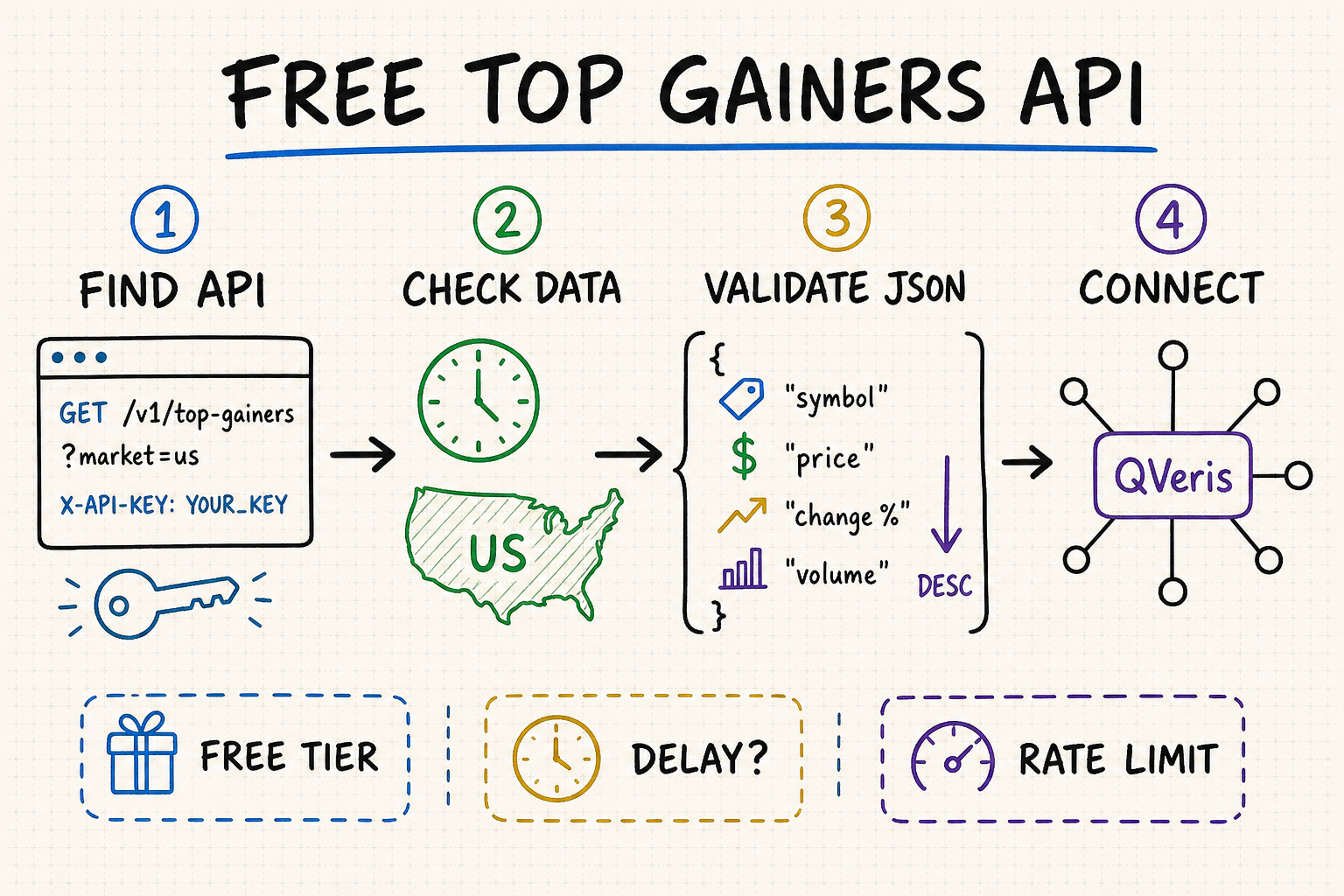
This page targets positive-momentum discovery. The useful output is not merely a descending percentage list: it is a session-aware candidate set that explains the comparison price, validates liquidity, detects split distortions, and can be joined to catalysts such as earnings, guidance, approvals, analyst actions, or M&A. It supports breakout scanners and research queues, not an automatic buy recommendation.
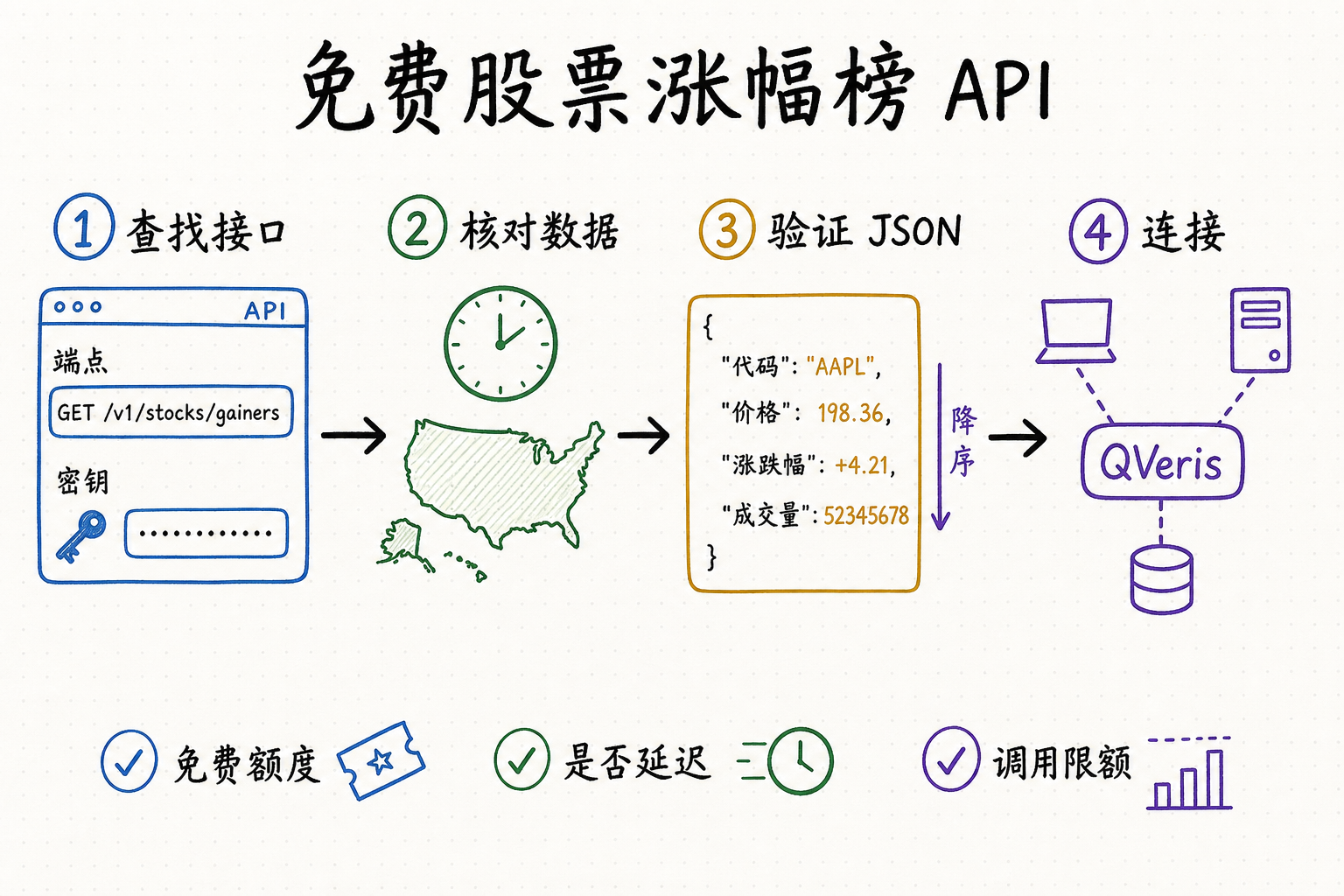
本页聚焦正向动量发现。真正有用的输出不只是按涨幅降序排列,而是一个理解交易时段、说明比较基准价、验证流动性、识别拆股扭曲,并能关联财报、指引、审批、分析师行动或并购等催化因素的候选集合。它服务于突破扫描和研究队列,不是自动买入建议。
For most products, the safest default is a regular-session U.S. equity leaderboard ranked by an independently recalculated return from the adjusted prior close. Premarket and after-hours lists should be separate views because thin trading, wider spreads, and different reference times can otherwise make the same symbol appear to have conflicting gains.
对多数产品而言,更稳妥的默认口径是:限定美股常规交易时段,并用复权后的上一交易日收盘价独立重算收益率。盘前与盘后榜单应单独展示,因为这些时段成交更稀疏、点差更宽、参考时间也不同;若混在一起,同一只股票可能出现彼此冲突的涨幅。
Ranking definition: preserve current price, prior regular-session close, session, adjustment state, volume, and eligibility rule. A large premarket move, an unadjusted split, and a liquid regular-session breakout are three different events even if the percentage field is identical.
排名定义:应保存当前价格、上一常规时段收盘、交易时段、复权状态、成交量和入选规则。盘前大涨、未复权拆股和常规盘中高流动性突破,即使百分比相同,也属于三类不同事件。
What a stock market top gainers API should return股票涨幅榜 API 应返回哪些字段
Use the correct positive-return denominator
Require current price, prior regular close, absolute change, percentage change, adjustment flag, and session. Recalculate the percentage instead of trusting a preformatted string.
Filter for actionable liquidity
Store volume, relative volume, price, market cap, exchange, security type, and spread when available. A 300% move on one trade is not equivalent to broad participation.
Detect splits, IPO baselines, and stale closes
Check corporate actions and listing dates before ranking. New listings may lack a valid prior close, while split-adjustment timing can manufacture an apparent gain.
Attach catalyst and continuation context
Join earnings, filings, news, gaps, intraday high, and distance from the opening price. This distinguishes a current breakout from a stock that spiked early and already faded.
Separate sessions and quote states
Label premarket, regular, and after-hours observations explicitly. Preserve last trade, bid, ask, quote time, market status, and halt state so an old print is not presented as a current executable move.
Control low-price and one-tick distortion
Use a configurable price floor, minimum dollar volume, trade-count threshold, and maximum spread. A few cents of movement can create a spectacular percentage on a very low-priced security without producing a durable or tradable signal.
使用正确的正收益分母
要求返回当前价、上一常规收盘、涨跌额、涨幅、复权标记和交易时段,并自行重算百分比,不要直接相信格式化字符串。
筛选可操作流动性
保存成交量、相对成交量、价格、市值、交易所、证券类型和可用时的点差。单笔成交造成的 300% 上涨不等于广泛参与。
识别拆股、IPO 基准和陈旧收盘
排名前检查公司行动和上市日期。新股可能没有有效前收盘,复权时点错误也会制造虚假涨幅。
关联催化因素与延续背景
关联财报、申报、新闻、跳空、盘中最高和距开盘价变化,区分仍在突破的股票与早盘冲高后已经回落的股票。
区分交易时段与报价状态
明确标注盘前、常规盘和盘后数据,并保留最新成交、买价、卖价、报价时间、市场状态与停牌状态,避免把陈旧成交误当成当前可执行的上涨。
控制低价股与单笔成交失真
设置可调整的最低价格、最低成交额、成交笔数门槛和最大点差。极低价证券只变动几分钱就可能产生惊人涨幅,却未必形成持续或可交易的信号。
Free stock market gainers API sources to evaluate可评估的免费股票涨幅榜接口
The providers below document market-mover or gainers endpoints, but their lists are not interchangeable. Treat the table as a starting point for verification rather than an endorsement because access and terms can change. Do not compare providers by row count alone. First write down the market, eligible security types, session, baseline price, minimum liquidity, refresh interval, and licensing required by your application, then test the same event-day sample against every candidate.
下面这些服务商都提供市场异动或涨幅榜相关文档,但各自榜单不能直接互换。下表只用于确定验证起点,并不代表推荐,因为接口权限和条款可能变化。比较供应商时不要只看返回条数,应先写清应用所需的市场、证券类型、交易时段、基准价格、最低流动性、刷新频率和许可条件,再用同一组事件日样本逐一验证。
| Source来源 | Useful signal可用信号 | Verify before use使用前核对 |
|---|---|---|
| Alpha Vantage | Official documentation lists TOP_GAINERS_LOSERS, returning 20 U.S. gainers, losers, and most-active tickers.官方文档列出 TOP_GAINERS_LOSERS,可返回美股涨幅榜、跌幅榜和最活跃股票。 | Free-key quota, default data freshness, exchange entitlements, and production terms.免费 Key 配额、默认数据时效、交易所授权和生产用途条款。 |
| Massive | Its Top Market Movers endpoint documents the top 20 U.S. gainers or losers and a minimum-volume filter.Top Market Movers 文档说明可返回美股前 20 名上涨或下跌股票,并设有最低成交量过滤。 | Current plan access, snapshot timing, market delay, and redistribution rights.当前套餐权限、快照时间、行情延迟和再分发权利。 |
| Financial Modeling Prep | Its Market Top Gainers page exposes a gainers endpoint and fields such as symbol, name, price, and change.Market Top Gainers 页面提供涨幅榜端点,并展示代码、名称、价格和涨跌等字段。 | Current endpoint path, free-plan availability, quota, freshness, and security types included.当前端点路径、免费权限、额度、时效和纳入的证券类型。 |
| Webull | Official docs support gainers/losers ranking by period, category, sort field, and sort direction.官方文档支持按周期、市场类别、排序字段和方向获取涨跌幅排名。 | App credentials, sandbox versus production, supported market, signature flow, and access approval.应用凭证、沙箱与生产环境、支持市场、签名流程和接入权限。 |
Top gainers API Python example and validation股票涨幅榜 API Python 示例与验证
Rebuild the leaderboard from normalized source rows instead of accepting a provider’s formatted percentage. The example below creates a regular-session gainers list with explicit price, dollar-volume, baseline, and adjustment rules.
不要直接采用供应商格式化后的百分比,而应从归一化原始记录重建榜单。下面的示例创建常规交易时段涨幅榜,并明确最低价格、最低成交额、比较基准和复权要求。
from decimal import Decimal, InvalidOperation


def build_top_gainers(
    rows: list[dict],
    minimum_price: Decimal = Decimal("1"),
    minimum_dollar_volume: Decimal = Decimal("1000000"),
    limit: int = 20,
) -> list[dict]:
    eligible = []
    for row in rows:
        if row.get("session") != "regular" or row.get("market_status") != "open":
            continue
        if row.get("security_type") != "common_stock":
            continue
        if row.get("prior_close_adjusted") is not True:
            continue
        if row.get("corporate_action_status") not in {None, "resolved"}:
            continue
        try:
            current = Decimal(str(row["current_price"]))
            prior_close = Decimal(str(row["prior_regular_close"]))
            volume = Decimal(str(row["volume"]))
        except (KeyError, InvalidOperation):
            continue
        if current < minimum_price or prior_close <= 0 or volume < 0:
            continue
        dollar_volume = current * volume
        if dollar_volume < minimum_dollar_volume:
            continue
        change_pct = ((current / prior_close) - Decimal("1")) * Decimal("100")
        if change_pct <= 0:
            continue
        eligible.append({
            "symbol": row["symbol"],
            "exchange": row["exchange"],
            "current_price": current,
            "prior_regular_close": prior_close,
            "change_pct": change_pct,
            "dollar_volume": dollar_volume,
            "source_timestamp": row["source_timestamp"],
            "rule_version": "regular-gainers-v1",
        })
    eligible.sort(key=lambda item: (-item["change_pct"], item["symbol"]))
    for rank, item in enumerate(eligible[:limit], start=1):
        item["rank"] = rank
    return eligible[:limit]
Filtering is part of the ranking definition. Changing the minimum price, dollar-volume floor, security types, session, or adjustment policy changes the candidate universe and therefore every rank. Store the rule version and the excluded-row reasons with each snapshot so the list can be reproduced later.
筛选条件本身就是排名定义的一部分。最低价格、成交额门槛、证券类型、交易时段或复权政策发生变化,候选证券池和全部名次都会随之改变。每个快照都应保存规则版本及记录被排除的原因,才能在之后复现榜单。
1. Rebuild the positive return
Parse current price and prior regular close as decimals, apply the provider’s split-adjustment convention, and calculate (current / prior_close - 1) × 100. Reject rows without a valid denominator.
2. Apply momentum eligibility rules
Filter by exchange, security type, minimum price, market cap, dollar volume, relative volume, and spread before sorting. Save the rule version with the resulting list.
3. Add breakout and catalyst fields
Enrich each candidate with opening gap, intraday high, distance from high, volume versus average, earnings or filing event, and relevant news. The percentage rank becomes a research queue rather than a blind signal.
4. Track list entry, persistence, and exit
Store the first time a symbol entered the gainers set, peak rank, consecutive observations, and time of exit. This reveals whether momentum persisted or resulted from one early print.
5. Reconcile the ranking against raw bars
For a sample of ordinary days, earnings gaps, splits, IPOs, halts, and resumed trading, fetch the underlying close and intraday bars. Recompute the move, inspect excluded symbols, and record whether differences come from timing, adjustment, universe, or stale data.
6. Store point-in-time snapshots
Persist provider timestamp, retrieval time, rank, raw values, normalized values, and filter version. Backtests must use the list visible at that moment rather than the final end-of-day leaderboard, which contains information unavailable earlier.
1. 重新计算正收益
把当前价与上一常规收盘解析为高精度数值,应用供应商拆股调整规则,并计算 (当前价 / 前收盘 - 1) × 100;没有有效分母的记录应排除。
2. 应用动量入选规则
排序前按交易所、证券类型、最低价格、市值、成交额、相对成交量和点差过滤,并把规则版本与榜单一起保存。
3. 增加突破与催化字段
为候选补充开盘跳空、盘中高点、距高点距离、相对成交量、财报或申报事件及相关新闻,让百分比排名成为研究队列而不是盲目信号。
4. 跟踪入榜、持续与退出
保存代码首次入榜时间、最高排名、连续出现次数和退出时间,从而判断动量是否持续,还是只由早盘一笔成交造成。
5. 用原始 K 线复核排名
选取普通交易日、财报跳空、拆股、IPO、停牌和复牌样本,获取对应收盘价与盘中 K 线,重新计算涨幅并检查被排除证券,记录差异究竟来自时间、复权、证券池还是陈旧数据。
6. 保存时点快照
保存供应商时间戳、抓取时间、排名、原始值、规范化值和过滤规则版本。回测必须使用当时实际可见的榜单,不能拿包含事后信息的最终收盘榜单替代。
How QVeris helps connect market movers APIsQVeris 如何连接股票涨跌幅榜能力
QVeris does not publish stock rankings, grant exchange licenses, or guarantee a provider’s feed. It helps developers and agents discover available financial-data capabilities, inspect interfaces, and connect a selected external tool through a consistent workflow.
QVeris 不发布股票排名、不授予交易所行情许可,也不保证供应商数据。它帮助开发者与 Agent 发现金融数据能力、检查接口,并通过一致流程连接选定的外部工具。
- Open the QVeris tool details for stock screener and market-data capabilities.
- Inspect inputs, outputs, authentication, supported markets, provider documentation, timestamps, session definitions, and adjustment conventions before connecting.
- Pass market, session, eligible universe, liquidity thresholds, freshness tolerance, and desired output schema as explicit tool requirements rather than leaving the agent to infer them.
- Use the QVeris Capability Map to explore adjacent data tools; connectivity and rankings are not investment advice.
- 使用 QVeris 工具详情搜索选股器和行情数据能力。
- 连接前检查输入、输出、鉴权、支持市场、供应商文档、时间戳、交易时段定义与复权规则。
- 把市场、时段、证券池、流动性门槛、时效容忍度和目标输出结构写成明确的工具要求,不要让 Agent 自行猜测。
- 通过 QVeris 能力地图探索相邻数据工具;连接能力和涨幅排名不构成投资建议。
Free top gainers API FAQ免费股票涨幅榜 API 常见问题
Is there a free API for top gaining stocks?
Yes. Some providers offer a free key or trial. Verify market coverage, data delay, quota, fields, licensing, and whether the endpoint remains in the current plan.
Which API returns top gainers and losers?
Alpha Vantage, Massive, FMP, and Webull document market movers or ranking endpoints. Their authentication and access terms differ.
Can I get real-time top gainers data for free?
Sometimes, but free responses may be delayed or end-of-day. Read the result timestamp and provider entitlement notes.
How do I call a top gainers API in Python?
Send a documented GET request, raise for HTTP errors, parse JSON, normalize percentage change, and verify the largest valid percentage gains sort first.
What fields should a stock gainers API return?
Look for symbol, name, price, change, percentage change, volume, market, timestamp, and explicit error or status fields.
Why do very cheap stocks dominate some gainers lists?
A one- or two-cent move can create a large percentage when the starting price is tiny. Add minimum price, dollar-volume, trade-count, and spread filters, then inspect the raw trades before treating the move as meaningful.
How should splits and IPOs be handled?
Use an adjusted prior close for split-affected securities and exclude rows without a comparable baseline. A new listing with no previous regular close should be labeled separately instead of forced into the same return formula.
Why do two top gainers APIs disagree?
They may use different snapshots, sessions, universes, reference closes, adjustment rules, liquidity filters, or quote entitlements. Compare the raw inputs and contract definitions before assuming one ranking is wrong.
有免费的股票涨幅榜 API 吗?
有些供应商提供免费 Key 或试用。应核对市场、延迟、额度、字段、许可,以及当前套餐是否仍包含该端点。
哪个 API 同时返回涨幅榜和跌幅榜?
Alpha Vantage、Massive、FMP 和 Webull 均有相关文档,但鉴权方式和访问权限不同。
能免费获取实时股票涨幅榜吗?
有时可以,但免费返回可能延迟或仅为收盘数据。必须检查结果时间戳和行情授权说明。
如何用 Python 调用涨幅榜接口?
按文档发送 GET 请求,处理 HTTP 错误并解析 JSON,再规范涨跌幅并确认最大的有效涨幅排在前面。
股票涨幅榜 API 返回哪些字段?
应关注代码、名称、价格、涨跌额、涨跌幅、成交量、市场、时间戳,以及明确的错误或状态字段。
为什么有些涨幅榜总被低价股占据?
起始价格很低时,只上涨一两分钱也会产生很大的百分比。应增加最低价格、成交额、成交笔数和点差过滤,并检查原始成交后再判断异动是否有意义。
拆股和 IPO 应该怎样处理?
受拆股影响的证券应使用复权前收盘;没有可比基准的新股则应排除或单独标注,不要强行套用同一收益率公式。
为什么两个涨幅榜 API 的结果不同?
它们可能采用不同快照时间、交易时段、证券池、基准收盘、复权规则、流动性过滤或行情权限。应先比较原始输入与口径定义,再判断哪一方存在问题。