
Free Top Losers API
Stock Movers & Python免费股票跌幅榜 API
数据源、字段与 Python
Compare free top losers API options, validate the price behind each decline, separate real drawdowns from market-state anomalies, and build an explainable Python risk workflow.
比较免费股票跌幅榜 API,验证每个跌幅背后的真实价格,
区分实际回撤与市场状态异常,并用 Python 构建可解释的风险流程。
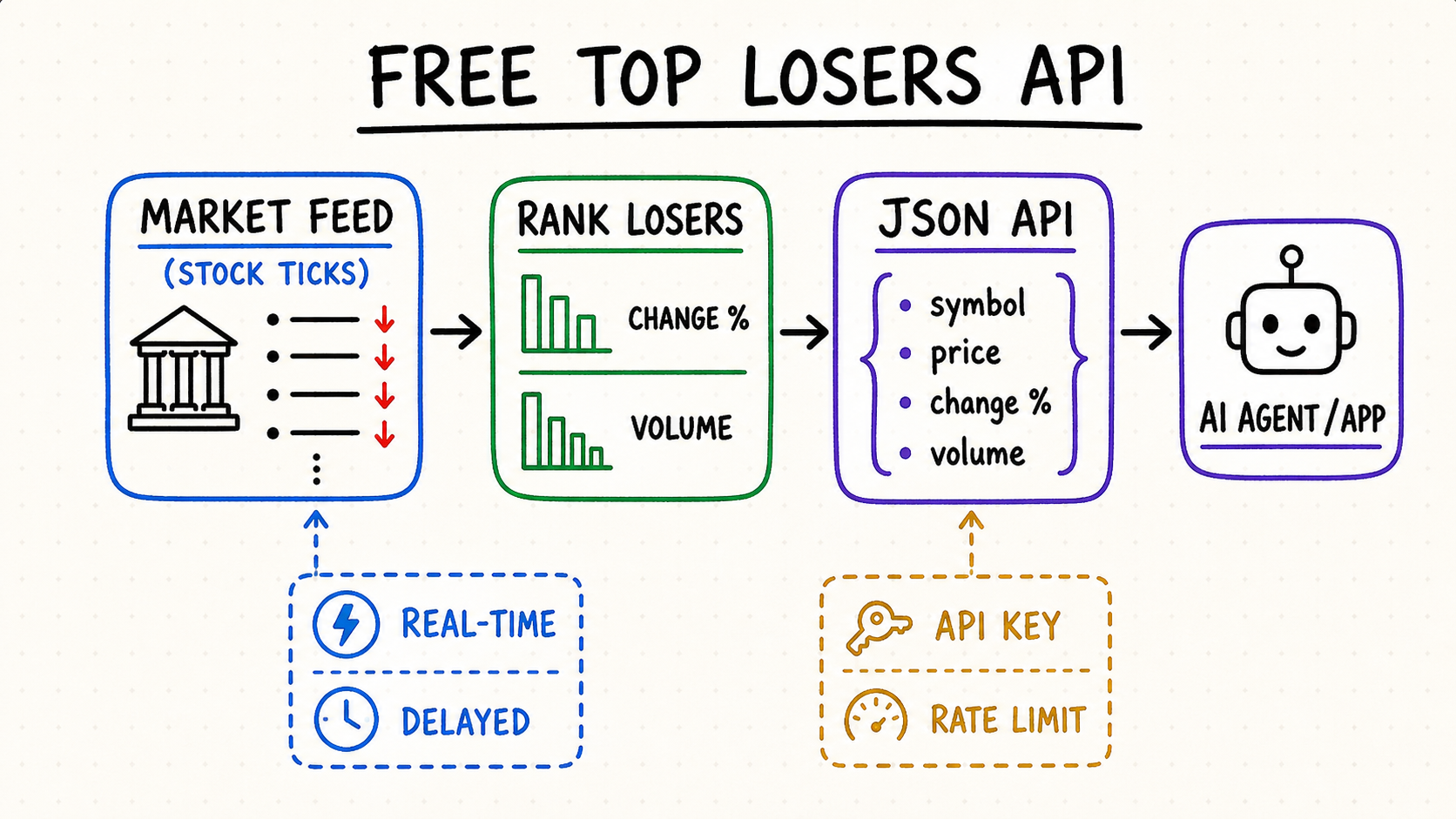
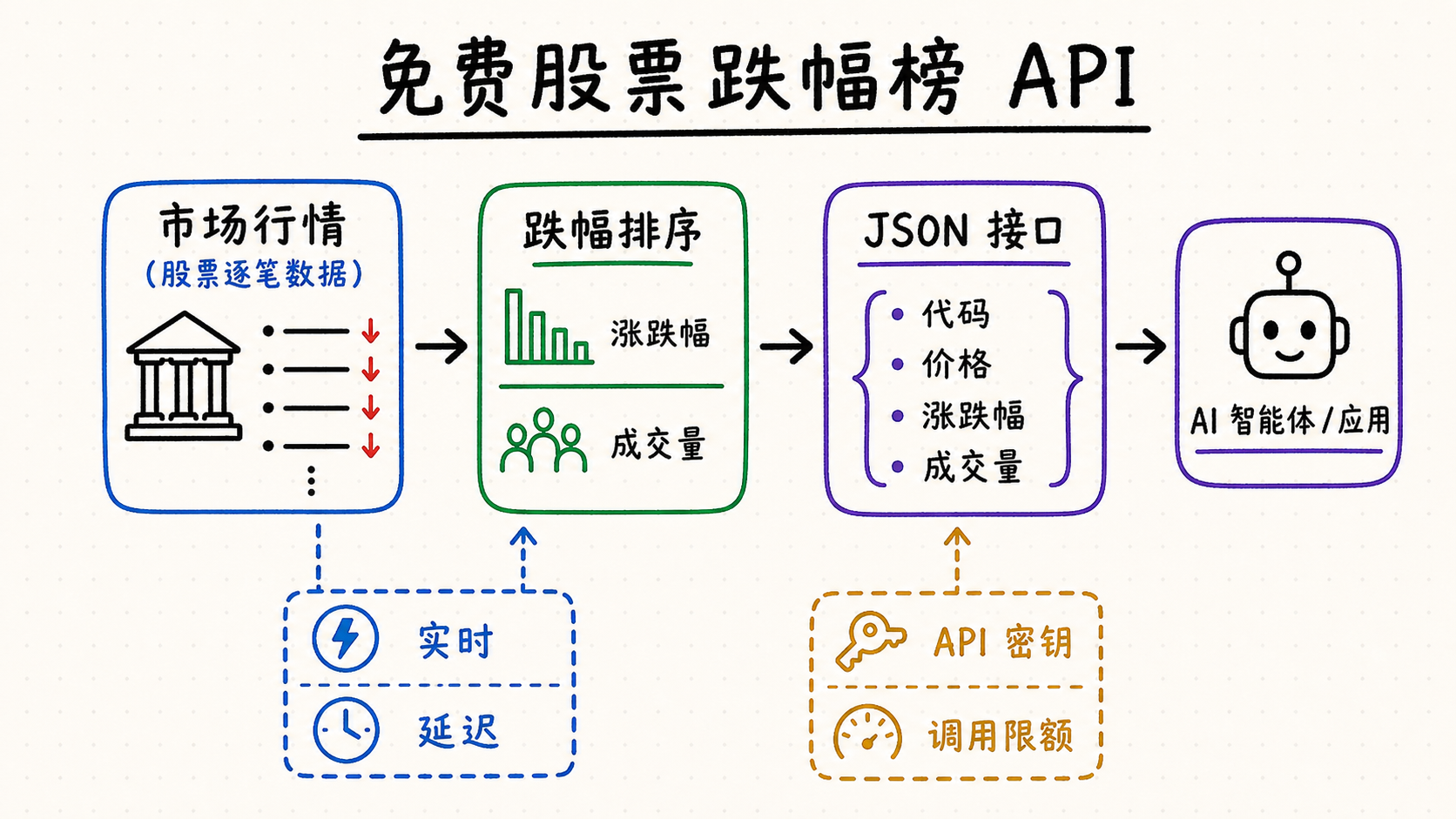
What a free top losers API should accomplish免费股票跌幅榜 API 应完成哪些任务
This page targets downside-risk monitoring. A useful losers feed helps a risk desk or agent distinguish a genuine drawdown from a bad print, reverse split, stale prior close, temporary halt, or illiquid microcap. The result should be joined to negative catalysts, portfolio exposure, short-sale constraints, and halt status before it triggers escalation. It is not simply the gainers page with the sort direction reversed.
本页聚焦下行风险监控。可用的跌幅榜数据应帮助风险团队或 Agent 区分真实回撤、错误成交、反向拆股、陈旧前收盘、临时停牌和低流动性微盘股。触发升级前,还应关联负面催化因素、组合敞口、卖空限制和停复牌状态。它绝不是把涨幅榜排序方向反过来那么简单。
The default leaderboard should state whether it ranks last trade, midpoint, bid, or an official session close against an adjusted prior close. That choice matters most during fast selloffs: the last trade may precede a halt, the bid can reprice before another trade occurs, and an after-hours print may be far outside the regular-session market. Risk systems should therefore keep the raw market ranking separate from their own exposure-weighted escalation queue.
默认榜单必须说明:它使用最新成交、中间价、买价还是官方时段收盘价,并以哪一种复权前收盘为基准。快速下跌时,这个选择尤其重要:最新成交可能发生在停牌之前,买价可能在下一笔成交前已经重估,盘后成交也可能远离常规盘市场。因此,风险系统应把原始市场排名与按自身敞口加权的升级队列分开。
Risk interpretation: preserve bid/ask, last trade, prior close, halt code, corporate actions, session, and quote condition. A displayed last price can be stale while the best bid has collapsed, or can be one erroneous trade outside the current market.
风险解释:应保存买卖价、最新成交、前收盘、停牌代码、公司行动、交易时段和报价状态。显示的最新价可能已经陈旧而最优买价已经大跌,也可能只是偏离当前市场的一笔错误成交。
What a stock market top losers API should return股票跌幅榜 API 应返回哪些字段
Validate the negative move against the market
Require prior close, current last, bid, ask, percentage change, session, and quote condition. Compare the last trade with the current spread before declaring a live drawdown.
Screen corporate-action distortions
Reverse splits, distributions, rights, spin-offs, and symbol changes can create extreme unadjusted losses. Join the effective corporate-action calendar before ranking.
Preserve halt, resume, and price-band states
A halted security may remain near the top while its displayed quote is stale. Store halt reason, halt time, resume time, auction state, and any regulatory price band.
Prioritize portfolio and liquidity impact
Join position size, borrow availability, spread, depth, volume, market cap, and negative event type. A smaller liquid decline can matter more than a spectacular move in an unowned microcap.
Distinguish price loss from total-return effects
A cash distribution or other ex-date event can reduce the quoted price without creating an equivalent economic loss. Preserve adjustment type, ex-date, distribution amount, and both raw and adjusted returns before labeling the move as a drawdown.
Handle delistings and terminal price states
Bankruptcy, delisting, symbol deletion, OTC migration, and a long trading suspension require explicit status fields. Do not keep carrying an old quote as though it were a live, continuously tradable price, and do not invent a zero when no closing transaction exists.
用当前市场验证负向变化
要求返回前收盘、最新成交、买价、卖价、跌幅、交易时段和报价状态。宣布实时回撤前,应把最新成交与当前点差进行比较。
排除公司行动扭曲
反向拆股、分派、配股、分拆和代码变更可能产生极端未复权跌幅。排名前必须关联公司行动生效日历。
保留停牌、复牌和价格限制状态
停牌证券可能长期位于榜首,但显示报价已经陈旧。应保存停牌原因、停牌时间、复牌时间、竞价状态和监管价格限制。
优先考虑组合与流动性影响
关联持仓规模、融券可用性、点差、深度、成交量、市值和负面事件类型。高流动性持仓的小幅下跌,可能比未持有微盘股的惊人跌幅更重要。
区分价格下跌与总回报影响
现金分派等除权事件会降低报价,却不一定造成同等经济损失。判定回撤前应保存调整类型、除权日、分派金额,以及原始收益率和复权收益率。
处理退市与终止报价状态
破产、退市、代码删除、转入场外市场或长期停牌都需要明确状态字段。不要把旧报价持续当成可交易实时价格,也不要在没有实际收盘成交时凭空补成零。
Free stock market losers API sources to evaluate可评估的免费股票涨跌幅榜接口
Treat the provider table as a verification checklist, not an endorsement; availability and terms can change. Evaluate every candidate with the same fixed incident set: an ordinary decline, earnings gap, reverse split, distribution ex-date, intraday halt, resumed auction, delisting event, and thin after-hours trade. Record which rows each source includes, how it timestamps them, and whether the displayed loss can be rebuilt from underlying prices.
下表只是一份供应商核验清单,不代表背书;接口权限和条款可能变化。评估时应让每个候选来源使用同一组固定事件,包括普通下跌、财报跳空、反向拆股、分派除权日、盘中停牌、复牌竞价、退市事件和稀疏盘后成交,并记录各数据源纳入哪些证券、如何标记时间,以及能否用底层价格重算所示跌幅。
| Source来源 | Useful signal可用信号 | Verify before use使用前核对 |
|---|---|---|
| Alpha Vantage | Official documentation lists TOP_GAINERS_LOSERS, returning 20 U.S. gainers, losers, and most-active tickers.官方文档列出 TOP_GAINERS_LOSERS,可返回美股涨幅、跌幅和最活跃股票。 | Free-key quota, default data freshness, exchange entitlements, and production terms.免费 Key 配额、默认数据时效、交易所授权和生产用途条款。 |
| Massive | Its Top Market Movers endpoint documents the top 20 U.S. gainers or losers and a minimum-volume filter.Top Market Movers 文档说明可返回美股前 20 名涨跌幅股票,并设有最低成交量过滤。 | Current plan access, snapshot timing, market delay, and redistribution rights.当前套餐权限、快照时间、行情延迟和再分发权利。 |
| Financial Modeling Prep | Its Market Top Losers page exposes a losers endpoint and fields such as symbol, name, price, and change.Market Top Losers 页面提供跌幅榜端点,并展示代码、名称、价格和涨跌等字段。 | Current endpoint path, free-plan availability, quota, freshness, and security types included.当前端点路径、免费权限、额度、时效和纳入的证券类型。 |
| Webull | Official docs support gainers/losers ranking by period, category, sort field, and ascending direction.官方文档支持按周期、市场类别、排序字段和升序方向获取涨跌幅排名。 | App credentials, sandbox versus production, supported market, signature flow, and access approval.应用凭证、沙箱与生产环境、支持市场、签名流程和接入权限。 |
Top losers API Python example and validation股票跌幅榜 API Python 示例与验证
Build an executable-market list from normalized rows and route excluded anomalies to review. This example requires an active, valid quote; recalculates the decline from an adjusted prior close; and refuses to turn a missing or terminal price into zero.
应从归一化记录构建具有当前可交易意义的榜单,并把被排除的异常记录转入复核。下面的示例要求报价有效且仍在交易,以复权前收盘重新计算跌幅,同时拒绝把缺失价格或终止报价状态补成零。
from decimal import Decimal, InvalidOperation


def build_tradable_losers(
    rows: list[dict],
    minimum_dollar_volume: Decimal = Decimal("1000000"),
    limit: int = 20,
) -> tuple[list[dict], list[dict]]:
    eligible, review = [], []
    for row in rows:
        reasons = []
        if row.get("session") != "regular":
            reasons.append("outside_regular_session")
        if row.get("halt_status") != "trading":
            reasons.append("halted_or_terminal")
        if row.get("quote_status") != "valid":
            reasons.append("stale_or_invalid_quote")
        if row.get("prior_close_adjusted") is not True:
            reasons.append("unverified_baseline")
        if row.get("corporate_action_status") not in {None, "resolved"}:
            reasons.append("unresolved_corporate_action")
        try:
            current = Decimal(str(row["current_price"]))
            prior_close = Decimal(str(row["prior_regular_close"]))
            bid = Decimal(str(row["bid"]))
            ask = Decimal(str(row["ask"]))
            volume = Decimal(str(row["volume"]))
        except (KeyError, InvalidOperation):
            review.append({"symbol": row.get("symbol"), "reasons": ["invalid_numeric_fields"]})
            continue
        if min(current, prior_close, bid, ask) <= 0 or volume < 0:
            reasons.append("non_positive_price_or_volume")
        if bid > ask:
            reasons.append("crossed_market")
        change_pct = ((current / prior_close) - Decimal("1")) * Decimal("100") if prior_close > 0 else Decimal("0")
        if change_pct <= Decimal("-100") or change_pct >= 0:
            reasons.append("not_a_valid_decline")
        if current * volume < minimum_dollar_volume:
            reasons.append("insufficient_dollar_volume")
        if reasons:
            review.append({"symbol": row.get("symbol"), "reasons": reasons})
            continue
        eligible.append({
            "symbol": row["symbol"], "exchange": row["exchange"],
            "current_price": current, "prior_regular_close": prior_close,
            "change_pct": change_pct, "bid": bid, "ask": ask,
            "source_timestamp": row["source_timestamp"],
            "rule_version": "tradable-losers-v1",
        })
    eligible.sort(key=lambda item: (item["change_pct"], item["symbol"]))
    for rank, item in enumerate(eligible[:limit], start=1):
        item["rank"] = rank
    return eligible[:limit], review
Review rows are evidence, not waste. A halted issuer, unresolved reverse split, or terminal listing can be more important to a risk team than a valid ranked quote. Keep those records with explicit reasons in a separate queue; excluding them from an executable leaderboard must not erase the underlying event.
待复核记录不是无用数据,而是重要证据。对风险团队而言,停牌、尚未确认的反向拆股或终止上市,可能比一条有效报价排名更重要。应把这些记录及明确原因保存在独立队列中;从可交易榜单排除,不代表可以删除其底层事件。
1. Validate the decline with bid, ask, and quote condition
Normalize percentage change, then compare last trade with current bid and ask. Quarantine crossed markets, out-of-sequence trades, stale quotes, and values outside the security’s valid price regime.
2. Join halt and corporate-action state
Before escalating, check regulatory halt codes, resume auctions, reverse splits, distributions, rights, spin-offs, and symbol changes. Preserve the state that explains why the move may not be directly tradable.
3. Rank by risk impact, not percentage alone
Combine decline with portfolio exposure, liquidity, spread, borrow status, options activity, market cap, and event severity. Keep raw market rank separate from the firm-specific escalation score.
4. Record evidence for each alert
Attach source timestamps, quote snapshot, corporate-action check, halt status, triggering news or filing, and validation outcome. A risk alert must remain explainable after the market recovers.
5. Build an event timeline, not a single snapshot
Store first appearance, worst rank, lowest validated bid or trade, halt and resume transitions, recovery from the low, and exit from the list. The path distinguishes a continuing impairment from a temporary liquidity vacuum or erroneous print.
6. Define escalation and suppression separately
Escalate on validated loss, owned exposure, liquidity deterioration, or a material filing. Suppress or route for review when the baseline is missing, a corporate action is unresolved, the quote is stale, or trading is halted without a current executable market.
1. 用买卖价与报价状态验证下跌
标准化跌幅后,把最新成交与当前买卖价比较,隔离倒挂市场、乱序成交、陈旧报价和超出证券有效价格范围的数值。
2. 关联停牌与公司行动状态
升级前检查监管停牌代码、复牌竞价、反向拆股、分派、配股、分拆和代码变更,并保存能够解释该变化为何可能不可交易的状态。
3. 按风险影响排序,而不是只看百分比
把跌幅与组合敞口、流动性、点差、融券状态、期权活动、市值和事件严重程度结合,原始市场排名与机构内部升级分数分开保存。
4. 为每条风险提醒保存证据
附上来源时间、报价快照、公司行动检查、停牌状态、触发新闻或申报和验证结果。市场恢复后,风险提醒仍必须可以解释。
5. 建立事件时间线,而不是只存单个快照
保存首次入榜、最差排名、经验证的最低买价或成交价、停复牌变化、从低点恢复幅度和退出榜单时间,用完整路径区分持续性损伤、短暂流动性真空和错误成交。
6. 分别定义升级与抑制条件
经验证的跌幅、已持有敞口、流动性恶化或重大申报可触发升级;基准缺失、公司行动尚未确认、报价陈旧,或停牌且没有当前可执行市场时,应抑制自动提醒或转人工复核。
How QVeris helps connect market movers APIsQVeris 如何连接股票涨跌幅榜能力
QVeris does not publish stock rankings, grant exchange licenses, or guarantee a provider’s feed. It helps developers and agents discover available financial-data capabilities, inspect interfaces, and connect a selected external tool through a consistent workflow.
QVeris 不发布股票排名、不授予交易所行情许可,也不保证供应商数据。它帮助开发者与 Agent 发现金融数据能力、检查接口,并通过一致流程连接选定的外部工具。
- Open the QVeris tool details for stock screener, quote, corporate-action, filing, and market-status capabilities.
- Inspect inputs, outputs, authentication, supported markets, provider documentation, quote conditions, timestamps, and adjustment conventions before connecting.
- Make session, baseline, eligible universe, freshness tolerance, portfolio context, and escalation schema explicit in the tool request.
- Use the QVeris Capability Map to explore adjacent data tools; connectivity and downside rankings are not investment advice.
- 使用 QVeris 工具详情搜索选股器、报价、公司行动、申报与市场状态能力。
- 连接前检查输入、输出、鉴权、支持市场、供应商文档、报价条件、时间戳与复权规则。
- 在工具请求中明确写出交易时段、比较基准、证券池、时效容忍度、组合背景和升级输出结构。
- 通过 QVeris 能力地图探索相邻数据工具;连接能力和下跌排名不构成投资建议。
Free top losers API FAQ免费股票跌幅榜 API 常见问题
Is there a free API for top losing stocks?
Yes. Some providers offer a free key or trial. Verify market coverage, data delay, quota, fields, licensing, and whether the endpoint remains in the current plan.
Which API returns top gainers and losers?
Alpha Vantage, Massive, FMP, and Webull document market movers or ranking endpoints. Their authentication and access terms differ.
Can I get real-time top losers data for free?
Sometimes, but free responses may be delayed or end-of-day. Read the result timestamp and provider entitlement notes.
How do I call a top losers API in Python?
Send a documented GET request, raise for HTTP errors, parse JSON, normalize percentage change, and verify the most negative valid values sort first.
What fields should a stock losers API return?
Look for symbol, name, price, change, percentage change, volume, market, timestamp, and explicit error or status fields.
Should a halted stock remain on the losers list?
It may remain visible, but it must be labeled halted with the halt time and last valid market state. A stale displayed price should not be presented as an executable quote or used for repeated automated alerts.
Can a dividend make a stock look like a top loser?
Yes. On the ex-date, the quoted price can drop by roughly the distribution amount. Compare raw and adjusted returns and preserve the distribution record before interpreting the move as economic loss.
Why do the bid and last price show different losses?
The last trade records a completed transaction, while the bid reflects current displayed buying interest. During a fast decline or thin session they may update at different times; preserve both with timestamps and quote conditions.
有免费的股票跌幅榜 API 吗?
有些供应商提供免费 Key 或试用。应核对市场、延迟、额度、字段、许可,以及当前套餐是否仍包含该端点。
哪个 API 同时返回涨幅榜和跌幅榜?
Alpha Vantage、Massive、FMP 和 Webull 均有相关文档,但鉴权方式和访问权限不同。
能免费获取实时股票跌幅榜吗?
有时可以,但免费返回可能延迟或仅为收盘数据。必须检查结果时间戳和行情授权说明。
如何用 Python 调用跌幅榜接口?
按文档发送 GET 请求,处理 HTTP 错误并解析 JSON,再规范涨跌幅并确认最负的有效值排在前面。
股票跌幅榜 API 返回哪些字段?
应关注代码、名称、价格、涨跌额、涨跌幅、成交量、市场、时间戳,以及明确的错误或状态字段。
停牌股票是否应该留在跌幅榜?
可以保留展示,但必须标注停牌、停牌时间和最后有效市场状态。陈旧价格不能被描述为可执行报价,也不应持续触发自动提醒。
分红会让股票看起来像跌幅榜首吗?
会。除权日的报价可能大致下调分派金额。解释为经济损失前,应比较原始与复权收益,并保留对应分派记录。
为什么买价与最新成交显示的跌幅不同?
最新成交代表已经完成的交易,买价代表当前公开买盘。快速下跌或成交稀疏时两者更新时间不同,因此应同时保存各自时间戳和报价状态。