
Choose a Free Valuation Data API
with Confidence如何可靠选择
免费估值数据 API
Choose a free valuation data API by field definitions, fiscal periods, price timing, estimate provenance, historical revisions, and usage rights—not by a long list of ratios.
选择免费估值数据 API 时,应重点核对字段定义、财务期间、价格时点、预期数据来源、历史修订与使用授权,而不能只看估值指标的数量。
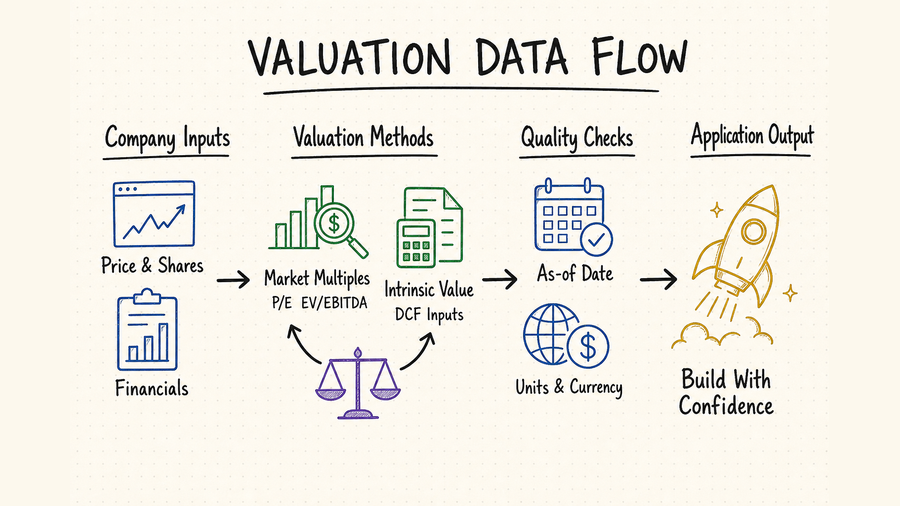
TL;DR核心摘要
A screener, comparable-company model, DCF, and historical factor test require different fields. Start with the decision and output, then choose the smallest dataset that supplies compatible inputs.
Market value, enterprise value, TTM ratios, forward estimates, and reported fundamentals can refer to different dates and calculation policies. Preserve every relevant timestamp and denominator.
Free access is useful for schema review, prototypes, personal research, and a limited acceptance test. Production fit still depends on coverage, quota, stability, history, support, and redistribution rights.
股票筛选、可比公司分析、现金流折现和历史因子回测需要的字段并不相同。应先确定决策目标和输出结果,再选择能够提供一致输入的最小数据集。
市值、企业价值、TTM 倍数、前瞻预期和已披露基本面可能对应不同日期与计算口径。所有关键时间戳和分母都应保留。
免费访问适合检查数据结构、制作原型、个人研究和小规模验收;生产适用性仍取决于覆盖、配额、稳定性、历史深度、支持和再分发权。
What valuation data should the API cover?估值数据 API 应覆盖哪些内容?
Start from the decision, not the endpoint从决策目标出发,而不是从接口出发
A stock screener may need current market capitalization and comparable-company multiples. A research notebook may need standardized financial statements, diluted shares, net debt, estimate horizons, and historical ratios. A DCF model needs revenue drivers, margins, taxes, capital expenditure, working capital, discount-rate assumptions, and terminal-value inputs. No single “valuation” field can serve all these jobs, and a provider-calculated fair value cannot replace a transparent model when the assumptions matter.
股票筛选器通常需要当前市值和可比公司倍数;研究笔记还可能需要标准化财务报表、稀释后股数、净负债、预期区间和历史倍数;现金流折现模型则依赖收入驱动因素、利润率、税率、资本开支、营运资本、折现率和终值假设。单一“估值”字段不可能同时满足这些任务。当估值假设会影响决策时,服务商直接给出的公允价值也不能替代透明、可复算的模型。
Separate reported inputs, calculated metrics, and estimates区分披露数据、计算指标与预测数据
Reported facts come from company filings; standardized fundamentals reflect a provider's mapping and normalization; market capitalization and enterprise value combine market and balance-sheet inputs; ratios apply an additional formula; analyst estimates introduce a forecast horizon and contributor set. Store the data class, provider, fiscal period, filing or publication date, revision status, and calculation timestamp. Without those fields, two values with the same label may not be comparable.
公司披露是原始事实,标准化基本面经过服务商映射和归一化,市值与企业价值还要组合市场数据和资产负债表数据,估值倍数又增加了一层计算公式,分析师预期则包含预测区间和样本范围。建议保存数据类别、服务商、财务期间、披露或发布时间、修订状态和计算时间。缺少这些信息时,即使字段名称相同,数值也未必具有可比性。
Keep price, price time, basic and diluted shares, market cap, debt, cash, preferred equity, minority interest, and enterprise value. State whether each value is reported, normalized, or provider-calculated.
Retain fiscal period, filing date, currency, accounting standard, restatement status, original reported value, and normalized value when both exist. Do not mix annual, quarterly, and TTM periods.
Store numerator, denominator, period, and formula beside P/E, P/S, P/B, EV/Sales, EV/EBITDA, free-cash-flow yield, and return metrics. A ratio without lineage is difficult to validate.
For estimates, preserve the forecast period, as-of date, contributor count when available, mean or median convention, and revision history. For DCF assumptions, identify which values came from the API and which were chosen by the analyst.
保留价格及其时间、基本与稀释后股数、市值、债务、现金、优先股、少数股东权益和企业价值,并说明字段属于公司披露、标准化结果还是服务商计算值。
保存财务期间、申报日期、币种、会计准则、重述状态,以及同时存在时的原始披露值和标准化值。年度、季度与 TTM 数据不能混用。
对市盈率、市销率、市净率、EV/Sales、EV/EBITDA、自由现金流收益率和回报指标,应同时保留分子、分母、期间和公式。没有数据血缘的倍数很难核验。
分析师预期应保留预测期间、数据时点、可用时的样本数量、均值或中位数口径及修订历史。DCF 假设还要区分哪些来自 API,哪些由分析人员自行设定。
Preserve identity, currency, and time保留证券身份、币种和时间语义
Resolve symbol plus exchange to a stable security and issuer identifier before joining prices, statements, and estimates. Record the listing currency, statement currency, conversion rate and conversion date when they differ. Keep the price timestamp separate from the shares-effective date and the financial-period end. For historical research, also preserve when the filing, estimate, or normalized record first became available; period end is not the same as information availability.
在关联价格、财报和预期数据前,应先把股票代码与交易所映射到稳定的证券及发行人标识。上市币种与报表币种不一致时,还要保存换算汇率和汇率日期。价格时间、股份数生效日期和财务期末应分别记录。历史研究还要保存申报、预测或标准化记录首次可获得的时间,因为“财期结束”并不等于“市场已经获知”。
Match API fields to the valuation method让 API 字段匹配估值方法
Choose one method and define its inputs before evaluating providers. The same API can be suitable for a current comparable-company screen and unsuitable for a historical factor test. The table below identifies the minimum data contract and the failure that deserves the most attention.
评估服务商前,先选定估值方法并写清输入要求。同一个 API 可能适合当前可比公司筛选,却不适合历史因子回测。下表列出各方法的最低数据要求,以及最需要防范的失真来源。
| Method估值方法 | Required fields所需字段 | Key caveat关键注意事项 |
|---|---|---|
| Comparable multiples可比公司倍数 | Price, shares, enterprise value, sales, EBITDA, earnings, book value, and estimates.价格、股本、企业价值、收入、EBITDA、净利润、账面价值与分析师预期。 | Peers, fiscal periods, and adjusted metrics must be consistent.可比公司、财务期间与调整后指标必须保持一致。 |
| Discounted cash flow现金流折现 | Cash flow drivers, debt, cash, share count, discount rate, and terminal assumptions.现金流驱动因素、债务、现金、股份数量、折现率与终值假设。 | The API supplies inputs; your assumptions still determine the result.API 只提供输入,估值结果仍取决于你的假设。 |
| Asset-based value资产基础估值 | Assets, liabilities, off-balance-sheet items, and asset-specific adjustments.资产、负债、表外项目与针对不同资产的调整。 | Reported book values may differ greatly from realizable values.账面价值与可变现价值可能存在很大差异。 |
| Historical factor历史估值因子 | Point-in-time prices, shares, statements, estimates, publication dates, and universe history.严格时点的价格、股数、财报、预测、发布日期与历史股票池。 | Later revisions and survivor-only universes create look-ahead bias.后续修订和只保留存续公司的样本会引入前视偏差。 |
Rebuild key metrics from their components从原始组件复算关键指标
For a representative sample, independently calculate market cap, net debt, enterprise value, and several ratios from the returned components. Reconciliation should align the security, as-of time, currency, share class, split basis, fiscal period, and adjusted-versus-reported convention. Set absolute and percentage tolerances appropriate to the application, then route exceptions for review instead of automatically accepting the newest or largest value. The related free market cap API guide covers price and share-count alignment in more detail.
应选取有代表性的公司样本,用接口返回的原始字段重新计算市值、净负债、企业价值和若干估值倍数。对账时要统一证券身份、数据时点、币种、股份类别、拆股基础、财务期间,以及调整后或原始披露口径。根据用途设置绝对与百分比容差,超出范围的记录进入复核,不能默认采用最新或最大的数值。价格与股份数如何对齐,可进一步参考免费市值 API 指南。
Validate historical and operational fit验证历史适用性和运行稳定性
- Test representative companies: include a financial institution, a loss-making company, a recent IPO, a multi-class issuer, a foreign listing, and a company with a recent restatement or major capital-structure change.
- Check missing-value semantics: distinguish zero, unavailable, not meaningful, and not covered. A negative denominator can make a ratio economically meaningless without making the source value invalid.
- Inspect period labels: confirm annual, quarterly, latest-quarter, TTM, and forward values are not silently mixed in one comparison.
- Exercise failures: test invalid symbols, authentication failure, rate limits, timeouts, partial payloads, schema changes, and provider maintenance.
- Measure freshness: monitor the age of market inputs, filing inputs, and estimates separately. A successful HTTP response can still contain stale valuation data.
- Review data rights: check whether caching, derived calculations, display, exports, and redistribution are permitted for the intended product.
- 覆盖代表性公司:样本应包含金融机构、亏损公司、近期 IPO、多股份类别发行人、境外上市公司,以及最近发生重述或重大资本结构变化的公司。
- 区分缺失状态:零值、不可用、不适用和未覆盖必须分别处理。分母为负可能让估值倍数失去经济意义,但不代表原始财务数据错误。
- 核对期间标签:确认年度、季度、最近季度、TTM 和前瞻数据没有被静默混入同一比较。
- 覆盖运行故障:测试无效代码、鉴权失败、限流、超时、部分字段缺失、结构变化和服务维护。
- 分别监控时效:市场数据、财报数据和预测数据应独立计算数据年龄。HTTP 请求成功,并不代表估值数据仍然新鲜。
- 检查使用授权:确认缓存、派生计算、页面展示、导出和再分发是否符合产品用途。
For backtests, require point-in-time fundamentals and the date each record became available. Do not combine historical prices with today's restated fundamentals or current share count. Keep the historical universe, delistings, identifier changes, and estimate revisions. See the separate stock data API for backtesting guide for a fuller treatment of availability dates and survivorship controls.
回测必须使用严格的时点基本面,并保存每条记录真正可获得的日期。不能把历史价格与今天重述后的财报或当前股份数直接组合。历史股票池、退市记录、标识符变化和预测修订也应保留。关于可获得时间和存续偏差控制,可查看回测股票数据 API 指南。
Inspect a valuation-metrics capability with QVeris用 QVeris 检查估值指标能力
The exact QVeris Key Metrics Tool is a strong match for company valuation screening. Its record describes annual or quarterly metrics including market cap, enterprise value, EV/Sales, EV/EBITDA, earnings yield, free-cash-flow yield, working capital, and per-share measures.
QVeris 中的 Key Metrics 工具与公司估值筛选高度相关。工具记录显示,它可返回年度或季度关键指标,包括市值、企业价值、EV/Sales、EV/EBITDA、盈利收益率、自由现金流收益率、营运资本和每股指标。
Inspect before calling调用前先检查字段契约
Review the required symbol, period, and limit parameters; inspect the returned schema; and confirm the provider identity on the Financial Modeling Prep Provider Profile. Start with one representative company and save the tool ID, request parameters, raw response, retrieval time, and validation result before expanding coverage.
先确认 symbol、period 和 limit 等参数要求,检查返回结构,并通过 Financial Modeling Prep 服务商资料核对供应商身份。建议先用一家有代表性的公司做测试,保存工具 ID、请求参数、原始响应、抓取时间和校验结果,再逐步扩大覆盖范围。
Keep the product boundary explicit明确工具的适用边界
The Key Metrics capability supplies standardized metrics; it does not make a complete valuation decision. A DCF still needs explicit operating forecasts, discount rates, terminal assumptions, and scenario controls. A historical strategy still needs point-in-time availability and revision history. QVeris helps discover, inspect, and call the capability, but provider documentation, licensing, and your acceptance tests remain authoritative for production use.
Key Metrics 能力提供的是标准化指标,而不是完整的估值结论。DCF 仍需要明确的经营预测、折现率、终值假设和情景控制;历史策略仍需要时点可获得性与修订记录。QVeris 负责帮助发现、检查和调用能力,但生产使用仍应以供应商文档、授权条款和实际验收结果为准。
FAQ常见问题
It can be useful, but reliability depends on source filings, normalization, price timing, corporate actions, estimate revisions, and calculation definitions. Verify representative records and reconcile important metrics from components.
Not automatically. Free access and commercial use or redistribution are separate rights. Review the provider's current terms for caching, display, attribution, derived values, exports, and redistribution.
Only when the data is point-in-time and preserves publication or availability dates, revisions, historical identifiers, and the investable universe. Historical prices combined with current fundamentals create look-ahead bias.
No. It can supply statements, market values, ratios, and some assumptions, but the analyst still controls forecasts, discount rates, terminal value, scenarios, and the interpretation of uncertainty.
可以作为研究输入,但可靠性取决于原始披露、标准化方式、价格时点、公司行动、预测修订和计算定义。关键指标应抽样核验,并尽量从原始组件复算。
不能默认可以。免费访问与商业使用、再分发属于不同授权,需要核对缓存、展示、署名、派生值、导出和再分发条款。
只有在数据符合时点口径,并保留发布日期、可获得时间、修订记录、历史标识和当时可投资股票池时才合适。历史价格配合当前基本面会产生前视偏差。
不能。API 可以提供财报、市场价值、估值倍数和部分假设,但经营预测、折现率、终值、情景设置及不确定性的解释仍由分析人员决定。
References and next steps参考资料与下一步
FMP Key Metrics documentation
FMP Financial Ratios documentation
FMP Stable API documentation